
A new report highlights research suggesting bacteria and archaea may have become free-living cells independently—implying one shared genetic code but two separate transitions into autonomous life. Here’s what the source claims, what’s established vs inferred, and how to read “two origins” carefully.
A 240-Million-Year-Old Reptile From Brazil and the “In-Between” Steps Before Dinosaurs and Crocodiles
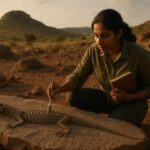
A Middle Triassic reptile from Brazil—known mainly from limb bones—is reported to reveal an “in-between” stage before dinosaurs and crocodiles. We summarize what the source claims, what the fossil actually preserves, and how to interpret posture, family-tree placement, and ancient geography without overreading fragmentary evidence.
For 15,000 Years, Humans and Dogs Have Been Changing Each Other—What Co‑Evolution Really Means

A curated breakdown of a ScienceDaily summary reporting Peter Mitchell’s view that dog domestication was gradual, diverse, and shaped by hunter-gatherer partnerships. We separate evidence from interpretation, add context from evolutionary science, and give a quick checklist for verifying claims about ancient dogs.
Collagen in a 66-Million-Year-Old Dinosaur Bone: Why This Claim Matters (and What It Doesn’t Prove Yet)

A ScienceDaily report summarizes research claiming collagen fragments were detected in a 66-million-year-old Edmontosaurus fossil. We unpack what the source says, why contamination is the central alternative explanation, what the finding could change for evolutionary inference, and what it definitely does not prove.
A Major Rewrite of the Human Family Tree? Why Some Scientists Want Australopithecus and Paranthropus Moved Into Homo

A Monash University researcher argues that Australopithecus and Paranthropus should be folded into Homo because new fossils blur the traits once used to separate these groups. Here’s what the source reports, what it means for how we tell the human story, and how to evaluate taxonomy “rewrites” without hype.
Tiny 1.7-Billion-Year-Old Fossils and the Hard Question: When Did Complex Life Really Begin?

A ScienceDaily report highlights the hunt for ~1.7-billion-year-old microfossils that may capture early eukaryotes—the cellular step that later enabled animals, plants, and fungi. Here’s what the source claims, what’s established vs uncertain, and how to read these discoveries without overhyping them.
A 324-Million-Year-Old “Amphibious” Insect Fossil and What It Really Tells Us About Life’s Move Onto Land

A ScienceDaily summary reports a newly identified 324-million-year-old stem-insect, Chosha praecursor, with six legs and paddle-like abdominal appendages—evidence that insects may have spent a long semi-aquatic phase before becoming fully terrestrial. Here’s what the source claims, what’s inference, and how to read “bridge fossil” stories responsibly.
Complexity & Emergence
Complexity & Emergence Self-Organization and Layered Systems Why Complexity Matters in Scientific Models Modern science increasingly recognizes that many natural systems cannot be fully understood by analyzing their smallest components in isolation. While reductionism remains a powerful method, certain phenomena emerge only when elements interact within organized systems. Complexity science examines how structure, order, […]
Evolutionary Systems
Evolutionary Systems Biological Development and Adaptive Complexity Why Evolution Matters in a Scientific Model Biological evolution provides one of the most robust and well-supported explanatory frameworks in modern science. It explains how complex organisms arise from simpler forms through variation, selection, and environmental interaction. Unlike physics, which describes structural relations among energy and matter, […]
Curated Library: Evolution & Understanding

Curated Library: Evolution & Understanding Beyond Biology — The Evolution of Systems, Models, and Meaning Evolution as a Universal Process Evolution is often treated as a purely biological mechanism. But evolutionary dynamics appear in: Cognition Language Culture Technology Scientific paradigms This section curates work that examines evolution beyond genetics — especially where it intersects […]
- 1
- 2
- 3
- …
- 10
- Next Page »