Physics Foundations Cornerstone Article
Information has become one of the most important and surprising concepts in modern science. Once viewed primarily as a tool for describing reality, information now appears at the foundations of quantum mechanics, thermodynamics, black hole physics, and emerging theories of spacetime.
This cornerstone article explores how information moved from the periphery of scientific thought toward its center and examines what modern physics may be revealing about the relationship between information, observation, consciousness, and physical reality.
As part of the Physics Foundations section of Species Universe, this guide investigates some of the deepest questions in contemporary science, including entropy, the Black Hole Information Paradox, the Holographic Principle, Wheeler’s “It From Bit,” and the possibility that information plays a more fundamental role in reality than previously imagined.
Because these questions span physics, information theory, cosmology, and consciousness studies, this article is intentionally comprehensive. Readers are encouraged to use the Table of Contents below to navigate individual sections and return to the article as their understanding develops.
Table of Contents
- The Information Revolution in Physics
- What Is Information?
- Information, Entropy, and the Physical World
- Can Information Be Destroyed? The Black Hole Information Paradox
- The Holographic Principle: Is Reality Written on the Boundary?
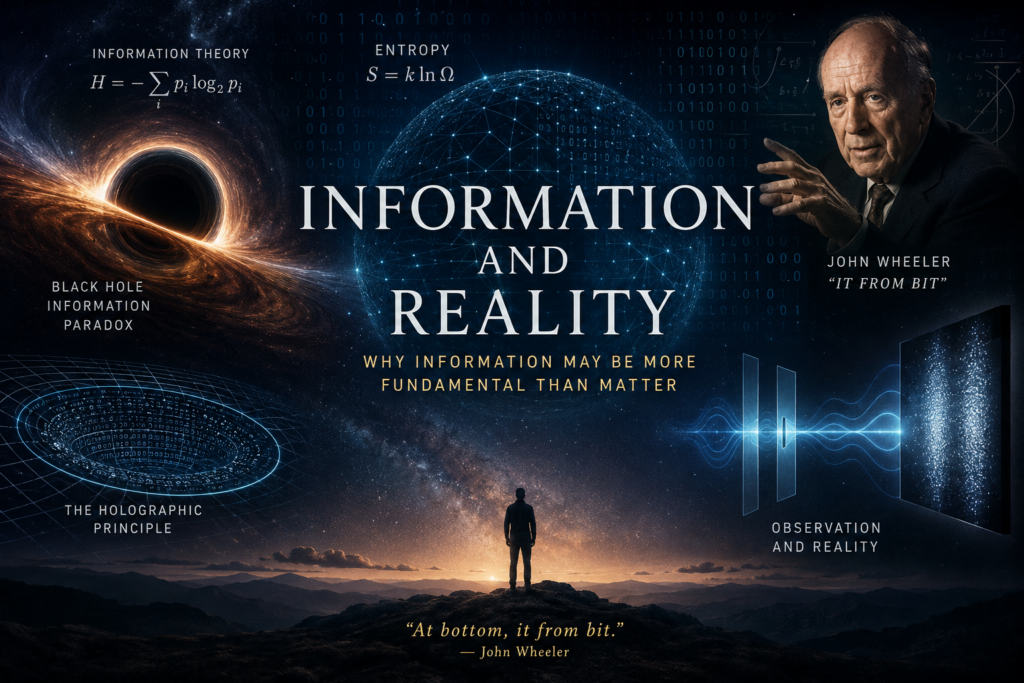
- John Wheeler and “It From Bit”
- Information Is Not Consciousness
- Toward a Deeper Unity: The Species Universe Perspective
- Frequently Asked Questions
- The Beginning, Not the End
- Further Exploration
Why Information May Be More Fundamental Than Matter | The Information Revolution in Physics
For most of scientific history, information occupied a surprisingly minor role in our understanding of reality.
Matter was considered fundamental.
Energy was considered fundamental.
Information was regarded as something secondary—something observers used to describe the world rather than something that existed as part of the world itself.
A map contains information.
A book contains information.
A scientist records information.
Information appeared to be a useful tool for describing reality, but not a fundamental component of reality itself.
This assumption seemed reasonable.
After all, the universe appeared to consist of physical objects interacting through physical forces. Information simply reflected our knowledge of those interactions.
Yet over the past century, something unexpected happened.
Information began appearing at the foundations of physics itself.
The Shift Nobody Expected
The transformation emerged gradually.
- Relativity challenged the idea of absolute measurements.
- Quantum mechanics challenged the separation of observer and observed.
- Thermodynamics revealed deep connections between information and entropy.
- Black hole physics raised questions about whether information can ever truly disappear.
- The Holographic Principle suggested that information may play a role in the very structure of spacetime.
Again and again, information appeared where physicists expected to find only matter and energy.
One of the most surprising developments in modern science is that information increasingly appears not merely as a description of reality, but as something woven into reality itself.
A New Question Emerges
The result has been a subtle but profound change in perspective.
For centuries, the central question seemed obvious:
What is the universe made of?
Today, another question increasingly stands beside it:
What role does information play in the existence of the universe itself?
This question is not merely technical.
If information is only a tool used by observers, then reality remains fundamentally physical and information remains secondary.
But if information is woven into the fabric of reality itself, then our understanding of matter, energy, observation, and perhaps even consciousness may require reconsideration.
Why This Matters
The stakes are higher than they first appear.
Modern science increasingly depends upon information:
- Measurements produce information.
- Observations reveal information.
- Quantum states encode information.
- Black holes appear constrained by information.
- Living systems process information.
- Artificial intelligence operates through information.
Yet despite its importance, physicists still disagree about what information actually is.
Is information fundamental?
Is it emergent?
Is it physical?
Or is it something even deeper?
Key Question
If matter and energy describe what exists, what exactly does information describe—and why does it appear everywhere we look?
The challenge is determining which possibilities are closest to the truth.
This article is part of the Physics Foundations series, which explores the observer problem, the measurement problem, information, consciousness, and the deeper structure of reality.
And that begins with a deceptively simple question.
What exactly is information?
Species Universe Reflection
One of the most intriguing developments in modern science is that information appears increasingly difficult to treat as merely descriptive.
Whether information is fundamental or emergent remains an open question.
But its repeated appearance at the deepest levels of inquiry suggests that it may occupy a more central role in reality than previous generations of scientists imagined.
If so, the question may not simply be what the universe is made of.
The question may also be how information, observation, and reality are related.
What Is Information?
At first glance, information seems like one of the simplest concepts imaginable.
A book contains information.
A computer stores information.
A conversation communicates information.
The meaning appears obvious.
Yet when scientists attempt to define information precisely, the concept becomes surprisingly difficult to pin down.
Part of the challenge is that the word is often used to describe several different things at once.
Information can refer to data.
Information can refer to meaning.
Information can refer to knowledge.
Sometimes it refers to all three simultaneously.
To understand why information has become so important in modern physics, we must first separate these ideas.
Data Is Not Information
Imagine opening a file containing the following sequence:
7 4 2 9 1 5 8 3 6
The sequence contains data.
But does it contain information?
Perhaps.
Perhaps not.
Without context, the numbers are simply symbols.
Data consists of distinctions, measurements, or recorded states.
Information emerges when those distinctions reduce uncertainty about something.
This may sound subtle, but the distinction is important.
Key Idea
Data consists of symbols or measurements.
Information exists when those symbols or measurements tell us something meaningful about a system.
Claude Shannon and Information Theory
The modern scientific study of information began largely through the work of mathematician and engineer Claude Shannon.
In 1948, Shannon developed a mathematical framework for understanding communication.
His goal was practical.
How much information can be transmitted through a communication channel?
How efficiently can messages be encoded?
How much noise can be tolerated before information is lost?
Remarkably, Shannon discovered that information could be quantified mathematically.
Information became measurable.
Not by its meaning.
But by its ability to reduce uncertainty.
For Shannon, information was not about meaning. It was about the reduction of uncertainty.
This distinction would later become extremely important.
Physics could now discuss information without requiring human interpretation.
The concept became objective and measurable.
The Bit
Shannon’s theory introduced one of the most important concepts in modern science:
the bit.
A bit represents the smallest possible unit of information.
A yes or no.
A true or false.
A 1 or a 0.
At first glance, a bit seems almost trivial.
Yet modern civilization is built upon combinations of these simple distinctions.
- Computers process bits.
- The internet transmits bits.
- Digital images consist of bits.
- Artificial intelligence operates through vast quantities of bits.
The bit became the fundamental unit of information just as the atom once became a fundamental unit of matter.
Readers interested in the original work can review Claude Shannon’s foundational paper on information theory.
Information Is Not Meaning
Here we encounter an important limitation.
Shannon’s theory can tell us how much information a message contains.
It cannot tell us what the message means.
Consider two statements:
The sun will rise tomorrow.
The colorless green idea sleeps furiously.
Both contain information in the Shannon sense.
Both can be encoded and transmitted.
Yet one possesses clear meaning while the other does not.
This distinction reveals that information and meaning are not identical.
The difference will become important when we eventually discuss consciousness.
Information and Reality
At this stage, information might still appear to be something abstract.
A mathematical tool.
A way of describing systems.
Many scientists initially viewed it that way.
Yet as physics advanced, information began appearing in places where no one expected it.
Entropy could be interpreted informationally.
Quantum states appeared to encode information.
Black holes seemed constrained by information.
Even spacetime itself began to show surprising connections to informational descriptions.
The question therefore changed.
Physicists were no longer asking merely:
How do we measure information?
They began asking:
Is information something we use to describe reality—or is it part of reality itself?
A technical overview is available through the Stanford Encyclopedia of Philosophy’s discussion of the Holographic Principle.
Species Universe Reflection
Information occupies a unique position within modern thought.
It appears simultaneously objective and relational.
Information requires distinctions.
Yet distinctions only become meaningful within relationships.
This tension mirrors many of the deeper questions explored throughout Species Universe.
The observer problem challenges the separation of observer and observed.
The measurement problem challenges the separation of possibility and actuality.
Information introduces another possibility.
Perhaps reality is not merely composed of things.
Perhaps relationships and distinctions play a more fundamental role than classical intuition suggests.
To explore that possibility, we must next examine one of the most surprising discoveries in modern science:
The connection between information and entropy.
Information, Entropy, and the Physical World
At first glance, information and entropy appear to belong to completely different worlds.
Information seems associated with knowledge, communication, and understanding.
Entropy seems associated with disorder, randomness, and the Second Law of Thermodynamics.
One appears mental.
The other appears physical.
Yet one of the most surprising discoveries in modern science is that the two are deeply connected.
In many situations, information and entropy appear to be different ways of describing the same underlying reality.
The Puzzle of Entropy
Entropy entered physics through the study of heat and energy.
Nineteenth-century scientists were trying to understand why certain processes occur naturally while others do not.
A hot cup of coffee cools.
An ice cube melts.
A drop of ink spreads through water.
These processes occur spontaneously.
The reverse processes almost never occur.
The coffee does not suddenly become hotter.
The melted ice does not spontaneously reassemble itself.
The ink does not gather itself back into a perfect drop.
The question was obvious.
Why does nature seem to prefer one direction of change over another?
The answer became known as the Second Law of Thermodynamics.
Entropy tends to increase.
More Than Disorder
Entropy is often described as a measure of disorder.
While useful, this description can be misleading.
A better way to think about entropy is through the number of possible arrangements available to a system.
Consider a deck of cards.
A brand-new deck arrives in a highly ordered arrangement.
There is only one configuration that matches the factory ordering.
After repeated shuffling, an enormous number of configurations become possible.
The deck has moved toward a higher-entropy state.
Not because it became chaotic in some mystical sense.
But because many more arrangements are available.
Key Idea
Entropy measures the number of possible states a system can occupy.
The greater the number of possibilities, the higher the entropy.
Boltzmann’s Great Insight
The Austrian physicist Ludwig Boltzmann transformed our understanding of entropy.
He realized that entropy could be understood statistically.
Rather than focusing on a system as a whole, Boltzmann examined the countless microscopic arrangements hidden beneath everyday observations.
A glass of water may appear simple.
Yet it contains an astronomical number of molecules moving in different ways.
Many microscopic arrangements can produce the same visible appearance.
Entropy reflects the number of hidden possibilities compatible with what we observe.
The greater the number of possible microscopic arrangements, the greater the entropy.
Suddenly, entropy was no longer merely a property of heat.
It became a measure of possibility.
A measure of how many ways reality could be organized while appearing the same to an observer.
Where Information Enters the Story
This is where things become interesting.
Imagine you know the exact position and motion of every molecule in a container of gas.
Your description is extremely detailed.
Your uncertainty is minimal.
You possess a large amount of information about the system.
Now imagine that information is removed.
You know only the temperature and pressure.
Many microscopic arrangements become possible.
Your uncertainty increases.
Entropy increases.
The connection begins to emerge.
Entropy and information appear related through uncertainty.
| Information | Entropy |
|---|---|
| More knowledge about a system | Lower uncertainty |
| Less knowledge about a system | Higher uncertainty |
| More distinctions available | Greater informational structure |
| Fewer distinctions available | Greater entropy |
Information and entropy are not identical.
Yet they appear deeply connected.
The more uncertainty exists, the less information is available.
The more information is available, the lower the uncertainty.
Landauer’s Principle
During the twentieth century, physicists discovered something even more surprising.
Information is not merely abstract.
It appears to possess physical consequences.
Physicist Rolf Landauer demonstrated that erasing information requires energy.
Information processing is therefore not separate from physics.
It is constrained by physics.
Information is physical.
— Rolf Landauer
This statement became one of the most influential ideas in modern information theory.
If information is physical, then information cannot simply be treated as an abstract bookkeeping device.
It becomes part of the story of reality itself.
A New Mystery Appears
The deeper physicists explored entropy and information, the stranger the picture became.
Information appeared connected to:
- Thermodynamics
- Computation
- Quantum mechanics
- Black holes
- Spacetime itself
The implications were profound.
Perhaps information was not merely something observers used to describe the world.
Perhaps information participated in the organization of the world itself.
And if that possibility were true, then the question becomes unavoidable.
Can information ever truly be destroyed?
That question leads directly to one of the most important puzzles in modern theoretical physics.
A puzzle involving black holes, quantum mechanics, and the fundamental nature of reality.
Species Universe Reflection
Entropy is often presented as a story of increasing disorder.
Yet viewed informationally, entropy tells a different story.
It becomes a story about possibilities, distinctions, and uncertainty.
The observer problem asks why observation matters.
The measurement problem asks how possibilities become actualities.
Information theory asks how distinctions are created and preserved.
Entropy asks what happens when those distinctions are lost.
Together, these questions suggest that reality may involve far more than objects moving through space and time.
It may also involve the informational relationships that make those objects distinguishable in the first place.
The next challenge is understanding whether information itself can ever truly disappear.
That question leads directly to the Black Hole Information Paradox.
Can Information Be Destroyed? The Black Hole Information Paradox
By the late twentieth century, physicists found themselves facing an unexpected crisis.
The problem did not arise from quantum mechanics alone.
Nor did it arise from relativity alone.
It emerged precisely where the two theories collided.
The setting was one of the most extreme objects in the universe:
a black hole.
What Happens Inside a Black Hole?
According to Einstein’s General Theory of Relativity, a black hole forms when enough matter collapses into a sufficiently small region of space.
The resulting gravitational field becomes so intense that not even light can escape.
A boundary known as the event horizon marks the point beyond which return is impossible.
Anything crossing the event horizon appears lost forever.
- Matter falls in.
- Energy falls in.
- Information falls in.
For many years, physicists assumed this was simply the end of the story.
Black holes were viewed as cosmic storage vaults from which nothing could escape.
Then Hawking Changed Everything
In the 1970s, physicist Stephen Hawking made a remarkable discovery.
When quantum mechanics is applied near the event horizon of a black hole, the black hole should slowly emit radiation.
This radiation became known as Hawking Radiation.
The implication was astonishing.
Black holes are not entirely black.
They slowly evaporate.
Given enough time, a black hole could disappear completely.
A black hole can eventually vanish.
At first, this seemed like a brilliant synthesis of quantum mechanics and relativity.
Then physicists realized it created a far deeper problem.
The Information Problem Appears
Imagine throwing a book into a black hole.
The book contains information.
Its words.
Its structure.
Its physical arrangement.
All of that information crosses the event horizon.
Now imagine waiting long enough for the black hole to evaporate completely.
What remains?
According to Hawking’s original calculations, only thermal radiation escapes.
The radiation appears random.
It contains no obvious record of the book.
The book is gone.
The black hole is gone.
The information appears gone.
The Paradox
If information truly disappears, quantum mechanics appears incomplete.
If information cannot disappear, our understanding of black holes appears incomplete.
Why Physicists Became Alarmed
This may sound like an obscure technical issue.
It is not.
Quantum mechanics depends upon a principle known as unitarity.
In simplified terms, the principle states that information is preserved through time.
Quantum systems evolve.
They transform.
They interact.
Yet the underlying information is never fundamentally lost.
If black holes destroy information, one of the central foundations of quantum theory would be violated.
The Black Hole Information Paradox is not merely about black holes.
It is about whether reality preserves information at its deepest level.
The Battle of the Titans
For decades, the debate divided theoretical physics.
Stephen Hawking initially argued that information is genuinely lost.
Many other physicists disagreed.
The disagreement became one of the most famous controversies in modern science.
Some researchers believed quantum mechanics would eventually prevail.
Others believed our understanding of black holes required revision.
Still others suspected both theories were incomplete.
The paradox became a signpost pointing toward deeper physics not yet fully understood.
The Surprising Outcome
Over time, evidence increasingly accumulated in favor of information preservation.
Today, most theoretical physicists believe that information is not destroyed by black holes.
Exactly how information survives remains debated.
But the growing consensus is that nature somehow preserves it.
This conclusion is extraordinary.
It suggests that information may possess a status far deeper than originally imagined.
Even the most extreme objects in the universe may be unable to erase it completely.
A Clue About Reality?
The implications extend far beyond black holes.
If information is truly fundamental, then information is not merely something observers use.
It becomes part of the structure of reality itself.
The universe begins to look less like a collection of objects and more like a system that preserves distinctions, relationships, and informational structure across time.
This shift in perspective has inspired some of the most ambitious ideas in modern theoretical physics.
Among them is a proposal so surprising that it initially seemed impossible.
The proposal suggests that the information describing a volume of space may actually reside on its boundary.
This idea became known as the Holographic Principle.
Species Universe Reflection
The Black Hole Information Paradox represents more than a conflict between two scientific theories.
It reveals how central information has become to modern physics.
The observer problem challenged the removal of observation.
The measurement problem challenged the transition from possibility to actuality.
The information paradox challenges the possibility of ultimate loss.
At each stage, information appears increasingly difficult to treat as secondary.
Whether information is fundamental remains unknown.
But the willingness of physicists to defend information preservation even against black holes suggests how deeply the concept has become embedded within modern scientific thinking.
The next step is even more surprising.
If information cannot be destroyed, where is it stored?
The answer may lead to one of the most radical ideas ever proposed about the nature of reality itself.
The Holographic Principle.
The Holographic Principle: Is Reality Written on the Boundary?
Some scientific ideas are surprising.
Others are difficult.
A few are so strange that they challenge our most basic intuitions about reality itself.
The Holographic Principle belongs in that final category.
It proposes something that initially sounds impossible.
The information describing a three-dimensional region of space may be encoded on a two-dimensional boundary.
If true, the implications are profound.
Space, matter, and perhaps even spacetime itself may emerge from deeper informational relationships.
This possibility relates closely to Localized Reality, which examines how physical reality may emerge from deeper levels of organization.
The Puzzle Begins with Black Holes
The origins of the Holographic Principle lie in the Black Hole Information Paradox.
Physicists attempting to understand black holes made a surprising discovery.
The amount of information a black hole can contain does not appear to scale with its volume.
Instead, it scales with the area of its event horizon.
This was deeply unexpected.
Ordinarily, we assume that the contents of a region depend upon how much space exists inside it.
A larger room can hold more objects than a smaller room.
A larger container can hold more water.
Volume appears to determine capacity.
Black holes seemed to disagree.
The information content of a black hole appears to scale with surface area, not volume.
This observation emerged from the work of physicists such as Jacob Bekenstein and Stephen Hawking.
It suggested that information and geometry might be connected in a far deeper way than anyone had previously imagined.
Bekenstein’s Insight
Jacob Bekenstein proposed that black holes possess entropy.
This idea initially seemed absurd.
Entropy measures the number of possible microscopic arrangements compatible with a system.
If a black hole possesses entropy, then it must somehow contain information.
Yet information appeared trapped behind the event horizon.
Where could that information reside?
Bekenstein’s calculations suggested an astonishing answer.
The entropy of a black hole depends upon the area of its horizon.
Not its volume.
Not the size of its interior.
The surface itself appears to carry the informational burden.
Key Idea
For black holes, information appears linked to boundaries rather than interiors.
This observation became the seed from which the Holographic Principle eventually emerged.
The Cosmic Hologram
During the 1990s, physicists Gerard ‘t Hooft and Leonard Susskind pushed the idea much further.
They asked a radical question.
What if black holes are not special?
What if this informational relationship applies more broadly?
What if the information describing an entire region of space can be encoded on its boundary?
The resulting idea became known as the Holographic Principle.
The name comes from holograms.
A hologram is a two-dimensional surface capable of encoding a three-dimensional image.
In a similar way, the Holographic Principle suggests that a lower-dimensional informational description may contain everything necessary to generate a higher-dimensional reality.
A hologram appears three-dimensional even though the information describing it is stored on a two-dimensional surface.
The universe itself may possess a similar relationship between information and physical reality.
What the Principle Does Not Mean
Popular discussions often distort the Holographic Principle.
It is important to be precise.
The principle does not claim that the universe is a computer simulation.
It does not claim that physical reality is an illusion.
It does not claim that space literally exists on a giant cosmic screen.
Instead, the principle proposes something more technical and more interesting.
The information required to describe a region of spacetime may be encoded in fewer dimensions than the spacetime itself appears to possess.
The implication is not that reality is unreal.
The implication is that reality may be organized differently than our everyday intuitions suggest.
Information Before Geometry?
The Holographic Principle hints at a remarkable possibility.
Perhaps information is more fundamental than geometry.
For centuries, space appeared to be the stage upon which reality unfolds.
Objects move through space.
Events occur in space.
Information describes what happens within space.
The Holographic Principle reverses this relationship.
Information may come first.
Geometry may emerge afterward.
Spacetime itself may arise from deeper informational structures.
This possibility remains under investigation.
Yet it represents one of the most significant conceptual shifts in modern theoretical physics.
| Traditional View | Holographic View |
|---|---|
| Space is fundamental | Information may be fundamental |
| Information exists within space | Space may emerge from information |
| Geometry comes first | Geometry may emerge later |
| Reality consists of objects in spacetime | Reality may arise from informational relationships |
Why Physicists Take It Seriously
The Holographic Principle is not merely a philosophical speculation.
Versions of the idea appear naturally within several advanced theories of quantum gravity.
Perhaps most famously, the AdS/CFT correspondence developed by Juan Maldacena demonstrated a concrete mathematical realization of holographic ideas.
Many physicists regard this as one of the most important developments in theoretical physics over the past several decades.
The mathematics suggests that holographic descriptions are not merely metaphors.
They may reflect genuine features of reality.
Species Universe Reflection
The Holographic Principle does not prove that information is fundamental.
Nor does it prove that consciousness and physical reality emerge from a common source.
What it does reveal is that information appears increasingly difficult to separate from our deepest descriptions of reality.
The observer problem challenged the independence of observer and observed.
The measurement problem challenged the transition from possibility to actuality.
The information paradox challenged the destruction of information.
The Holographic Principle challenges the assumption that spacetime itself is fundamental.
Each step moves inquiry toward a deeper level of description.
Each step reduces the certainty that the world is composed simply of objects existing independently within a fixed spacetime background.
Whether information ultimately occupies the deepest level remains unknown.
Yet the repeated appearance of informational structure at the foundations of physics suggests that information may be more than a tool for describing reality.
It may participate in the organization of reality itself.
The next question naturally follows.
If information appears so central to modern physics, what relationship exists between information, observation, and reality?
John Wheeler and “It From Bit”
By the late twentieth century, information had become impossible for physicists to ignore.
Quantum mechanics relied upon information.
Thermodynamics revealed deep connections between information and entropy.
The Black Hole Information Paradox challenged whether information could ever truly be destroyed.
The Holographic Principle suggested that information might be more fundamental than spacetime itself.
Yet a deeper question remained.
What exactly is the relationship between information and physical reality?
Few physicists explored that question more boldly than John Archibald Wheeler.
Readers interested in Wheeler’s original ideas can explore John Wheeler’s It From Bit concept.
Einstein’s Student, Bohr’s Colleague
Wheeler occupied a unique position within twentieth-century physics.
He worked alongside many of the architects of modern science.
He studied under Niels Bohr.
He collaborated with some of the most influential physicists of his era.
His work contributed to nuclear physics, relativity, black hole research, and quantum theory.
Yet Wheeler became increasingly fascinated by questions that extended beyond individual theories.
He wanted to understand what reality itself might be telling us.
“We are no longer satisfied with insights into particles, fields, geometry, or even spacetime itself. Today we demand of physics some understanding of existence itself.”
— John Archibald Wheeler
That search eventually led him to one of the most provocative ideas in modern physics.
The Meaning of “It From Bit”
Wheeler summarized his proposal with a simple phrase:
It from Bit.
The phrase is deceptively simple.
The “it” refers to physical reality.
Particles.
Fields.
Matter.
Energy.
Even spacetime itself.
The “bit” refers to information.
The most basic distinction possible.
A yes or no.
A 1 or a 0.
A distinction that reduces uncertainty.
Wheeler’s question was profound.
What if physical reality ultimately emerges from informational distinctions?
Key Question
Do information and physical reality merely interact, or does physical reality emerge from information itself?
Observation and Reality
Wheeler’s thinking was strongly influenced by quantum mechanics.
Again and again, quantum experiments revealed an unusual relationship between observation and physical outcomes.
Measurements matter.
Observations matter.
Information matters.
The observer problem highlighted this repeatedly.
The measurement problem highlighted it again.
Wheeler wondered whether these patterns were revealing something deeper.
Perhaps information is not merely recorded after physical events occur.
Perhaps informational distinctions participate in the unfolding of reality itself.
The Participatory Universe
This line of thinking led Wheeler to another famous concept.
The Participatory Universe.
Wheeler did not suggest that individual observers create reality through belief.
His proposal was more subtle.
Reality may involve an ongoing relationship between observation and the physical world.
The universe is not simply a machine running independently of observation.
Nor is it merely a projection of consciousness.
Instead, observer and observed may participate in a deeper process through which reality becomes increasingly defined.
“No phenomenon is a real phenomenon until it is an observed phenomenon.”
— John Archibald Wheeler
This statement remains controversial.
Many physicists interpret it cautiously.
Others view it as pointing toward unresolved aspects of quantum theory.
Regardless of interpretation, Wheeler’s emphasis on information and observation continues to influence modern discussions.
Delayed Choice and the Nature of Reality
Wheeler became particularly interested in thought experiments involving delayed-choice measurements.
These experiments appear to suggest that how a quantum system is measured can influence which description of the system becomes meaningful.
The experiments do not imply that the past is literally rewritten.
Nor do they imply that observers possess magical powers.
What they do reveal is that quantum reality often resists simple classical descriptions.
The relationship between observation and physical phenomena appears more subtle than ordinary intuition suggests.
Beyond Matter and Energy
For centuries, science sought the fundamental building blocks of reality.
Atoms.
Particles.
Fields.
For Wheeler, information represented a different possibility.
Rather than asking what reality is made of, he asked:
What distinctions must exist for reality to be described at all?
This shift may seem philosophical.
Yet it emerges naturally from the informational challenges encountered throughout modern physics.
Information appears repeatedly at the foundations of quantum mechanics, thermodynamics, black holes, and spacetime.
Wheeler simply followed the implications further than most.
| Traditional Perspective | Wheeler’s Perspective |
|---|---|
| Matter is fundamental | Information may be fundamental |
| Information describes reality | Reality may emerge from information |
| Observation records outcomes | Observation may participate in defining outcomes |
| Objects come first | Distinctions may come first |
Species Universe Reflection
Wheeler’s “It From Bit” proposal does not prove that information is the ultimate foundation of reality.
Nor does it prove that consciousness and matter emerge from a common source.
What it does demonstrate is that some of the most respected physicists of the twentieth century became increasingly willing to question assumptions that earlier generations regarded as obvious.
The observer problem challenged the independence of observer and observed.
The measurement problem challenged the transition from possibility to actuality.
The Black Hole Information Paradox challenged the destruction of information.
The Holographic Principle challenged the fundamentality of spacetime.
Wheeler’s work challenges another assumption:
That information is merely a passive description of reality.
Whether information is fundamental remains unknown.
Yet its repeated appearance at the deepest levels of inquiry suggests that it may occupy a more central role than classical physics ever imagined.
The next challenge is equally important.
Even if information is fundamental, information alone does not explain experience.
Information can be measured.
Information can be transmitted.
Information can be stored.
But information is not obviously the same thing as awareness.
To understand why, we must carefully distinguish information from consciousness.
Information Is Not Consciousness
As information has become increasingly important within modern physics, a natural question has emerged.
If information appears fundamental, does that mean consciousness is simply information?
The answer is not obvious.
And despite decades of research, science has not reached a consensus.
In fact, one of the most important lessons from both physics and consciousness studies is that information and experience may not be the same thing.
The Temptation
The temptation is understandable.
Information appears everywhere.
Computers process information.
Brains process information.
DNA stores information.
Communication depends upon information.
Quantum systems encode information.
If information seems central to so many aspects of reality, it is natural to wonder whether consciousness itself might simply be another form of information processing.
Many theories of mind begin precisely from this assumption.
If the brain processes information, perhaps consciousness is what information processing feels like from the inside.
This idea is appealing.
It offers the possibility of unifying mind and matter within a single framework.
Yet significant difficulties remain.
The Hard Problem Remains
Consider a simple example.
A computer can store information about the color red.
It can record wavelengths.
It can process images.
It can classify objects as red.
It can transmit information about red to another computer.
All of these processes involve information.
Yet none obviously explain the experience of seeing red.
The subjective quality of experience appears fundamentally different from the information itself.
This distinction became one of the central concerns raised by philosopher David Chalmers.
He referred to it as the Hard Problem of Consciousness.
The Hard Problem
Why should information processing be accompanied by subjective experience at all?
Why is there something it is like to be conscious?
Information theory can describe distinctions.
It can describe relationships.
It can describe processing.
Whether it can explain experience remains unknown.
Information Without Awareness
The modern world is filled with systems that process information.
- Computers process information.
- Smartphones process information.
- Internet routers process information.
- Artificial intelligence systems process information.
Yet information processing alone does not automatically imply consciousness.
At least, no scientific experiment has yet demonstrated that it does.
This distinction is important.
Information may be necessary for consciousness.
It does not automatically follow that information is sufficient for consciousness.
All known conscious systems process information.
It does not necessarily follow that all information-processing systems are conscious.
The Limits of Description
The observer problem revealed limits in purely objective descriptions of reality.
The measurement problem revealed limits in our understanding of possibility and actuality.
Information theory reveals another boundary.
Information can describe structures and relationships.
Yet description itself may not explain experience.
This does not mean information is unimportant.
Quite the opposite.
Information may prove essential to any future theory of consciousness.
The question is whether information alone is enough.
Integrated Information and Other Approaches
Several modern theories attempt to bridge the gap.
Integrated Information Theory proposes that consciousness corresponds to the integration of information within a system.
Other approaches emphasize self-reference, recursive modeling, or global information sharing.
These theories remain active areas of research.
None has yet achieved universal acceptance.
The relationship between information and experience therefore remains one of the great open questions of modern science.
Readers interested in broader perspectives can explore Comparative Models of Consciousness, which examines scientific, philosophical, and traditional approaches to awareness.
Why the Distinction Matters
The distinction between information and consciousness is often overlooked.
Yet it may be one of the most important distinctions in contemporary thought.
If consciousness is simply information processing, then future science may eventually explain experience entirely through informational mechanisms.
If consciousness involves something beyond information processing, then a deeper framework may be required.
At present, the evidence remains incomplete.
The responsible scientific position is to acknowledge that uncertainty.
| Information | Consciousness |
|---|---|
| Can be measured | Directly experienced |
| Can be transmitted | Cannot be directly transferred |
| Can exist in computers | Known primarily through experience |
| Describes distinctions | Includes awareness of distinctions |
| Objectively modeled | Contains subjective qualities |
Species Universe Reflection
The growing importance of information within physics does not eliminate the mystery of consciousness.
If anything, it sharpens it.
The observer problem revealed the importance of observation.
The measurement problem revealed the importance of actuality.
The information revolution revealed the importance of distinctions and relationships.
Yet consciousness remains the one phenomenon known directly from within.
Information can be measured.
Experience can only be lived.
Whether these represent fundamentally different aspects of reality or different expressions of a deeper underlying reality remains unknown.
This uncertainty is precisely what makes the question so important.
For if information alone cannot explain consciousness, then our investigation is not finished.
The next challenge is determining what relationship actually exists between information, observation, and reality itself.
Toward a Deeper Unity: The Species Universe Perspective
The purpose of this article has not been to prove that information is fundamental.
Nor has it been to prove that consciousness creates reality.
Neither conclusion follows from the evidence currently available.
Yet as we have followed the development of modern physics, a remarkable pattern has emerged.
Again and again, reality appears more interconnected than classical assumptions once suggested.
A Recurring Pattern
The observer problem revealed that observers cannot always be cleanly removed from physical descriptions.
The measurement problem revealed an unresolved relationship between possibility and actuality.
This transition is explored further within the Species Universe framework as The Measurement Boundary.
Information theory revealed that distinctions and uncertainty possess measurable structure.
The Black Hole Information Paradox suggested that information may be preserved even under the most extreme conditions known to physics.
The Holographic Principle challenged the assumption that spacetime itself is fundamental.
Wheeler’s “It From Bit” proposal suggested that informational distinctions may occupy a deeper level of description than physical objects alone.
None of these developments prove a common conclusion.
Yet they point repeatedly toward the same question.
Are the categories through which we normally understand reality as fundamental as we assume?
The Limits of Separation
Much of modern thought has been organized around separation.
- Observer and observed.
- Mind and matter.
- Information and physical reality.
- Subjective and objective experience.
- Possibility and actuality.
These distinctions are useful.
Science depends upon them.
Everyday life depends upon them.
Yet usefulness does not necessarily imply fundamentality.
At deeper levels of inquiry, these boundaries often become more difficult to maintain.
Quantum mechanics repeatedly blurs distinctions between observer and observed.
Relativity reveals that measurements depend upon relationships rather than absolute perspectives.
Information increasingly appears woven into the structure of physical theory itself.
Consciousness remains the one aspect of reality known directly through experience.
The result is not a solution.
It is a growing tension within our existing categories.
Central Question
What if observer and observed, consciousness and matter, information and physical reality are not fundamentally separate domains, but different expressions of a deeper underlying reality?
The Lesson of Light
Throughout the history of physics, progress has often occurred when familiar assumptions were challenged by simple but powerful observations.
Einstein’s thought experiments concerning light transformed our understanding of space and time.
The resulting theories of relativity revealed that reality behaves very differently from everyday intuition.
From the perspective of ordinary experience, objects appear separate.
Distances appear absolute.
Time appears universal.
Relativity demonstrated that these assumptions are incomplete.
Light became a guide for exposing hidden limitations in our understanding.
The Species Universe perspective treats unresolved questions in quantum mechanics and consciousness in a similar way.
The goal is not to use light as proof of a philosophical position.
The goal is to use it as a conceptual probe.
A reminder that reality may possess structures that are not immediately visible from ordinary experience.
Information and Experience
The previous sections demonstrated that information occupies an increasingly important role within modern physics.
Yet information alone does not obviously explain experience.
A distinction remains.
Information can be measured.
Information can be stored.
Information can be transmitted.
Experience is different.
Experience is known directly.
The existence of conscious awareness remains one of the central facts requiring explanation.
Any complete account of reality must therefore explain both:
- The existence of physical phenomena.
- The existence of conscious experience.
Explanations that successfully account for one while ignoring the other remain incomplete.
A Species-Level Question
The questions explored throughout this article are not uniquely human concerns.
Any sufficiently advanced intelligence may eventually confront similar problems.
How does possibility become actuality?
What role does information play in reality?
Can consciousness be explained entirely through physical processes?
What is the relationship between observer and observed?
These questions arise naturally wherever inquiry reaches the deepest levels of existence.
For this reason, Species Universe adopts a species-level perspective.
The goal is not to defend a cultural tradition, ideology, or philosophical doctrine.
The goal is to investigate questions that may emerge for any intelligence attempting to understand reality itself.
The Beginning of a Larger Investigation
The perspective presented here remains exploratory.
It is not a finished theory.
It is not a final answer.
It is a framework for inquiry.
A framework motivated by the observation that many of the deepest unresolved questions in modern science appear at boundaries we normally assume to be fundamental.
Perhaps those boundaries are indeed fundamental.
Or perhaps they emerge from a deeper level of reality not yet fully understood.
At present, science cannot answer that question definitively.
Yet the recurring appearance of information, observation, measurement, and consciousness at the foundations of inquiry suggests that the question deserves serious investigation.
The purpose of Species Universe is not to begin with unity as a conclusion.
The purpose is to investigate whether unity emerges naturally from the problems themselves.
Species Universe Reflection
The history of science repeatedly demonstrates that reality is often stranger, deeper, and more interconnected than it first appears.
Information has moved from the periphery of scientific thought toward its center.
Whether information ultimately proves fundamental remains unknown.
Yet its growing importance challenges assumptions that earlier generations rarely questioned.
The observer problem, the measurement problem, the information paradox, and the holographic principle may ultimately prove to be separate puzzles.
Or they may be different windows into the same deeper reality.
The answer remains open.
The investigation continues.
New readers may wish to begin with the Start Here guide for an overview of the broader Species Universe framework.
And that investigation begins by taking the questions seriously.
Frequently Asked Questions
What is information in physics?
In physics, information generally refers to distinctions that reduce uncertainty about a system. Modern information theory allows information to be measured mathematically, making it possible to study information as part of physical processes rather than merely as human knowledge.
Is information considered fundamental in modern physics?
There is no scientific consensus that information is fundamentally more basic than matter or energy. However, information plays an increasingly important role in quantum mechanics, thermodynamics, black hole physics, and theories of quantum gravity, leading many researchers to investigate whether it occupies a deeper level of description.
What is the relationship between information and entropy?
Entropy and information are closely related through uncertainty. Higher entropy generally corresponds to greater uncertainty about the detailed state of a system, while information reduces uncertainty by providing distinctions and structure.
What is the Black Hole Information Paradox?
The Black Hole Information Paradox arises because quantum mechanics suggests information should be preserved, while early calculations of black hole evaporation appeared to allow information to disappear. Resolving this conflict has become one of the most important challenges in theoretical physics.
What is the Holographic Principle?
The Holographic Principle proposes that the information describing a region of space may be encoded on its boundary rather than throughout its volume. This idea emerged from black hole physics and has become influential in modern approaches to quantum gravity.
Does the Holographic Principle mean the universe is a simulation?
No. The Holographic Principle does not imply that the universe is a computer simulation. It is a mathematical and physical proposal about how information may be organized within spacetime, not evidence that reality is artificially generated.
What does John Wheeler mean by “It From Bit”?
John Wheeler’s phrase “It From Bit” expresses the idea that physical reality may arise from informational distinctions. Wheeler suggested that information may play a more fundamental role in the structure of reality than previously assumed.
Is information the same thing as consciousness?
Not necessarily. Information can be measured, stored, transmitted, and processed. Consciousness includes subjective experience, which remains one of the deepest unresolved questions in science. Whether consciousness can be fully explained through information remains an open question.
Why is information important to Species Universe?
Species Universe explores whether information, observation, measurement, consciousness, and physical reality may be related at a deeper level than classical assumptions suggest. The project investigates these possibilities through scientific problems rather than predetermined conclusions.
Does this article claim that consciousness creates reality?
No. This article does not argue that consciousness creates reality. Instead, it examines how information, observation, and physical reality appear repeatedly at the foundations of modern physics and explores what implications may emerge from those unresolved questions.
The Beginning, Not the End
Information began this journey as a seemingly simple concept.
A message.
A measurement.
A distinction.
A reduction of uncertainty.
Yet as modern science progressed, information appeared in increasingly unexpected places.
It appeared in thermodynamics.
It appeared in quantum mechanics.
It appeared in black hole physics.
It appeared in discussions of spacetime itself.
Again and again, information emerged where physicists expected to find only matter and energy.
The purpose of this article has not been to prove that information is the ultimate foundation of reality.
Science has not reached that conclusion.
Nor has it been to argue that information and consciousness are identical.
That question remains open as well.
Instead, the goal has been to follow a remarkable pattern wherever it leads.
And that pattern is difficult to ignore.
The deeper physics investigates reality, the more central information appears to become.
The observer problem revealed that observation cannot always be removed from our descriptions of nature.
The measurement problem revealed an unresolved relationship between possibility and actuality.
The Black Hole Information Paradox challenged the destruction of information.
The Holographic Principle challenged the assumption that spacetime itself is fundamental.
Wheeler’s “It From Bit” proposal challenged the idea that information is merely descriptive.
Taken individually, each problem is fascinating.
Taken together, they suggest that information may occupy a far more important position within reality than previous generations imagined.
Questions That Remain Open
Many of the deepest questions remain unanswered.
- Is information fundamental or emergent?
- Can spacetime arise from informational relationships?
- Why does information appear so central to modern physics?
- Can consciousness be explained entirely through information?
- What relationship exists between information, observation, and reality?
Science continues to investigate these questions.
No consensus yet exists.
The mystery remains.
The Larger Significance
Perhaps the most important lesson is not any particular answer.
It is the recognition that reality may be organized in ways that challenge ordinary intuition.
Throughout history, scientific progress has repeatedly required the abandonment of assumptions once considered obvious.
The Earth is not the center of the universe.
Space and time are not absolute.
Quantum systems do not behave according to classical expectations.
Information may represent another such turning point.
Whether it ultimately proves fundamental or not, its growing importance has already transformed how physicists think about reality.
A Final Reflection
If matter tells us what exists, energy tells us how change occurs, and information tells us what distinctions can be made, then understanding reality may require understanding the relationship between all three.
The Species Universe perspective does not begin by assuming that information is the deepest layer of existence.
Nor does it assume that consciousness and physical reality are separate domains requiring explanation across an unbridgeable divide.
Instead, it asks whether the recurring appearance of information, observation, measurement, and experience at the foundations of inquiry points toward a deeper and more unified description of reality.
The answer remains unknown.
The investigation continues.
And perhaps that is exactly where it should be.
The purpose of inquiry is not to protect existing assumptions.
The purpose of inquiry is to follow reality wherever it leads.
For the next question naturally follows from this one:
If information appears woven into the structure of reality, what does that reveal about the relationship between observer, observed, and existence itself?
Further Exploration
The questions explored in this article connect directly to several of the deepest unresolved problems in modern science. Continue your exploration through the Physics Foundations section below.
-
- The Observer Problem: Why Modern Physics Cannot Fully Remove the Observer
Explore why both relativity and quantum mechanics repeatedly encounter the observer and why the distinction between observer and observed remains difficult to fully remove from modern scientific descriptions.
- The Observer Problem: Why Modern Physics Cannot Fully Remove the Observer
-
- The Quantum Measurement Problem: Why Possibility Becomes Reality
Investigate how quantum mechanics describes possibilities with extraordinary precision while leaving unanswered the question of how those possibilities become the definite reality we experience.
- The Quantum Measurement Problem: Why Possibility Becomes Reality
-
- Observer Dependence in Physics
Examine how relativity and quantum mechanics challenge the idea of a single, observer-independent description of reality.
- Observer Dependence in Physics
-
- Quantum Entanglement and Nonlocality
Discover why entangled systems continue to challenge classical assumptions about separation, locality, and the structure of reality.
- Quantum Entanglement and Nonlocality
-
- Wheeler’s Participatory Universe
Explore John Wheeler’s proposal that observation may play a deeper role in reality than traditional scientific models assumed.
- Wheeler’s Participatory Universe
-
- The Black Hole Information Paradox
Follow one of the most important debates in modern theoretical physics and investigate why many physicists believe information can never truly be destroyed.
- The Black Hole Information Paradox
-
- The Holographic Principle
Examine the possibility that spacetime itself may emerge from deeper informational structures encoded on lower-dimensional boundaries.
- The Holographic Principle
- Comparative Models of Consciousness
Compare scientific, philosophical, and traditional approaches to consciousness while examining where they converge and where they differ.
Physics Foundations explores reality through a series of interconnected questions.
Each page investigates a specific problem.
Together, they form a larger inquiry into observation, measurement, information, consciousness, and the structure of reality itself.