
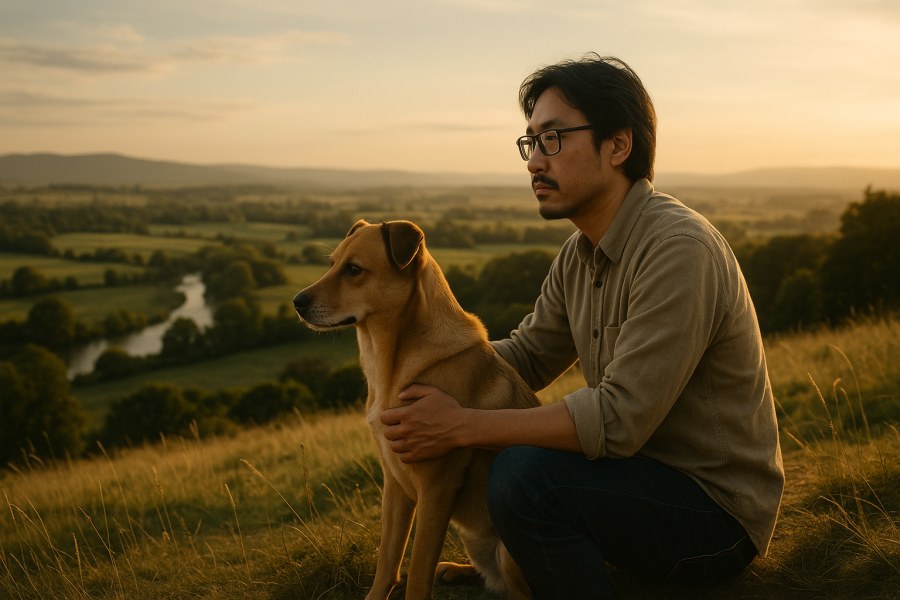


Source attribution: This post is a curated breakdown of For 15,000 years, humans and dogs have been changing each other, with additional scientific context and philosophical analysis from Species Universe.
If you live with a dog—or grew up around one—you’re part of a relationship that has been shaping bodies, behaviors, and cultures for millennia. This isn’t only a story about how humans “made” dog breeds. It’s also about how dogs helped humans survive in extreme environments, how they influenced daily work and ritual life, and how human societies in turn guided which canine traits flourished.
In this post for Species Universe, we’ll walk through a recent popular-science summary of archaeologist Peter Mitchell’s argument that dog domestication was gradual, geographically diverse, and in early stages potentially more of a partnership than a one-sided human project. We’ll also add careful context: what counts as evidence in archaeology and genetics, what remains debated, and what you can personally verify (and avoid over-reading) when you encounter strong claims about dog origins.
Who this affects (and why it matters)
Dog guardians and breeders often think in terms of “breed traits,” but the deeper story is about function, environment, and culture shaping canines over long time spans—sometimes faster than we intuit.
Anyone interested in human evolution and culture can treat dogs as a living case study in how relationships—between species, not just within one—can redirect survival strategies, settlement patterns, and even belief systems.
Readers exploring “unity” across nature (a common Species Universe theme) can use the human–dog relationship as a grounded, evidence-friendly example of interdependence: not mystical proof of oneness, but a real, historically traceable entanglement of lives.
What the source says
The source frames dog domestication as roughly a 15,000-year story of mutual change. It reports that archaeological findings include dogs buried alongside humans in graves as old as ~14,000 years, and that dogs appear broadly in ancient art and cultural narratives.
According to the summary, Professor Peter Mitchell (in his book First Dogs: Hunter-Gatherers and their Canine Companions from Prehistory to the Present) argues that domestication was:
- Gradual and complex, not a single “threshold event.”
- Deeply shaped by hunter-gatherer life, before agriculture and large-scale animal husbandry.
- Possibly cooperative in early phases, with humans and wolves/dogs as relatively “equal participants” at the beginning of the relationship (as reported in the summary).
The source then highlights several examples of dogs adapting to different environments and cultural needs:
- Arctic sled dogs: archaeological evidence of skeletal traits and spinal stress patterns consistent with repeated pulling, plus stable isotope work suggesting dogs and people in some coastal settings ate similar marine-based diets.
- Tropical hunting dogs: described as generally smaller and agile for rainforest hunting, with ethnographic records suggesting controlled breeding, including possible crossing with wild canids to reinforce traits.
- High-altitude dogs on the Tibetan Plateau: reported genetic variants supporting function in low-oxygen environments, with the source noting similarities to genetic changes in local human populations and acknowledging uncertainty about timing (the summary explicitly says “we do not know when dogs first joined them”).
- Woolly-coated dogs on the Northwest Coast of North America: bred for hair used in ceremonial blankets, illustrating that “use” can mean textiles and ceremony, not only hunting or transport.
- Disease limits: the source reports growing interest in how vector-borne diseases (examples given: trypanosomiasis and ehrlichiosis) may have constrained canine survival/expansion in parts of sub-Saharan Africa, potentially shaping where dogs became common and when.
- Colonial-era replacement of lineages: the summary says many ancient dog populations no longer survive “in their original form” due to spread of European breeds during colonial expansion, with some genetic signatures persisting.
Why this matters: co-evolution is real, but it’s not one simple mechanism
The phrase “humans and dogs have been changing each other” can mean several different things. Some are established scientific ideas; others are interpretations that need careful framing.
1) Established: selection can act quickly when environments and breeding choices change
From an evolutionary biology standpoint, once a population experiences consistent selection pressures—climate, diet, work tasks, human preferences—traits can shift measurably over many generations. Dogs are an unusually visible example because their reproduction was often influenced by humans (intentionally or indirectly) and because dogs live in many human-made niches.
For readers who want a clear, mainstream primer on natural selection and how it produces adaptation, UC Berkeley’s evolution resource is a solid starting point: Understanding Evolution (UC Berkeley).
2) Likely but context-dependent: “mutual change” can include behavior, culture, and economics
Even when genetic change in humans isn’t demonstrated, dogs can reshape human behavior in practical ways: hunting success, transport capacity, security, herding, and companionship. Those changes can cascade into culture—stories, taboos, ritual roles, and social status.
This is where Species Universe tends to slow down and ask: what kind of “change” are we talking about?
- Biological change in dogs (anatomy, genes, physiology): often testable via bones, DNA, and functional morphology.
- Behavioral change in humans (work patterns, settlement choices): sometimes inferable but less directly measurable.
- Meaning and symbolism (myth, religion, ceremony): real and important, but primarily evidenced through texts, art, oral tradition, and interpretation.
3) Open questions: how early, where, and how many times?
The source points to an “ongoing” process rather than a single moment. That aligns with a broader scholarly landscape in which the timing and geography of dog domestication—and the number of domestication events or admixture episodes—have been actively debated. The summary itself signals uncertainty about timing in the Tibetan Plateau case, which is a good reminder that evolutionary history is often reconstructed from incomplete records.
Adding practical context: how to evaluate claims about ancient dogs
The source is rich in examples, but the confidence you can place in each example depends on what kind of evidence is behind it. Here’s a simple interpretive map—useful whenever you read a summary like this.
Bones and burials: strong for “presence,” nuanced for “relationship”
A dog buried with a human strongly suggests social significance, but the details matter: Is it a deliberate burial or a mixed deposit? Are there grave goods? Is the dog’s age known? Is there pathology indicating work (or care)? These questions move you from “dogs existed here” toward “dogs mattered to these people in this way.”
Stable isotopes: useful for diet overlap, but not a full portrait of daily life
Stable isotope analysis can sometimes show that humans and dogs consumed similar protein sources (for instance, marine foods). That supports the idea of shared lifeways, provisioning, or scavenging around the same resources. But isotopes don’t directly tell you whether dogs were beloved companions, working animals, or opportunistic camp followers. They’re one clue among many.
Genetics: powerful, but summaries can oversimplify
When a summary says “researchers identified genes that allow Tibetan dogs to function in low oxygen,” that likely refers to genetic variants associated with high-altitude physiology. The scientific core is plausible: high altitude can select for oxygen-transport and metabolism-related adaptations. But the strength of the claim depends on which genes, how big the samples were, and whether the variants truly improve fitness or are just correlated with ancestry.
Ethnography: valuable, but don’t time-travel it without care
The source mentions ethnographic records of controlled breeding among Indigenous tropical hunter-gatherers. Ethnography can illuminate how people manage dogs, but it’s not automatically a direct window into prehistory. The best use is cautious: ethnography offers plausible mechanisms (how selection could happen), not a guaranteed description of what happened 10,000 years ago.
Convergence with traditional knowledge—without turning it into “proof”
Across many Indigenous and traditional cultures, dogs have been more than tools: they can be kin, guardians, messengers, or spiritually significant beings. The source notes ceremonial roles and mythic presence across cultures, which resonates with a wider human pattern: we interpret animals not only biologically, but relationally.
From a Species Universe perspective, this is a good place to practice disciplined comparison:
- Established science can show that dogs and humans influenced each other through ecology, selection, and cultural practice.
- Traditional knowledge can preserve nuanced observations about animal behavior, human responsibility, and relationship—often embedded in ethics and cosmology.
- Philosophical interpretation may suggest that relationship is a fundamental feature of reality (a theme in many traditions), but that is not the same thing as a biological mechanism.
If you want to see how Species Universe approaches cross-method inquiry—respecting both empirical constraints and lived meaning—our hub and framework pages are the best orientation points: Species Universe Framework and methodological framework for comparing knowledge systems.
Checklist: what to verify on your own computer before you “believe the headline”
This is the practical step that keeps curious readers from sliding into either credulity (“it’s in the news, so it’s settled”) or cynicism (“it’s popular science, so it’s worthless”). Here’s a quick verification workflow you can do in 10–20 minutes.
- 1) Identify what the piece actually is. Is it a press release, a book announcement, a peer-reviewed study, or a review? In this case, the source is a ScienceDaily summary drawing on Taylor & Francis material about a book.
- 2) Find the underlying scholarship. Search the book title and author (Peter Mitchell, First Dogs) and look for the bibliography or cited case studies. (If you can’t access the book, look for talks, interviews, or review articles that name the key sites and datasets.)
- 3) Separate “what was found” from “what it means.” Example: “dog bones show stress patterns” (observation) versus “dogs were essential survival partners” (interpretation—plausible, but broader).
- 4) Check whether specific technical claims have a traceable source. “Tibetan dogs have genes for hypoxia” should ideally connect to a named genetic study or dataset.
- 5) Watch for geographic generalizations. A claim about sub-Saharan disease constraints might be true in some areas and periods and not in others; look for whether the argument is regional, time-bounded, and evidence-based.
What this story changes for how we think about “domestication”
The source’s strongest contribution—at least as presented in the summary—is a reframing: domestication isn’t only about domination; it can begin as mutual advantage. That doesn’t mean wolves and humans were equal in every sense, or that humans didn’t later exert strong control. It means early phases may have looked more like a shifting alliance: some wolves benefited from human proximity; some human groups benefited from canine senses and behaviors; and over time the relationship became culturally stabilized and biologically expressed.
This also helps explain why dog diversity is so wide. If dogs repeatedly entered different human worlds—Arctic transport, rainforest hunting, plateau living, coastal textile traditions—then “dog” is less a single design and more a family of solutions shaped by place, work, and meaning.
For readers who want to explore these themes through a broader lens of biological and cultural change, Species Universe’s evolution hub provides additional context: Evolution & Species Development.
A balanced takeaway
The source paints a credible, nuanced picture: dogs are not merely artifacts of human will; they are partners in a long ecological and cultural experiment. Archaeology, genetics, and ethnography together can illuminate parts of that story—especially when we keep clear boundaries between evidence (bones, isotopes, DNA, artifacts) and interpretation (social meaning, spirituality, “essentialness,” and sweeping global narratives).
If there’s a Species Universe lesson here, it’s that “unity” can be approached in layers. The human–dog bond demonstrates an observable, historically grounded unity of lives and outcomes. It invites philosophical reflection, but it does not force metaphysical conclusions. That combination—evidence first, meaning second, speculation clearly labeled—is how we keep wonder honest.
For more on how we handle the edges between lived experience, interpretation, and scientific method, you may also like: Consciousness & Awareness and comparative models of consciousness.
Bottom line
For most readers, the safest approach is to treat the source as a useful starting point, then verify the details on your own device before making changes. If the issue affects a work computer, important files, or business operations, get help before taking risky steps.
Q&A
Does “15,000 years” mean we know exactly when dogs became dogs?
No. It’s best read as an approximate timeframe for early domestication processes, not a precise single moment. Different lines of evidence (burials, anatomy, ancient DNA) can point to different milestones, and the source itself notes uncertainty in at least one region (the Tibetan Plateau).
What’s the strongest evidence mentioned in the source?
The summary points to archaeological findings such as very old human–dog burials and skeletal patterns consistent with sled pulling in Arctic dogs, plus stable isotope studies suggesting diet overlap in some settings. These are concrete categories of evidence, though the summary doesn’t provide the underlying study citations.
Did humans domesticate wolves by controlling them, or was it more of a partnership?
The source reports Peter Mitchell’s view that early stages may have involved relatively “equal participants,” with a gradual process rather than a single takeover event. That’s an interpretation consistent with some domestication models, but evaluating it fully requires the specific archaeological and genetic arguments in the book and related research.
Do similarities between human and dog high-altitude adaptations prove a deeper metaphysical “unity”?
They don’t prove a metaphysical claim. Similar adaptations can emerge because different species face similar environmental pressures (like low oxygen), which is a standard evolutionary idea. Philosophical reflections on unity may be meaningful, but they are separate from what genetic data alone can establish.
Related posts:
 A 324-Million-Year-Old “Amphibious” Insect Fossil and What It Really Tells Us About Life’s Move Onto Land
 A Major Rewrite of the Human Family Tree? Why Some Scientists Want Australopithecus and Paranthropus Moved Into Homo
 Hilbert Space, Quantum “Possibilities,” and What the Math Really Means
 How the Brain Compresses a Noisy World: Predictions, Needs, and the Categories You Live By













Leave a Reply