
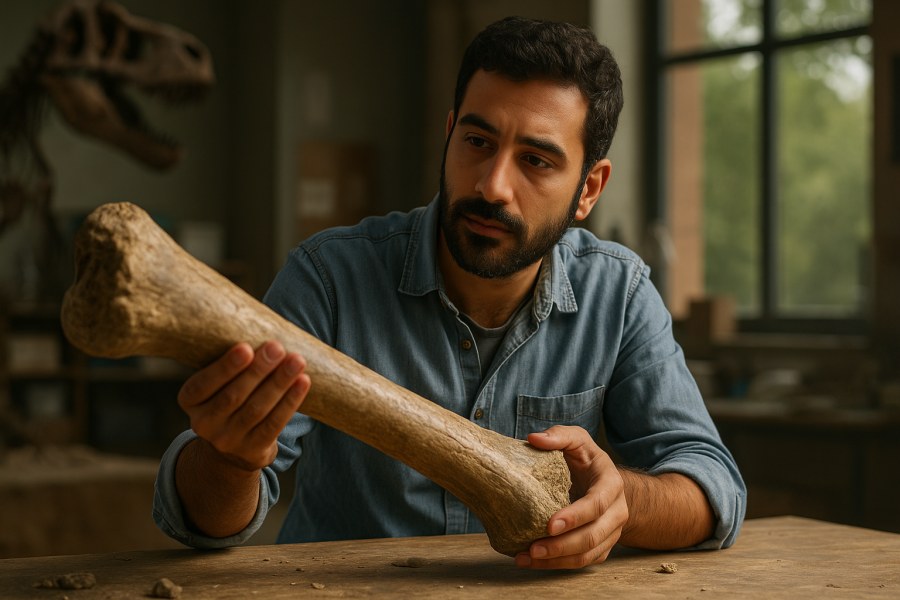


Source attribution: This post is a curated breakdown of Paleontology rocked by organic molecules found in 66-million-year-old dinosaur bones, with additional scientific context and philosophical analysis from Species Universe.
Quick takeaways
- A new report argues that fragments of original collagen (bone’s main structural protein) were detected in a 66-million-year-old Edmontosaurus fossil—if confirmed broadly, it changes what molecular questions fossils can answer.
- The controversy isn’t just “is it there?” It’s also about contamination, chemical alteration, and how multiple methods converge (or fail to) on the same conclusion.
- This is promising for paleontology, not permission for hype. Protein traces could refine evolutionary relationships and biology, but they won’t resurrect dinosaurs, and they don’t automatically validate sweeping philosophical claims about life or mind.
Finding anything like “original biology” inside deep-time fossils has been one of the most argued-over topics in modern paleontology. If proteins can persist in some specimens, then fossils become more than shapes in rock—they can become partial biochemical archives.
In this Species Universe breakdown, you’ll learn what the new ScienceDaily report claims, what counts as stronger versus weaker evidence for ancient proteins, why contamination is such a serious competing explanation, and what practical signals to look for as this line of research develops.
What the source says
The ScienceDaily piece summarizes research led by the University of Liverpool reporting strong evidence for endogenous (original-to-the-animal) collagen in a dinosaur fossil. The specimen is described as an exceptionally well-preserved Edmontosaurus sacrum (part of the lower spine/pelvic region), excavated from Upper Cretaceous rocks in the Hell Creek Formation (South Dakota) and held in the University of Liverpool’s collections.
According to the report, the team used multiple analytical approaches, including mass spectrometry and protein sequencing, to detect molecular signatures consistent with collagen. A key detail in the summary is the reported detection and quantification of hydroxyproline—an amino acid strongly associated with collagen in bone—using tandem mass spectrometry contributed by researchers at UCLA. The report also states that fragments of collagen alpha-1 (a major collagen form in bone) were identified by a University of Liverpool proteomics center.
The article frames the work as part of a long-running debate (described as about 30 years) over whether organic signals in dinosaur fossils reflect contamination (microbes, soil, handling, later infiltration) versus remnants of original biomolecules. It also suggests a practical implication: older archives of cross-polarized light microscopy images of fossil bone—collected for roughly a century—might help identify specimens that still contain collagen-like patches and are therefore good candidates for modern molecular tests.
The plain-English meaning: what would “collagen survived” actually imply?
Collagen is the tough, rope-like protein that helps give bone its strength. In living animals, bone is a composite: mineral crystals embedded in a scaffold of collagen and other proteins. After death and burial, that organic scaffold is expected to break apart through chemical reactions, microbial activity, water movement, and time.
So when researchers report collagen in dinosaur bone, they typically do not mean an intact, fresh protein like you’d find in a butcher shop. They usually mean degraded fragments, chemical “fingerprints” consistent with collagen, or molecular pieces that match collagen sequences well enough to support a confident identification.
If that identification holds up, it opens a different class of questions than anatomy alone can answer. Anatomy tells us what bones look like; molecular traces can sometimes hint at relationships (which lineages are closer), biochemistry, and the mechanisms of preservation themselves.
Why the contamination argument is central (and why it’s not a cheap “gotcha”)
Contamination is the strongest alternative explanation because fossils are not sealed time capsules. Over millions of years, a bone can interact with:
- groundwater carrying dissolved organics,
- biofilms and microbial communities,
- soil-derived amino acids and humic substances,
- conservation materials and handling residues after excavation.
Many molecules associated with life are not exclusive to dinosaurs. Even if a lab detects “protein-like” material, skeptics can reasonably ask: did it come from the original animal, or did it enter later?
The ScienceDaily report emphasizes multiple techniques and a collagen-associated amino acid (hydroxyproline) as converging evidence. Convergence matters because contamination has to “explain” several independent signals at once—not just one suggestive test.
What’s genuinely new here (based on the source summary)
Three aspects stand out in the way the source describes the work:
- Specimen quality and context: an “exceptionally well preserved” Edmontosaurus sacrum from Hell Creek, large enough to support multiple tests.
- Modern analytical tooling: tandem mass spectrometry, protein sequencing, and supporting materials analyses across collaborating groups.
- A practical screening idea: revisiting cross-polarized light microscopy images of fossil bones collected over ~100 years to flag promising specimens.
The last point is easy to miss but potentially powerful: it suggests a bridge between “classic” paleontology archives (slides, images, thin sections) and newer molecular methods. If older images reliably correlate with molecular preservation, that could save researchers from hunting blindly.
How could proteins last tens of millions of years? (What we know vs what’s still open)
The source calls it an “intriguing mystery,” and that’s the right framing. Proteins are generally expected to degrade over time, but degradation is not a single clock that ticks at the same rate everywhere. Preservation can depend on micro-environments.
Some plausible (not guaranteed) contributors discussed in this broader research area include:
- Mineral shielding: bone mineral and later mineral infilling can reduce exposure to water and microbes in micro-pores.
- Chemical cross-linking: certain reactions can bind molecules into more resistant forms (though this may also distort “original” sequences).
- Iron and reactive chemistry: some hypotheses propose iron-related chemistry may stabilize or “fix” tissues under certain conditions, while also complicating interpretation.
- Temperature and burial history: cooler, more stable conditions generally slow chemical breakdown; heating tends to accelerate it.
Why this matters for evolution and “species development” questions
Species Universe focuses on how evidence changes our picture of life’s history. If endogenous proteins can sometimes survive deep time, paleontology gains another layer of evidence—one that can complement morphology.
Potential payoffs (if replicated across specimens and labs) include:
- Sharper evolutionary comparisons: protein fragments may help test relationships among dinosaur groups when anatomy alone is ambiguous (while still respecting that fossils rarely preserve a full molecular record).
- New biological questions: bone biology, growth patterns, and tissue chemistry could be approached from both structure and molecules.
- Better preservation science: understanding why certain fossils retain organics helps museums conserve them and helps field paleontologists target collection strategies.
To place this in a larger learning map, our Evolution & Species Development hub explores how multiple evidence streams—fossils, genetics, development, ecology—support and refine evolutionary explanations.
What this does not mean (important boundaries)
Exciting molecular claims can trigger exaggerated headlines. A few careful clarifications help keep the science and the wonder aligned:
- Not “soft tissue survived unchanged.” Even strong evidence for collagen typically points to altered fragments, not pristine tissue.
- Not “DNA from dinosaurs is next.” DNA is generally less stable than many proteins, and claims about dinosaur DNA would require extraordinary evidence and replication.
- Not a shortcut to certainty. Molecular signals can be powerful, but they also introduce new failure modes (sample prep artifacts, database matching ambiguity, background organics).
Practical guidance: how to read future coverage of “ancient proteins in fossils”
If you see follow-up stories to this one, here are concrete questions that help you evaluate whether a claim is strengthening or weakening over time:
1) Is the result replicated in independent labs?
In contentious areas, replication isn’t optional—it’s the point. The strongest shift in scientific confidence happens when different groups, using different facilities and reagents, still find comparable signals.
2) Are there multiple lines of evidence in the same specimen?
Look for combinations like: chemical markers (e.g., collagen-associated amino acids), sequence fragments that map best to vertebrate collagen, and signals that localize to bone microstructures rather than random surface contamination.
3) How do they handle contamination controls?
Responsible studies usually describe blanks, controls, and steps taken to reduce modern protein carryover. They may also analyze surrounding sediment or adjacent materials to test whether the same signal is everywhere (a red flag) or specifically associated with the fossil interior (more persuasive).
4) Do authors discuss alternative explanations fairly?
In mature science, the best papers steel-man counterarguments. If a report treats skepticism as silly or malicious, that’s a warning sign that communication may be outrunning the evidence.
For readers who want the broader philosophy of how Species Universe thinks about evidence and interpretation, the Species Universe Framework is our overview of how we balance measurement, inference, uncertainty, and meaning-making.
A note on “meaning”: wonder, worldview, and what science can legitimately claim
Discoveries like this often spark a bigger feeling: if molecules can persist across deep time, what else might reality be holding onto? That’s a human response—and it can be intellectually fertile.
But it’s also where boundaries matter. Molecular preservation does not imply that observation, measurement, or “information” proves consciousness is fundamental. Those are separate philosophical questions. Species Universe welcomes thoughtful reflection, including cross-cultural perspectives, while keeping the scientific claim narrowly tied to the methods and the data.
If you’re interested in how complex systems produce surprising persistence and pattern, see our exploration of complexity and emergence and how researchers use systems thinking without turning it into mysticism.
Conclusion
The source report describes a serious, method-heavy claim: collagen-related molecular traces appear to persist in a 66-million-year-old Edmontosaurus fossil, with multiple analytical approaches pointing in the same direction. If this line of evidence continues to replicate, paleontology may gain a new molecular dimension—one that complements anatomy and deepens evolutionary inference.
The right stance right now is informed curiosity: appreciate how big the implication could be, watch how well contamination is ruled out, and look for independent replication. That’s how “rocked by” becomes “integrated into what we know.”
To stay oriented as new findings arrive, our site homepage curates major updates across evolution, cognition, and systems thinking: Species Universe.
Q&A
Did scientists really find “original collagen” in a dinosaur bone?
The source summary says researchers report strong evidence for collagen remnants in a 66-million-year-old Edmontosaurus fossil, supported by multiple analytical methods. The key scientific question is whether those collagen-related signals are endogenous (from the dinosaur) or could be explained by later contamination or chemical look-alikes—something that requires careful controls and replication.
Why is hydroxyproline mentioned as important?
Hydroxyproline is strongly associated with collagen in bone. The source summary says tandem mass spectrometry detected and quantified hydroxyproline in the fossil sample, which the authors interpret as a chemical clue consistent with degraded collagen rather than a generic “organic” signal.
Does this mean we can get dinosaur DNA next?
Not necessarily. Proteins and DNA differ in stability, and evidence for ancient proteins does not automatically imply recoverable dinosaur DNA. Claims about dinosaur DNA would require their own extraordinary, independently replicated evidence.
How could proteins survive for tens of millions of years?
The source frames this as an open mystery. In general, researchers consider factors like mineral shielding within bone, chemical cross-linking, local burial conditions, and complex geochemistry that might slow breakdown. None of these mechanisms guarantees preservation; they suggest possible pathways that still need predictive testing.
What would be the biggest scientific payoff if this holds up?
If endogenous protein fragments can be reliably recovered from some Mesozoic fossils, paleontologists could sometimes add molecular evidence to anatomical comparisons—potentially refining evolutionary relationships and learning new details about ancient biology, while also improving understanding of fossil preservation.

















Leave a Reply