Transcendental consciousness is the term Maharishi Mahesh Yogi used for a state in which awareness remains present while ordinary thought, perception, and mental activity become minimal or absent. Within the Transcendental Meditation tradition, this state is described as pure consciousness: awareness knowing itself rather than being occupied by an object of experience.
That description places TM within a much older contemplative conversation. Indian traditions have long used terms such as samādhi, turiya, pure awareness, self-realization, liberation, and enlightenment to describe states or stages in which ordinary mental activity is transformed or transcended. Yet these terms do not all mean the same thing across traditions.
This Species Universe page therefore asks three separate questions: What does Maharishi mean by transcendental consciousness? How does that relate to samādhi and enlightenment in broader contemplative traditions? And what can modern science actually say about these experiences?
What is transcendental consciousness?
Within Transcendental Meditation, transcendental consciousness is described as a state in which the mind has settled beyond ordinary thought while awareness remains awake.
Maharishi International University describes TM as allowing the mind to settle inward toward the “source of thought,” identified in that tradition as pure awareness or transcendental consciousness.
The key feature is not unconsciousness. It is the opposite: awareness is said to remain present even when the usual content of awareness becomes minimal.
This is why Maharishi often described the state as restful alertness.
In ordinary waking life, awareness is usually directed toward something—a sound, sensation, thought, memory, object, or task. During transcendental consciousness, the claim is that awareness remains without being occupied by a particular object.
Pure consciousness as self-referral awareness
Maharishi used the phrase self-referral consciousness to distinguish this state from ordinary object-directed awareness.
In object-referral awareness, consciousness is aware of something.
In self-referral awareness, consciousness is said to be aware of itself.
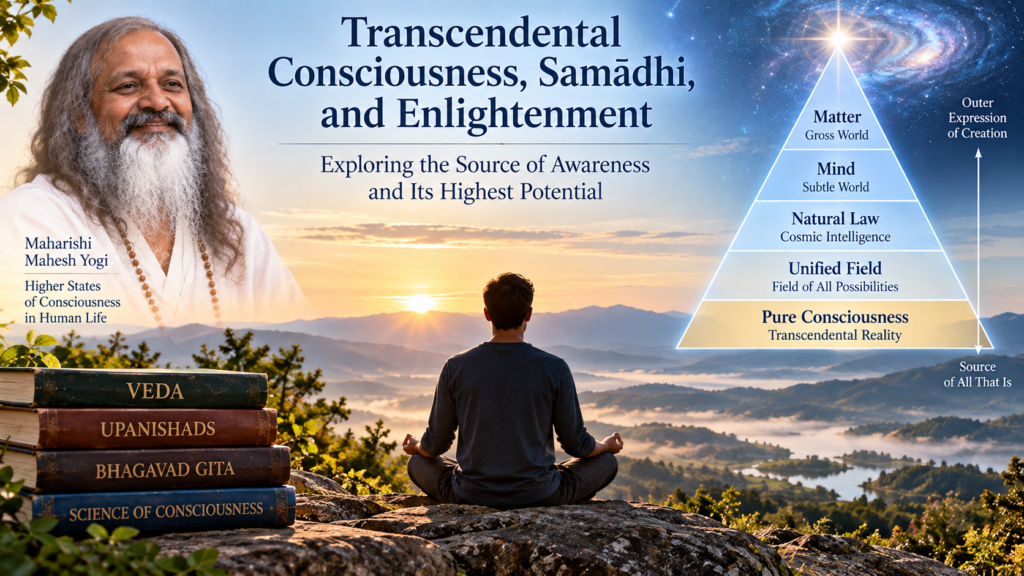
This is one of the central ideas in Maharishi Vedic Science. Pure consciousness is not merely treated as a temporary mental condition. Maharishi interprets it as the most fundamental level of individual awareness and, ultimately, as the deepest field of intelligence underlying nature.
That second step is a philosophical and metaphysical interpretation. Science can study the reported experience and its physiological correlates; it does not automatically establish the larger ontological claim.
For the broader framework, see Maharishi Mahesh Yogi and Maharishi Vedic Science.
How does this relate to samādhi?
Samādhi is one of the most important—and most differently interpreted—terms in Indian contemplative traditions.
In the Yoga tradition associated with Patanjali, samādhi refers to profound meditative absorption. In Vedantic traditions, the term may be used in connection with direct realization of the Self or ultimate reality. In other systems, distinctions are made between forms of samādhi with and without conceptual content.
Maharishi’s description of transcendental consciousness is closely related to this broader contemplative territory, but it should not simply be assumed to be identical to every traditional use of the word.
The most careful way to state the relationship is:
- TM describes a reproducible experience of awareness with reduced thought content;
- Maharishi interprets that experience through Vedic concepts of pure consciousness;
- traditional Yoga and Vedanta contain related concepts of samādhi;
- but different traditions disagree about the exact meaning, depth, and ultimate significance of these states.
Turiya and the “fourth state”
Maharishi frequently described transcendental consciousness as a fourth state of consciousness, distinct from waking, dreaming, and deep sleep.
This language parallels the Vedic and Upanishadic concept of turiya, literally “the fourth.” Turiya is traditionally described as beyond or underlying the familiar three states of waking, dreaming, and deep sleep.
Within Maharishi’s interpretation, transcendental consciousness provides direct experiential access to this fourth state.
Again, this is best understood in layers:
- Phenomenological claim: practitioners report a distinctive state unlike ordinary waking, dreaming, or sleep.
- Physiological claim: that state may have recurring measurable correlates.
- Traditional interpretation: the state corresponds to turiya or pure consciousness.
- Metaphysical interpretation: pure consciousness is fundamental to individual and universal existence.
Maharishi’s higher states of consciousness
Maharishi’s model does not stop with temporary experiences during meditation.
He proposed that repeated experience of transcendental consciousness can gradually become integrated with ordinary waking activity.
Within this framework, development is described through a sequence of higher states of consciousness.
Cosmic consciousness
Cosmic consciousness is described as the permanent coexistence of transcendental consciousness with waking, dreaming, and sleeping.
In this state, the person is said to retain an underlying sense of unbounded awareness or Self even while ordinary mental and physical activity continues.
God consciousness
Maharishi described a further refinement in which perception becomes increasingly subtle and appreciative of the finest values of the environment.
This stage is described in devotional and perceptual terms and is more difficult to translate into conventional scientific variables.
Unity consciousness
The culmination of Maharishi’s developmental model is unity consciousness, in which the distinction between inner Self and outer reality is said to dissolve.
The claim is that the same underlying reality experienced inwardly as pure consciousness is recognized as the basis of everything perceived outwardly.
These descriptions belong primarily to Maharishi’s philosophical and experiential framework. Some aspects may be studied through psychology, neuroscience, cognition, and first-person reports, but the full interpretation goes beyond what present scientific methods can establish.
What does enlightenment mean here?
In everyday language, enlightenment can sound vague or mystical. In Maharishi’s system, it has a more structured meaning.
Enlightenment is not simply an unusual meditation experience. It is described as a stable transformation of consciousness in which the benefits or qualities of transcendental consciousness become permanently integrated with everyday life.
This distinction is important.
A temporary meditative state can be measured during a laboratory session. A claim of enlightenment concerns long-term human development.
Scientific research would therefore need to ask different questions:
- Are there stable changes in self-experience?
- Do long-term practitioners show persistent differences in EEG or brain organization?
- Are cognition, emotional regulation, resilience, and behavior measurably different?
- Are such differences specific to TM or common across long-term contemplative practice?
- Do the experiences described as cosmic or unity consciousness remain stable over years?
This moves the research question from altered states to altered traits.
How Buddhist interpretations differ
Comparisons with Buddhism are useful precisely because they show that contemplative traditions do not all interpret deep meditative experience in the same way.
Many Buddhist traditions reject the idea of an eternal, unchanging Self. Their analysis often emphasizes impermanence, dependent arising, emptiness, and the absence of a permanent personal essence.
Some Buddhist systems nevertheless describe extremely subtle levels or continuities of consciousness. Yogācāra, for example, developed the concept of ālaya-vijñāna, often translated as storehouse consciousness, as a continuing basis underlying ordinary manifest cognition.
These ideas should not be collapsed into Maharishi’s pure consciousness.
The similarities are interesting:
- both traditions investigate consciousness through disciplined first-person practice;
- both describe states beyond ordinary discursive thought;
- both developed detailed maps of meditative development.
But their philosophical conclusions can differ sharply.
Vedantic interpretations may identify pure awareness with the true Self or ultimate reality. Many Buddhist interpretations resist exactly that move.
This disagreement is intellectually valuable. It suggests that even highly refined contemplative experience may still admit more than one philosophical interpretation.
How can science study these states?
Science cannot directly measure “pure consciousness” as a metaphysical entity.
It can, however, study:
- first-person reports;
- EEG and neural synchrony;
- autonomic activity;
- respiration;
- metabolic changes;
- sleep physiology;
- attention and cognition;
- and long-term psychological development.
The key scientific challenge is to correlate subjective reports with reproducible objective patterns.
If people independently describe a similar state and that state repeatedly coincides with a distinctive physiological signature, confidence increases that researchers are studying a genuine and recognizable mode of consciousness.
Physiological and EEG findings
A frequently cited study by Fred Travis and Craig Pearson examined subjective reports and physiological correlates of what participants described as “consciousness itself” during TM.
The study reported experiences characterized by reduced or absent ordinary sensory and cognitive content, accompanied by physiological features including distinctive breathing changes and EEG patterns.
Another study examined long-term TM practitioners who reported maintaining a form of inner awareness during sleep. Their nighttime EEG was compared with shorter-term practitioners and non-practitioners.
These studies are scientifically interesting because they attempt to connect unusual first-person reports with measurable physiology.
They are not definitive.
Sample sizes were small, the research was closely connected with the TM research community, and independent replication remains important.
Nevertheless, the work supports a reasonable research question: can trained contemplative practice produce stable physiological signatures associated with distinctive forms of awareness?
First-person phenomenology
Modern consciousness research faces a basic problem: consciousness is directly known only from the first-person point of view.
Brain imaging and EEG measure neural activity. Behavioral tests measure performance. But the actual quality of experience is available only to the person having it.
Contemplative traditions therefore offer something science does not normally possess: long-developed methods for refining attention and systematically exploring subjective experience.
This does not make every contemplative claim automatically reliable.
But it does suggest that first-person data should not simply be discarded.
A mature science of consciousness may need to integrate:
- first-person phenomenology;
- third-person physiology;
- behavioral measurement;
- longitudinal development;
- and philosophical analysis.
That is one reason Species Universe treats meditation as a technology of consciousness rather than merely a wellness technique.
What science cannot yet determine
Several questions remain beyond present evidence.
- Is pure consciousness ontologically fundamental? Neuroscience cannot currently answer this.
- Is transcendental consciousness identical to turiya? That is a traditional interpretation, not a laboratory finding.
- Are Maharishi’s higher states universal stages of human development? More independent longitudinal research would be needed.
- Is unity consciousness a transformation in perception, a metaphysical realization, or both?
- Are similar states across TM, Yoga, Vedanta, Buddhism, and other traditions actually the same state?
- Does the brain generate these experiences, mediate them, or reflect a more fundamental consciousness? This remains an open philosophical and scientific question.
These are not reasons to abandon the inquiry.
They are reasons to keep the categories clear.
The Species Universe perspective
Transcendental consciousness may be the most important concept in the entire TM silo because it addresses the central Species Universe question directly:
What happens when consciousness becomes the object of systematic investigation?
The TM tradition answers by pointing to a state in which awareness remains while ordinary mental content subsides.
Modern science can investigate whether that state is reproducible, whether it has distinctive physiological correlates, and whether repeated experience produces durable developmental changes.
Traditional Vedic philosophy goes further and interprets pure consciousness as the deepest Self and as the basis of natural law.
Buddhist traditions offer alternative interpretations, often rejecting the idea of a permanent Self while still describing highly refined states of awareness.
Species Universe does not need to choose among those interpretations prematurely.
The productive position is:
- take the reported experience seriously;
- measure what can be measured;
- compare traditions carefully;
- distinguish phenomenology from metaphysics;
- and allow the larger ontological question to remain open.
If pure consciousness is merely a distinctive brain-mediated state, it is still scientifically important.
If it represents a stable developmental capacity of human consciousness, it is more important still.
And if future evidence were ever to show that consciousness is more fundamental than the brain processes associated with it, the implications would reach far beyond meditation.
That is why this question belongs at the center of Species Universe.
Continue Exploring
- Transcendental Meditation as a Technology of Consciousness
- Scientific Research on Transcendental Meditation
- The Maharishi Effect and Collective Consciousness
- Maharishi Mahesh Yogi and Maharishi Vedic Science
- Maharishi International University
- The TM-Sidhi Program
- Maharishi Ayurveda
Selected Sources
- Pure Consciousness: Distinct Phenomenological and Physiological Correlates of “Consciousness Itself”
- Electrophysiological Correlates of Higher States of Consciousness During Sleep in Long-Term TM Practitioners
- MIU Research — EEG Patterns During Transcendental Meditation
- Maharishi International University — Transcendental Meditation Technique
- Maharishi International University — Maharishi Vedic Science
Editorial note: Institutional TM sources are used to represent Maharishi’s model accurately. Their interpretation of pure consciousness and higher states should be distinguished from independent scientific confirmation of the underlying metaphysical claims.