


Source attribution: This post is a curated breakdown of A new Ice Age species was hiding in la brea tar pits fossils for decades, with additional scientific context and philosophical analysis from Species Universe.
Sometimes the biggest shift in what we think we know about an ecosystem comes from the smallest bones. A recent report describes a newly recognized extinct amphibian species from Los Angeles’ La Brea Tar Pits—an Ice Age spadefoot toad named Spea labreae. The headline surprise isn’t only that a new species was identified, but that the fossils had been in museum collections since the 1950s.
For Species Universe readers, this is a story about three intertwined themes:
- Evolutionary and ecological inference: how small, sensitive animals can act as “local climate witnesses.”
- Knowledge as an evolving system: museums aren’t just storage; they’re “slow science engines” where new questions can extract new meaning from old specimens.
- How to think clearly about uncertainty: fossil interpretation is powerful, but it’s also constrained by preservation bias and limited sample access.
What the source says
According to the source excerpt:
- Researchers working with La Brea Tar Pits collections identified a previously unrecognized extinct amphibian species, named Spea labreae, described as an “Ice Age spadefoot toad.”
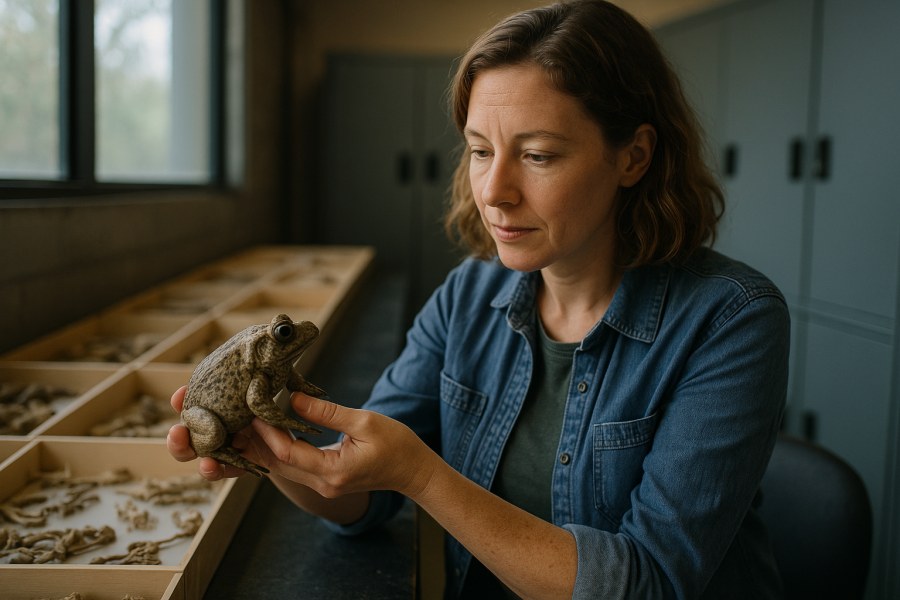
- The fossil material had been collected decades ago (the excerpt notes the 1950s), but was only recognized as distinct when a researcher noticed anatomical features that did not match known spadefoot toads.
- The lead author, Dr. Alberto Cruz, was studying an understudied part of the collection (reptiles and amphibians). He initially considered whether unusual bones could reflect disease or injury (paleopathology) before concluding they represented a distinct species.
- The excerpt emphasizes rarity: it claims only one other extinct Pleistocene amphibian has been identified in North America (a tree frog from Florida).
- To test the “new species” interpretation, Cruz compared La Brea specimens with modern comparative material—80 specimens across museum herpetology collections (including the Natural History Museum of Los Angeles County and UC Berkeley’s Museum of Vertebrate Zoology, per the excerpt).
- The work also reports a separate finding: a record of the Mexican burrowing toad (Rhinophrynus) in the southwestern United States, far from its closest living populations today (the excerpt says nearly 2,500 km away in southern Mexico). The implication presented is that late Pleistocene distributions and local environments differed markedly from the modern region.
- The excerpt frames amphibians as valuable climate proxies because they tend not to travel long distances and are sensitive to environmental shifts; it also notes their skeletons are delicate and rarely fossilize except in special conditions like asphaltic sites.
Why a tiny toad can matter more than a mammoth (for climate inference)
La Brea is famous for large mammals, but large-bodied animals can complicate environmental reconstruction:
- They may range widely, so a fossil at a site doesn’t always mean the animal lived right there year-round.
- They can sometimes tolerate broader conditions (behavioral flexibility, mobility), which blurs the local signal.
Amphibians often supply the opposite kind of information: a tighter ecological “signature.” The source excerpt highlights two traits that make amphibians informative:
- Limited dispersal (many amphibians live within relatively small home ranges compared with megafauna).
- Sensitivity to moisture and temperature, because amphibian skin and life cycles are often tightly linked to local water availability.
So, if an amphibian lineage appears in a deposit—and especially if it is absent in the same region today—that can strengthen the case that local conditions were different. But it’s not an automatic “climate thermometer.” It’s a clue that must be integrated with other evidence (plants, sediments, isotopes, other vertebrates, dating, and taphonomy).
How a “new species” can hide in plain sight
The excerpt describes a familiar dynamic in paleontology and taxonomy: an old collection, a new set of eyes, and a question that wasn’t asked before.
In this case, the pathway described runs roughly like this:
- Specimens were excavated and curated decades ago.
- A specialist revisited a portion of the collection that had not been assessed in detail for a long time (the excerpt mentions ~30 years without detailed assessment).
- Unusual anatomy triggered competing hypotheses: individual abnormality (injury/disease) versus consistent differences that indicate a distinct species.
- Comparative anatomy against a wide reference set of modern specimens supported the distinct-species interpretation.
This is also a reminder that “discovery” isn’t always about a new field expedition. It can be about improved comparative collections, better sorting and imaging, refined taxonomic frameworks, or simply more time allocated to smaller, less charismatic taxa.
What the second toad (Rhinophrynus) adds to the story
The excerpt’s second headline—identifying a Mexican burrowing toad (Rhinophrynus) in the southwestern U.S.—is especially interesting because it shifts the discussion from “a new extinct species” to “a reshuffled biogeography.”
If the identification holds up under peer scrutiny, the significance is not mystical; it’s ecological and historical:
- Ranges move as climates and habitats change. That can happen through gradual tracking of suitable conditions, stepwise expansions, or fragmented “refugia” that later disappear.
- Local extinctions can be invisible if the animals are small, preservation is rare, and the record is sparse.
- Community composition changes can be more sensitive than broad “warming/cooling” labels. Amphibians may reveal changes in seasonality, moisture regimes, and vegetation structure that a large-mammal list alone could miss.
Notably, the excerpt links these ancient shifts to the present as a cautionary lens: understanding how amphibians responded at the end of the last Ice Age may help us think about vulnerability under human-caused climate change. That’s a reasonable framing, but it should be kept in proportion: past changes don’t give one-to-one predictions, because today’s drivers (rate of change, land use, pollutants, disease dynamics, barriers to migration) differ.
Established science vs. inference: what we can and can’t conclude from fossils like these
Readers sometimes (understandably) want fossils to deliver simple answers: “It was wetter,” “It was colder,” “It was a different ecosystem.” The reality is more layered.
Here are some careful takeaways that stay close to what the excerpt supports:
- Direct observation: there are amphibian fossils in the La Brea collections that researchers interpret as belonging to a distinct spadefoot toad species, Spea labreae.
- Strong inference (if identification is robust): local amphibian assemblages can reflect local environmental conditions, because many amphibians have limited dispersal and specific habitat requirements.
- Open questions: how abundant these animals were, how long they persisted, and which precise microhabitats they occupied are typically harder to infer from rare and delicate remains.
Species Universe angle: what this says about “knowledge evolution”
At Species Universe, we often ask how understanding itself develops—how communities of investigators, tools, institutions, and narratives change what can be seen.
This story is a clean example of that dynamic:
- Collections are memory: specimens preserve information that outlives the first generation of questions asked about them.
- Attention is a limiting resource: charismatic megafauna can dominate analysis time, while small vertebrates wait decades for a specialist to revisit them.
- Interpretation is iterative: Cruz’s initial hypothesis (pathology) gave way to a species-level interpretation after broader comparison. That is scientific humility in action—changing the model when the pattern persists across individuals and comparisons.
If you’re interested in how complex systems generate new knowledge over time, this pairs naturally with our explorations of complexity and emergence in science and how explanatory frameworks grow and reorganize.
Climate change lessons—without overclaiming
The excerpt suggests these amphibians may help illuminate how dramatically Los Angeles’ climate changed near the end of the last Ice Age. That is plausible in principle, but a few balancing points matter:
- Amphibians are informative, not omniscient: presence/absence is a coarse signal unless paired with dating, abundance, and independent environmental proxies.
- Tar pits are selective recorders: asphaltic deposits can preserve delicate bones, but they also represent a particular trap-and-preservation pathway, not a neutral census of the whole ecosystem.
- Range shifts have multiple causes: temperature and rainfall matter, but so do vegetation structure, predators, prey, disease, and habitat connectivity.
Still, the broader value is real: small vertebrates can help convert “Ice Age Los Angeles” from a dramatic label into a more precise ecological portrait.
Where this fits in evolution and species development
From an evolutionary standpoint, the report sits at the intersection of speciation, extinction, and biogeography:
- Speciation (pattern): the recognition of Spea labreae adds a branch to the spadefoot toad story. Even without DNA, consistent anatomical differences can justify a distinct species in paleontology—especially when carefully compared across many modern specimens.
- Extinction (pattern): the excerpt implies S. labreae did not persist into the modern fauna. Understanding why often requires integrating climate, habitat, and ecological interactions—not just a single “cause.”
- Biogeography (pattern): the reported presence of Rhinophrynus far from its current range highlights how quickly (in geological terms) distributions can reorganize.
If you want a grounded refresher on how scientists define and test evolutionary mechanisms (and common misconceptions), UC Berkeley’s Understanding Evolution is a reliable starting point.
Convergence with traditional knowledge (and what it can’t prove)
Many traditional knowledge systems emphasize that land, seasons, and living beings form a coupled whole—change the water and the plants change; change the plants and the animals change; change the animals and people’s lives change.
This fossil story resonates with that relational view because amphibians are, in a sense, biological “boundary beings”—they sit at the interface of water and land, and their vulnerability makes ecological change visible.
But we should keep the epistemic boundary clear:
- Scientific evidence here comes from comparative anatomy, museum curation, stratigraphic context, and peer-reviewed description.
- Traditional insight can offer interpretive wisdom about ecological interdependence and humility toward landscape change, but it is not, by itself, a substitute for taxonomic diagnosis or dating.
Convergence can be meaningful without being treated as scientific proof of any one worldview.
What to watch for next (practical reading of future updates)
If you see follow-up coverage—or if you decide to look up the Journal of Vertebrate Paleontology paper referenced in the excerpt—these are the details that will most affect how strongly you should update your beliefs:
- Diagnostic traits: which bones, which measurements, and which morphological characters distinguish Spea labreae from close relatives like Spea hammondii (mentioned in the excerpt as a modern local species).
- Sample size and consistency: how many individuals and how consistent are the distinguishing features across specimens?
- Dating and stratigraphy: how tightly are the relevant layers dated, and are the amphibian remains confidently associated with specific time windows?
- Alternative explanations: how thoroughly are pathology, deformation, and within-species variation ruled out?
For more Species Universe context on how evolutionary and ecological stories are built from incomplete records, explore our Evolution & Species Development hub and the curated library on understanding evolution. If you’re interested in how such discoveries shape our self-understanding as a knowledge-building species, the Species Universe Framework is the larger home for that discussion.
Bottom line
The core claim in the source is straightforward: a new extinct amphibian species, Spea labreae, was identified from La Brea Tar Pits material collected decades ago, and additional amphibian evidence suggests Ice Age southern California hosted different local conditions and faunal ranges than today. The deeper lesson is about method and patience: museum collections, revisited with careful comparison, can still rewrite the ecological history of a place—sometimes starting with a toad small enough to be overlooked.
Q&A
How can a new species be discovered if the fossils were collected in the 1950s?
Because “discovery” can mean recognizing a distinct pattern in material that was already stored and labeled more generally. As the source describes, a researcher re-examined understudied amphibian bones, considered whether odd features were due to injury or disease, and then compared them against many modern specimens to test whether the differences were consistent with a separate species.
Why are amphibian fossils especially informative for reconstructing local climate?
Many amphibians tend to have relatively limited dispersal and are sensitive to temperature and moisture. That can make their presence or absence a more local ecological signal than large mammals. The caveat is that amphibian remains are also fragile and rare, so the record is incomplete and must be integrated with other evidence.
Does finding Rhinophrynus in the Ice Age Southwest prove Los Angeles was tropical?
No. A range extension suggests past conditions differed, but it doesn’t translate into a single simple climate label. Habitat suitability can depend on seasonality, moisture, vegetation, and landscape connectivity, and fossil deposits don’t record ecosystems evenly. The strongest conclusion is that distributions and local environments were not the same as today.
Does this discovery tell us anything direct about consciousness or mind in nature?
Not directly. It’s primarily a paleontology and paleoecology story about species identification and environmental change. Philosophically, it can support a broader Species Universe theme—knowledge evolves through attention, comparison, and preserved evidence—but it does not provide scientific evidence that consciousness is fundamental or that observation in itself drives biological change.
Related posts:
 Tiny 1.7-Billion-Year-Old Fossils and the Hard Question: When Did Complex Life Really Begin?
 Collagen in a 66-Million-Year-Old Dinosaur Bone: Why This Claim Matters (and What It Doesn’t Prove Yet)
 Two Origins of Life? What a New Metabolism Map Suggests About Bacteria, Archaea, and Earth’s First Cells
 A Japanese Mosasaur Fossil Revisited: Four Hidden Bones and the Possibility of a New Sea Monster Species













Leave a Reply