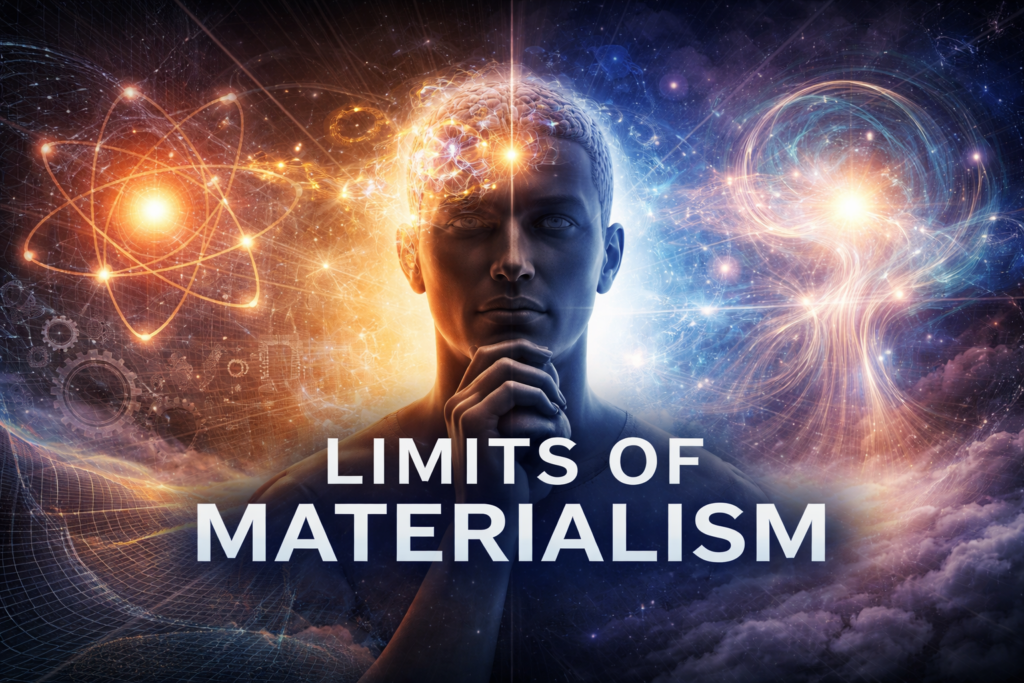
🧠 Limits of Materialism
(Traditional Knowledge → Comparative Structure)
Introduction: A Framework Under Pressure
Materialism—more precisely, physicalism in its modern form—has been one of the most successful frameworks in the history of science. It assumes that:
- reality is fundamentally physical
- all phenomena can, in principle, be explained in terms of physical processes
- consciousness arises from material interactions
This approach has enabled extraordinary advances in:
- physics
- chemistry
- biology
- engineering
However, as inquiry moves toward foundational questions, certain tensions emerge.
This page does not reject materialism. Instead, it examines its limits—where it explains effectively, where it encounters difficulty, and whether expansion may be required.
This analysis follows the Methodological Framework for comparing knowledge systems, beginning with shared problems rather than conclusions.
What Materialism Explains Well
Before examining limitations, it is important to recognize where materialism succeeds.
Predictive Power
Materialist models allow precise predictions of physical systems:
- planetary motion
- electromagnetic interactions
- chemical reactions
Technological Success
Modern technology—from semiconductors to medical imaging—relies on physicalist assumptions.
Biological Explanation
Materialism provides powerful explanations for:
- evolution by natural selection
- cellular processes
- neural activity
At these levels, treating reality as fundamentally physical is highly effective.
The Shift Toward Foundations
As science progresses, it encounters questions that are less about prediction and more about interpretation.
These include:
- What is the nature of measurement?
- What is the status of information?
- How does subjective experience arise?
At this level, materialism is not necessarily wrong—but it may be incomplete.
The Measurement Problem
In quantum mechanics, physical systems are described by probabilistic states.
Yet measurements yield definite outcomes.
This raises a key question:
How does a range of possibilities become a single observed result?
Materialist interpretations typically attempt to explain this through:
- decoherence
- many-worlds frameworks
- hidden variables
Each approach preserves physical description, but often introduces:
- unresolved assumptions
- interpretive complexity
This issue is closely tied to the measurement boundary between potential and reality, where the transition from possibility to outcome occurs.
The Role of the Observer
Materialism traditionally treats the observer as:
- a physical system among others
- ultimately reducible to neural processes
However, as explored in observer-centered epistemologies and the role of the observer in reality, the observer cannot always be treated as external to the system.
This introduces a tension:
- If observation plays a structural role
- and the observer is part of the system
then the framework must account for self-reference.
Materialism can describe the brain.
It is less clear how it fully accounts for:
- the act of observation itself
- the structure of awareness
The Hard Problem of Consciousness
One of the most persistent challenges is the so-called hard problem of consciousness:
How do physical processes give rise to subjective experience?
Materialist approaches typically attempt to explain consciousness through:
- neural correlates
- computational models
- emergent properties
While these approaches provide important insights, a gap remains between:
- description of processes
- experience of those processes
This gap does not prove materialism false.
But it raises the question:
Is something missing from the framework?
Information, Matter, and Description
Modern physics increasingly treats information as fundamental.
Examples include:
- quantum information theory
- black hole entropy
- holographic principles
This raises a subtle issue:
- Is matter primary, with information as a description?
- Or is information more fundamental than matter?
Materialism traditionally prioritizes matter.
Yet some interpretations suggest that:
- what we call “matter” may be structured information
- physical reality may be relational rather than absolute
These ideas are explored in modern physics through quantum information theory and physical systems, where information plays a central role.
This does not resolve the issue—but it shifts the discussion. These developments are closely connected to the foundations of modern physics and information theory, where matter and information become increasingly difficult to separate.
Traditional Perspectives as Comparative Models
Traditional systems are not introduced as replacements for science.
They are examined as alternative models of interpretation.
In Vedic Knowledge Systems
and consciousness inquiry, consciousness is often treated as fundamental, as explored in Vedic Knowledge Systems and consciousness inquiry, where awareness is not considered a byproduct of matter but a primary aspect of reality.
In Buddhist Frameworks
Experience is analyzed as dependent and relational, without fixed underlying substances.
These perspectives differ significantly, but they share a feature:
They do not treat consciousness as a secondary byproduct of matter.
Within this project, they are evaluated only where structural correspondence exists—not as authority, but as comparative models.
Meditation and Direct Observation
If consciousness is difficult to access through third-person methods alone, then alternative approaches may be relevant.
As explored in meditation as a technology of consciousness, structured practices aim to:
- stabilize attention
- reduce cognitive noise
- observe awareness directly
This does not provide final answers.
But it introduces a method for investigating:
- the structure of experience
- the role of the observer
Expansion vs Rejection
A critical distinction:
This page does not argue that materialism should be discarded.
Instead, it considers whether:
materialism represents a highly successful but incomplete stage in the evolution of understanding
Historically, scientific frameworks evolve by:
- expanding scope
- integrating new domains
- refining assumptions
Materialism may follow a similar trajectory.
Toward an Expanded Framework
An expanded framework might:
- retain the predictive power of physical models
- incorporate the role of the observer
- address the structure of consciousness
- integrate information as a central concept
Such a framework is not yet established.
But the need for it is suggested by:
- unresolved foundational problems
- increasing role of observer-dependence
- limits of purely external description
Relationship to the Species Universe Framework
Within your structure:
- The Unmanifest → potential states
- Measurement Boundary → transition
- Localized Reality → realized outcomes
Materialism operates most effectively at:
- the level of localized reality
Its limitations become more visible at:
- the measurement boundary
- the relationship between observer and system
Criticisms of Non-Materialist Approaches
For balance, it is important to acknowledge:
Risks include:
- lack of empirical grounding
- overextension of interpretation
- conflating experience with ontology
These risks reinforce the need for:
- methodological discipline
- clear distinction between evidence and interpretation
Conclusion: A Productive Tension
Materialism remains one of the most powerful tools in science.
Its success should not be dismissed.
At the same time, certain problems suggest that:
- the observer cannot be fully excluded
- consciousness cannot be fully reduced
- information may not be purely secondary
These tensions do not invalidate materialism.
These questions naturally lead toward comparative models of consciousness and reality, where multiple frameworks are examined together.
They define the frontier of inquiry.
Transition Forward
The next stage in this section explores:
👉 Comparative Models of Consciousness
Where we examine:
- how different traditions and scientific frameworks describe awareness
- where they converge
- where they diverge
What is materialism in science?
Materialism is the view that reality is fundamentally physical and that all phenomena, including consciousness, can ultimately be explained in terms of physical processes.
What are the limits of materialism?
Materialism encounters challenges in explaining consciousness, the role of the observer in physics, and how probabilistic systems produce definite outcomes in quantum mechanics.
Does this mean materialism is wrong?
No. Materialism remains highly successful in many domains. The question is whether it is complete or requires expansion to address unresolved problems.
What is the hard problem of consciousness?
The hard problem of consciousness asks how subjective experience arises from physical processes, a question that remains unresolved within current scientific frameworks.
How does this relate to quantum physics?
Quantum mechanics raises questions about measurement and observation, suggesting that the observer may play a role that materialist models do not fully explain.