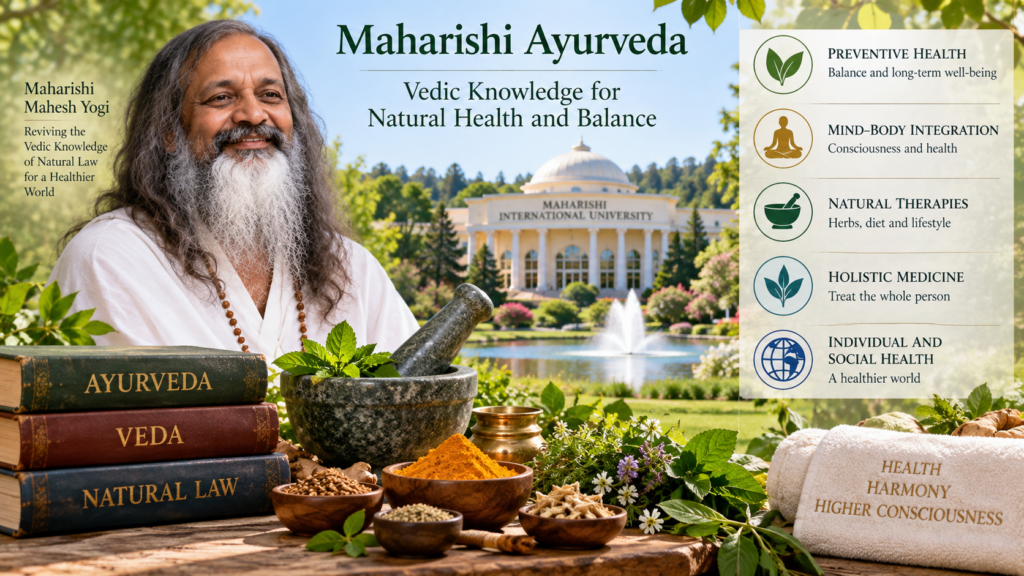
Maharishi Ayurveda is a modern system that seeks to recover, organize, and apply the traditional knowledge of Ayurveda within the broader framework of Maharishi Vedic Science. Its central idea is that health depends on balance across multiple levels of life: consciousness, mind, behavior, physiology, environment, daily routine, diet, and natural law.
That gives Maharishi Ayurveda a scope much wider than herbal medicine. It includes lifestyle, sleep, food, seasonal routines, meditation, pulse assessment, rejuvenation practices, yoga, environmental influences, and other traditional approaches. Within Maharishi’s interpretation, the deepest level of health is connected with pure consciousness, treated as the source of order and intelligence within the individual and nature.
For Species Universe, this makes Maharishi Ayurveda an important bridge between traditional knowledge and modern health science. Some parts of Ayurveda are lifestyle-oriented and comparatively low-risk. Others involve herbs, diagnostic systems, therapeutic procedures, or claims that require much stronger clinical evidence and careful safety evaluation.
What is Ayurveda?
Ayurveda is the traditional medical system of India. The word is commonly translated as knowledge of life or science of life. Classical Ayurvedic medicine developed a broad framework involving constitution, digestion, diet, daily routine, seasonal adaptation, herbs, physical therapies, mental balance, and prevention.
Modern public-health organizations generally classify Ayurveda as a traditional or complementary medical system rather than as part of conventional biomedicine.
Its historical importance is not in question. The scientific question is which specific Ayurvedic practices are safe and effective, under what conditions, and how traditional concepts should be interpreted in relation to modern physiology and medicine.
What is Maharishi Ayurveda?
Maharishi Ayurveda emerged from Maharishi Mahesh Yogi’s effort to restore and systematize traditional Vedic knowledge for modern use.
Maharishi International University describes Maharishi Ayurveda as a comprehensive, prevention-oriented approach to health care rooted in the traditional system of natural medicine of India. The university currently offers bachelor’s, master’s, fellowship, certificate, and doctoral programs involving Ayurveda, integrative medicine, physiology, and health.
Within this modern formulation, Ayurveda is not reduced to herbs. It is treated as a whole-system model linking consciousness, behavior, physiology, environment, and daily life.
Consciousness and health
The most distinctive feature of Maharishi Ayurveda is the role given to consciousness.
In Maharishi Vedic Science, pure consciousness is treated as the deepest level of intelligence and order in the individual. Health is therefore understood not only as the absence of disease but as the orderly expression of life from its most fundamental level outward.
This is a philosophical and traditional interpretation, not an established conclusion of contemporary medicine.
However, the broader idea that mental state, stress, sleep, behavior, social environment, and physical health interact is entirely compatible with modern biopsychosocial and integrative models of health.
The point of real scientific interest is therefore not whether all traditional terminology maps directly onto modern biology. It is whether a whole-system approach that improves sleep, diet, stress regulation, movement, daily rhythm, and self-care can produce measurable health benefits.
A whole-system approach
Maharishi Ayurveda attempts to address health at multiple levels rather than through a single intervention.
Depending on the practitioner or program, that may include:
- daily and seasonal routines;
- sleep and wake timing;
- individualized diet;
- herbal preparations;
- oil massage and other traditional body therapies;
- yoga and breathing practices;
- Transcendental Meditation;
- pulse assessment;
- rejuvenation practices;
- environmental and lifestyle recommendations;
- and, in some settings, integration with modern medical care.
This breadth is both a strength and a research challenge. A whole-system intervention may help because several useful changes occur at the same time. But that can make it difficult to determine which component caused a specific outcome.
Individual constitution and diagnosis
Traditional Ayurveda classifies individuals according to patterns involving the three doshas—vata, pitta, and kapha—and interprets health partly through the balance or imbalance of these organizing principles.
Maharishi Ayurveda also emphasizes traditional pulse assessment and individualized recommendations.
These diagnostic concepts should be represented accurately as part of the Ayurvedic system. They should not automatically be equated with established biomedical categories unless a reliable empirical correspondence has been demonstrated.
That distinction is important because traditional diagnostic language may function as a useful organizational model without mapping one-to-one onto contemporary anatomy, genetics, endocrinology, or pathology.
Lifestyle, diet, herbs, and therapies
Maharishi Ayurveda includes both low-risk lifestyle practices and interventions that require more caution.
Lifestyle and routine
Recommendations involving regular sleep, balanced diet, movement, stress reduction, and daily routine may overlap substantially with established preventive-health principles.
Meditation
Transcendental Meditation is often included as part of the Maharishi Ayurveda framework. TM has its own research base and should be evaluated separately from claims about herbs or traditional diagnostics.
See Scientific Research on Transcendental Meditation.
Herbal preparations
Ayurvedic herbs and formulas require more careful evaluation because biological activity, dosage, interactions, contaminants, and manufacturing quality all matter.
A 2024 systematic review of randomized controlled trials on Maharishi Amrit Kalash, a specific Maharishi Ayurveda herbal preparation, identified three eligible RCTs involving 418 participants. The review reported potentially beneficial findings in chemotherapy-related symptoms and visual discrimination, but concluded that the small number of studies, heterogeneity, and mixed risk of bias prevented firm conclusions.
This is a good example of how Species Universe should approach traditional medicine: a positive signal is worth following, but it should not be inflated into certainty.
MIU and modern professional education
Maharishi International University has become one of the main institutional centers for teaching Maharishi Ayurveda in the United States.
MIU currently lists programs including:
- BA in Ayurveda Wellness & Integrative Health;
- MS in Ayurveda & Integrative Medicine;
- Fellowship MS in Integrative Medicine and Ayurveda for doctors and advanced practice providers;
- Advanced Graduate Certificate in Integrative Ayurveda;
- MS in Aromatherapy & Ayurveda;
- and PhD study in Physiology & Health.
The university states that its Ayurveda programs integrate traditional knowledge with modern health science and emphasize responsible wellness communication, critical inquiry, and professional application.
This is significant because it places Ayurveda inside an accredited higher-education setting rather than treating it only as informal alternative medicine.
For the institution itself, see Maharishi International University.
What does the evidence show?
The evidence for Ayurveda as a whole is mixed and uneven.
The U.S. National Center for Complementary and Integrative Health notes that some studies suggest Ayurvedic approaches may improve pain and function in osteoarthritis and may help with some aspects of type 2 diabetes, but it also emphasizes that many trials are small or not well designed and that evidence is limited for many other conditions.
This does not mean Ayurveda has no value. It means broad claims about “Ayurveda” are too imprecise.
A better research strategy is to examine individual interventions and whole-system programs separately:
- specific herbs or formulas;
- dietary programs;
- sleep and routine interventions;
- massage and body therapies;
- integrative programs combining several components;
- and measurable outcomes such as blood pressure, pain, glycemic control, quality of life, or symptom burden.
That approach makes it possible to preserve traditional knowledge while still applying modern standards of evidence.
Safety and quality control
Safety is one of the most important issues in Ayurvedic medicine.
NCCIH warns that some Ayurvedic preparations have contained lead, mercury, or arsenic in amounts capable of causing toxicity. Some traditional formulations intentionally include metals or mineral ingredients, while contamination and manufacturing quality are additional concerns.
Herbs may also interact with prescription medications or affect liver, kidney, cardiovascular, endocrine, or neurological function.
Therefore:
- Ayurvedic products should come from reputable sources with transparent testing and quality control;
- people taking prescription medication should discuss herbs and supplements with qualified health professionals;
- pregnancy, liver disease, kidney disease, serious cardiovascular disease, and other medical conditions require particular caution;
- and Ayurveda should not be used as a reason to delay necessary diagnosis or evidence-based treatment.
This safety issue should not be confused with a blanket rejection of Ayurveda. It is a reminder that “natural” does not automatically mean harmless.
Where the evidence is limited
Several recurring problems limit confidence in Ayurvedic research:
- Small sample sizes.
- Heterogeneous treatments. Different studies may use different herbs, formulas, diets, or whole-system protocols.
- Variable product quality.
- Difficult blinding.
- Insufficient independent replication.
- Inconsistent diagnostic frameworks.
- Publication bias and selective reporting.
- Difficulty separating specific effects from the broader care environment.
These weaknesses do not justify ignoring the tradition. They show where better research is needed.
The Species Universe perspective
Maharishi Ayurveda belongs naturally within the Species Universe exploration of consciousness and traditional knowledge because it proposes that health is not merely mechanical.
It treats the human organism as an integrated system shaped by consciousness, behavior, environment, rhythm, nutrition, and physiology.
Some of that language fits comfortably with modern systems medicine. Some reflects traditional concepts that do not yet have a direct biomedical equivalent. Some claims are clinically testable, while others are philosophical.
The productive approach is therefore classification rather than dismissal.
Species Universe places Maharishi Ayurveda into several overlapping categories:
- Traditional knowledge: concepts inherited from Ayurveda and Vedic medicine.
- Lifestyle medicine: sleep, diet, routine, movement, stress reduction, and behavior.
- Integrative medicine: combining traditional approaches with modern care.
- Clinical hypothesis: specific herbs, formulations, diagnostic systems, and therapeutic procedures that can be tested.
- Philosophical framework: the claim that consciousness and Natural Law lie at the deepest level of health.
These categories should not be confused with one another.
The deepest Species Universe question is whether traditional systems such as Ayurveda preserve useful knowledge that arose from long-term observation and contemplative experience but has not yet been fully translated into modern scientific language.
That possibility is worth investigating carefully.
But the standard should remain the same throughout: preserve what the tradition actually claims, test what can be tested, identify what is safe, and keep open questions open.
Continue Exploring
- Transcendental Meditation as a Technology of Consciousness
- Scientific Research on Transcendental Meditation
- The Maharishi Effect and Collective Consciousness
- Maharishi Mahesh Yogi and Maharishi Vedic Science
- Maharishi International University
- The TM-Sidhi Program
- Transcendental Consciousness, Samādhi, and Enlightenment
Selected Sources
- National Center for Complementary and Integrative Health — Ayurvedic Medicine: In Depth
- Maharishi International University — Department of Physiology & Health
- MIU — MS in Ayurveda & Integrative Medicine
- Systematic review of randomized controlled trials of Maharishi Amrit Kalash, 2024.
Health and safety note: This page is educational and does not provide medical diagnosis or treatment. Ayurvedic herbs and preparations can interact with medications or contain harmful contaminants. Serious symptoms and diagnosed medical conditions should be managed with appropriately qualified health professionals.