
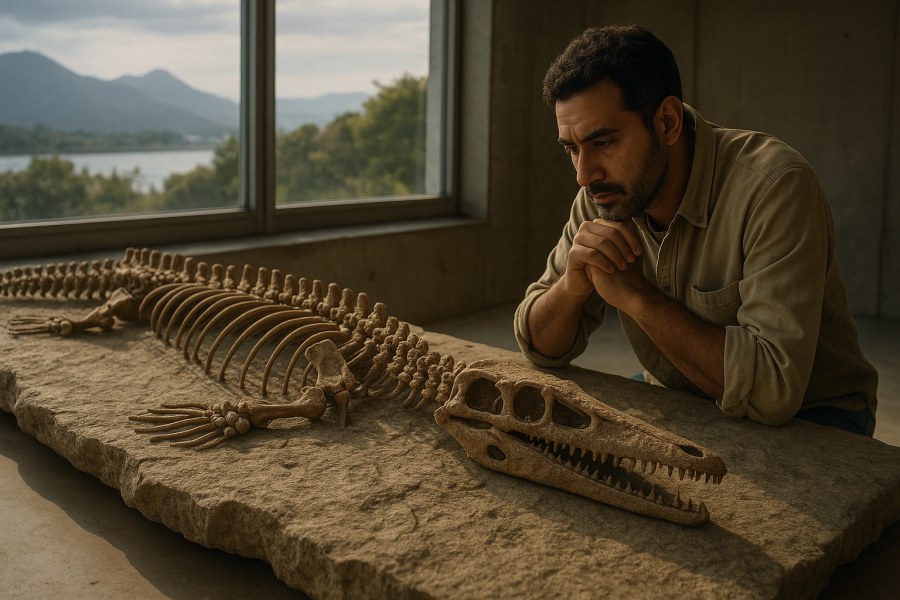


Source attribution: This post is a curated breakdown of A 30-year-old fossil was hiding bones from a mysterious ancient sea monster, with additional scientific context and philosophical analysis from Species Universe.
A giant marine reptile fossil collected in Osaka in the early 1990s may be more scientifically valuable today than it seemed back then—not because the animal changed, but because our ability to recognize what we’re looking at did. Researchers reexamining rock associated with the specimen report that four bones went unrecognized for roughly 30 years, including what they describe as the first confirmed mosasaur premaxilla (frontmost bone of the upper jaw) identified from Japan. Even more striking: parts of the skull reportedly show a combination of anatomical features that does not neatly match known mosasaurs, raising the possibility the fossil represents a new species.
Why this matters (beyond the headline)
“New species?” headlines can feel like a familiar cycle: a surprising claim, a dramatic reconstruction, and then silence. But this story is interesting even if it never becomes a formal new species description, because it highlights three deeper points about how paleontology actually advances:
- Museums aren’t just storage—they’re active research reservoirs. Unprepared rock and older specimens can still contain discoveries.
- Identification can depend on context. What was ambiguous in 1992 can become recognizable after decades of comparative work.
- “Unusual anatomy” is not the same as “new species”. It’s a hypothesis that needs careful testing against variation, preservation, and known diversity.
For Species Universe readers, there’s also a broader species-development angle: even when life is long gone, our collective knowledge system continues to evolve—through new tools, bigger reference collections, and better conceptual maps of anatomy. If you’re interested in that bigger framing, see our hub on Evolution & Species Development and our evolving lens on systems thinking in Complexity & Emergence.
What the source says
According to the source summary:
- The fossil material was collected in Osaka Prefecture (reported as Sobura, Kaizuka City area) between 1990 and 1992 and stored at the Natural History Museum, Kishiwada City.
- Researchers later revisited pieces of rock associated with the specimen that had not been fully prepared and found four bones that had not been recognized previously.
- One of those bones is described as the premaxilla, and the team reports it as the first confirmed premaxilla identified in a Japanese mosasaur specimen.
- The team also examined a bone near the braincase—the basisphenoid—and reports a mix of traits they describe as unusual compared with previously documented mosasaurs (including short outward projections likened to “horns,” and the absence of a ventral median groove).
- Because the combination of traits does not match known mosasaurs (as characterized by the team), the remains may represent a species new to science, though the summary stresses that additional research is needed.
- The results were reported as presented at the 177th Annual Meeting of the Palaeontological Society of Japan (June 27, 2026, at Osaka Metropolitan University), with a multi-institution research group listed.
What’s a premaxilla—and why is it a big deal?
In many vertebrates (including reptiles), the premaxilla forms the very front of the upper jaw and often holds the front teeth. In fossil reptiles, identifying it confidently can matter because:
- It anchors skull reconstruction. If you know what’s “front,” you can better orient other fragments.
- It carries diagnostic features. The shape, tooth arrangement, and sutures (where bones meet) can help distinguish groups.
- It improves comparisons with better-known specimens elsewhere, which is essential when the regional fossil record is sparse.
So even if the specimen doesn’t end up being a new species, confirming a premaxilla in Japan’s mosasaur record could still strengthen how paleontologists interpret other finds from the region and time period.
How can bones “hide” for 30 years?
It’s less mysterious than it sounds. Fossils are often embedded in rock (matrix) that must be prepared—carefully removed or stabilized—before smaller or more delicate bones can be recognized. Reasons a bone might remain unnoticed include:
- Incomplete preparation: some rock pieces may be set aside due to time, funding, or risk of damage.
- Fragmentary preservation: bones can look like irregular mineral patches until exposed at the right angle.
- Limited comparative context at the time: if few reference specimens exist, a fragment may be left unidentified rather than guessed.
The source emphasizes that, in the early 1990s, researchers had fewer mosasaur specimens available for comparison. Over the decades, the global sample and descriptive literature expanded, making it easier to recognize bones that once fell into the “unknown fragment” category.
Supporting evidence versus interpretation in this case
From the summary alone, we can separate what appears to be direct anatomical identification from the interpretive leap toward a new species:
More grounded: identifying specific bones
Recognizing an exposed structure as a premaxilla or basisphenoid is a standard paleontological task: it relies on comparative anatomy (shape, articulations, landmarks). If those landmarks are clear enough, the identification can be relatively robust, even if the broader taxonomy remains uncertain.
Less settled: “new species” based on an unusual trait combination
Claiming a new species usually requires showing that differences are not better explained by:
- Normal variation within a known species (age-related changes, individual variation, sexual dimorphism—though dimorphism is often hard to test in fossils).
- Distortion during fossilization (compression, shearing, or chemical alteration that can mimic “new” shapes).
- Incompleteness (missing parts can make a specimen appear more unusual than it really is).
- Mis-association (rarely, bones in the same rock can come from different individuals; the summary does not say whether that was evaluated, so we should not assume either way).
The source’s language (“suggesting,” “possibility,” “additional research needed”) is appropriately cautious, and that caution is worth preserving.
Reasonable criticism to keep in view
Here are the strongest skeptical questions a careful reader can ask without dismissing the work:
1) Has the finding been formally described and peer reviewed?
The summary points to a conference presentation. In many fields, that’s an early public milestone, not the final word. A formal species claim typically comes with a detailed description, specimen numbers, comparisons, and an explicit diagnosis (what features distinguish it). Until that exists, “new species” remains provisional.
2) Are the “unusual” basisphenoid traits truly outside known mosasaur variation?
Basisphenoid anatomy can be informative, but it’s also a region where preservation and deformation matter. Without images, measurements, and a broad comparative set explicitly shown, we should treat “doesn’t match known mosasaurs” as a report from the team—not yet an independently checkable conclusion.
3) How complete is the specimen overall?
The summary highlights four newly recognized bones. That’s exciting, but it also implies that the key diagnostic story may rest on a limited set of skull elements. Many taxonomic debates in paleontology hinge on whether the available anatomy is enough to justify a new name.
Alternative interpretations (that still keep the discovery meaningful)
Even if the specimen does not end up being a new species, several alternatives still matter scientifically:
- A regional variant of a known group: The northwestern Pacific may have hosted populations with slightly different skull traits.
- An unusual growth stage: Juvenile-to-adult changes can alter skull proportions and surface features.
- A mosaic of traits: Evolution doesn’t always produce neat, textbook groupings. A specimen can carry a combination of features that blurs boundaries, especially if we’re sampling an incomplete fossil record.
- Preservation-driven oddities: Small projections and grooves can be exaggerated or erased by preservation, preparation, or mineral replacement.
Notice that none of these alternatives “debunk” the work. They simply change what kind of conclusion is warranted.
Where this fits in established science: mosasaurs and the Late Cretaceous
The source places mosasaurs in the Late Cretaceous (roughly 98–66 million years ago), consistent with standard paleontological understanding. Mosasaurs were marine reptiles (not dinosaurs) that diversified into many forms and sizes and became major predators in Cretaceous seas.
If you want a clear, reader-friendly grounding in how evolutionary inference works (and why fossil classification is often provisional), UC Berkeley’s Understanding Evolution is a solid reference for concepts like evidence, inference, and how scientific ideas change with new data.
Why revisiting museum specimens can change the story of an ecosystem
The source suggests the find may help clarify marine ecosystems in the northwestern Pacific during the Cretaceous. That’s not just a “cool creature” storyline. The presence (or absence) of large predators can affect how scientists interpret:
- Food webs: what other animals might have been prey, competitors, or scavengers.
- Biogeography: how lineages spread between ocean basins and coastal regions.
- Sampling bias: whether a region seems low-diversity simply because fewer specimens were prepared or studied.
From a Species Universe perspective, it’s also a reminder that knowledge is an evolving system: the fossils didn’t change; the network of comparisons did. If you enjoy that lens, our Evolutionary Systems section explores how complex systems—biological and informational—accumulate structure over time.
Philosophical reflection (clearly labeled): what “a hidden bone” symbolizes—and what it doesn’t prove
It’s tempting to turn this kind of story into a metaphor: the past hides truths; attention reveals them. That’s a legitimate philosophical reading, and traditional knowledge systems often emphasize patient re-seeing of what’s already present.
But metaphor isn’t measurement. This discovery does not imply that observation “creates” reality, nor does it by itself support claims that consciousness is fundamental in a physics sense. What it does show—quite powerfully—is that human understanding is contingent: new methods, new comparisons, and new questions can reconfigure what an old object means.
If you want our broader framing for how Species Universe holds science and philosophy together without collapsing them into one another, see the Species Universe Framework.
What to watch for next (if you want to follow the science responsibly)
If this specimen is eventually proposed as a new species, the most informative next steps would likely include:
- A formal anatomical description with clear photographs/diagrams, specimen catalog numbers, and explicit comparisons.
- A diagnosis: which features (and combinations) distinguish it from close relatives.
- Discussion of preservation and preparation: how distortion and missing data were evaluated.
- Independent commentary from other mosasaur specialists once details are public.
Until then, the most solid takeaway is already valuable: reexamining older, partially prepared fossils can still yield major anatomical information—sometimes literally from inside the rock.
To explore more about how paleontological evidence feeds into our larger picture of life’s changing forms, you can browse the Evolution Understanding curated library.
What remains open
The source can be valuable without every broader implication being settled. Keep established findings, interpretation, philosophical argument, traditional perspective, and open speculation distinct, then follow the evidence and the argument as far as each genuinely supports.
Q&A
Does this discovery confirm a brand-new mosasaur species in Japan?
No. The source reports unusual skull anatomy that could indicate a new species, but it frames this as a possibility needing additional research. A formal species claim typically requires a detailed, peer-reviewed description and diagnosis.
What exactly was newly identified in the old fossil material?
The report describes four previously unrecognized bones found in rock associated with the specimen, including a premaxilla (frontmost upper-jaw bone) and a basisphenoid (near the braincase).
Why is the premaxilla such an important bone?
Because it helps anchor skull reconstruction and can carry diagnostic features useful for comparing specimens across regions. The team reports it as the first confirmed premaxilla identified in a Japanese mosasaur fossil.
How can scientists miss bones for decades?
Fossils can remain embedded in unprepared rock, or fragments can be hard to recognize until comparative collections and anatomical references improve. Museums often hold partially prepared material that can yield new finds later.
What would strengthen the case that this fossil represents a new species?
A formal publication with clear specimen documentation, detailed images/measurements, explicit comparisons to related mosasaurs, and a diagnosis showing the traits are not better explained by variation, preservation distortion, or incomplete material.
Related posts:
 Tiny 1.7-Billion-Year-Old Fossils and the Hard Question: When Did Complex Life Really Begin?
 Collagen in a 66-Million-Year-Old Dinosaur Bone: Why This Claim Matters (and What It Doesn’t Prove Yet)
 Two Origins of Life? What a New Metabolism Map Suggests About Bacteria, Archaea, and Earth’s First Cells
 Quantum Apocalypse – Discovering Nothing as the Sources of Everything













Leave a Reply