


What makes a living individual? A yeast cell can live and reproduce on its own. Your own body, by contrast, consists of many cells working together. The evolutionary puzzle is not merely how cells came to live in groups, but how those groups became organized units capable of evolving in their own right.
A October 7, 2026 review in Nature by G. Ozan Bozdag and colleagues examines this transition using comparative biology and experimental research. One particularly revealing model involves branching clusters of yeast grown in the laboratory.
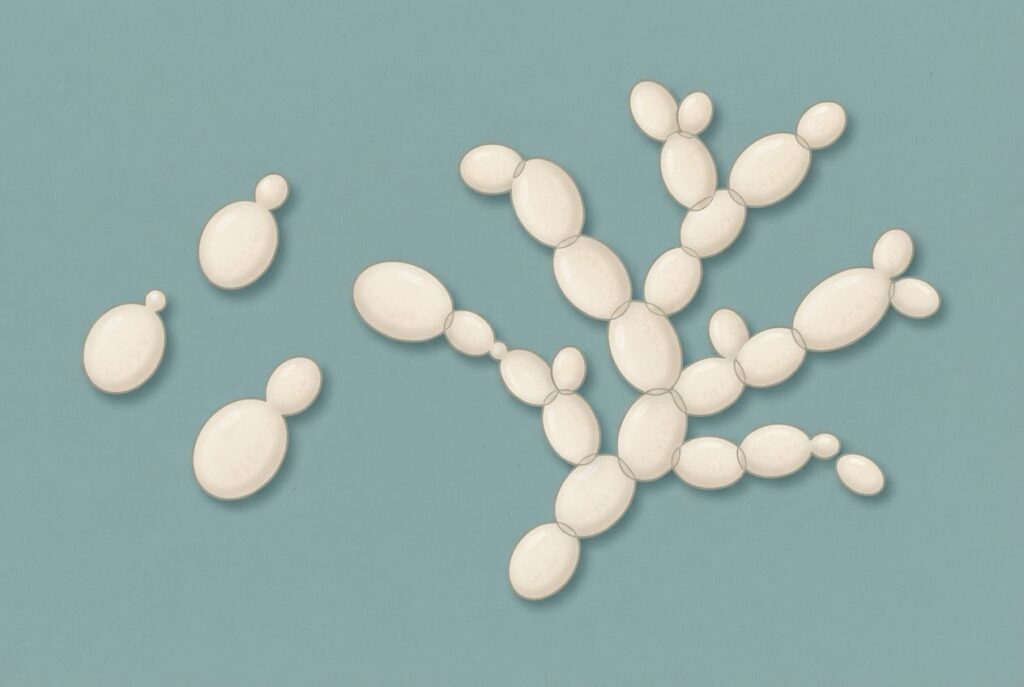
Featured image: AI-generated conceptual illustration of yeast; not a microscopy image or experimental measurement.
From an association to a new unit
Imagine two possibilities. In one, separate cells briefly gather in a favorable environment and disperse. In the other, cells remain connected as they divide, produce offspring groups, and pass on properties that influence the survival and reproduction of those groups.
Both are forms of collective organization, but the second makes it easier to understand how a group can have an evolutionary history of its own. Selection can act on inherited differences between groups, not just on differences between the cells that make them up.
The 2026 review identifies the formation of groups, the evolution of group-level adaptation, and the origins of cell specialization as separate challenges. Solving one does not guarantee that the others will follow.
A laboratory version of the transition
The Multicellularity Long-Term Evolution Experiment (MuLTEE) at Georgia Tech grows snowflake yeast, which remain connected as they reproduce. Researchers repeatedly favor clusters that settle more quickly, creating selection conditions in which properties of a whole cluster matter.
In their 2023 Nature research paper, Bozdag and colleagues reported that, after 600 selection cycles, yeast in the treatment without oxygen had evolved clusters reaching millimeter scales. The geometry of the cells changed: elongated cells and interwoven branches helped large clusters resist breaking apart.
Other treatment conditions produced much smaller clusters. The contrast is important because it makes environmental context part of the explanation, rather than assuming that size or complexity automatically increases over time.
Why bigger is not always better
Large size can be an advantage when the method of selection rewards settling. But being part of a large cluster can also change how easily cells obtain resources.
A 2024 Nature Ecology & Evolution paper from the same research program describes an experiment in which differently sized yeast lineages persisted together, with a trade-off involving oxygen access, growth and survival. Different strategies could occupy different ecological niches rather than one simply eliminating the other.
These observations are a reminder that the advantages of a trait depend on the setting. There is no single universal direction in which every population must evolve.
What this evidence does not demonstrate
The yeast experiments start with organisms that already have a long evolutionary history. They use selected laboratory conditions and do not reconstruct a particular ancient ancestor of plants or animals. A yeast cluster is also not equivalent to an animal with organs, a nervous system and a developmental program.
Nevertheless, the model provides something difficult to obtain from fossils alone: opportunities to observe and experimentally investigate steps in the emergence of new levels of organization. Complementary evidence from comparative biology is still needed to reconstruct particular events in the history of life.
A species-level perspective
Species Universe asks how the capacity for understanding can evolve. The transition from cells to organisms provides an instructive analogy: properties that matter at one scale need not be identical to the properties that matter at another.
In biological evolution, the analogy becomes science when the relevant units, inherited differences and selection pressures can be specified and measured. Applying that reasoning to human society, knowledge or consciousness would require a separate account of those mechanisms. It would be a mistake to treat the yeast experiment as proof that humanity is becoming a single conscious organism.
It does, however, offer a useful question. What arrangements make the success of a larger organization compatible with the success of its constituents, and under what conditions do those interests conflict?
Questions and further reading
Is the evolution of multicellularity directed toward more complex life? The experimental changes reflect the conditions under which the populations evolve. Increasing complexity is not a universal requirement of natural selection.
Are yeast clusters the same as the first animals? No. They are a model for exploring particular mechanisms of multicellular evolution.
Continue with The Altruism Paradox: Evolution and the Power of Group Survival and Evolution of Consciousness for the broader Species Universe inquiry.
Research sources
- Bozdag, Tong, Yunker, Herron and Ratcliff, Overcoming key challenges in the evolutionary transition to multicellularity, Nature, October 7, 2026 (review; DOI 10.1038/s41586-026-11038-w).
- Bozdag and colleagues, De novo evolution of macroscopic multicellularity, Nature, May 10, 2023 (experimental study; DOI 10.1038/s41586-023-06052-1).
- Emergence and maintenance of stable coexistence during a long-term multicellular evolution experiment, Nature Ecology & Evolution, 2024 (experimental and modeling study; DOI 10.1038/s41559-024-02367-y).
- MuLTEE experiment website, research program context.
Related posts:
 Tiny 1.7-Billion-Year-Old Fossils and the Hard Question: When Did Complex Life Really Begin?
 Collagen in a 66-Million-Year-Old Dinosaur Bone: Why This Claim Matters (and What It Doesn’t Prove Yet)
 Two Origins of Life? What a New Metabolism Map Suggests About Bacteria, Archaea, and Earth’s First Cells
 Spea labreae: The Ice Age spadefoot toad that sat unnoticed in La Brea’s collections for decades













Leave a Reply