
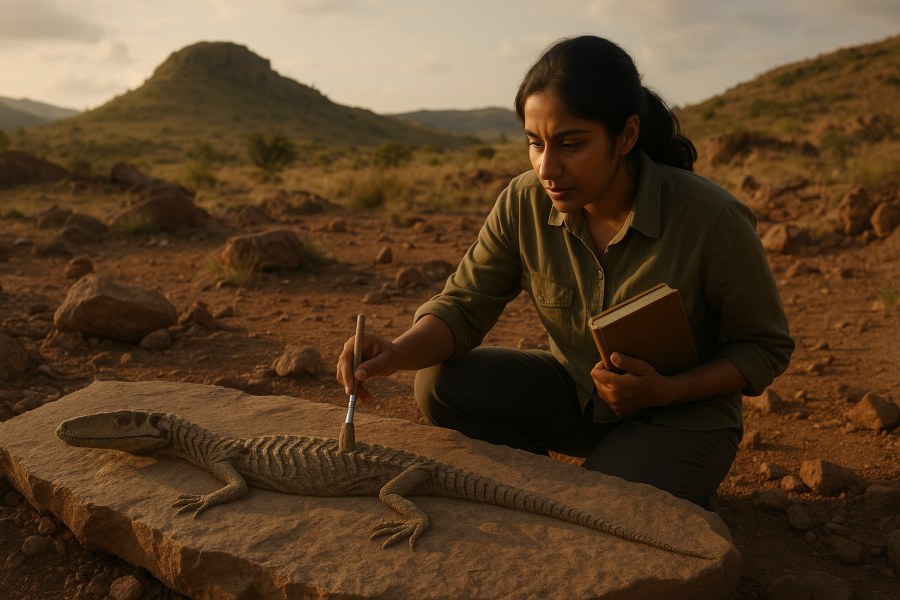


Source attribution: This post is a curated breakdown of 240-million-year-old reptile fossil reveals a lost chapter before dinosaurs and crocodiles, with additional scientific context and philosophical analysis from Species Universe.
Sometimes the most revealing fossils aren’t giant skulls or nearly complete skeletons—they’re “in-between” specimens that show evolution mid-experiment. A newly described Middle Triassic reptile from southern Brazil is being presented as exactly that kind of bridge: not a dinosaur, not a crocodile, but a close relative living during the recovery after Earth’s greatest mass extinction.
In this post for Species Universe, you’ll learn what the report claims this animal was, what parts were actually found, why limb bones can be surprisingly informative, and how paleontologists turn fragmentary anatomy into cautious evolutionary inferences. We’ll also step back and ask what this kind of discovery can—and can’t—tell us about big narratives like “the rise of dinosaurs,” and why humility around incomplete evidence is not a weakness but a feature of good science.
Why this matters (beyond one new species)
The Triassic Period is where many of the lineages that later shaped land ecosystems—dinosaurs, crocodile-line archosaurs, and their relatives—diversified into new ecological roles. But the “early chapters” are patchy. Fossils are rare, preservation is uneven, and what we find is often partial. That means each well-contextualized specimen can matter disproportionately, especially if it comes from regions or time slices that are underrepresented in museum drawers.
This report matters to readers not because it “rewrites everything,” but because it highlights a realistic way science progresses: a modest set of bones, recovered from a specific geological setting, is used to test (and sometimes complicate) an evolutionary family tree. Understanding that process makes it easier to evaluate future headlines—whether they’re cautious, overstated, or somewhere in between.
What the source says
According to the provided excerpt, researchers describe a new fossil reptile species from the Middle Triassic (about 240 million years ago) found in Dona Francisca, Rio Grande do Sul, Brazil, in rocks associated with the UNESCO Quarta Colônia Geopark. The animal is named Silescelida acristata.
Where it fits in the family tree (as reported)
The report places the animal among archosauriforms—reptiles on the broader line leading toward archosaurs. Archosaurs include crocodiles and dinosaurs (and birds as living dinosaurs). The fossil is presented as filling a gap in understanding what archosauriform evolution looked like before dinosaurs and crocodiles took their familiar forms.
What was actually preserved
The excerpt emphasizes that the specimen primarily preserves limb elements. That matters because it sets boundaries on what can be known. With limb bones, scientists can often infer aspects of posture and locomotion, and they can compare distinctive features (like ridges, crests, and muscle attachment sites) against other fossils to estimate relationships. But they usually cannot reconstruct the entire appearance, behavior, or ecology with high confidence.
Locomotion and posture: the “semi-erect” claim
One headline feature in the report is the femur (thigh bone). The excerpt says the legs were positioned in a more semi-erect orientation—more under the body rather than strongly splayed to the side—which could have made movement more efficient by reducing drag as the animal traveled over ground. This is presented as part of a broader suite of anatomical shifts that later contributed to archosaur success.
A geographic surprise: links to a rare group
The report says phylogenetic analyses suggest Silescelida acristata may be related to Euparkeriidae, described here as a rare and still poorly understood group. The key point is biogeographic: fossils associated with that group were previously known mostly from Africa, Asia, and Europe, so a related form in South America would expand the known distribution and imply these reptiles may have been more widespread than the fossil record had indicated.
An unusual backstory: the “rediscovered” fragment
The excerpt also describes a chain-of-custody issue that will feel familiar to anyone who has worked with legacy collections: a fragment crucial for provenance was reportedly lost for more than two decades and then found in 2022 during a technical visit to the scientific collection at PUCRS. The report says this rediscovery helped confirm the specimen’s origin and enabled formal description.
The name, explained (as reported)
- Silescelida is said to blend references to “silence” (the long period the fragment was forgotten) and “leg” (the mainly limb-based preservation).
- acristata is explained as “without a crest,” referring to the reported absence of a femoral crest/trochanter-like feature where some musculature would attach. The excerpt says this absence distinguishes it from most close relatives.
Practical context: how to read this discovery without getting swept up
Species Universe readers often want the deeper pattern: what this does to the “story of life.” Here are grounded ways to interpret the report while keeping the uncertainty honest.
1) Separate three different claims: anatomy, family tree, and world map
- Anatomy claim: The femur and other limb elements suggest a posture that may be more semi-erect than many earlier reptiles. This is typically the most direct line from bone to inference.
- Phylogeny claim: Analyses suggest a relationship to Euparkeriidae. This depends on how traits are coded, which comparisons are available, and what the algorithms favor—useful, but inherently revisable.
- Biogeography claim: If the relationship holds, then distribution was wider than previously documented. This is exciting, but it stacks inference on inference: classification first, then geography.
2) Remember what “efficiency” can mean in paleontology
When reports say a posture allowed “more efficient locomotion,” that is usually shorthand for plausible mechanical advantages: less lateral undulation, less belly drag, better stride mechanics, or different muscle leverage. But fossils rarely provide direct measures of speed or endurance. The safest takeaway is narrower: the limb anatomy is consistent with a shift toward a more under-the-body stance seen in some later lineages, and the authors interpret it as functionally meaningful.
3) Treat the “after the mass extinction” setting as ecological context, not a single cause
The excerpt places the animal in a world rebuilding after the Permian–Triassic extinction. That context is important—ecosystems were reorganizing, niches were open, climates and plant communities were shifting—but it doesn’t mean one extinction event “caused” any single anatomical innovation. It’s a stage-setting factor: a changed world can amplify the success of certain body plans, without being the sole driver of those traits.
4) Fossil geography is a map of discovery as much as a map of life
The report’s geographic point (a South American relative of a group otherwise known from other continents) is plausible and significant. But it’s also a reminder: absence of fossils in a region often reflects sampling, exposure of rock layers, collecting history, and museum pipelines. A single new specimen can change the apparent distribution quickly—because the prior picture may have been incomplete rather than truly narrow.
What this adds for Species Universe readers: a wider lens without forcing metaphysics
Species Universe often explores how different knowledge systems—scientific, historical, contemplative—build models of reality. A Triassic fossil might seem far from those themes, but it actually illustrates a shared discipline: inference under constraints.
Inference under constraints: a scientific parallel to careful interpretation
Paleontology works with partial traces and builds probabilistic narratives. Many traditional knowledge systems also insist on disciplined methods and clear domains of validity—though their “data” may include ethical practice, long-term observation of mind, or culturally embedded ecological memory. The convergence here is methodological humility: knowing what you can responsibly infer from the kind of evidence you have.
For our site’s approach to integrating ways of knowing—without collapsing them into one—see the Species Universe Framework and our overview of method in traditional-knowledge comparisons.
Evolution isn’t only “progress”—it’s branching experimentation
This report emphasizes an “experimenting” phase before dinosaurs and crocodiles. That framing aligns well with a modern evolutionary view: lineages explore many forms; some persist, some vanish, some radiate. If you want a broader evolutionary foundation in plain language, our readers often start with Evolution & Species Development.
If you want to follow up: smart next steps
- Look for the original paper: The excerpt says the study was published in Scientific Reports. Reading the figures and the diagnostic traits (even just the summary and images) can clarify how strong the anatomical case is.
- Check what is meant by “related to Euparkeriidae”: Is it nested inside the group, or adjacent? The difference matters for biogeography.
- Watch for future finds from the same rocks: A skull, vertebrae, or more complete pelvis could sharply refine posture and relationship claims. Triassic sites sometimes produce a cascade of reinterpretations as collections grow.
- Keep categories distinct: “Archosauriform,” “archosaur,” “dinosaur,” and “crocodile-line” aren’t interchangeable. Many headlines blur them; careful reading keeps the actual claim intact.
Bottom line
The source report presents Silescelida acristata as a new Middle Triassic reptile from southern Brazil known mainly from limb bones, interpreted to show a semi-erect posture and to sit near a rare archosauriform group. If those interpretations hold up, the find helps illuminate a less-documented interval before dinosaurs and crocodiles took center stage—and it strengthens the case that Triassic reptile diversity and distribution were broader than the current fossil record alone might suggest.
For Species Universe, the deeper lesson is not a dramatic rewrite of history, but a clean example of how science builds careful narratives from incomplete traces—then stays willing to revise those narratives as new evidence arrives. That mindset is a form of intellectual ecology: it keeps wonder alive without letting it outrun the data.
If you’re exploring how we weigh different kinds of evidence across domains (biology, mind, philosophy), you may also like our hub on Vedic Science & Traditional Knowledge—not because a Triassic femur “proves” anything about consciousness, but because disciplined inquiry has many legitimate forms, and each needs its own standards.
Q&A
Was Silescelida acristata a dinosaur or a crocodile?
No. In the source excerpt, it’s described as neither a dinosaur nor a crocodile, but as an archosauriform—on a broader lineage related to the groups that later include crocodiles and dinosaurs (including birds).
If the fossil is mostly limb bones, how can scientists say much at all?
Limb bones can preserve distinctive shapes and muscle-attachment features that help diagnose a species and compare it to related animals. They can also support cautious inferences about posture and locomotion. But a limb-heavy fossil usually leaves major uncertainties about skull anatomy, diet specifics, and overall appearance.
What’s the key anatomical point reported in the excerpt?
The excerpt highlights the femur and suggests a more semi-erect leg posture (more under the body than fully splayed). The report interprets this as potentially enabling more efficient movement than in many earlier reptiles.
Why is the South America location important in the report?
The excerpt says phylogenetic analyses may link the animal to Euparkeriidae, a rare group previously known mainly from Africa, Asia, and Europe. If that relationship is correct, it expands the group’s known geographic distribution and suggests wider Triassic dispersal than the fossil record had shown.
Does this discovery ‘prove’ a straight line to dinosaurs?
Not by itself. Fossils like this more often clarify branching relationships among close relatives rather than identify direct ancestors. The excerpt frames it as illuminating an earlier phase near the lineage that later includes dinosaurs and crocodiles, but ancestry versus cousin relationships would require careful phylogenetic support.
Related posts:
 A 324-Million-Year-Old “Amphibious” Insect Fossil and What It Really Tells Us About Life’s Move Onto Land
 A Major Rewrite of the Human Family Tree? Why Some Scientists Want Australopithecus and Paranthropus Moved Into Homo
 For 15,000 Years, Humans and Dogs Have Been Changing Each Other—What Co‑Evolution Really Means
 Hilbert Space, Quantum “Possibilities,” and What the Math Really Means













Leave a Reply