
A beginner-friendly guide to Sāṅkhya’s two foundational principles—puruṣa (the witnessing consciousness) and prakṛti (nature and change). Learn clear definitions, a simple discrimination practice, common pitfalls, and how to compare the model with modern science without overclaiming.

What the Upanishads Mean by Ātman (Self)—and What They Don’t

Ātman is often translated as “Self,” but the Upanishads don’t mean your personality—or a physics “field.” This beginner-friendly guide shows how to read Ātman in context, what different Vedānta schools claim, what’s philosophy vs. science, and common pitfalls to avoid.
Dharma in the Bhagavad Gītā: A Practical Guide to Duty, Meaning, and Inner Freedom

A beginner-friendly, practical guide to dharma (right order) in the Bhagavad Gītā—what the term means, how svadharma works, and a step-by-step method for applying duty and non-attachment to real decisions without moral rigidity or spiritual bypassing.
Traditional Ecological Knowledge and Systems Science: A Careful, Practical Comparison

A beginner-friendly, practical guide to comparing Traditional Ecological Knowledge (TEK) with modern systems science—without forcing equivalence. Learn definitions, a step-by-step “translation map,” three types of convergence, and common pitfalls to avoid.
Transcendental Consciousness, Samādhi, and Enlightenment
Transcendental consciousness is the term Maharishi Mahesh Yogi used for a state in which awareness remains present while ordinary thought, perception, and mental activity become minimal or absent. Within the Transcendental Meditation tradition, this state is described as pure consciousness: awareness knowing itself rather than being occupied by an object of experience. That description places […]
Maharishi Ayurveda
Maharishi Ayurveda is a modern system that seeks to recover, organize, and apply the traditional knowledge of Ayurveda within the broader framework of Maharishi Vedic Science. Its central idea is that health depends on balance across multiple levels of life: consciousness, mind, behavior, physiology, environment, daily routine, diet, and natural law. That gives Maharishi Ayurveda […]
The TM-Sidhi Program

The TM-Sidhi Program is presented within Maharishi Vedic Science as an advanced extension of Transcendental Meditation. Where ordinary TM is intended to allow awareness to settle inward toward transcendental or pure consciousness, the TM-Sidhi Program is intended to cultivate the ability to think and act from that quieter level of awareness. This makes the program […]
Maharishi International University

Maharishi International University (MIU) is one of the clearest real-world expressions of Maharishi Mahesh Yogi’s larger educational vision. Founded in 1971, the university was created around an unusual premise: education should develop not only knowledge of a subject, but also the consciousness of the student who is acquiring that knowledge. Today MIU is an accredited […]
Maharishi Mahesh Yogi and Maharishi Vedic Science
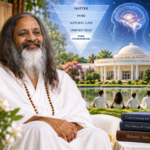
Maharishi Mahesh Yogi is best known internationally for bringing the Transcendental Meditation technique to a global audience. But TM was only one part of a much larger intellectual and practical project. Over several decades, Maharishi presented what he called Maharishi Vedic Science: a systematic framework in which consciousness is treated not merely as a product […]
The Maharishi Effect and Collective Consciousness

Can a sufficiently large group practicing Transcendental Meditation and the TM-Sidhi program measurably influence the behavior of people who are not participating in the meditation? That is the claim at the center of the Maharishi Effect. It is one of the most ambitious and controversial hypotheses to emerge from the Transcendental Meditation research tradition because […]
- 1
- 2
- 3
- …
- 14
- Next Page »