
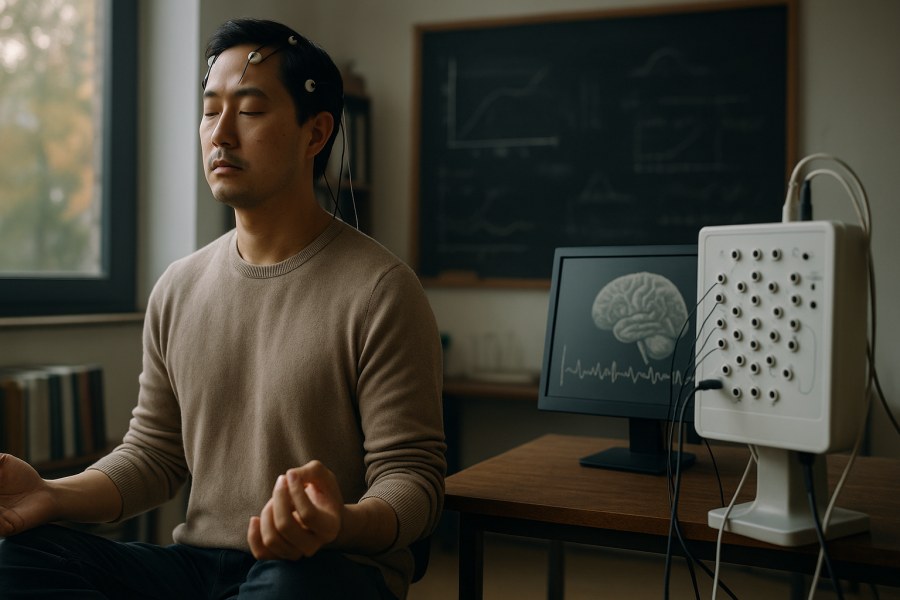


Bottom line: Meditation research is strongest when it treats subjective reports (what practice feels like) and objective measures (what brains and bodies do) as different kinds of evidence that can inform each other—without pretending either one automatically “proves” the other.
If you’ve ever read a headline like “Meditation changes the brain” and wondered, “So does that mean the experience is ‘real’—or that it’s just brain activity?” you’re asking the right question. The science is useful, but it’s easy to over-interpret both sides: to treat brain scans as final truth, or to treat inner experience as self-verifying proof of a cosmic conclusion.
In this guide, you’ll learn a practical way to read meditation studies: how to interpret first-person reports, how to interpret EEG/fMRI and physiological measures, and how to connect them responsibly. We’ll also map common pitfalls—like mistaking correlation for explanation, or confusing “observer” talk with claims that consciousness controls physics.
Two kinds of data: what they are (and what they’re not)
First-person reports (phenomenology)
First-person reports include:
- Questionnaires (stress, mood, mindfulness, absorption, well-being)
- Experience sampling (“What is happening in your mind right now?”)
- Interviews describing states (clarity, effortlessness, sense of self, time, emotion, spaciousness)
- Practice logs (duration, technique type, context)
What they’re good for: describing what it’s like and distinguishing practices or states that may look similar from the outside. First-person data is the primary window into subjective experience—something third-person measures cannot directly replace. Philosophers sometimes call this the “hard problem” neighborhood: explaining experience itself, not just behavior and function. (Background reference: Stanford Encyclopedia of Philosophy: Consciousness.)
What they don’t do by themselves: confirm a specific biological mechanism, prove a metaphysical worldview, or establish that a reported state is identical across people. Memory, expectations, teacher language, cultural framing, and demand characteristics can all shape reporting.
Brain and body measures (third-person data)
Common measures include:
- EEG (electrical activity on the scalp; good time resolution)
- fMRI (blood-oxygen signals related to neural activity; good spatial resolution)
- Autonomic physiology (heart rate variability, respiration, skin conductance)
- Hormonal/immune markers (context-dependent; often noisy)
What they’re good for: tracking patterns that reliably shift with tasks, training, or states; estimating how attention, emotion regulation, and arousal may change; and identifying candidate “neural correlates” of particular experiences.
What they don’t do by themselves: tell you the content of someone’s experience, settle philosophical debates about whether consciousness is fundamental, or distinguish “deep” from “shallow” meditation in any universal sense. Many brain patterns are multi-purpose: the same network can support different mental functions depending on context.
A step-by-step way to read meditation research responsibly
Step 1: Identify what “meditation” means in the study
“Meditation” is not one thing. Studies may examine mindfulness-style open monitoring, focused attention, compassion practices, mantra-based approaches, or other traditions. Even within a single label, instructions can differ: effortful concentration vs. effortless practice can produce very different experiences and physiology.
When a study doesn’t clearly define the practice (training, teacher lineage, instructions, and what participants actually did), interpret results as about that particular protocol, not about meditation as a whole.
For Species Universe context on how we try to separate models and meanings across traditions, see the Species Universe framework.
Step 2: Ask: what is the “first-person target”?
Good studies specify the experiential variable they’re trying to track, such as:
- Effort vs. ease
- Mind-wandering vs. stable attention
- Self-referential thinking vs. reduced narrative self
- Absorption or “non-dual” style reports (carefully defined)
If the paper only measures outcomes like stress reduction without clarifying the experience, it may still be useful—but it’s not really a study of meditation states. It’s a study of interventions and outcomes.
Step 3: Check how first-person reports were collected
Key quality questions:
- Timing: were reports collected during the practice, immediately after, or days later?
- Training in reporting: were participants coached to describe experience precisely, or just given a survey?
- Blinding/expectancy: did participants know the study hypothesis?
- Language effects: are terms like “pure awareness,” “emptiness,” or “transcendence” defined operationally, or left poetic?
The more a study relies on retrospective, highly interpretive language, the more cautious you should be about strong conclusions.
Step 4: Check what the brain measure can actually resolve
EEG and fMRI are powerful, but each has limits. EEG is fast but coarse in where signals originate; fMRI is better for location but is an indirect measure related to blood flow and slower timescales. This matters when researchers claim they found “the” signature of a meditative state.
When reading neuroimaging claims, treat them as candidate correlates rather than definitive “causes.” For general grounding on how brain research is approached in medical and health science contexts, see National Institute of Neurological Disorders and Stroke.
Step 5: Look for the bridge: how were the two data types linked?
The most informative designs explicitly connect reports and measures, for example:
- Experience sampling during scanning (e.g., periodic prompts)
- Within-person analyses (changes relative to each participant’s baseline)
- Pre-registered hypotheses about which experiential dimensions map to which measures
Weak bridges look like: scanning people, then asking them afterward “How meditative was it?” and correlating with a brain metric—especially if the hypothesis was discovered after the fact.
Common interpretation traps (and better alternatives)
Trap 1: “Brain changes prove the spiritual interpretation”
Why it’s tempting: a scan feels objective, so it can look like it validates a traditional claim.
Steel-manned alternative: brain measures can be consistent with a practice’s traditional descriptions without proving the metaphysics. Traditional systems often provide phenomenological maps and training methods; neuroscience provides correlates and mechanisms at another level of description. Convergence is interesting; it’s not automatic confirmation.
If you’re exploring how Species Universe handles these crossings carefully, see Vedic Science & Traditional Knowledge.
Trap 2: “Subjective reports are unreliable, so ignore them”
Why it’s tempting: reports are messy and shaped by culture.
Steel-manned alternative: without first-person data, you don’t actually know what mental state your physiology is supposed to correspond to. The fix isn’t to discard reports; it’s to improve how they’re elicited and interpreted (clear definitions, timing, triangulation across methods).
Trap 3: “Meditation quiets the self-network, so the self is an illusion”
This can slide from a lab finding into a philosophical conclusion. Reduced activity in self-referential processing (in some tasks, in some studies) may relate to less narrative self-talk or altered self-experience. But “the self is an illusion” is a broader claim that depends on definitions (self as narrative, self as embodied agency, self as witness, etc.).
Trap 4: “Observer effects in quantum physics mean meditation proves consciousness is fundamental”
In popular discussion, “observation” in quantum mechanics is sometimes conflated with human awareness. But in standard physics, measurement typically refers to physical interactions and information becoming effectively irreversible (often discussed with decoherence), not necessarily a conscious mind “creating reality” by attention. Meditation research—valuable as it is—does not by itself adjudicate the foundations of quantum measurement.
Practical steps if you’re designing (or choosing) a study to trust
- Prefer clear practice definitions: technique, training dose, teacher qualification, and compliance checks.
- Look for appropriate controls: active controls (e.g., relaxation training) are often more informative than waitlists.
- Watch sample size and multiple comparisons: brain studies with many metrics can find “significant” results by chance unless corrected and ideally pre-registered.
- Prefer within-person designs: baseline vs. intervention comparisons reduce individual variability.
- Value triangulation: when experience reports, behavior (task performance), and physiology point in the same direction, conclusions are stronger.
If you want a primer on the broader landscape of models and claims around consciousness (beyond meditation specifically), see Consciousness & Awareness and our overview of neuroscience approaches to consciousness.
Conclusion: keep both kinds of evidence in their proper role
Meditation research works best when it respects the difference between describing experience and measuring correlates. First-person reports are essential for knowing what state is being studied; brain and body measures are essential for testing reliability, mechanisms, and practical outcomes. When you keep the bridge honest—careful definitions, appropriate controls, and modest conclusions—you get something rare: a genuinely integrative picture that neither reduces experience to a slogan nor inflates it into unwarranted certainty.
For readers who want to go deeper, a practical next step is to pick one meditation claim you care about (stress reduction, attention stability, reduced rumination, altered self-experience), then read at least two studies: one emphasizing first-person methodology and one emphasizing brain/physiology—asking how well each side actually measures what it claims.
Q&A
Are first-person meditation reports “scientific data”?
They can be data when they’re collected systematically (clear questions, careful timing, appropriate analysis). They’re best at describing experience itself, but they don’t automatically establish a biological mechanism or prove a philosophical worldview.
Do brain scans prove someone is in a specific meditative state?
Usually not by themselves. EEG/fMRI can reveal patterns that correlate with certain tasks or reported states, but most patterns are not unique “fingerprints.” Stronger studies explicitly connect real-time reports, behavior, and physiology.
If meditation changes the brain, does that mean meditation is “just” brain activity?
Not as a settled conclusion. “Brain activity is involved” is an established point; “therefore experience is nothing but brain activity” is a philosophical interpretation. Competing views differ on what counts as a complete explanation of conscious experience.
Is it valid to compare meditation experiences to traditional descriptions like samādhi or pure awareness?
It can be meaningful as a comparison of phenomenology and training goals, as long as you don’t treat similarity in language as scientific proof of the tradition’s metaphysical claims. Clear definitions and careful translation matter.
Does meditation research support the idea that consciousness is fundamental or affects quantum measurement?
Meditation research can inform questions about attention, awareness, self-experience, and their correlates. It does not, by itself, test quantum measurement interpretations. Claims that “observation” in quantum mechanics means human awareness collapses reality are controversial and not established by meditation findings.
Related posts:
 Neural Correlates of Consciousness: What We Can Measure—and What We Can’t
 Meditation and Awareness: What Lab Measures Capture vs Lived Experience
 Quantum Consciousness Proposals: Mechanisms, Objections, and Testable Bets
 TIMP2 and the Aging Brain: Can a “Youth-Associated” Protein Rejuvenate Microglia?













Leave a Reply