


When you see a red apple, the experience is not presented to you as a list of separately processed colors, edges and movements. You encounter a scene. How does the activity of many neurons relate to that apparently unified experience?
A November 20, 2026 conceptual review by Leo Poom in Neuroscience of Consciousness argues that the brain’s own electromagnetic fields deserve closer attention. It is a serious proposal about an unresolved question, not a newly demonstrated mechanism of consciousness. Understanding the distinction is especially important for readers interested in the relation between physics and mind.
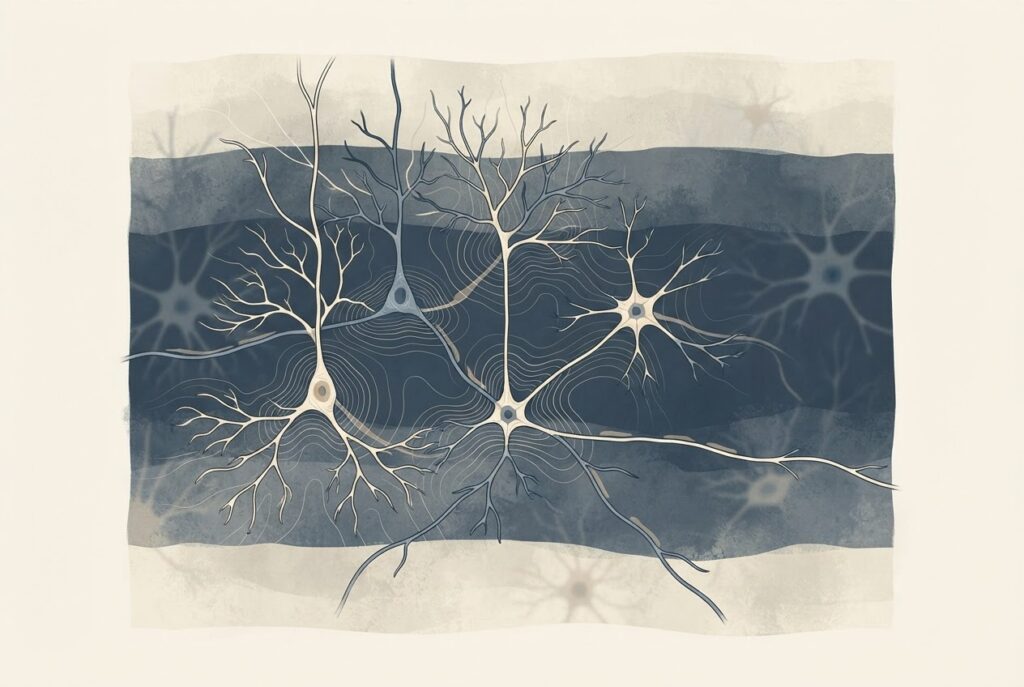
Featured image: AI-generated conceptual illustration, not a measured electric field or brain scan.
What is already established?
Neural activity involves electrical changes across cell membranes. Those changes can generate electric fields in surrounding tissue. Ordinarily, when we imagine communication between neurons, we picture signals crossing synapses. But the local electrical environment can also affect a nearby neuron, without a direct synaptic connection. Researchers call this ephaptic coupling.
In a 2011 Nature Neuroscience study by Costas Anastassiou and colleagues, researchers used cortical slices from rats to investigate how extracellular electrical fields influence cortical neurons. This is evidence that the local field can interact with neuronal activity. It is not an experiment that identifies the source of subjective experience. A slice of tissue responding to a field does not establish that the slice is conscious.
What the new review proposes
Poom’s review compares field-based accounts with theories that emphasize neural computation and organization. Its starting point is the apparent unity of experience: the colors, sounds and other contents of a moment seem to belong to one experienced world.
The author considers whether distributed electrical activity could create a spatially organized field that both reflects and influences that activity. On this account, the field is more than a passive by-product. The review suggests different frequency ranges could contribute differently to the organization of experience. These suggestions are hypotheses, not established findings about the physical basis of awareness.
Importantly, the paper is a conceptual synthesis, not a report of a new experiment establishing field-based consciousness.
The strongest competing explanation
A neuroscientist need not deny the existence of fields to question the proposal. A network of neurons can exchange and integrate information, and a field may be one consequence or contributor to its operation. If the field changes when the network changes, the two descriptions may predict the same behavior without settling which process, if either, constitutes experience.
Global neuronal workspace accounts, for example, examine how information becomes broadly available to other processes. For a contrasting approach and its limitations, see our guide to global neuronal workspace theory. Both approaches confront a difficult issue: explaining how a measurable mechanism relates to what an experience feels like from within.
What evidence could move the debate forward?
Consider a proposed test, rather than an experiment we claim has been performed. A field theory would need to specify which field property matters, predict an observable difference from a competing neural account, and state a result that would count against it.
Researchers might try to vary a well-defined local field property while controlling for other changes in neural activity. They would need reliable measures of perception and behavior, appropriate controls, and a way to rule out changes in attention or reporting. Because fields and neural activity influence each other, isolating the relevant variable is particularly challenging.
Even a positive causal result would establish a role for that field property in the measured task. A further argument would still be needed to identify that role with conscious experience itself.
Why this matters for Species Universe
The site explores whether consciousness is fundamental or better explained as a property of organized physical systems. Field theories offer an opportunity to test specific physical proposals rather than collapse these alternatives into one conclusion.
They should not be confused with Roger Penrose and Stuart Hameroff’s distinct quantum-consciousness proposal, discussed in our quantum brain overview. Nor is a brain-generated electromagnetic field evidence of a universal mind. The existence of a physical field and the philosophical idea of unified awareness are different claims.
The productive question is whether a theory can give us a more precise relation between the observed brain and the experiencing observer. A theory that makes clear what would prove it wrong is particularly valuable to that inquiry.
Questions and next reading
Do EEG recordings prove consciousness is electromagnetic? No. A measurement that tracks conscious states need not identify the mechanism that produces them.
Does a field theory require quantum consciousness? No. The proposal discussed here primarily concerns organized electromagnetic activity; a separate quantum mechanism would need its own evidence.
Continue with Neural Correlates of Consciousness: What We Can Measure—and What We Can’t.
Research sources
- Leo Poom, Electromagnetic field theories of conscious experience: a conceptual review and reappraisal, Neuroscience of Consciousness, November 20, 2026 (review; DOI 10.1093/nc/niag078).
- Costas A. Anastassiou, Rodrigo Perin, Henry Markram and Christof Koch, Ephaptic coupling of cortical neurons, Nature Neuroscience, January 16, 2011 (experimental study; DOI 10.1038/nn.2727).
Related posts:
 Global Neuronal Workspace Theory (GNWT): Mechanism, Evidence, and the Strongest Objections
 Meditation and Awareness: What Lab Measures Capture vs Lived Experience
 Why Male Survivors of Intimate Partner Violence Often Don’t Seek Help (and What Can Actually Lower the Barriers)
 Regenerative Astrocytes and a Surprising Way the Adult Brain May Repair Damage













Leave a Reply