
A Quanta Magazine report describes the first major advance in nearly 30 years toward the Komlós conjecture in discrepancy theory—an unexpectedly strong guarantee about how evenly we can split high-dimensional objects into two groups. Here’s what the source says, why it matters, and how to interpret the “huge breakthrough” without overclaiming.

NASA’s Roman Space Telescope: Hubble-Level Detail, 100× the Sky—Why That Changes What We Can Know

NASA’s Nancy Grace Roman Space Telescope is described as delivering Hubble-like detail across a field of view 100× larger—shifting astronomy from “deep but narrow” to “wide and sharp.” Here’s what the source says, what it means for dark matter, dark energy, and exoplanets, and where the real uncertainties remain.
Vacuum Birefringence: Did a Magnetar Just Reveal “Empty” Space Changing Light?

A magnetar’s polarized radio and X-ray light may carry the first strong evidence that “empty” space changes how light travels—an effect called vacuum birefringence. Here’s what the source reports, what was measured vs. inferred, and what still needs confirmation.
The “Cosmic Hum” in Pulsars: Could Ancient Dark Stars Be Echoing Through Today’s Gravitational-Wave Background?
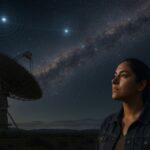
A Colgate University analysis argues the nanohertz gravitational-wave “hum” detected with pulsar timing arrays may encode clues about the earliest supermassive black hole seeds—possibly including hypothetical remnants of supermassive Dark Stars. Here’s what the source claims, what’s measured versus modeled, and what to verify yourself.
Cosmology & Large-Scale Structure
Cosmology & Large-Scale Structure From Early Universe to Galactic Complexity Why Cosmology Matters in Scientific Models Cosmology studies the universe at the largest observable scales. If physics describes fundamental structure, and complexity science describes layered organization, cosmology examines how large-scale cosmic structures arise under physical law. This page presents the current scientific understanding of: […]