
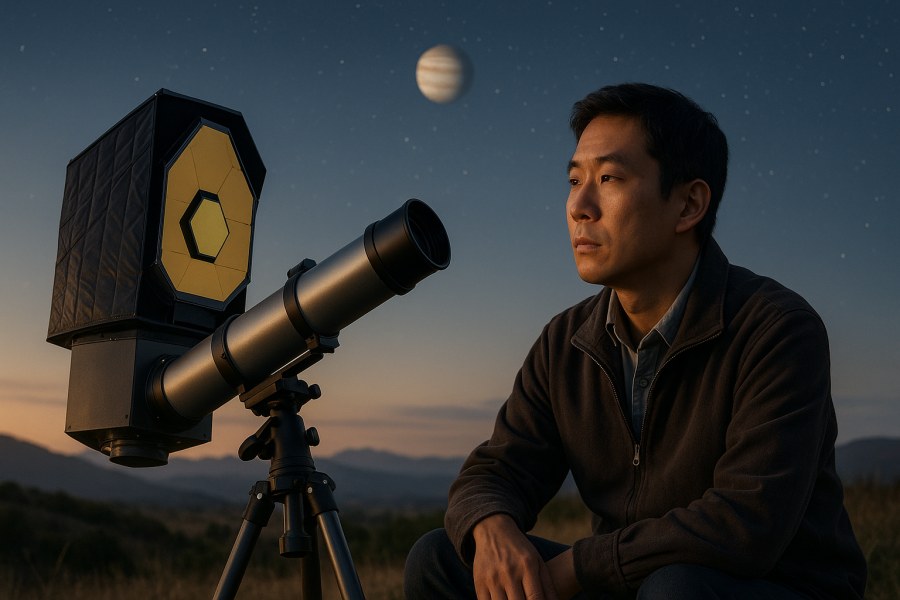


Source attribution: This post is a curated breakdown of NASA’s Roman Space Telescope is ready to hunt thousands of alien worlds, with additional scientific context and philosophical analysis from Species Universe.
NASA’s Nancy Grace Roman Space Telescope is being positioned as a rare kind of mission: one observatory designed to dramatically expand our census of planets beyond our solar system while also surveying the large-scale structure of the universe for clues about dark matter and dark energy. In late August 2026, NASA reported that Roman had been enclosed inside the payload fairing of a SpaceX Falcon Heavy rocket—one of the final physical milestones before launch.
For Species Universe readers, Roman is especially interesting because it sits at a crossroads: it’s a technical instrument built for public, testable measurements—yet the questions it serves (Are there many worlds like ours? What is the universe made of? Why is it expanding faster?) can echo older philosophical and traditional inquiries about plurality, order, and our place in a vast cosmos. The key is to keep the categories straight: Roman can strengthen (or weaken) physical models with data. What those models “mean” for consciousness, purpose, or ultimate reality remains largely philosophical.
What the source says
The source excerpt describes a set of concrete near-launch steps and a high-level overview of Roman’s science goals:
- Encapsulation milestone: On Aug. 21, 2026, teams enclosed Roman inside the Falcon Heavy payload fairing at NASA’s Kennedy Space Center in Florida. The fairing is described as a protective shell, about 43 feet tall, that helps shield the observatory during early launch conditions (acoustics, aerodynamic forces, heating) and maintains a controlled environment during ground transport.
- Fairing separation and recovery: A few minutes after liftoff—once the atmosphere is thin enough—the fairing halves are expected to separate and fall away. The source reports that SpaceX plans to recover both fairing sections after return to Earth.
- Where Roman is headed: Roman is planned to travel to the Sun–Earth Lagrange point 2 (L2), described as a region that helps spacecraft maintain a relatively stable position and supports continuous observing for powerful telescopes.
- Launch target (at the time of the update): NASA and SpaceX were targeting “no earlier than” 7:26 a.m. EDT on Sunday, Aug. 30 (2026) for liftoff, with remaining steps including transport to SpaceX facilities at Launch Pad 39A, mating to the rocket, and roll-out to the pad.
- Science aims: Once in operations, Roman is expected (per the source) to discover thousands of exoplanets and to investigate dark matter and dark energy by surveying large areas of sky and tracking how matter and galaxies are distributed. The source frames these as ways to better understand cosmic evolution and why expansion has sped up over time.
Why “inside the fairing” is a meaningful milestone (without overhyping it)
It’s easy to treat encapsulation as mere logistics. But for space missions, it’s a threshold: it suggests the observatory is sufficiently complete and environmentally stable to be integrated with the launch system. The fairing’s role—shielding from intense acoustic vibration and aerodynamic stress during ascent—is one reason telescopes are not “just launched” the way a smaller satellite might be.
Still, it’s not the same as being “proven in space.” Many mission risks only resolve after launch and commissioning, when instruments cool, deploy (if needed), point, focus, calibrate, and begin collecting science-grade data. The source is careful to describe Roman as “nearly ready” and “one major step closer,” not as already operating.
L2: a practical choice with philosophical resonance
The source says Roman will travel to Sun–Earth L2. In practical spaceflight terms, L2 is favored for many observatories because it offers a stable thermal and viewing environment: the Sun and Earth remain roughly in the same direction, which can help with shielding and steady operations. That stability supports the kind of wide-field surveys Roman is meant to conduct.
In Species Universe terms, there’s also a softer, philosophical resonance: placing an observatory at L2 is an example of “choosing the right vantage point.” Traditional epistemologies—whether in Indian philosophy, Buddhist analysis, or other contemplative lineages—often emphasize that what we can know depends on where and how we observe. Roman operationalizes that idea in a rigorously physical way: location and conditions shape what can be measured.
“Thousands of exoplanets”: what kind of discovery is this?
The source emphasizes that Roman could uncover thousands of exoplanets and help astronomers learn how common different types of planetary systems are. That phrasing matters. Roman’s exoplanet impact is not mainly about finding a single “Earth 2.0” headline; it’s about building a large statistical population.
Why does a population matter?
- It turns anecdotes into distributions. When you have only dozens of examples, you can be misled by what’s easiest to detect. A mission that finds thousands can better map the diversity of planets and systems, not just the most obvious ones.
- It pressures formation theories. Planet formation models must explain not only that a planet can exist, but how frequently different outcomes occur across many star systems.
- It reframes “rare vs. common.” Questions like “Are solar systems like ours unusual?” become less speculative when the sample size rises.
The source excerpt doesn’t specify the detection technique (for example, transit, radial velocity follow-up, microlensing, direct imaging, etc.). So in this post we won’t claim a particular method based on this excerpt alone. What we can say, grounded in the excerpt, is that Roman is intended to discover exoplanets at scale and to inform how common various planetary architectures are.
Roman’s second major aim: dark matter and dark energy—what the source claims, and what remains open
The source states two broad cosmological targets:
- Dark matter: cannot be seen directly, but its gravity appears to shape galaxies and large-scale structure.
- Dark energy: the name used for whatever is driving the accelerating expansion of the universe.
Those are careful definitions: they describe how these ideas function in cosmology (as explanatory constructs tied to observable gravitational effects and expansion history) without claiming we already know their underlying nature.
Roman’s role, per the source, is to survey huge areas of sky and track the distribution of matter and galaxies—work that can add constraints to models of cosmic structure and expansion. That’s a mainstream approach in modern cosmology: you don’t “see” dark matter directly; you infer its influence through patterns in the visible universe and gravitational effects. Likewise, “dark energy” is a placeholder name for a cause (or set of causes) inferred from expansion behavior.
How to read this kind of NASA update without getting swept into hype
NASA (and science news syndication) often mixes three kinds of statements in one story:
- Engineering status: encapsulated in fairing; moved between facilities; attached to rocket; targeted launch window. These are comparatively concrete.
- Mission capability claims: could discover thousands of exoplanets; could provide new clues about dark matter/energy. These are plausible but still conditional on performance and survey outcomes.
- Big-picture significance: may help explain cosmic evolution and accelerated expansion. This is aspirational and model-dependent; it’s why missions are funded, but it isn’t guaranteed by launch readiness.
Reading carefully means letting each statement keep its own epistemic status: “what happened,” “what is intended,” and “what might be learned.”
Where this intersects with Species Universe themes (without turning it into a forced “science proves tradition” story)
Roman is a tool for third-person, instrument-based knowledge. Species Universe is also interested in first-person and philosophical inquiry—how consciousness relates to what is known, and whether reality has an underlying unity. So where is the genuine convergence?
1) Plurality of worlds and humility of viewpoint
The possibility of “thousands of new worlds” lands psychologically even before it lands scientifically. It can loosen the default assumption that the human story is the obvious center of the cosmic story. Many traditions cultivate this kind of decentering through contemplative practice—though they do it for ethical or liberative reasons, not as an astronomical claim.
Roman doesn’t validate any specific cosmology from traditional texts. But it can support a broadly compatible posture: reality may be far more populated and varied than everyday perception suggests.
2) The “known/unknown” boundary as a living frontier
Dark matter and dark energy are reminders that even successful physics can contain large unknowns. Philosophically, that can be read in multiple ways:
- Strong physicalist reading (steel-man): Unknown components are invitations to better measurements and better models. History suggests mysteries often become tractable without requiring non-physical explanations.
- Metaphysical openness reading (steel-man): Persistent unknowns could indicate that our current categories (matter/energy/spacetime) are incomplete. This does not prove consciousness is fundamental, but it keeps the door open to deeper ontologies.
Roman adds to this frontier by improving the observational constraints; it does not, by itself, decide between metaphysical interpretations.
3) Observation, meaning, and the limits of instruments
Roman’s measurements will be publicly shareable and, in principle, checkable by other researchers using independent data and methods. That is the power of modern science.
But meaning-making—what those findings imply for purpose, value, or the inner life—is not something a telescope can measure. This is where a Species Universe approach recommends a “both/and” discipline: honor the precision of astronomy while not pretending it answers existential questions it was never designed to answer.
For readers wanting a structured way to integrate different ways of knowing, the Species Universe approach is outlined in the Species Universe Framework. For the broader traditional-knowledge lens, see the Vedic Science & Traditional Knowledge hub.
What would count as success for Roman (in plain language)
Based on the source’s stated aims, a reasonable, non-hype definition of “success” would include:
- Operational success: reaching its intended observing environment (L2), stabilizing, and collecting high-quality survey data over time.
- Exoplanet science success: producing a large, useful catalog of exoplanet detections that meaningfully improves our understanding of how planetary systems vary.
- Cosmology science success: delivering survey maps and analyses that tighten constraints on models involving dark matter and dark energy (even if they don’t “solve” either mystery).
Notice what’s not required: a final answer to what dark energy “is,” a definitive count of inhabited planets, or a philosophical resolution of consciousness. Those are larger than any single mission.
Where readers can go next inside Species Universe
- If this story raises questions about how we know what we know, explore a methodological framework for comparing knowledge systems.
- If it raises questions about the role of the knower and the known, see observer-centered epistemologies (philosophical and traditional perspectives, not a claim about quantum physics).
- If it stirs the “big questions” about mind and reality, start with Consciousness & Awareness for careful distinctions between scientific evidence and metaphysical interpretation.
- If it makes you wonder how physical theories handle “unity,” visit Quantum Reality—with the important caution that quantum theory doesn’t automatically entail consciousness-first conclusions.
Bottom line
The source describes Roman as physically encapsulated inside its Falcon Heavy fairing and heading toward launch, with a mission designed to (1) discover thousands of exoplanets and (2) survey the universe in ways that could sharpen our understanding of dark matter and dark energy. The deeper takeaway is not just “more data,” but a coming shift in scale: more worlds, broader surveys, tighter constraints—and therefore better questions.
On the Species Universe view, Roman is also a reminder of a healthy boundary: instruments extend our reach into the cosmos, while philosophy and contemplative traditions explore the meaning and nature of experience. Both inquiries can coexist, inform one another, and stay honest about what they can—and cannot—prove.
Q&A
Is Roman already in space and collecting data?
Not according to the source excerpt. It describes Roman being enclosed inside the Falcon Heavy payload fairing and moving through final pre-launch integration steps, with a launch time stated as a target (“no earlier than” a specific date and time).
Does discovering “thousands of exoplanets” mean Roman will find inhabited planets?
Not necessarily. “Exoplanet” just means a planet orbiting another star. A large catalog helps estimate how common different kinds of planetary systems are, but habitability and life require additional measurements and interpretation beyond simply detecting many planets.
Will Roman solve the mysteries of dark matter and dark energy?
The source says Roman could give researchers new clues by surveying large areas and tracking matter and galaxy distributions. That kind of work can tighten constraints on models, but it does not guarantee a final explanation of what dark matter or dark energy fundamentally are.
Does Roman’s work on “observation” support claims that consciousness creates reality?
No. Roman is an instrument making physical measurements. While its success depends on careful observation protocols, that does not by itself support the metaphysical claim that consciousness is fundamental or that observation in physics automatically implies mind-based causation.
Related posts:
 The Universe Is Still Speeding Up—And the Mystery of Dark Energy Isn’t Going Away
 Hilbert Space, Quantum “Possibilities,” and What the Math Really Means
 How the Brain Compresses a Noisy World: Predictions, Needs, and the Categories You Live By
 What the Upanishads Mean by Ātman (Self)—and What They Don’t













Leave a Reply