
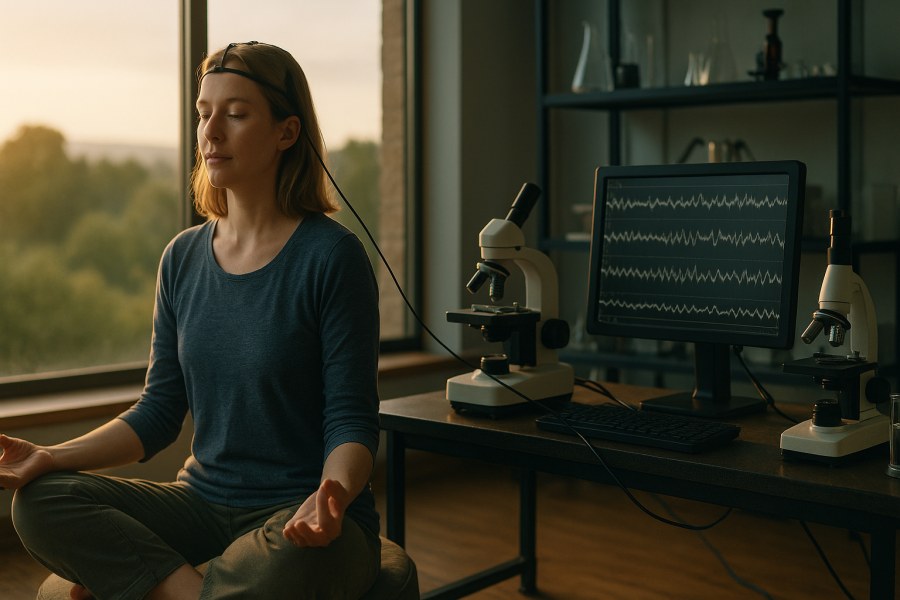


People often come to meditation with two questions that pull in different directions: “What is actually happening in my mind?” and “Can science measure it?” If you’ve ever felt calmer, more spacious, or strangely more “awake” after practice—and then looked at a brain scan headline that seems to either prove everything or dismiss it all—this guide is for you.
You’ll learn what laboratory measures (like EEG, fMRI, heart-rate variability, and behavioral tests) can responsibly tell us about meditation and awareness, what they cannot settle, and how to interpret results without turning them into metaphysical proof. We’ll also lay out practical steps for tracking your own practice in a way that respects both third-person measurement and first-person experience—without confusing either for the whole truth.
Why “measuring meditation” is harder than it sounds
Meditation isn’t one thing. It’s an umbrella term covering different techniques and goals: focused attention, open monitoring, compassion practices, mantra-based practices, and more. Two people can say “I meditated for 20 minutes” while doing very different cognitive and emotional activities. That makes measurement tricky, because labs need stable, well-defined tasks and comparable groups.
There’s a second challenge: “awareness” isn’t a single meter you can stick into the brain. In science, researchers often measure correlates—changes that reliably accompany certain reports or behaviors. In philosophy and consciousness science, this is sometimes framed as the difference between explaining brain mechanisms and fully explaining subjective experience (what it is like). Overviews like the Stanford Encyclopedia of Philosophy’s article on consciousness summarize why that explanatory gap remains debated rather than solved.
What labs commonly measure—and what each measure really means
1) Self-report: questionnaires and experience sampling
Most meditation studies rely on self-report, because subjective experience is the target. Researchers may ask about mind-wandering, calm, stress, meta-awareness (“knowing that you’re thinking”), nonjudgment, or compassion. Some studies use experience sampling (brief prompts during the day) to reduce memory bias.
What it captures well: phenomenology and day-to-day impact—especially when repeated over time.
Common pitfalls: demand characteristics (wanting to be a “good meditator”), shifting interpretations of questionnaire items as you learn more, and the fact that “I felt spacious” can mean different things across traditions.
2) Behavioral tasks: attention, perception, and decision-making
Labs use tasks like sustained attention, response inhibition, and mind-wandering probes to see if training changes performance patterns. These tests can be helpful because they’re comparable across people and time.
What it captures well: certain aspects of attention control and vigilance, sometimes emotion-related biases.
Common pitfalls: task performance can improve simply because you’ve taken the task before; motivation and sleep can matter as much as meditation; and better performance doesn’t automatically translate to deeper well-being or insight.
3) EEG: rhythmic activity and event-related potentials
EEG measures electrical activity at the scalp. Researchers often analyze rhythmic bands (commonly labeled delta, theta, alpha, beta, gamma) or time-locked responses to stimuli (event-related potentials).
What it captures well: timing. EEG can track rapid changes in brain dynamics during practice and in response to sounds, images, or other events.
Common pitfalls: scalp EEG is a blended signal from many neural sources; muscle tension and tiny movements can contaminate the recording; and broad claims like “gamma equals enlightenment” are not justified. Similar frequency changes can occur for many reasons (attention, arousal, effort, expectation).
4) fMRI: blood-flow proxies for neural activity
fMRI tracks changes in blood oxygenation (the BOLD signal), a proxy for neural activity. It has good spatial resolution but is slower than EEG.
What it captures well: which large-scale networks shift during a practice condition (for example, task-positive attention networks vs. networks often associated with self-referential processing).
Common pitfalls: reverse inference (assuming that activation in a region proves a specific mental state), small sample sizes, and the challenge of getting people to meditate naturally inside a loud scanner. A pattern of activation can be consistent with several different psychological interpretations.
5) Autonomic measures: heart-rate variability, breathing, skin conductance
Autonomic nervous system measures can reflect stress regulation and arousal. Heart-rate variability (HRV) is often discussed as a window into vagal (parasympathetic) influences on the heart, though interpretation depends on context and measurement choices.
What it captures well: shifts in physiological arousal and stress response during and after practice.
Common pitfalls: HRV is sensitive to breathing pattern, posture, caffeine, illness, and time of day. Some techniques directly change breath, which can change HRV even if the underlying mental state hasn’t shifted much. So “HRV increased” does not automatically mean “awareness expanded.”
What lab measures capture well (and why it still matters)
Even with limitations, lab measures do real work when they answer bounded questions. Here are the strongest kinds of claims measurement can support when studies are well designed and results replicate:
- Training-related changes in attention and meta-awareness (for certain techniques), reflected in task performance and some neural signatures.
- Stress and arousal modulation, reflected in autonomic measures and sometimes hormone-related proxies (depending on the study design).
- Emotion regulation and reactivity shifts, reflected in self-report and behavioral responses to emotional stimuli.
- Differences between practice states (e.g., active mind-wandering vs. instructed practice) in network-level brain activity.
This kind of evidence doesn’t “prove enlightenment.” But it can help people choose practices, troubleshoot, and understand which changes are likely to be training effects versus wishful thinking or normal fluctuation.
What lab measures do not (yet) capture—and why that isn’t failure
1) The full texture of lived experience
First-person reports can include subtle shifts: a quieter “narrator,” less compulsive evaluation, a more stable sense of witnessing, or (in some traditions) a sense of awareness without objects. These can be meaningful to practitioners and are legitimate data about phenomenology. But the lab’s tools typically translate experience into categories that are easier to count than to fully describe.
2) Meaning, ethics, and life-context
Meditation is often embedded in an ethical and philosophical framework. Traditional systems may treat insight, compassion, and self-understanding as central—not merely side effects. A scanner doesn’t directly measure meaning, wisdom, or moral development, even if it can measure attention and stress physiology.
3) Ontology (what consciousness ultimately is)
A frequent mistake is to move from correlation to metaphysics: “This brain pattern happened, therefore consciousness is produced by the brain,” or conversely, “This meditative state felt fundamental, therefore consciousness is the ground of reality.” Neither inference is forced by the data. Measurements can constrain theories, but they don’t automatically settle philosophical interpretations.
A practical “translation guide” between experience and measurement
If you want a grounded way to connect what you feel with what labs can test, try translating your practice into three layers:
- Phenomenology (first-person): What changed in experience? (clarity, effortlessness, stability, emotional tone, selfing, time sense)
- Function (behavior): What changed in daily life? (reactivity, focus, sleep, interpersonal patience, rumination)
- Mechanism (third-person correlates): What could be measured? (attention task metrics, HRV, EEG spectral changes, network-level fMRI differences)
This keeps you honest: experience is not dismissed, but you also avoid turning a single measurement into a metaphysical conclusion.
How to evaluate a meditation study without getting misled
Step 1: Identify the technique precisely
“Meditation” as a label is not enough. Look for instructions: focused attention on breath? nonjudgmental monitoring? loving-kindness? mantra-based practice? In Species Universe terms, it also matters to describe Transcendental Meditation accurately as an effortless technique taught in a specific program—distinct from concentration or breath control—because those differences plausibly change what gets measured.
Step 2: Check the comparison condition
Ask what meditation was compared against: eyes-closed rest, relaxing music, reading, a placebo-like wellness activity, or another meditation technique. Weak controls can exaggerate results.
Step 3: Look for “state vs. trait” separation
Some findings are state effects (during or right after practice). Others are trait effects (long-term changes). Many headlines blur this distinction. If you’re seeking durable change, trait outcomes matter most.
Step 4: Watch for reverse inference
Be cautious when authors claim that activity in a brain region “means” one specific experience. Brain regions participate in multiple functions. Strong studies triangulate: subjective reports + behavior + physiology + careful analysis.
Step 5: Check sample size and replication signals
Small studies can be informative but fragile. Look for replication, converging evidence across labs, and transparent methods. If you’re searching databases for primary research, PubMed is a useful index for biomedical literature, but a listing alone doesn’t guarantee that a finding is strong or replicated.
Try a simple self-study: measuring what you can, without overclaiming
You don’t need a lab to become more evidence-respecting in your own practice. Here’s a low-tech protocol for 2–4 weeks:
1) Define your practice and keep it consistent
- Technique: write a one-sentence instruction you will follow.
- Dose: duration and frequency (e.g., 15 minutes daily).
- Context: time of day and environment, as consistent as possible.
2) Track three numbers daily
- Practice quality (0–10): not “how blissful,” but how faithfully you followed the instruction.
- Stress/reactivity (0–10): your typical baseline that day.
- Sleep quality (0–10): since sleep strongly influences attention and mood.
Add 2–3 short notes about what stood out (e.g., “more mind-wandering,” “less rumination,” “irritability dropped after practice”).
3) Use one optional physiological proxy
If you already have a wearable that estimates HRV or resting heart rate, you can log it—but interpret it cautiously. Treat it as a trend indicator, not a verdict on awareness.
4) Look for patterns, not miracles
At the end, ask: Do days with practice correlate with lower reactivity? Does the effect depend on sleep? Is improvement gradual or immediate? If there’s no signal, that’s information too: maybe the technique, dose, or life-context needs adjusting.
Common pitfalls (and how to avoid them)
- Pitfall: Equating calm with awareness. Calm can accompany awareness, but you can also be calm and dull, or highly aware and emotionally activated. Track clarity and reactivity separately.
- Pitfall: Chasing brain states. “Getting alpha” or “getting gamma” can turn practice into performance anxiety. Use measurement to learn, not to grasp.
- Pitfall: Over-reading peak experiences. Unusual experiences can be meaningful, but they’re not automatically universal, permanent, or metaphysically revelatory.
- Pitfall: Ignoring technique differences. Results from one method don’t automatically generalize to another. Labels like “mindfulness” or “mantra” can hide significant variation in instruction.
Where traditional knowledge and modern science genuinely converge (without forcing equivalence)
Many contemplative traditions developed sophisticated maps of attention, distraction, emotion, and self-experience through long-term introspective training. Modern science brings systematic measurement, statistical tools, and mechanistic modeling. The convergence is real when both sides talk about:
- Trainable attention and meta-awareness (both traditions and labs recognize skill development over time).
- Reduced reactivity as a practical marker of progress (often described differently, but observable in life).
- State changes vs. enduring traits (traditions often differentiate temporary states from stable realizations; science differentiates state and trait effects).
The non-convergence is also important: traditions often make metaphysical claims (about the ultimate nature of mind or reality) that science is not designed to confirm or refute directly. Respecting that boundary helps prevent “science-washing” spirituality and also prevents dismissing inner life as meaningless.
Connecting this to the wider Species Universe framework
If you want a broader map of how Species Universe approaches questions at the intersection of experience and explanation, explore the guiding orientation on the Species Universe framework and the larger section on consciousness and awareness. For readers who want the traditional side of the conversation—without treating it as laboratory proof—see Vedic Science and Traditional Knowledge, including how classical systems structure meditation and mental training in the eight limbs of yogic meditation.
Conclusion: treat measures as maps, not as the territory
Lab measures are valuable when they answer precise questions: how a practice shifts attention, stress physiology, or brain network dynamics under controlled conditions. They become misleading when turned into sweeping claims about what consciousness ultimately is—or when they pretend to replace lived experience.
A balanced approach is practical: define your technique clearly, track outcomes you actually care about (reactivity, clarity, behavior), and read studies with attention to controls, state-versus-trait effects, and interpretive humility. That way, measurement can support practice—and practice can keep measurement honest—without either one claiming more authority than it has.
Reference note: For readers who want careful background on the philosophical and scientific framing of consciousness, see major overview resources such as the Stanford Encyclopedia of Philosophy entry on consciousness, and for browsing primary biomedical literature relevant to meditation and neuroscience, databases like PubMed can help you locate original abstracts and papers. These are starting points for context, not final proof of any single worldview.
Q&A
Does brain imaging prove that meditation causes “higher consciousness”?
No. Brain imaging can show correlates—patterns that tend to accompany certain practices or reported states. It doesn’t, by itself, establish the metaphysical status of consciousness or prove that a meditative experience reveals ultimate reality.
If my HRV improves with meditation, does that mean my awareness is deeper?
Not necessarily. HRV can reflect shifts in autonomic regulation and arousal, and it’s influenced by breathing, sleep, illness, caffeine, and posture. Improved HRV can be a meaningful health-related signal, but it isn’t a direct meter of awareness depth.
Why do different meditation studies seem to contradict each other?
Often because the techniques differ, control conditions differ (rest vs active control), samples are small, and outcomes measure different things (state effects vs long-term trait changes). “Meditation” is not a single standardized intervention.
What’s a responsible way to connect my subjective experience with scientific measurement?
Translate your practice into three layers: phenomenology (what it felt like), function (what changed in behavior and daily life), and plausible correlates (what could be measured, like attention task performance or autonomic trends). Use patterns over time, not one-off peaks.
Do EEG frequency bands like alpha or gamma have one clear meaning in meditation?
No. The same frequency changes can appear in different mental and physiological contexts, and EEG signals can be contaminated by movement and muscle tension. Band changes can be informative when paired with careful methods and multiple converging measures, but they don’t map one-to-one onto specific spiritual conclusions.
Related posts:
 Neural Correlates of Consciousness: What We Can Measure—and What We Can’t
 Quantum Consciousness Proposals: Mechanisms, Objections, and Testable Bets
 TIMP2 and the Aging Brain: Can a “Youth-Associated” Protein Rejuvenate Microglia?
 The Mind–Body Problem, Scientific Regress and “Woo” – Scientific American (blog)













Leave a Reply