
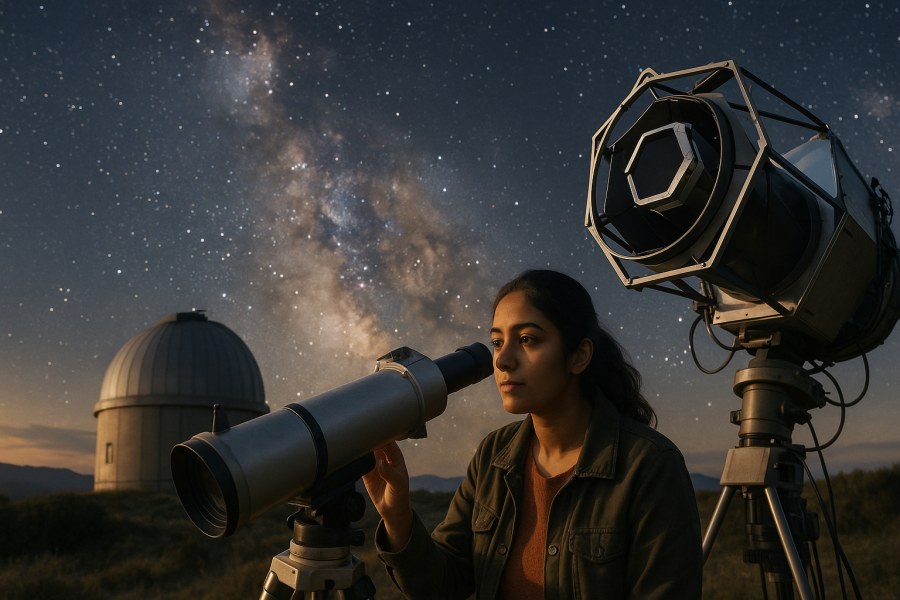


Source attribution: This post is a curated breakdown of NASA’s Roman telescope will see 100 times more sky than Hubble, with additional scientific context and philosophical analysis from Species Universe.
Bottom line: If the source’s description holds, NASA’s Nancy Grace Roman Space Telescope is built to do something astronomy has rarely had at this quality level: map huge stretches of sky with Hubble-like sharpness. That combination—fine detail plus massive coverage—isn’t just “more pictures.” It changes how confidently scientists can test ideas about dark matter, dark energy, galaxy evolution, and the population of planets around other stars.
This post breaks down what the provided report says Roman will do, what those claims mean in practice, and where the real uncertainties live (in calibration, statistics, modeling choices, and the fact that “dark” components are inferred from effects, not directly seen). You’ll also see why Roman complements James Webb rather than replacing it—and why wide-field surveys tend to produce fewer “single iconic images,” but far more discoverable patterns.
What the source says
The report frames Roman as NASA’s next flagship astrophysics mission after the James Webb Space Telescope, with science operations expected to begin in January 2027. The central claim: Roman aims to deliver Hubble-like detail over a field of view about 100 times larger than Hubble’s, allowing it to survey large swaths of the sky quickly.
Key points and people highlighted in the report include:
- Roman vs. Webb: Webb is described as optimized for studying smaller regions in great depth, while Roman is optimized for large surveys. Both can observe infrared light, and the report emphasizes that combining the two could be more powerful than either alone.
- Two main instruments:
- Wide Field Instrument (WFI): The survey workhorse, intended to produce Hubble-like imaging across much larger sky areas.
- Coronagraph Instrument: Designed to suppress starlight so astronomers can directly image exoplanets and disks around nearby stars—hard targets because planets are extremely faint next to their host stars.
- Survey scale comparison: The report states Hubble has observed roughly 0.1% of the night sky over more than 30 years, while Roman “has the potential” to survey the entire sky at the same resolution (a phrasing that signals ambition and capability, not a guaranteed observing plan).
- Dark matter and dark energy focus: The University of Arizona’s Arizona Cosmology Lab is said to support efforts related to Roman cosmology, including a team led by Elisabeth Krause working on “kinematic lensing,” and another group connected to the High Latitude Imaging Survey infrastructure led by Tim Eifler.
- Exoplanet imaging preparation: The report describes planning and modeling work by several researchers (including Schuyler Wolff, Mark Marley, Ewan S. Douglas, Ramya Anche, Justin Hom, and others) to prepare coronagraph observations, select targets, and model the infrared spectra of young, hot giant planets that emit their own thermal infrared light.
- Open data access: The report says Roman data will be made available to the wider research community once science operations begin.
Why 100× more sky matters (even if the mirror is “only” Hubble-sized)
It’s tempting to think telescope power is mostly about mirror diameter. Mirror size matters a lot for light-gathering and resolution, but Roman’s headline advantage in the source is different: survey efficiency.
If you can image many more square degrees of sky per unit time at high quality, you can do science that’s fundamentally statistical:
- Find rare things (unusual gravitational lenses, short-lived transients, uncommon galaxy types) because you’re looking at enough of the universe for “rare” to show up frequently.
- Beat down uncertainty by measuring huge samples rather than relying on a few exemplary objects.
- Map structure (how matter clumps across cosmic time) with less risk that you’ve accidentally picked a non-representative patch of sky.
Roman and the “dark universe”: what it can test vs. what it can’t directly reveal
The source emphasizes Roman’s role in studying dark matter and dark energy. It also defines them in the standard way: dark matter as “gravity without light,” and dark energy as something associated with the accelerating expansion of the universe.
Here’s the key distinction Species Universe readers should keep in mind:
- What’s observed directly: galaxy shapes and alignments, apparent brightness, positions on the sky, distances (often inferred from redshift), and how light is distorted by gravity (gravitational lensing).
- What’s inferred: how much mass must be present (including unseen mass) to produce the observed lensing and clustering; and how cosmic expansion has changed over time, which informs models of dark energy.
The report highlights “kinematic lensing,” described as combining Roman imaging with spectroscopic measurements. In plain language: images tell you how light is warped and how galaxies are oriented; spectroscopy can tell you how galaxies are moving (via Doppler shifts) and can improve distance and dynamics estimates. Combining these can help reduce certain systematic errors—one of the biggest challenges in precision cosmology.
What Roman likely won’t do by itself is identify the fundamental nature of dark matter (particle? field? something else?) or settle what dark energy “is” (a cosmological constant? evolving field? a sign that gravity behaves differently on large scales?). Those are interpretive layers that require combining multiple datasets and model comparisons. Roman can tighten the leash on the possibilities, but not automatically pick the final explanation.
For readers exploring how scientific models relate to bigger worldview questions, it helps to hold onto a framework where evidence, model, and meaning are separate layers. Species Universe keeps that separation explicit in the Species Universe Framework.
Catalogs of billions: why “turning surveys into a map” is a whole field
The report notes that Roman will identify galaxies across a wide range of distances and build large catalogs that then require “substantial computing power” to interpret. That’s not just logistics; it’s where many scientific pitfalls live.
To go from “a sky full of detected objects” to “a reliable map of cosmic structure,” teams must:
- Calibrate the instrument so that brightness and shape measurements are stable and comparable across time and across the detector.
- Classify objects (star vs. galaxy vs. artifact), estimate distances, and quantify uncertainty.
- Model selection effects: what the telescope is more likely to see, and what it will systematically miss.
- Compare to physical models and simulations to infer parameters like the matter density and how structure grew over time.
Those steps are why the report’s mention of infrastructure funding and high-performance computing is scientifically relevant: cosmology is increasingly limited not by “can we take images?” but by “can we control systematics and interpret giant datasets responsibly?”
If you want a broader tour of how scientific modeling turns measurements into claims, Species Universe has a useful hub at Cosmology and structure: models and interpretation.
Exoplanets: what Roman’s coronagraph can (and cannot) claim
The source’s exoplanet section is centered on the Coronagraph Instrument: a technology demonstrator designed to suppress starlight so faint nearby planets and dusty disks can be directly imaged. The report describes performance expectations in terms of contrast (planets tens of millions to hundreds of millions of times fainter than their stars), and it frames Roman as a pathfinder for a future “Habitable Worlds Observatory.”
Direct imaging is exciting because it changes the kind of information you can get:
- Indirect methods (like transits) are powerful for discovering planets and measuring sizes and orbits, but they usually see silhouettes or gravitational effects.
- Direct imaging can separate planet light from starlight, letting scientists study planetary atmospheres and temperatures more directly—especially for young, warm giant planets that glow in infrared.
But readers should keep one caution in mind: a coronagraph image is not automatically an “Earth 2.0” detector. Roman’s coronagraph, as described, is aimed at demonstrating high-contrast technology and characterizing certain kinds of planets (often giant, young, or otherwise favorable). Even when atmospheres are probed, interpreting spectra is model-dependent: clouds, hazes, and chemistry can mimic or mask signals.
For a grounded overview of how observation shapes what we can claim in physics more broadly, see Quantum Reality—not because Roman is “quantum mysticism,” but because measurement, inference, and interpretation are recurring themes across science.
Roman + Webb: a practical way to think about “synergy”
The source emphasizes that Roman and Webb both detect infrared light and can be used together. Here’s a practical analogy with limits:
- Roman is like a high-end wide-angle survey camera: it finds patterns and targets across an enormous landscape.
- Webb is like a high-end zoom lens and spectrograph suite: it can linger on a smaller number of targets to extract deep physical detail.
In practice, a common workflow could be:
- Roman discovers unusual objects (rare lenses, peculiar galaxies, promising planetary systems).
- Follow-up telescopes (often including Webb, and also ground-based spectrographs) do deeper characterization.
This “find broadly, then study deeply” pattern is one of the most productive ways science scales up without turning every project into a decades-long bespoke campaign.
Pitfalls and over-interpretations to avoid
A few common ways Roman’s promise can be overstated—worth watching for in headlines:
- “Roman will prove what dark matter is.” More accurate maps of gravitational effects don’t necessarily reveal the microphysical nature of dark matter.
- “Roman will photograph the whole sky like Hubble.” Wide-field capability doesn’t mean every part of the sky will be imaged to the same depth, in the same filters, on the same timeline.
- “Direct imaging means we’ll see life.” Even the best future missions will face ambiguity; Roman’s coronagraph is primarily described as a high-contrast technology step and an exoplanet science enabler, not a life-detector.
And because Species Universe also explores philosophical interpretations: there’s no reason to tie Roman’s surveys to claims that “observation creates reality” in a consciousness-first sense. Roman will measure photons, shapes, and spectra; the deeper questions about interpretation belong to physics foundations and philosophy of science, not to the telescope alone. If you’re interested in that boundary, the piece on information and reality in physics foundations is a better place to dig in.
Short FAQ
Is Roman basically “Hubble but wider”?
That’s close to the source’s core comparison: a similar mirror diameter to Hubble paired with a much wider imaging field. But “wider” is not a small tweak—it changes what kinds of questions become tractable, especially statistical ones about structure and populations.
Will Roman replace James Webb?
No. The report presents Roman as complementary to Webb: Roman surveys big areas quickly; Webb studies smaller areas in extraordinary depth. Used together, they can be more scientifically powerful.
How can Roman help with dark matter if dark matter doesn’t emit light?
By mapping dark matter’s gravitational effects—especially gravitational lensing (how mass bends light) and the way galaxies cluster. Those are indirect measurements: we see the influence on visible matter and light, not the dark matter itself.
Does Roman’s coronagraph mean we’ll directly image Earth-like planets?
The source frames the coronagraph as a major step in high-contrast imaging and a pathfinder for a future observatory focused on habitable worlds. Roman’s coronagraph can directly image some planets and disks, but “Earth-like and inhabited” is a much higher bar than “detectable with a coronagraph.”
What should I watch for once Roman data starts coming out?
Look for: (1) early calibration and validation papers, (2) survey strategy details (what areas, what depth), and (3) results that combine Roman with spectroscopy and other missions. The most trustworthy breakthroughs will show converging lines of evidence, not single-plot declarations.
For more context on why space observatories reshape our cosmic self-understanding—without forcing metaphysical conclusions—browse the Science & Technology of the Cosmos hub.
Bottom line
For most readers, the safest approach is to treat the source as a useful starting point, then verify the details on your own device before making changes. If the issue affects a work computer, important files, or business operations, get help before taking risky steps.
Q&A
What is the single biggest difference between Roman and Hubble in this report?
The report’s headline difference is field of view: Roman is described as delivering Hubble-like detail while imaging an area about 100 times larger per shot, enabling much faster wide surveys.
Does a Hubble-sized mirror mean Roman can only do what Hubble did?
No. Mirror size is only part of capability. Roman’s wide-field design changes the kind of science it can do—especially large statistical studies of galaxies, lensing, and rare objects—because it can cover much more sky efficiently.
How does Roman help study dark matter and dark energy if they can’t be seen directly?
By measuring their effects. Roman can map how gravity warps light (lensing) and how cosmic structure evolves across time, which constrains models that include dark matter and dark energy—even though it doesn’t directly detect their underlying nature.
What is the coronagraph for, in practical terms?
A coronagraph suppresses a star’s glare so astronomers can try to directly image much fainter nearby planets and dusty disks. That can enable atmospheric and thermal studies for certain favorable targets, especially giant planets.
Will Roman prove a specific explanation for dark energy?
Not by itself. Improved measurements can rule out or support classes of models, but multiple underlying explanations can fit the same broad observations unless several independent probes converge.














Leave a Reply