
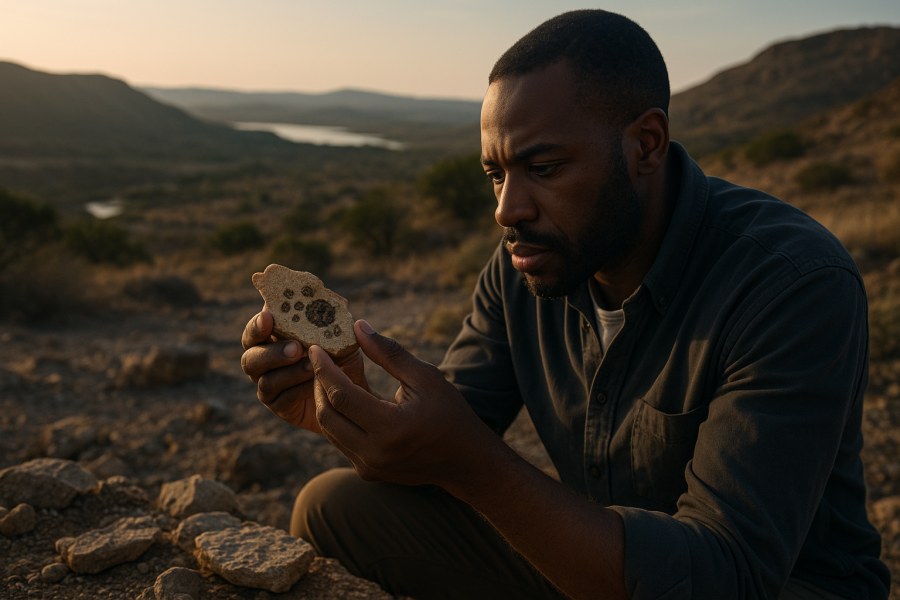


Source attribution: This post is a curated breakdown of Tiny 1.7-billion-year-old fossils could reveal how complex life began, with additional scientific context and philosophical analysis from Species Universe.
Imagine trying to reconstruct the most important chapter in life’s story—how our planet shifted from mostly microbial mats and single cells to the first lineages that would eventually make plants, animals, and fungi—using evidence you can barely see even with a microscope. That’s the problem paleontologists face when they hunt for the earliest eukaryotes: the first organisms built from complex cells with internal compartments.
This article breaks down a recent report about the search for ~1.7-billion-year-old microfossils, why they matter for understanding the origins of complex life, and what to watch for when headlines imply we’ve “found the start” of plants and animals. We’ll stick closely to what the source actually claims, then add practical, technician-style context: what counts as a eukaryote in the fossil record, why clays and certain coastal settings are singled out, and what a careful next step looks like for readers who want to follow the evidence rather than the hype.
What the source says
The source frames a major unresolved question in Earth history: when the first eukaryotes appeared, and how their emergence helped set the stage for complex multicellular life. It emphasizes that microbes dominated Earth for roughly 90% of the planet’s history, so the “microbes to complex life” transition sits across a vast, sparsely sampled stretch of time.
Key points and claims presented in the source include:
- Timeline claims (broad, simplified milestones): life began more than 3.5 billion years ago; oxygen-producing cyanobacteria were present by at least ~2.3 billion years ago; eukaryotes had appeared by at least ~1.7 billion years ago; algae by at least ~1 billion years ago (and possibly earlier); animals by at least ~570 million years ago (and possibly earlier).
- Why eukaryotes matter: eukaryotic cells have a nucleus and organelles (mitochondria are highlighted as an example tied to energy supply). The source treats early eukaryotes as the first “complex life” in a cellular sense, and as ancestors to all animals, plants, and fungi.
- Why the evidence is rare: organisms older than ~500 million years typically lacked hard parts (shells/skeletons), so fossils depend on rare preservation conditions. The source stresses that billion-year-old microfossils have been altered by geological processes, making them even harder to detect.
- Where researchers look: the report highlights a remote region near Svalbard, Norway, described as once a shallow sea, and notes that Australia has produced very old eukaryotic microfossils (around ~1.75 billion years in the account). Ancient coastal environments are described as promising due to nutrients and organic material. Clay-rich deposits are singled out as potential preservers of ancient remains.
- Astrobiology angle: learning how Earth preserves early life—especially via clay deposits—could help scientists recognize possible signs of life elsewhere, and refine expectations about whether complex life could emerge beyond Earth.
Importantly, the piece is largely about the search and the difficulty of interpreting extremely ancient traces, not a definitive announcement that a specific new fossil find conclusively explains how complex life began.
Why this matters (beyond trivia about ancient rocks)
For Species Universe readers, this topic is a live example of how big evolutionary transitions are studied when the evidence is incomplete. It also challenges a common habit of mind: imagining evolution as a clean ladder. The early history of eukaryotes is more like a detective story with missing pages—where a single good data point can reshape timelines, but also where one ambiguous structure can mislead.
If you care about questions like “How did complex systems arise?” and “Is complex life likely elsewhere?”, the eukaryote transition is foundational. Eukaryotes aren’t just “bigger bacteria.” They represent a major reorganization of life at the cellular level—one that later enabled multicellularity in multiple lineages.
Technician-style context: what has to go right for a 1.7-billion-year-old microfossil to be convincing?
When a report says “tiny fossils could reveal how complex life began,” it’s pointing at a chain of reasoning with several fragile links. Here are the practical checkpoints that typically matter in ancient microfossil work (explained at an intermediate, field-aware level):
1) Preservation: you need the right rock, not just the right age
Age is necessary but not sufficient. Rocks can be the right age and still be terrible at preserving cellular structures. The source highlights clay deposits and coastal/shallow marine settings as promising. That fits a broader idea in paleontology: some fine-grained sediments can bury and protect delicate remains quickly, and certain geochemical conditions can slow decomposition.
But readers should keep a healthy distinction between “promising environment” and “confirmed fossil.” The source itself emphasizes how rare these windows are.
2) Morphology: shape alone can be misleading
At microscopic scales, spheres, filaments, and wrinkles can form biologically—or through non-biological mineral processes. Even if something is biological, it may not be eukaryotic. Many bacteria also form filaments and colonies. Without hard parts, researchers look for subtle features consistent with eukaryotic organization (for example, certain sizes, wall structures, or patterns). The source doesn’t list diagnostic criteria; it highlights the general difficulty.
3) Chemistry: useful, but not an automatic “life detected” stamp
The report notes that Anderson studies rock chemistry to identify environments likely to preserve fossils. In practice, chemical signatures can support a biological interpretation (for instance, carbon-rich structures in the right context). But chemistry can also be altered over deep time. A careful conclusion usually comes from multiple independent lines of evidence aligning: geology, microscopy, and chemical data that cohere rather than contradict.
4) Sampling bias: the “poorly sampled” problem is real
The source calls out that this time period remains poorly sampled. That has a straightforward consequence: absence of evidence is not strong evidence of absence. If only a few places on Earth preserve the right rocks, and only a few are accessible and studied, then the fossil record will be patchy—even if early eukaryotes were widespread.
Common mistakes readers (and headline writers) make with this kind of story
- Mistake 1: Equating “first eukaryotes” with “first animals/plants.” The source connects eukaryotes to later complex life, but eukaryotes are a broad domain of life. Most early eukaryotes were not animals or plants; they were single-celled lineages. The link is ancestral and deep-time, not direct and simple.
- Mistake 2: Treating a date like 1.7 billion years as a single, settled “birthday.” Fossil ages come with uncertainties, and “appeared by at least” language matters. A fossil provides a minimum age for that lineage (it existed by then), not necessarily the earliest origin date.
- Mistake 3: Confusing “complex life” (cells with organelles) with “complex life” (multicellular ecosystems). The source uses “complex” largely in the cellular sense. Multicellularity is a further step—and it evolved multiple times.
- Mistake 4: Assuming that preservation hotspots tell us where life began. Deserts and Arctic outcrops are often great for access, not because life originated there. The rocks are exposed today; that doesn’t mean the original environment was uniquely important globally.
How this connects to bigger questions—without overclaiming
Astrobiology: what Earth’s clays might (and might not) teach us
The source suggests that understanding how clays preserve traces of early life could help us search for life elsewhere. That’s plausible as a methodological bridge: if some minerals are good at trapping or protecting biosignatures on Earth, they may be good targets on other worlds too.
Still, it’s a leap from “good preservation medium” to “complex life likely elsewhere.” Earth’s history includes contingencies: oxygenation events, ecological feedbacks, and long stretches of time. A careful takeaway is narrower: Earth’s deep-time record helps us refine what to look for, and how easily we might miss it.
Traditional knowledge and modern science: meaningful resonance, not proof
Some traditions describe life as unfolding through stages or cycles, and it can be tempting to map those narratives onto the scientific timeline. It can be personally meaningful to reflect on that resonance. But it isn’t scientific evidence by itself. The scientific work described here stands or falls on field geology, microscopy, and geochemistry—public, testable lines of inquiry that can be challenged by alternative interpretations.
A safe next step: how to follow this story responsibly
If you want to go one step deeper without getting lost in technical papers, here’s a grounded path:
- Track the underlying research trail. The source notes it is “materials provided by Universe Today” and credits an original author. If a peer-reviewed paper is associated, look for the paper title and journal in follow-up coverage (not all news pieces include it).
- Use a stable learning reference for evolutionary mechanisms. For a clean, non-sensational refresher on how evolutionary change and evidence work (and common misconceptions), the University of California, Berkeley’s Understanding Evolution site is a reliable starting point: Understanding Evolution (UC Berkeley).
- Bring the question back to “what would change my mind?” What additional evidence would strengthen the eukaryote interpretation (e.g., multiple sites, multiple methods, better-preserved structures)? What evidence would weaken it (e.g., a mineral process that mimics the same features)?
Where this fits in the Species Universe map
At Species Universe, we treat this kind of report as a window into how knowledge grows: by searching difficult terrain, proposing interpretations, and keeping multiple hypotheses alive until the evidence narrows them. If you want more context on how we frame major transitions and uncertainty in evolutionary science, explore:
- Evolution & Species Development hub for our broader coverage of mechanisms and transitions.
- Complexity & emergence models for how scientists talk about higher-level organization without assuming purpose.
- Species Universe framework for how we combine scientific rigor with philosophical care.
- Our evolution section within the framework for related essays that connect evidence to meaning—explicitly labeled as interpretation when we go beyond data.
Bottom line
The source report highlights a real and difficult scientific frontier: finding and interpreting microscopic fossils around 1.7 billion years old that may record early eukaryotes—cells whose internal architecture helped make later complex life possible. It also underscores why this remains unsettled: preservation is rare, signals are degraded, and sampling is thin.
The most evidence-respecting way to hold the story is: researchers are learning where to look (often clay-rich, ancient coastal settings), improving how to detect faint traces, and gradually tightening our picture of when complex cellular life emerged. That’s already a profound shift in understanding—even before any single fossil “solves” the origin of complex life.
Q&A
Did scientists find the very first eukaryote in these rocks?
The source is mainly about the search strategy and why the fossil record is hard to read at these ages. It discusses eukaryotes being present by at least ~1.7 billion years ago and highlights places researchers look, but it doesn’t present a single definitive “first eukaryote ever” specimen with full technical detail.
Why are clay-rich deposits mentioned so often in searches for ancient life?
Clays and other fine-grained sediments can sometimes help preserve delicate biological material by rapidly burying it and reducing physical disruption. The source reports that clay deposits motivate some of the work because they may preserve traces useful for Earth history and astrobiology. That said, clay isn’t a guarantee—interpretation still requires multiple lines of evidence.
Are eukaryotes the same thing as multicellular life?
No. Eukaryotes are organisms made of cells with a nucleus and organelles; many are single-celled. Multicellularity is a further evolutionary transition that occurred later and more than once in different lineages.
Does this mean complex life is likely elsewhere in the universe?
Not by itself. The source suggests Earth’s preservation lessons could help identify signs of life elsewhere and inform expectations, but it doesn’t (and can’t) prove complex life is common. Earth’s path includes many contingencies, and the safest conclusion is methodological: we can get better at knowing what to look for—and how easy it is to miss.
How should I read headlines about “the earliest” fossils without being misled?
Treat “earliest” as provisional and look for what was actually found, how the rock was dated, and how non-biological explanations were addressed. Also remember that a fossil typically provides a minimum age (it existed by then), not the true origin date of the lineage.

















Leave a Reply