
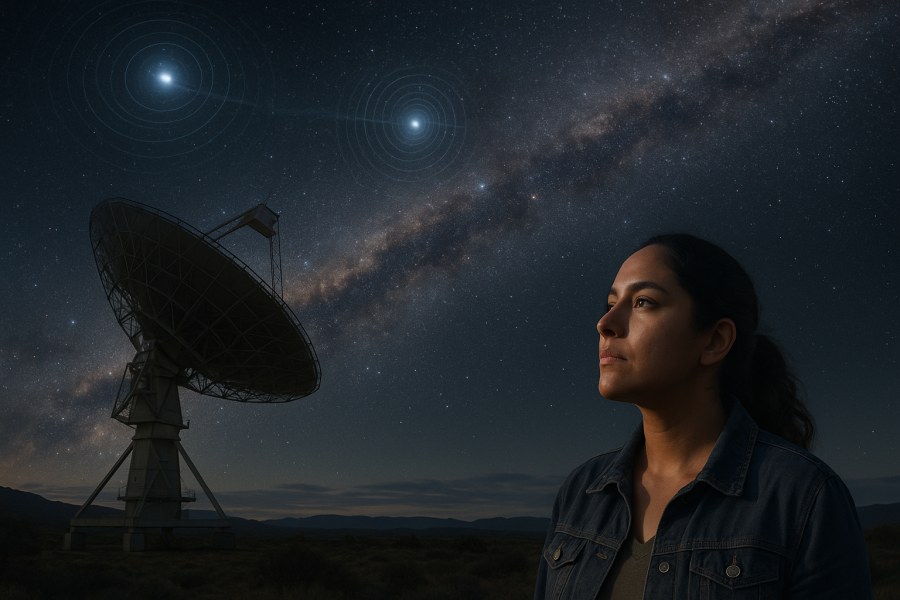


Source attribution: This post is a curated breakdown of A mysterious cosmic hum may come from 13-billion-year-old dark stars, with additional scientific context and philosophical analysis from Species Universe.
If you follow space science news, you may be “affected” by this story in a particular way: it changes what today’s gravitational-wave observations might be telling us. The nanohertz gravitational-wave background detected with pulsar timing arrays (PTAs) is often discussed as a signal from supermassive black hole binaries in the relatively recent universe. This new analysis asks a different question: what if part of that low, persistent “hum” carries information about how the very first giant black holes got started?
In this post for Species Universe, you’ll learn what the source report claims, what is actually being measured (and what isn’t), and how a hypothetical object called a “Dark Star” could—if it existed—connect dark matter physics, early-universe structure formation, and the gravitational-wave background we’re beginning to map today. We’ll also give you a simple checklist of what to verify on your own computer so you can separate the press-summary storyline from the underlying, model-dependent scientific claim.
Who this story matters to (and why)
- Curious readers tracking the PTA “background” news: You’ll get a clearer sense of what PTAs measure and why interpretation depends on population models of black holes.
- People intrigued by cosmic dawn: The study is about using a present-day signal to constrain ancient “seed” black holes that formed at very high redshift (the early universe).
- Anyone interested in dark matter—carefully: “Dark Stars” are tied to specific dark matter assumptions. This is not a detection of dark matter, and not proof dark stars existed.
What the source says
The source describes a Physical Review D Letter by Colgate University researchers Sohan Ghodla and Cosmin Ilie. Their central question is whether very early pathways to forming massive black hole “seeds” could plausibly lead, billions of years later, to a major portion of the stochastic gravitational-wave background now being measured by PTAs.
1) The “cosmic hum” is a gravitational-wave background inferred from pulsar timing
According to the source, PTAs track many pulsars over long time spans. Passing gravitational waves would slightly alter the time it takes pulses to reach Earth, producing a pattern of timing deviations. When these deviations show correlated structure across the sky, researchers interpret it as evidence for a gravitational-wave background at nanohertz frequencies (extremely low frequency compared with LIGO/Virgo/KAGRA’s detections).
2) The standard explanation: a population of supermassive black hole binaries
The source presents the widely accepted working explanation: countless supermassive black hole binaries (pairs of central black holes brought together by galaxy mergers) contribute overlapping gravitational waves, creating a background rather than individually resolved “chirps.” It highlights that binaries with a combined mass above roughly a billion solar masses contribute strongly at PTA-accessible frequencies.
3) The puzzle: how did huge black holes exist so early?
The source frames an underlying motivation: telescopes including the James Webb Space Telescope and Chandra have reported massive black holes in the early universe, pushing scientists to consider formation routes that can produce large “seeds” quickly. (That is a motivation for the modeling; it is not, by itself, evidence for any specific seed mechanism.)
4) Two seed pathways compared: direct collapse vs. dark-star remnants
The paper (as summarized) compares two routes for early massive seeds:
- Direct collapse black holes: a scenario where very massive gas clouds collapse into a black hole under specific conditions (suppressing fragmentation into ordinary stars).
- Collapse of “supermassive Dark Stars”: hypothetical primordial stars whose power source would be significantly influenced by dark matter heating rather than (only) nuclear fusion.
The source states that in the particular scenario they considered, Dark Stars could remain relatively cool and extended while accreting, potentially growing to around 10^6 solar masses (or more) before collapsing into massive black holes.
5) A key inference: PTAs might constrain cosmic-dawn seed populations
One of the most important ideas in the source is not “dark stars exist,” but rather: PTA measurements can place limits on how many massive seeds could have formed early on. Make too many, and you would overproduce the gravitational-wave background. Make too few, and you need other growth channels later.
The source also notes that in their models, seed densities in the range of 10^−2 to 10^−1 per cubic megaparsec could begin to exceed what PTA observations allow (with the exact constraint depending strongly on the host halo masses where seeds formed).
What this means (and what it does not mean)
What it could mean, if the modeling holds up
- A new “fossil record” channel: PTAs may help test early-universe black hole seeding scenarios indirectly, by checking whether those scenarios would predict too much (or too little) nanohertz gravitational-wave background today.
- A bridge between cosmic dawn and the present: Even if the mergers generating today’s signal happen much later, the population statistics depend on what was seeded very early.
What it does not mean
- It is not a detection of Dark Stars. The “dark star” route is hypothetical, and the source is describing a scenario where it could explain a large fraction of the background.
- It is not direct evidence for any specific dark matter particle. The source mentions a WIMP-based heating picture. WIMPs remain unconfirmed as dark matter candidates.
- It does not imply consciousness, observation, or “measurement” is driving cosmic outcomes. PTA “measurement” here is a technical term for data collection and inference; it does not carry philosophical weight about mind being fundamental.
Practical context: how PTAs “hear” nanohertz gravitational waves (plain-language version)
A pulsar is a rapidly rotating neutron star that emits lighthouse-like beams of radio waves. Some pulsars—especially millisecond pulsars—are stable enough that their pulse arrival times can be predicted with extraordinary precision once you account for known effects.
A gravitational wave gently stretches and squeezes spacetime. For PTAs, the key idea is that this stretching changes the apparent pulse travel time by tiny amounts. If you monitor many pulsars scattered across the sky for years, a real gravitational-wave background should create a subtle, correlated pattern in the timing residuals (the difference between expected and measured arrival times).
Species Universe readers who want a bigger-picture framing may enjoy our hub on Science & Technology of the Cosmos, which connects observing techniques to what they can (and can’t) establish about the universe.
Why Dark Stars are intriguing—and why they’re still uncertain
“Dark Stars,” as described in the source, are not the same as ordinary stars. They’re a proposed early-universe object where dark matter heating (in a particular particle scenario) supplies a significant part of the energy budget, potentially changing how the object grows and how long it persists.
That is intriguing because it offers a potential path to very massive seed black holes early on—seeds that could later grow and participate in mergers that contribute strongly to the PTA band.
Checklist: what to verify on your own computer (so you can evaluate this claim responsibly)
This story blends observation (a background signal inferred from pulsars) with interpretation (what population produced it). Here’s a reader-friendly verification checklist you can do with basic web searching and careful reading—no specialized software required.
- Identify the underlying journal article: Confirm the work is a Physical Review D Letter and note whether it is primarily a population-modeling exercise, an interpretation of existing PTA data, or both.
- Separate observation from scenario: Write down two columns: (A) what PTAs measure (timing residual correlations) and (B) what the authors propose as an explanation (seed channels + merger histories). Keep them distinct.
- Look for key assumptions: In the paper or summary, note assumptions about seed number densities, host halo masses, black hole growth prescriptions, and merger rates. These assumptions are where conclusions can change.
- Check what is meant by “dominant contribution”: Does it refer to overall signal amplitude, a frequency range, or a portion of the background under a specific parameter set?
- Ask what else could contribute: The source foregrounds supermassive black hole binaries. Verify whether the discussion considers alternative astrophysical contributions or uncertainties in binary evolution that could shift the inferred background.
For grounding on the broader idea of gravitational-wave astronomy in the universe context, NASA’s overview pages can be a useful starting point (institutional background rather than a proof of any one model). See NASA’s universe science overview for accessible context on how different observations fit together.
Steel-manning competing views: why “dark stars did it” is not the only reasonable read
Even if PTAs have detected a background consistent with many supermassive black hole binaries, there are multiple plausible ways to build a universe that produces that background:
- Direct collapse seeds could be rarer but still important if growth is efficient and merger environments favor rapid pairing—though the source suggests their modeled densities were much lower and thus less contributory.
- Stellar-remnant seeds + fast accretion might work in some environments, depending on feedback and gas supply (details matter, and different groups model them differently).
- Uncertainties in binary “hardening” (how binaries shrink from galaxy scales to the gravitational-wave-dominated regime) can change how many systems contribute at PTA frequencies.
The strongest takeaway is methodological: PTAs are becoming a tool not only for “counting mergers,” but for testing which early-universe stories are consistent with a present-day gravitational-wave background.
A Species Universe perspective: connecting modern science and older “cosmic harmony” intuitions—carefully
Across many cultural traditions, the cosmos is described as having an underlying order—sometimes imagined as a kind of harmony or vibration. It’s tempting to map that language onto the modern idea of a gravitational-wave “hum.” But it’s important to keep categories clear:
- Established science: gravitational waves are ripples in spacetime predicted by general relativity and measured through multiple methods.
- Emerging research: nanohertz background characterization and its astrophysical interpretation are still being sharpened.
- Philosophical interpretation: “The universe has a deep rhythm” can be a meaningful metaphor, but it isn’t evidence about the universe’s ultimate nature.
- Speculation: using the word “hum” to imply intention, mind-like properties, or consciousness as fundamental goes beyond what the measurements establish.
If you’re interested in how Species Universe navigates these boundary lines—science, meaning-making, and humility about what we can claim—our guiding approach is outlined in the Species Universe Framework.
Bottom line
The source report describes a study arguing that today’s PTA gravitational-wave background could encode information about how early supermassive black holes were seeded, and that one hypothetical channel—remnants of supermassive Dark Stars—could, under certain assumptions, contribute a large fraction of the signal. The exciting part is not that dark stars have been found, but that PTAs may become a practical way to constrain “cosmic dawn” scenarios that are otherwise hard to test.
For readers, the best stance is curious and disciplined: treat the PTA background as a real observational frontier, and treat specific origin stories (dark stars, direct collapse, rapid accretion histories) as models competing to explain that frontier—models that will be strengthened, weakened, or ruled out as PTA datasets improve.
If you want to explore how deep questions about reality show up at the edges of physics without overclaiming what “measurement” means, our Quantum Reality section is a good next stop.
Q&A
What is the “cosmic hum” in this story?
It refers to a stochastic (background) signal of extremely low-frequency gravitational waves inferred from correlated timing shifts in many pulsars monitored by pulsar timing arrays.
Does this mean dark stars have been detected?
No. The source describes a modeling study where hypothetical dark-star remnants could explain a large share of the PTA background under certain assumptions. That is not direct observational confirmation of dark stars.
Why would ancient black hole “seeds” affect a signal measured today?
Because the present-day background depends on the population of supermassive black hole binaries that formed over cosmic time, and those populations trace back to how many seeds existed, how massive they were, and how they grew and merged.
What’s the most important uncertainty to keep in mind?
The interpretation is model-dependent: it relies on assumptions about seed number densities, host halo properties, black hole growth, galaxy merger history, and how efficiently binaries shrink to the regime where they emit strong nanohertz gravitational waves.
Is this related to quantum measurement or consciousness ideas?
Not in a way the evidence supports. “Measurement” here means collecting pulsar timing data and inferring gravitational-wave effects. It does not imply anything about consciousness being fundamental or observation causing cosmic phenomena.

















Leave a Reply