What makes Maharishi Mahesh Yogi’s effortless technique distinct—and why transcending thought matters
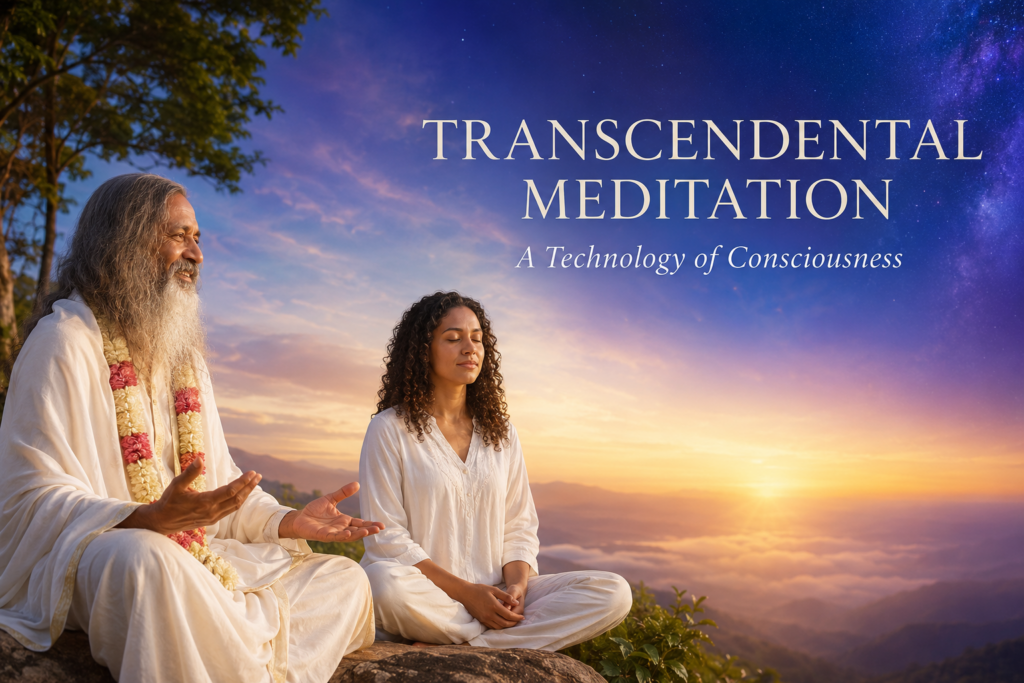
Transcendental Meditation, as taught by Maharishi Mahesh Yogi, is not simply another way to concentrate, observe the breath, control attention, or create a peaceful mood. Its defining purpose is more fundamental: to allow the mind to settle naturally through progressively quieter levels of thought and, at times, to transcend the thinking process altogether.
What remains when ordinary mental activity becomes silent is described in Maharishi Vedic Science as transcendental consciousness or pure consciousness—awareness awake within itself, without needing an external object of experience. In the language of the classical Yoga tradition, this bears an important relationship to samādhi, although different schools define and classify samādhi in different ways.
Species Universe treats the Transcendental Meditation program as a central example of meditation understood as a technology of consciousness: a repeatable method for investigating consciousness through direct experience while also examining its measurable effects through scientific research. This page explains what makes the technique distinctive, why Maharishi’s understanding of the thinking process is essential to it, and how TM fits into the larger purpose of Species Universe.
Three essential takeaways
- TM is taught as an effortless technique, not a concentration practice. Thoughts are not treated as enemies, and mental silence is not produced by force.
- The immediate direction of the practice is inward and transcending. The mind is allowed to experience subtler levels of thought and potentially pure consciousness beyond ordinary mental content.
- Direct experience, traditional interpretation, and scientific measurement answer different questions. Species Universe examines all three without pretending that any one of them automatically proves every claim made by the others.
What the Transcendental Meditation technique is
The Transcendental Meditation program was brought to the wider world by Maharishi Mahesh Yogi. It is taught as a simple, natural, effortless technique practiced while sitting comfortably with the eyes closed, ordinarily for about twenty minutes twice each day. The complete technique is learned through a standardized course of personal instruction from a trained TM teacher.
The practice uses a mantra, but that fact alone does not define it. Many traditions use words, sounds, prayers, or mantras in very different ways. A mantra can be contemplated for its meaning, repeated aloud, synchronized with breathing, held through concentration, or used devotionally. TM is distinguished not merely by having a mantra, but by how the mantra is used within an effortless process of transcending.
The mantra is not treated as a target that must be held rigidly in attention. Nor is the practitioner instructed to eliminate thoughts through willpower. Maharishi’s explanation is that, under the proper conditions, the mind can naturally experience increasingly subtle stages of the thinking process. The technique is intended to permit that inward movement without strain.
A necessary boundary
This page explains the principles, purposes, context, and evidence surrounding TM. It does not attempt to reproduce the private instructional procedure, assign a mantra, or substitute written instructions for learning from a qualified TM teacher. Readers interested in learning the technique should consult the official Transcendental Meditation program.
What makes TM different from most meditation methods
The word meditation now covers an enormous range of practices. Some train focused attention. Some monitor thoughts and sensations. Some regulate breathing. Others cultivate compassion, visualize a form, repeat a prayer, analyze a philosophical question, or attempt to remain continuously present.
These methods may be valuable within their own systems, but they should not be treated as interchangeable. They employ attention differently, aim at different immediate outcomes, and may produce different patterns of subjective and physiological experience.
| Approach | Typical immediate process | How TM differs |
|---|---|---|
| Concentration | Holding or repeatedly returning attention to an object | TM does not make successful practice depend on maintaining fixed attention. |
| Mindfulness or open monitoring | Observing present-moment experiences with reduced judgment or reactivity | TM is directed toward transcending mental content rather than continually monitoring it. |
| Contemplation | Reflecting on a meaning, teaching, question, or sacred idea | The TM mantra is not used for its intellectual meaning or as a subject of analysis. |
| Breath regulation | Deliberately changing or tracking respiration | TM does not require deliberate control of breathing. |
| Transcendental Meditation | Effortlessly allowing the mind to settle toward subtler thought and transcendence | Its central mechanism is the natural inward movement of the mind rather than imposed control. |
This comparison describes broad tendencies, not rigid boundaries. Meditation traditions are internally diverse, and skilled practitioners may report overlapping experiences. The point is not that every other method is ineffective. The point is that TM makes a specific claim about how transcending occurs, and that claim cannot be evaluated fairly if TM is inaccurately described as ordinary concentration or generic mantra repetition.
Maharishi’s insight into the natural tendency of the mind
Maharishi’s explanation begins with a simple observation: the mind does not move only because it is forced. Attention is naturally attracted toward experiences perceived as more interesting, satisfying, meaningful, or pleasant. A person listening to faint music spontaneously leans closer. Someone reading an absorbing passage may forget the surrounding room. Attention follows increasing value with little sense of effort.
TM applies this principle inwardly. Maharishi taught that subtler levels of thought can possess increasing charm as the mind approaches the quieter source of thinking. When the technique is used correctly, the mind is not compelled to become silent. It is given the opportunity to follow its own tendency toward greater satisfaction until even the subtlest mental activity may be transcended.
This is one reason intellectual understanding alone is insufficient. A person may understand the phrase “effortless meditation” and still subtly try to manufacture effortlessness, hold onto the mantra, resist thoughts, or pursue a remembered experience. Proper instruction is intended to establish the correct use of the technique and provide follow-up checking when unnecessary effort enters the practice.
The distinctive insight is not that the mind must be defeated before consciousness can be known. It is that the thinking process can settle naturally when it is approached according to its own mechanics.
This proposition can be considered at several levels. As a practical teaching, it describes how TM is taught. As phenomenology, it can be compared with practitioners’ reports. As a scientific question, aspects of the process can be investigated through physiological and psychological measurement. As a philosophical claim, it raises the deeper question of whether pure consciousness is produced by the brain, revealed when ordinary processing quiets, or related to reality in some other way. These levels should inform one another without being confused.
Why thoughts and effort are understood differently
Many beginners assume that successful meditation means having no thoughts. That assumption can turn meditation into an internal struggle: every thought appears to be evidence of failure, and increasingly forceful control is used to chase silence.
TM does not begin from that premise. Thoughts during meditation are not automatically mistakes. Maharishi’s framework associates some mental activity during practice with the release of stress as the body gains deep rest, although the precise physiological meaning of any particular thought cannot be determined from subjective experience alone. The practical point is that fighting thoughts introduces effort and may interfere with the natural settling process.
Nor is one meditation judged solely by whether it felt deep, quiet, blissful, or transcendent. Experiences can vary from session to session. A meditation containing many thoughts is not necessarily useless, and a peaceful meditation is not proof of advanced spiritual development. The larger test is whether regular practice supports clearer, healthier, more integrated life outside meditation.
What TM should not be reduced to
- forcing the mind to become blank;
- holding attention rigidly on a sound;
- repeating a mantra as rapidly or continuously as possible;
- monitoring every thought without leaving mental activity behind;
- using suggestion to create a preferred mood;
- imagining unity and calling the imagination transcendental consciousness.
What it means to transcend thought
To transcend means to go beyond. Within TM, transcending does not mean rejecting intelligence, escaping life, or permanently eliminating the ability to think. It refers to going beyond the active thinking process to a condition in which consciousness is present without an ordinary object of thought, perception, or emotion dominating awareness.
Maharishi described this as pure consciousness: consciousness knowing itself. The ordinary structure of experience contains a knower, a process of knowing, and something known. In transcendental consciousness, this differentiated structure is said to settle into a self-referral condition of awareness.
For the practitioner, such an experience may be described as inner silence, wakefulness without thought, unboundedness, simplicity, or deep rest. Reports vary, and language is necessarily retrospective: the moment we describe an experience, conceptual thought has already resumed.
That limitation does not make the experience meaningless. First-person experience is indispensable for describing phenomenology—what a state is like and how it changes over time. But phenomenology alone does not settle every question about what consciousness is in the universe. A report of unbounded awareness is evidence that such an experience occurred; additional argument and evidence are needed before concluding that individual awareness is literally identical with a universal field.
This distinction is central to Species Universe. We take the experience seriously without demanding that readers accept one metaphysical interpretation in advance.
TM, pure consciousness, and samādhi
The Sanskrit term samādhi refers to refined states of meditative integration or absorption, but its precise meaning depends on the text and interpretive lineage. Patañjali’s Yoga Sūtras, Vedānta, later Yoga traditions, and Maharishi Vedic Science do not always organize the territory in identical language.
Within Maharishi’s teaching, the experience of transcending thought to pure consciousness is often related to samādhi. The distinctive emphasis is that this experience need not be produced by prolonged concentration or heroic mental control. The technique is intended to make transcending natural and repeatable within ordinary life.
Repeated experience is important because a silent state during meditation is not the complete goal. Maharishi described development in terms of stabilizing pure consciousness so that inner wakefulness increasingly coexists with waking, dreaming, and sleeping. In this framework, enlightenment is not one dramatic meditation, a temporary feeling of unity, or withdrawal from the world. It is the progressive integration of unbounded consciousness with thought, perception, relationship, creativity, and action.
Readers interested in the classical context can also explore the eight limbs of Patañjali’s Yoga Sūtras. A separate Species Universe page will examine more closely where Maharishi’s account of pure consciousness converges with—and differs from—classical descriptions of samādhi.
Why transcending is meant to enrich daily life
Meditation can be misunderstood as an escape from the physical world. Maharishi’s presentation of TM points in the opposite direction. The purpose of contacting the quietest level of consciousness is not to remain inactive but to return to activity with greater inner stability and available intelligence.
The alternation of meditation and activity is therefore fundamental. Rest allows accumulated stress to be reduced; activity provides the field in which the qualities of inner silence can become integrated. In Maharishi’s account, this repeated cycle supports growth toward higher states of consciousness.
This also supplies a practical safeguard against spiritual romanticism. A compelling inner experience should not be judged only by its intensity. We should ask whether practice contributes to clearer thinking, ethical behavior, resilience, compassion, creativity, physical well-being, and more constructive participation in the world.
Individual development is only part of the picture. Maharishi proposed that sufficiently large groups practicing TM and the advanced TM-Sidhi program could influence collective consciousness, producing measurable improvements in social coherence. This proposal is known as the Maharishi Effect. It has inspired an extensive research program as well as significant methodological debate. Because its claims and evidence deserve careful treatment, Species Universe will examine them on a dedicated cornerstone page rather than treating them as already settled here.
Why the technique is personally taught
In an age of apps, videos, and freely distributed meditation instructions, the TM program’s standardized personal teaching can appear unusual. Its rationale follows from the subtlety of effortlessness.
A written instruction can easily be converted into effort. A reader may strain to reproduce a sound, concentrate on it, coordinate it with breathing, evaluate every moment, or chase a previous experience. Personal instruction allows the teacher to communicate the technique in context and correct misunderstandings without turning meditation into a mechanical performance.
The course also includes follow-up instruction and checking. This matters because the practitioner’s relationship to the technique can drift over time. Standardization further gives researchers a more clearly defined intervention than the vague category “meditation,” although teacher, participant, expectation, study design, and adherence can still affect research outcomes.
Respecting this teaching structure does not require accepting every philosophical or scientific claim associated with TM. It simply means evaluating the technique that is actually taught rather than an improvised version bearing the same name.
What scientific research can—and cannot—tell us
TM has been studied in areas including stress, anxiety, cardiovascular risk factors, cognitive functioning, educational outcomes, brain activity, and quality of life. Some studies report meaningful benefits and distinctive physiological patterns. Other reviews identify limitations such as small samples, variable study quality, expectancy effects, researcher affiliation, inconsistent controls, and the need for stronger independent replication.
A rigorous evaluation should therefore avoid two extremes. It should not dismiss all TM research merely because some investigators are affiliated with the movement. Affiliation can create potential bias, but it does not by itself invalidate data. Nor should favorable findings be treated as proof of every claim about health, enlightenment, collective consciousness, or fundamental physics.
Species Universe evidence standard
- Established finding: supported by sufficiently strong and convergent evidence.
- Promising evidence: credible positive results that still require stronger confirmation or replication.
- Traditional or theoretical interpretation: a framework that gives meaning to experience but is not identical with an empirical finding.
- Personal experience: valid evidence about the practitioner’s phenomenology, but not automatically a universal outcome.
- Open question: a proposal whose truth remains unresolved.
The forthcoming Species Universe research guide will examine original studies, systematic reviews, independent evaluations, methodological objections, and conflicts of interest by topic. Readers may meanwhile consult the official Maharishi International University research portal, search individual publications through PubMed, and compare claims with independent evidence assessments.
Science can investigate what happens in the brain and body, whether measured benefits occur, how large they are, how long they last, and whether results replicate. Science can also improve its methods by taking precise contemplative descriptions seriously. What current experiments cannot establish by themselves is whether pure consciousness is ontologically fundamental or identical with a universal field. That remains a scientific-philosophical frontier requiring clearer theories and testable predictions.
Why TM is foundational to Species Universe
Species Universe grew from a conviction that understanding reality requires attention to both objective observation and the structure of the observer. Physics examines relationships among matter, energy, information, measurement, space, and time. Biology examines how living systems develop and adapt. Contemplative traditions examine the instrument through which every theory, observation, and measurement is ultimately known: consciousness.
A note from Species Universe founder John J. Zettel I have practiced and promoted the Transcendental Meditation program for many years and have a background teaching the program. I also attended Maharishi International University in Fairfield, Iowa. My experience of transcending has been fundamental to the questions behind Species Universe: What is consciousness? What is its relationship to the thinking process and the physical body? How can human understanding evolve beyond unnecessary ignorance and suffering?
I regard TM as the most complete and effective meditation technology I have encountered because Maharishi’s teaching works with the natural mechanics of the mind rather than against them. That is my informed experiential position, not a demand that readers accept it without investigation. Species Universe exists to bring experience, science, traditional knowledge, criticism, and philosophical reasoning into a disciplined conversation through which understanding can continue to evolve.
For Species Universe, enlightenment is not merely an achievement belonging to an isolated individual. Humanity lives through relationships, institutions, cultures, ecosystems, and shared fields of knowledge. Individual development matters, but so does collective development. The deeper promise of Maharishi’s program is therefore planetary: human beings cultivating their full potential while contributing to a more coherent and life-supporting civilization.
This possibility will be investigated through several connected pages:
- Scientific Research on Transcendental Meditation—the evidence, its strengths, its limitations, and what remains unresolved;
- The Maharishi Effect and Collective Consciousness—whether group practice can produce measurable social effects;
- Maharishi Mahesh Yogi and Maharishi Vedic Science—the larger systematic framework in which TM is situated;
- Maharishi International University—consciousness-based education, research, and the Fairfield community;
- The TM-Sidhi Program—advanced practice and its proposed individual and collective effects;
- Maharishi Ayurveda—the effort to recover and apply Vedic knowledge of health in a modern setting; and
- Transcendental Consciousness, Samādhi, and Enlightenment—how experience develops and how competing traditions interpret it.
These pages will not be written to manufacture agreement. They will be written to make the strongest responsible case, identify the strongest objections, and clarify what forms of evidence could move understanding forward.
For the larger intellectual structure connecting these questions, visit the Species Universe Framework and the Vedic Science & Traditional Knowledge hub.
Questions and answers
Is Transcendental Meditation a concentration technique?
No. TM is taught as an effortless technique that allows the mind to settle naturally toward subtler levels of thought and transcendence. It does not require holding attention rigidly on the mantra, forcing thoughts away, or making the mind blank.
Is TM the same as mindfulness?
No. Mindfulness commonly emphasizes observing present-moment experience with less judgment or reactivity. TM is directed toward transcending mental content and experiencing pure consciousness. The practices may produce some overlapping benefits, but their procedures and immediate aims are different.
Is TM simply mantra repetition?
No. Many practices use mantras, but they use them in different ways. TM is defined by a specific, effortless use of the mantra within a personally taught process of transcending. Repeating or concentrating on an arbitrary word is not equivalent to learning the TM technique.
Does having thoughts mean that TM is not working?
No. Thoughts are not automatically treated as failures, and experiences naturally vary. TM does not ask practitioners to fight thoughts or judge a meditation solely by how quiet it felt. Questions about practice should be addressed through the program’s follow-up checking rather than by increasing effort.
Is transcendental consciousness the same as samādhi?
Maharishi related pure or transcendental consciousness to samādhi, but the term samādhi has multiple classifications and interpretations across Yoga and Vedānta traditions. A careful comparison must specify which text and lineage are being discussed rather than declaring every use of the word identical.
Can someone learn TM from an article, book, or video?
An article can explain TM’s history, principles, research, and reported experiences, but the complete technique is taught through personal instruction by a trained TM teacher. This page does not provide mantras or attempt to substitute for that instruction.
Has science proven that TM leads to enlightenment?
No scientific study can presently establish a universal guarantee of enlightenment. Research can investigate measurable psychological, physiological, neurological, behavioral, and social outcomes. Higher states of consciousness also involve phenomenological and philosophical questions that require additional forms of inquiry.
Does TM prove that consciousness is the unified field?
No. Maharishi Vedic Science and some associated theorists propose a relationship between pure consciousness and the unified basis of natural law. TM may provide experiences interpreted within that framework, but current physics and neuroscience have not established that identity as scientific fact. Species Universe treats it as an important hypothesis and philosophical synthesis requiring continued investigation.
Conclusion: a practical doorway into the study of consciousness
The uniqueness of Transcendental Meditation lies in a precise inversion of a common assumption. The mind does not have to be conquered before deeper consciousness can be experienced. According to Maharishi, the mind can be allowed to settle according to its own nature, passing through subtler stages of thought toward the silent basis from which thought emerges.
Whether pure consciousness is ultimately understood as a brain-dependent state, a fundamental feature of reality, the individual expression of a universal field, or something our present categories cannot yet capture remains open to investigation. But the investigation should begin with an accurate account of the technique, respect for direct experience, careful scientific measurement, and a willingness to distinguish evidence from interpretation.
That combination—experience, verification, criticism, and evolving synthesis—is the work of Species Universe. TM is central to that work because it offers not only a theory about consciousness, but a practical and systematic means by which consciousness can investigate itself.
Editorial disclosure: Species Universe founder John J. Zettel is a long-term practitioner and advocate of the Transcendental Meditation program and has a background teaching the program. This commitment is stated openly so readers can evaluate both the perspective and the evidence presented.