
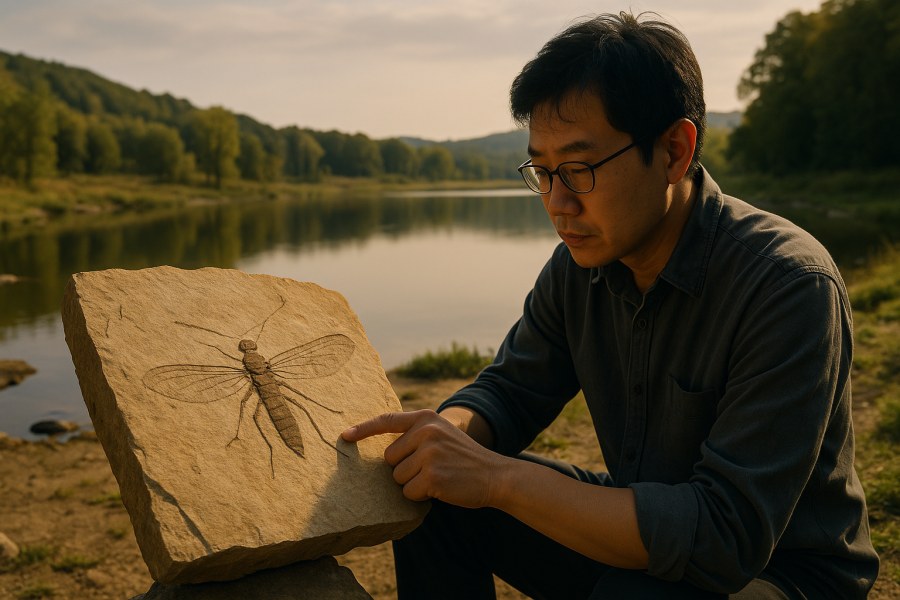


Source attribution: This post is a curated breakdown of 324-million-year-old fossil reveals how insects conquered land, with additional scientific context and philosophical analysis from Species Universe.
Three quick takeaways:
- The new fossil is presented as a “bridge” form: a 324-million-year-old stem-insect (named Chosha praecursor) with six walking legs and unusual abdominal appendages that look adapted for swimming.
- The central claim is gradual terrestrialization: instead of a sudden jump from water to dry land, the source argues insects likely spent a long time in semi-aquatic, humid shoreline habitats.
- It aims to shrink a major gap: by comparing this fossil with other enigmatic Paleozoic hexapods, the researchers argue we can better connect early Devonian hexapods with later Carboniferous insect diversity.
Insects are so thoroughly “land creatures” in our imagination that it’s easy to forget they descend from aquatic ancestors within the broader pancrustacean family (the arthropod grouping that includes crustaceans and insects). So when a fossil shows an insect-like body with extra limb structures on the abdomen—structures that resemble paddles—it forces a new question: what if “becoming terrestrial” wasn’t a clean break, but a long negotiation with shorelines?
This post walks through what a recent research news write-up claims, why it matters, and how to read it carefully. We’ll keep the boundary clear between (1) what the source reports, (2) what scientists can reasonably infer from a fossil and sedimentary context, and (3) broader philosophical reflections about life’s transitions—without turning a compelling discovery into a bigger metaphysical proof than the evidence supports.
What the source says
The source reports an international research team describing a new fossil species, Chosha praecursor, dated to about 324 million years ago (Late Mississippian). The work is described as led by Prof. Chenyang Cai (Nanjing Institute of Geology and Paleontology, Chinese Academy of Sciences) and Erik Tihelka (University of Cambridge), with collaborators from multiple countries.
According to the write-up, the fossil material comes from calcareous claystone concretions in the Tesnus Formation of the Marathon Uplift in western Texas. The preservation is said to be detailed enough that, using cross-polarized light imaging, the researchers concluded the specimens had been misidentified for years—mistaken for crustacean larvae rather than adult insects. The source specifies these were adult females and even provides measurements: roughly 32 mm body length, and nearly 50 mm including a median caudal filament and paired cerci.
The anatomy described is a mix of familiar and surprising traits:
- Insect-like traits: six walking legs; a segmented trunk; an ovipositor; and a terminal caudal filament.
- Unexpected traits: abdominal segments 1 through 9 bearing segmented appendages, with the posterior abdominal limbs modified into “paddle-like” structures.
The source emphasizes that no living “crown group” insect has this kind of abdominal appendage configuration. It links the animal’s anatomy to environment: the sediments are interpreted as near-shore, shallow-water delta coastal settings. Putting those together, the researchers infer an amphibious, semi-aquatic lifestyle—living in humid boundary zones between water and land.
Beyond the single species, the source says the team reexamined other “enigmatic” Paleozoic hexapods: a Devonian fossil called Leverhulmia from Scotland, and an unnamed hexapod from the Mazon Creek biota in Illinois. Their conclusion, as described, is that these fossils and Chosha form a primitive stem lineage of insects. This combination is presented as helping to fill an ~80-million-year gap between early, undisputed hexapod body fossils (the Rhynie Chert, ~405 million years ago) and abundant, clearly recognizable insect fossils in the Late Carboniferous.
The source also connects the find to two big evolutionary themes:
- Body plan evolution: modern insects have six legs on the thorax, and the abdomen largely lacks limbs. Paleozoic stem insects, the source says, retained abdominal limbs, and their gradual reduction/loss may have been part of adapting to terrestrial locomotion and life.
- Ecological roles: early stem insects may have lived in mixed aquatic-terrestrial margins and fed on humus, decaying plant material, and fungal spores—potentially contributing to early terrestrial ecosystem complexity as consumers/decomposers.
Plain-English translation: what’s new here?
In simplest terms, the story is: researchers think they have an early insect relative that still carries “extra” limb structures on its abdomen—structures that look useful for swimming. That combination makes it easier to imagine a long semi-aquatic phase where early insects weren’t fully land-dwellers yet, but weren’t purely aquatic either.
Why is that a big deal? Because a major puzzle in insect evolution is not just when insects became terrestrial, but how their bodies and lifestyles changed along the way. Fossils that preserve transitional combinations of traits are rare. If this interpretation holds up, Chosha praecursor becomes a concrete data point suggesting that “insects conquering land” involved incremental steps—especially along shorelines and humid habitats—rather than a single dramatic leap.
How strong are the claims, and what’s inference?
It helps to separate three levels of confidence:
1) Direct observation (from the fossil)
- That a fossil exists and can preserve anatomical details is straightforward.
- Counts of segments/appendages, presence of cerci/filaments, and general body proportions are the kind of things fossils can sometimes support—especially with good preservation and careful imaging.
2) Classification (what it “is”)
The source says the specimens were misclassified for years and are now interpreted as adult female insects in a stem lineage. Classification is a scientific judgment based on comparative anatomy and phylogenetic analysis. It can be robust, but it is also the kind of claim that may shift if new fossils, new analyses, or alternative interpretations emerge. In other words: “misidentified” doesn’t mean earlier scientists were careless—often the available data simply weren’t good enough, or key comparisons were missing.
3) Lifestyle and ecology (how it lived)
The amphibious lifestyle is an inference based on (a) paddle-like abdominal limbs and (b) a near-shore delta coastal depositional setting. That’s a reasonable chain of reasoning, but it’s still a reconstruction. “Paddle-like” implies swimming function, yet structures can be multifunctional (stability, digging, display, respiration-related movement) and sedimentary settings can include transported remains. The strongest version of the claim is modest: the animal likely spent substantial time in wet, shoreline-associated environments where swimming or maneuvering in water mattered.
Why this matters for readers of Species Universe
At Species Universe, we’re interested in how big transitions happen—biologically, culturally, and in our ways of knowing. The water-to-land transition is one of nature’s deepest “threshold crossings.” What this fossil story adds is a reminder that thresholds are often zones, not lines.
That’s relevant far beyond insects. In evolution, “in-between” phases can be long-lived and successful, not merely temporary failures on the way to a final form. A shoreline is literally a liminal space: tides, mud, vegetation mats, shallow pools, damp air. It makes sense that a lineage could thrive there while gradually evolving features that later look like “fully terrestrial” design.
To place this into our broader editorial framework, you can explore how we approach cross-disciplinary synthesis without collapsing distinct methods into one another in the Species Universe Framework.
Connecting the fossil story to established evolutionary principles (without overreaching)
The source leans on a familiar evolutionary pattern: new ecological opportunities are often exploited through a sequence of workable intermediate stages. This aligns with mainstream evolutionary thinking—adaptations are shaped by selection in specific environments, and complex transitions are typically mosaics of old and new traits.
If you want a grounded, accessible overview of how evolutionary inference works (adaptation, descent with modification, and the role of multiple lines of evidence), the University of California Museum of Paleontology’s evolution resource is a solid starting point: evolution.berkeley.edu.
Molecular clocks vs. fossils: why gaps happen
The source contrasts molecular clock estimates (suggesting very early divergence times for hexapods from marine crustacean relatives) with a fossil record that has sparse body fossils until later. This tension is common in deep-time biology. Molecular clocks estimate divergence times based on genetic differences and assumed rates of change; fossils provide minimum ages for lineages and direct morphology, but preservation is uneven. A major point for readers: disagreement between clocks and fossils doesn’t automatically mean one side is “wrong.” It often means uncertainties are large, rates vary, and the fossil record is patchy—especially for small-bodied animals in environments not conducive to preservation.
Practical guidance: how to read fossil “bridge” claims responsibly
Discoveries like this can get summarized with dramatic language (“conquered land,” “missing link,” “bridge between worlds”). Here are practical ways to stay curious without being misled.
1) Look for the specific trait combination
In this case, the key combination is: insect-like six legs and ovipositor alongside abdominal appendages, including paddle-like posterior limbs. That’s the concrete core of the story. When evaluating future coverage, ask: are journalists repeating the vibe, or explaining the actual traits?
2) Ask what’s being claimed: behavior, habitat, or lineage?
- Lineage claim: this belongs on the insect stem lineage rather than being a crustacean larva.
- Habitat claim: near-shore delta coastal environment.
- Behavior claim: semi-aquatic or amphibious lifestyle.
These are not equally certain. A fossil can be strong on morphology, moderate on environment, and more tentative on behavior.
3) Watch for “no living insect has this” as both a clue and a caution
The source highlights that modern insects don’t have comparable abdominal appendages. That supports the idea of an early, extinct body plan. But it’s also a caution: when there’s no living analog, function is harder to infer confidently. The best reconstructions remain probabilistic.
4) Keep the story inside biology—don’t smuggle in metaphysics
At Species Universe, we’re open to philosophical reflection and to respectful dialogue with traditional knowledge systems. Still, nothing about insect terrestrialization requires (or supports) claims that consciousness causes evolution, that observation “creates reality,” or that fossils prove a consciousness-first metaphysics. Those are separate debates with their own evidence standards.
If you’re interested in how we navigate these boundaries—how subjective experience can matter without being treated as automatic proof about external mechanisms—see our methodological framework and our section on Consciousness & Awareness.
A careful bridge to traditional perspectives: liminal zones as a universal theme (philosophical, not “proof”)
Many traditional knowledge systems treat transitions and thresholds as meaningful—dawn and dusk, shoreline and forest edge, waking and dreaming, initiation and return. In Indian philosophical and yogic contexts, for example, attention is sometimes trained toward transitional states (sandhyā, “junctions”) in daily practice and ritual life. That’s a phenomenological and cultural observation about how humans relate to change; it is not a scientific claim about insect evolution.
Still, there’s a genuine convergence worth appreciating: both ecology and contemplative traditions recognize that “in-between” spaces can be unusually creative. Ecotones (transition zones between habitats) often support distinctive communities; transitional mental states can reveal patterns in perception and self-modeling. The similarity is thematic and interpretive—not evidentiary equivalence.
For more on how we try to compare models without forcing them into sameness, visit Traditional Knowledge and our hub on Evolution & Species Development.
Open questions this discovery raises (and what would strengthen the case)
Based on the source summary alone (not the full paper), there are several questions a careful reader can hold open:
- Function of the abdominal appendages: Are there wear patterns, joint morphologies, or consistent orientation that strongly support a swimming function? Or is “paddle-like” mainly a visual analogy?
- How widespread was this body plan? Is Chosha a rare experiment, or part of a broader, common stem-insect design?
- Taphonomy and transport: Do the concretions and depositional context suggest the animal died where it lived, or could it have been transported?
- Phylogenetic stability: Do alternative analyses place these fossils differently? How sensitive are conclusions to which traits are weighted?
Science advances by turning finds like this into testable expectations: if amphibious stem-insects were common, we might predict more fossils in similar coastal/lagoonal settings, with intermediate degrees of abdominal appendage reduction, and with anatomical signs that track increasing terrestrial competence over time.
Conclusion
The source’s core message is refreshingly concrete: a 324-million-year-old stem-insect fossil appears to preserve a mix of insect-defining traits and aquatic-style abdominal appendages, supporting the idea that insects’ move onto land likely involved a long semi-aquatic phase in humid shoreline environments.
For Species Universe readers, the deeper lesson is about how transitions really happen. Nature often doesn’t “jump” so much as adapt within boundary zones—where old tools still work, new tools begin to matter, and the future body plan is assembled piece by piece. That’s a biological insight first, and only secondarily a philosophical invitation: to respect thresholds as places where complexity is forged, not merely crossed.
Q&A
What is Chosha praecursor?
It’s the name given (in the source summary) to a newly described 324-million-year-old fossil interpreted as a stem-lineage insect—an early relative outside today’s “crown” insects.
What makes this fossil unusual compared with modern insects?
The source reports it had six walking legs like insects, but also segmented appendages on abdominal segments 1–9, with rear abdominal limbs modified into paddle-like structures—something not seen in living insects.
Does this fossil prove insects “suddenly” moved onto land?
No. The source argues the opposite: that insects likely transitioned gradually and may have lived for a long time in semi-aquatic, humid shoreline habitats before becoming fully terrestrial.
How do scientists infer an amphibious lifestyle from a fossil?
Inferences typically combine anatomy (e.g., structures that look suited for swimming) with geological context (sediments interpreted as near-shore, shallow-water environments). It’s a reasoned reconstruction, not a direct observation of behavior.
Does this have any direct implications for consciousness or “observer” philosophy?
Not directly. This is a paleontology and evolutionary biology claim about anatomy, ecology, and deep time. Philosophical reflections about transitions can be meaningful, but they are not scientific evidence that consciousness is fundamental or that observation drives evolution.

















Leave a Reply