The TM-Sidhi Program is presented within Maharishi Vedic Science as an advanced extension of Transcendental Meditation. Where ordinary TM is intended to allow awareness to settle inward toward transcendental or pure consciousness, the TM-Sidhi Program is intended to cultivate the ability to think and act from that quieter level of awareness.
This makes the program one of the most important links between Maharishi’s philosophy and his practical claims. It is also the source of some of the most unusual and controversial assertions associated with the TM movement, including Yogic Flying and the proposal that sufficiently large groups of TM-Sidhi practitioners can influence social conditions through the Maharishi Effect.
For Species Universe, the right approach is neither to sensationalize those claims nor to dismiss them reflexively. The TM-Sidhi Program should be examined at several levels at once: as a traditional contemplative practice, as a claimed technology of consciousness, as a source of measurable physiological effects, and as the basis for larger hypotheses about collective consciousness.
What is the TM-Sidhi Program?
Official Maharishi sources describe the TM-Sidhi Program as an advanced aspect of Transcendental Meditation and of Maharishi Vedic Science and Technology. It is typically learned only after a period of regular TM practice.
The basic idea is that TM allows the mind to settle toward transcendental consciousness, while the TM-Sidhi Program is intended to train the mind to function from that state.
In Maharishi’s terminology, pure consciousness is the self-referral state of awareness and the total potential of Natural Law. The TM-Sidhi Program is presented as a method for enlivening specific intentions at that level so that thought and action become more coordinated, efficient, and aligned with Natural Law.
That is the traditional and philosophical claim. Science can evaluate some of its consequences, but not every part of the theory directly.
From transcending to action
The distinction between TM and TM-Sidhi is important.
TM is primarily described as a process of transcending: allowing mental activity to become quieter until awareness may remain without ordinary thought content.
The TM-Sidhi Program adds intentional mental activity while, according to the tradition, preserving contact with the settled state of pure consciousness.
In other words:
- TM: awareness settles toward silence.
- TM-Sidhi: an intention is introduced while awareness remains settled.
Within Maharishi Vedic Science, the expected result is that action becomes more powerful because it originates from a deeper level of consciousness.
This reflects a larger Vedic idea: that the closer thought arises to its source, the more organizing power it may carry.
Samyama and the traditional background
The TM-Sidhi Program is associated with samyama, a concept found in the Yoga Sutras of Patanjali.
In classical Yoga, samyama refers to the combined functioning of dharana (fixing or holding attention), dhyana (meditative flow), and samadhi (absorption or pure awareness).
A 2011 psychophysiology study comparing TM and TM-Sidhi practice explicitly described TM-Sidhi practice in terms of this simultaneous functioning of dharana, dhyana, and samadhi.
That traditional context matters because the TM-Sidhi Program is not simply a modern mental exercise. It is presented as Maharishi’s systematic application of techniques derived from the Yogic tradition, interpreted through his larger theory of pure consciousness and Natural Law.
What is Yogic Flying?
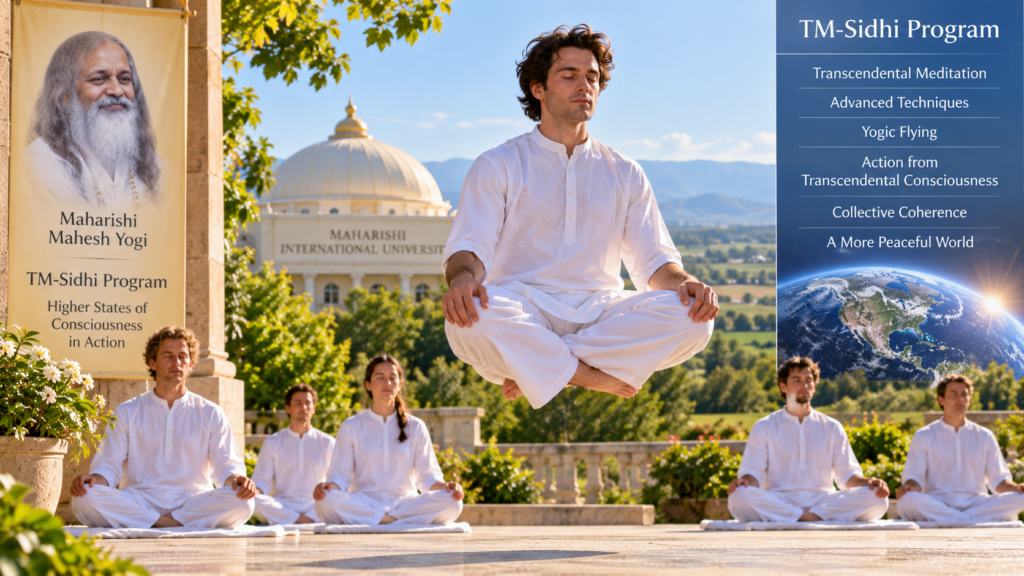
Yogic Flying is the best-known and most visually striking component of the TM-Sidhi Program.
Official Maharishi descriptions state that during the first stage of Yogic Flying, the body lifts and moves forward in short hops while the practitioner remains seated in a cross-legged position. Practitioners commonly describe the experience as light, joyful, or exhilarating.
It is important to describe this accurately.
The publicly documented first stage is not sustained aerodynamic flight. It consists of brief bodily movements or hops. Traditional texts and Maharishi’s teaching describe more advanced possibilities, but those are not established by modern scientific evidence.
What can science actually measure?
The TM-Sidhi Program generates several kinds of research questions that are accessible to modern methods.
Researchers can measure:
- EEG coherence and spectral activity;
- brain activation patterns;
- autonomic and cardiovascular changes;
- reaction time and cognitive performance;
- subjective experience;
- movement timing during Yogic Flying;
- and longer-term psychological or behavioral outcomes.
Science can also test whether effects attributed to group practice coincide with changes in social indicators. That is the research area associated with the Maharishi Effect and Collective Consciousness.
What science cannot establish merely from EEG or behavioral data is that the practitioner has gained “mastery over Natural Law” in the broad metaphysical sense used in Maharishi’s teaching.
EEG and brain-function research
One of the more concrete research areas involves brain-wave patterns.
A randomized study published in the International Journal of Psychophysiology in 2011 compared EEG activity during ordinary TM and during TM-Sidhi practice. Experienced practitioners were randomly assigned either to two TM sessions or to a TM session followed by TM-Sidhi practice.
The study reported differences in coherence, amplitude, and source-localization patterns between the two practices.
This is important because it suggests that TM-Sidhi practice is not merely subjectively described as different from TM; it may also involve a measurably different pattern of brain activity.
However, such results should be interpreted proportionately. A distinct EEG pattern can support the claim that the practices engage the nervous system differently. It does not by itself validate the full philosophical explanation of why those patterns occur or what they imply about consciousness.
Proposed individual effects
Official Maharishi sources attribute a broad range of benefits to the TM-Sidhi Program, including improved mind-body coordination, creativity, learning ability, neurological efficiency, happiness, and progress toward higher states of consciousness.
Some of these claims are empirically approachable. Others are harder to define operationally.
A useful way to separate them is:
- Measurable outcomes: cognition, EEG patterns, reaction time, stress, mood, health markers.
- Developmental outcomes: stable changes in self-awareness, emotional regulation, or sense of identity.
- Traditional outcomes: higher states of consciousness, enlightenment, or greater support of Natural Law.
The first category fits comfortably within conventional scientific research. The second can be studied but is methodologically more difficult. The third depends heavily on how traditional terms are defined and whether they can be linked to reproducible measurements.
Proposed collective effects
The most extraordinary claim associated with the TM-Sidhi Program concerns group practice.
Maharishi Effect researchers proposed that when a sufficiently large group practices the TM-Sidhi Program together, the resulting coherence may influence the surrounding population.
The commonly cited threshold is approximately the square root of 1% of a population.
Studies have reported associations with crime, conflict, accidents, and other social indicators. Some used prospective predictions and time-series methods. These findings are scientifically interesting because they make specific claims that can, in principle, be tested.
But the causal interpretation remains unresolved. Independent preregistered replication is still the most important missing step.
For a full treatment, see The Maharishi Effect and Collective Consciousness.
Where the evidence is limited
Several limitations recur in TM-Sidhi research.
Institutional concentration
Much of the literature has been produced by researchers associated with Maharishi institutions. This does not invalidate the findings, but independent replication would substantially increase confidence.
Small experimental samples
Many psychophysiological studies involve relatively small numbers of experienced practitioners.
Specialized participant populations
Long-term TM-Sidhi practitioners are highly selected. They may differ from non-practitioners in motivation, lifestyle, expectation, health behavior, and worldview.
Difficult blinding
Participants know which practice they are performing, and researchers may know the hypotheses being tested.
Extraordinary interpretations
Claims involving mastery of Natural Law, distant social effects, or extraordinary human abilities require much stronger evidence than claims involving relaxation, brain-wave patterns, or subjective experience.
Terminological ambiguity
Terms such as coherence, field, Natural Law, and higher states of consciousness can carry different meanings in neuroscience, physics, Vedic philosophy, and Maharishi’s own system. Similar terminology should not be mistaken for demonstrated equivalence.
What remains unresolved
- Does TM-Sidhi practice reliably produce a distinct neurophysiological state? Existing EEG work is suggestive, but larger independent replication would strengthen the case.
- Do practitioners develop durable cognitive or emotional benefits beyond ordinary TM?
- Can traditional descriptions of higher states of consciousness be operationalized scientifically?
- Does Yogic Flying involve anything beyond the observable first-stage hopping? No established scientific evidence currently demonstrates sustained physical flight.
- Can group TM-Sidhi practice causally influence distant social outcomes? This remains unresolved.
- What is the mechanism? No accepted physical theory currently explains a distant population-level effect of meditation.
- Are Maharishi’s claims best understood as metaphysical, phenomenological, or ultimately empirical? Different parts of the system may belong to different categories.
The Species Universe perspective
The TM-Sidhi Program is especially important to Species Universe because it sits directly at the boundary between experience, tradition, physiology, and extraordinary hypothesis.
At one level, it is a contemplative practice derived from a traditional Yogic framework.
At another, it generates measurable physiological and behavioral questions.
At another still, Maharishi interprets it as a means of acting from the field of pure consciousness and influencing Natural Law itself.
Those levels should not be collapsed.
Species Universe therefore takes the following position:
- The TM-Sidhi Program is a legitimate subject of scientific study.
- Its relationship to classical Yogic concepts such as samyama deserves accurate historical and philosophical treatment.
- EEG and psychophysiological findings are evidence about nervous-system function, not automatic proof of the whole metaphysical framework.
- Yogic Flying should be described exactly as observed rather than sensationalized.
- Collective-effect claims deserve continued investigation because they are testable, but they are not established scientific fact.
- Traditional claims about higher states of consciousness should be explored as traditional and phenomenological propositions unless stronger empirical bridges are demonstrated.
The most interesting possibility is not that every traditional claim will eventually be confirmed exactly as stated.
It is that disciplined contemplative traditions may contain reproducible methods for exploring aspects of consciousness that modern science has only begun to investigate.
If so, the TM-Sidhi Program deserves neither credulous acceptance nor casual dismissal. It deserves careful study.
Continue Exploring
- Transcendental Meditation as a Technology of Consciousness
- Scientific Research on Transcendental Meditation
- The Maharishi Effect and Collective Consciousness
- Maharishi Mahesh Yogi and Maharishi Vedic Science
- Maharishi International University
- Maharishi Ayurveda
- Transcendental Consciousness, Samādhi, and Enlightenment
Selected Sources
- Maharishi India — TM-Sidhi Programme
- Comparison of coherence, amplitude, and eLORETA patterns during Transcendental Meditation and TM-Sidhi practice, International Journal of Psychophysiology, 2011.
- MIU Research — Maharishi Effect
- MIU Brain Research Institute — Yogic Flying and Brain Functioning
Editorial note: Official Maharishi sources are used here to represent the TM-Sidhi Program accurately on its own terms. Claims about extraordinary abilities, Natural Law, or collective effects are distinguished from empirical findings and should be evaluated independently.