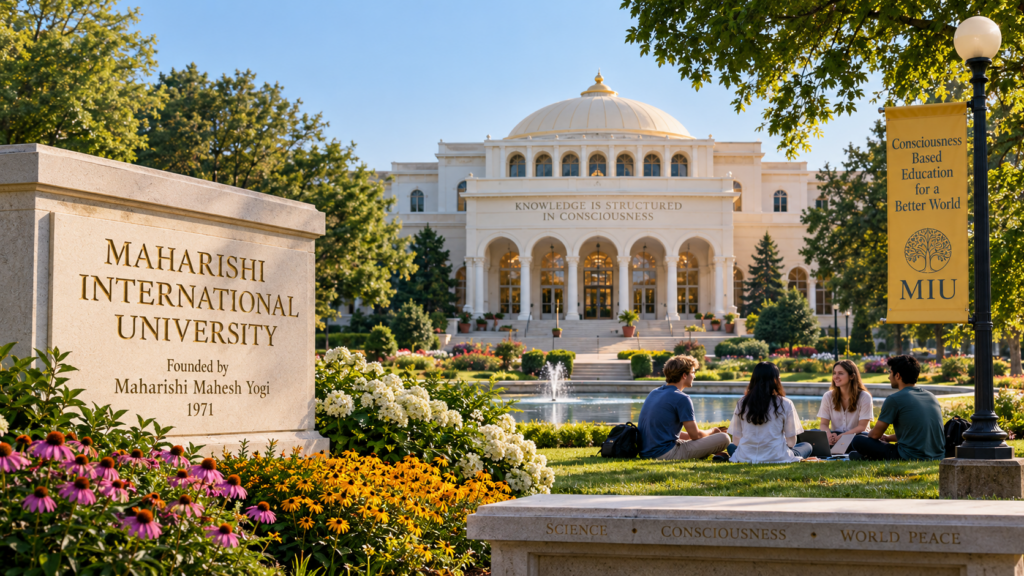
Maharishi International University (MIU) is one of the clearest real-world expressions of Maharishi Mahesh Yogi’s larger educational vision. Founded in 1971, the university was created around an unusual premise: education should develop not only knowledge of a subject, but also the consciousness of the student who is acquiring that knowledge.
Today MIU is an accredited nonprofit university in Fairfield, Iowa, offering both on-campus and online degree programs. Its distinctive educational model is called Consciousness-Based Education, which combines conventional academic study with the regular practice of the Transcendental Meditation technique and an explicit emphasis on personal development, self-knowledge, and the study of consciousness.
For Species Universe, MIU matters for several reasons. It is an educational institution, a research center, a community hub, and a long-running experiment in integrating meditation, science, health, sustainability, and academic life. It also provides a living context in which many of the claims surrounding Maharishi Vedic Science have been studied, taught, and debated.
History and founding
Maharishi International University was founded by Maharishi Mahesh Yogi in 1971. The institution was created around the idea that traditional higher education develops knowledge of the world while often doing comparatively little to develop the inner capacities of the student.
Maharishi’s response was Consciousness-Based Education: a model intended to combine academic learning with direct development of consciousness through the Transcendental Meditation technique.
The university later established its main campus in Fairfield, Iowa. Over time, it became a center for education, TM-related research, Maharishi Vedic Science, Ayurveda, sustainability, business, computer science, and programs exploring consciousness from both traditional and modern perspectives.
MIU describes itself as a 501(c)(3) nonprofit university and reports accreditation through the Higher Learning Commission.
What is Consciousness-Based Education?
Consciousness-Based Education is the defining feature of MIU.
The university presents it as an educational approach in which the student is not treated as a passive container for information. Instead, the development of awareness, creativity, learning ability, and well-being is considered part of the educational process itself.
In practical terms, the model combines:
- standard academic instruction;
- regular practice of Transcendental Meditation;
- courses and discussions about consciousness and human potential;
- an emphasis on personal development and self-knowledge;
- and an immersive block system in which students typically focus on one or two subjects at a time.
MIU states that this structure is intended to reduce academic stress and improve depth of learning. Students commonly take courses in four- to eight-week blocks rather than juggling many unrelated subjects simultaneously.
TM as part of university life
MIU states that students and faculty practice Transcendental Meditation as part of the university’s educational culture.
This is unusual in higher education. Meditation is not merely offered as an optional wellness activity; it is woven into the institutional philosophy of learning and personal development.
From the perspective of Maharishi Vedic Science, this makes sense. TM is viewed as a practical method for allowing awareness to settle inward toward quieter states and, potentially, toward pure or transcendental consciousness.
From a research perspective, MIU therefore functions as a naturally occurring environment in which long-term meditation practice can be studied across education, physiology, health, cognition, and subjective development.
For the broader evidence base, see Scientific Research on Transcendental Meditation.
Academic programs
MIU offers a wide range of programs, many of which resemble conventional university offerings, while others are unusual or unique because they explicitly integrate consciousness studies, Ayurveda, sustainability, or Maharishi Vedic Science.
Current programs listed by the university include areas such as:
- Consciousness and Human Potential;
- Maharishi Vedic Science;
- Physics and Consciousness;
- Ayurveda and Integrative Health;
- Business and Entrepreneurship;
- Computer Science;
- Regenerative Organic Agriculture;
- Sustainable and Regenerative Living;
- Creative Writing and Cinematic Arts;
- Leadership and Coaching;
- and individualized undergraduate programs.
Graduate offerings include a PhD in Maharishi Vedic Science, graduate programs in Consciousness and Human Potential, and degrees that explicitly explore the relationship between physics and consciousness.
This academic structure makes MIU one of the few accredited universities where consciousness is treated as a central subject rather than a peripheral topic within psychology, neuroscience, philosophy, or religious studies.
Research and scientific activity
Research has played a major role in MIU’s institutional identity.
The university’s research archive includes work on Transcendental Meditation, physiology, psychology, education, health, collective consciousness, and Maharishi Vedic Science. MIU also maintains archives of the journal Modern Science and Vedic Science and collections of TM research papers.
According to MIU, the university and affiliated researchers have received substantial research funding over the years, including federal grants. The university reports more than $32 million in federal and other grants, including funding from the National Institutes of Health.
Several research themes recur:
- physiological correlates of meditation;
- blood pressure and cardiovascular health;
- anxiety, stress, and trauma;
- brain-wave coherence and cognition;
- education and student development;
- collective consciousness and the Maharishi Effect;
- and theoretical comparisons between Vedic concepts and modern science.
The most important caution is institutional independence. A significant amount of TM research has been conducted by researchers associated with MIU or the broader TM movement. That does not invalidate the work, but it increases the value of independent replication by research teams with no institutional commitment to the technique or theory.
Fairfield and the surrounding community
MIU’s influence extends beyond the campus itself.
The university is located in Fairfield, Iowa, a small city that became internationally associated with the TM movement after large numbers of practitioners moved to the area.
Over time, Fairfield developed an unusually dense concentration of meditation practitioners, entrepreneurs, artists, health-oriented businesses, sustainability projects, and organizations associated with Maharishi’s programs.
MIU describes the surrounding community as strongly oriented toward sustainability, health, arts, entrepreneurship, and personal development.
This makes Fairfield sociologically interesting in its own right. It is not simply the location of a university; it is a community shaped in part by a shared contemplative culture.
The area has also played a role in Maharishi Effect research because large groups of TM and TM-Sidhi practitioners have practiced together there over extended periods.
What makes MIU distinctive
Several features distinguish MIU from conventional universities:
- Consciousness is treated as central to education.
- TM is integrated into student and faculty life.
- Academic programs explicitly connect consciousness with science, health, business, agriculture, and the arts.
- The university maintains a substantial research tradition around meditation and consciousness.
- The block system emphasizes depth and focus over simultaneous course load.
- Ayurveda, sustainability, and regenerative agriculture have an unusually prominent place in the curriculum.
- The Fairfield community provides a broader social environment built around many of the same values.
Whether one accepts Maharishi’s larger philosophical framework or not, the institution represents a rare attempt to redesign higher education around the systematic development of consciousness.
Questions and limitations
MIU also raises legitimate questions.
Can an institution study its own founding ideas objectively?
Researchers can do rigorous work within a sympathetic institution, but institutional commitment creates potential for researcher allegiance. Independent replication and external peer review are therefore especially important.
Does TM improve education outcomes?
The educational model is plausible and some research reports benefits in stress, cognition, and student development. But broad claims of superior educational performance require large, independent comparative studies.
How much of the experience is due to the whole environment?
Students at MIU encounter meditation, smaller classes, block scheduling, a distinctive community culture, and an emphasis on well-being simultaneously. Isolating which element produces which outcome can be difficult.
Does the success of an educational model validate Maharishi Vedic Science?
No. Even if students benefit from TM or the educational structure, that would not by itself establish broader metaphysical claims about pure consciousness, Natural Law, or the unified field.
Those larger questions must be evaluated separately.
The Species Universe perspective
Maharishi International University is important because it moves the discussion of consciousness out of abstraction and into institutional practice.
It asks a practical question:
What would education look like if consciousness itself were treated as something that can be systematically developed?
MIU’s answer is to combine conventional scholarship with meditation, self-development, and an explicit theory of consciousness.
Whether every theoretical claim associated with Maharishi Vedic Science is correct is a separate question. But the experiment itself is meaningful. It creates an environment in which claims about meditation, learning, health, creativity, and consciousness can be observed over time rather than discussed only in the abstract.
Species Universe therefore views MIU as:
- a legitimate accredited university;
- a major institutional center for TM and Maharishi Vedic Science;
- a research environment with both valuable data and potential institutional bias;
- a living example of Consciousness-Based Education;
- and a useful case study in how a theory of consciousness can shape education, community, and research.
The most interesting question is not whether MIU is conventional. It clearly is not.
The question is whether some of the ideas being tested there—especially the deliberate development of consciousness as part of education—deserve broader scientific and educational attention.
Continue Exploring
- Transcendental Meditation as a Technology of Consciousness
- Scientific Research on Transcendental Meditation
- The Maharishi Effect and Collective Consciousness
- Maharishi Mahesh Yogi and Maharishi Vedic Science
- The TM-Sidhi Program — next silo page
- Maharishi Ayurveda — upcoming silo page
- Transcendental Consciousness, Samādhi, and Enlightenment — upcoming silo page
Selected Sources
- Maharishi International University — About MIU
- MIU — Consciousness-Based Education
- MIU — Degree Programs
- MIU Research
Editorial note: MIU sources are used here to describe the university’s current structure, programs, philosophy, and institutional claims. Claims about educational effectiveness or consciousness should be evaluated separately from the institution’s own descriptions.