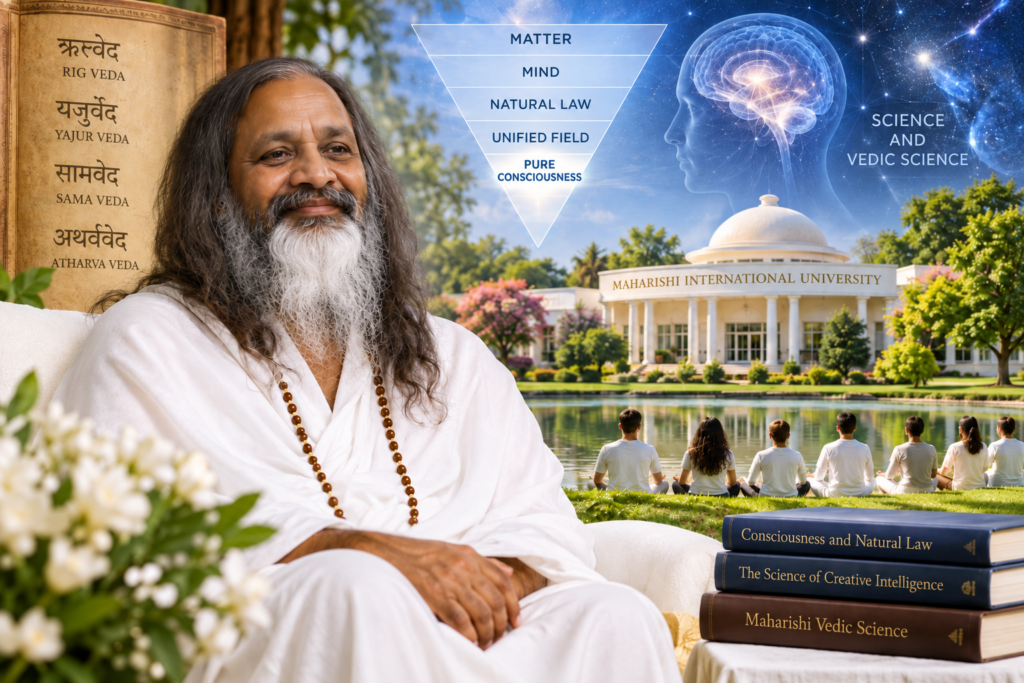
Maharishi Mahesh Yogi is best known internationally for bringing the Transcendental Meditation technique to a global audience. But TM was only one part of a much larger intellectual and practical project. Over several decades, Maharishi presented what he called Maharishi Vedic Science: a systematic framework in which consciousness is treated not merely as a product of mental activity, but as a fundamental domain of knowledge that can be investigated through direct experience, traditional Vedic sources, and modern scientific measurement.
That makes Maharishi difficult to place neatly within familiar categories. He was a spiritual teacher rooted in the Vedic tradition, an organizer who built a worldwide educational movement, and a thinker who deliberately used the language of modern science to describe ancient claims about consciousness, natural law, human development, and the structure of reality.
This Species Universe page examines that larger framework on its own terms while keeping several questions distinct: What did Maharishi actually teach? What is traditional Vedic interpretation? What has been studied scientifically? What remains philosophical or theoretical? And where might genuine convergence between ancient and modern knowledge still be possible?
Who was Maharishi Mahesh Yogi?
Maharishi Mahesh Yogi emerged as an international teacher in the 1950s. The official Transcendental Meditation organization describes him as having spent many years studying with his teacher before beginning a worldwide effort to make a simple meditation practice broadly available. By 1958, he was traveling internationally teaching what became known as the Transcendental Meditation technique.
Over the following decades, Maharishi trained thousands of teachers and inspired the creation of nonprofit organizations, schools, colleges, universities, research programs, health initiatives, and other institutions. His public reputation became strongly associated with TM, especially after the technique spread rapidly through Europe and North America.
But Maharishi did not present TM merely as a relaxation method. He described it as a means for the conscious mind to settle beyond ordinary thought and experience what he called transcendental consciousness or pure consciousness.
That experiential claim became the foundation for the much broader system that he later called Maharishi Vedic Science.
For the introductory page on the practice itself, see Transcendental Meditation as a Technology of Consciousness.
From TM to a larger science of consciousness
The central move in Maharishi’s system is simple to state but far-reaching in implication.
Modern science normally studies consciousness from the outside. Researchers observe brain activity, behavior, physiology, cognitive performance, and reports of experience. Maharishi argued that this is incomplete because consciousness is also the subject that performs observation.
In his framework, a complete science of consciousness must therefore contain both:
- objective investigation—measurement of observable processes and outcomes; and
- subjective investigation—systematic refinement of awareness so that consciousness can become an object of direct experience to itself.
TM was presented as the practical method by which the second form of investigation could occur.
This is one of the most important ideas for understanding Maharishi. He was not simply adding meditation to science. He was arguing that the knower must be included in the structure of knowledge.
What is Maharishi Vedic Science?
Maharishi International University describes Maharishi Vedic Science as a science of consciousness concerned with both the nature of individual awareness and its relation to the larger structure of natural law.
Within the system, three dimensions are especially important:
- knowledge—the theoretical account of consciousness, Veda, natural law, and human development;
- experience—direct access to quieter and allegedly more fundamental states of awareness through meditation; and
- application—programs intended to improve health, education, individual development, social coherence, and other areas of life.
Maharishi described Vedic Science not as a set of beliefs to be accepted on authority but as knowledge that, at least in principle, should become meaningful through direct experience and systematic verification.
That claim is philosophically significant. It resembles a form of first-person empiricism: the suggestion that disciplined inner experience can yield repeatable knowledge, just as disciplined outer observation does.
Pure consciousness and self-referral awareness
At the center of Maharishi Vedic Science is the concept of pure consciousness.
Ordinary waking awareness is usually directed toward something: a thought, sensation, memory, perception, object, or task. Maharishi called this object-referral awareness.
By contrast, transcendental consciousness is described as self-referral: awareness remaining awake without being occupied by a particular object of thought.
In Maharishi’s language, consciousness becomes aware of itself.
This is closely related to the traditional concept of samādhi, though interpretations of samādhi vary considerably across Vedic, Yogic, Buddhist, and other contemplative traditions.
The scientific question is whether such a state can be identified reliably. Researchers can investigate recurring subjective reports, EEG activity, autonomic changes, respiration, metabolism, and other physiological measures during meditation. If a reproducible physiological pattern accompanies a reproducible experiential report, that supports the claim that a distinctive state occurs.
It does not, by itself, settle the metaphysical question of what consciousness ultimately is.
That deeper question will be examined in Transcendental Consciousness, Samādhi, and Enlightenment.
Veda, Natural Law, and the structure of knowledge
In conventional historical understanding, the Veda refers to the ancient Sanskrit textual tradition at the foundation of Vedic culture and later Hindu thought.
Maharishi gave the term a broader epistemological interpretation.
Within Maharishi Vedic Science, Veda is described not merely as a collection of ancient texts but as knowledge structured in consciousness. MIU materials describe the Vedic literature as expressing fundamental patterns or laws of nature that can, in Maharishi’s interpretation, be cognized at the deepest level of awareness.
This is a traditional-philosophical claim, not an established conclusion of physics or neuroscience.
Its importance lies in how it reorganizes the relation between knowledge and reality. In this view, intelligence is not something produced only by individual brains and later imposed on a meaningless universe. Rather, order, intelligence, and lawful structure are intrinsic to nature itself, and the human mind may be capable of becoming consciously aligned with that deeper order.
Maharishi often used the phrase Natural Law to describe this universal ordering intelligence.
Species Universe considers this claim worth examining because modern science likewise discovers pervasive lawful structure throughout nature. But the similarity should not be overstated: scientific laws are mathematical descriptions derived from observation and experiment; Maharishi’s concept of Natural Law includes experiential and metaphysical dimensions that go beyond that conventional meaning.
Modern science and Vedic Science
Maharishi repeatedly contrasted what he regarded as the strengths and limitations of modern science with the proposed completeness of Vedic Science.
Modern science is extraordinarily successful at discovering objective regularities. It measures, predicts, models, and tests relationships among observable phenomena.
Maharishi’s critique was that the observer usually remains outside the explicit structure of this investigation.
Vedic Science, as he presented it, begins from the opposite direction: it investigates consciousness from within and then interprets objective nature in relation to that experience.
The intended synthesis is therefore not “ancient scripture replaces modern science.” It is closer to:
- modern science provides increasingly precise knowledge of objective natural law;
- Vedic Science provides a systematic account of consciousness and subjective development;
- and a complete knowledge system would ultimately have to explain both the observer and the observed within one framework.
Whether Maharishi’s proposed synthesis succeeds is an open question. But the problem he identifies is real: any complete theory of reality must eventually explain how conscious experience fits into nature.
The unified-field comparison
One of Maharishi’s boldest later claims was that the deepest level of consciousness described by Vedic Science corresponds to the most unified level of natural law sought by modern physics.
MIU publications explicitly describe Maharishi’s view that the “unified field” of natural law is experienced subjectively as pure consciousness.
This comparison has intuitive appeal within the framework. Modern physics seeks increasingly unified descriptions of fundamental interactions. Maharishi Vedic Science proposes an unmanifest, self-referral field from which diversity emerges. Both systems therefore use language of unity underlying multiplicity.
But similarity of conceptual structure does not establish physical identity.
Modern unified-field theories are mathematical frameworks evaluated through physical prediction and experiment. Pure consciousness is a first-person experiential and metaphysical concept. At present, there is no established derivation in physics showing that a meditative state is identical to a fundamental physical field.
The responsible position is therefore neither to equate the two nor to declare comparison forbidden.
The comparison can be explored as a hypothesis about deep structural correspondence. To become a scientific identity claim, however, it would need a clear mathematical and empirical bridge.
TM and TM-Sidhi as “technologies”
Maharishi often described TM and the later TM-Sidhi program as technologies of consciousness.
The word technology is important here. A technology is not merely an idea; it is a reproducible procedure intended to produce a particular result.
TM is presented as a standardized procedure for transcending ordinary mental activity and experiencing quieter levels of awareness. The TM-Sidhi program is presented as an advanced extension intended to develop the ability to act from that more settled level of consciousness.
That formulation creates testable questions:
- Do trained practitioners reliably report similar classes of experience?
- Are recurring experiences associated with measurable physiological patterns?
- Do long-term practitioners show durable differences in cognition, health, or behavior?
- Does the TM-Sidhi program produce effects beyond ordinary TM practice?
- Can group practice influence outcomes outside the practitioners themselves?
The last question leads directly to the Maharishi Effect and Collective Consciousness.
For the broader clinical evidence on TM, see Scientific Research on Transcendental Meditation.
Education and institutions
Maharishi’s ideas were institutionalized most visibly in education.
Maharishi International University—founded by Maharishi and based in Fairfield, Iowa—describes its educational system as Consciousness-Based Education. The model combines conventional academic study with regular TM practice and courses addressing consciousness, human potential, and Maharishi Vedic Science.
MIU currently offers academic programs in Maharishi Vedic Science, consciousness and human potential, physics and consciousness, business, regenerative agriculture, and other fields.
The educational logic follows directly from Maharishi’s philosophy: knowledge is incomplete if it develops information about the world without simultaneously developing the consciousness of the knower.
The larger history, research environment, and Fairfield community will be examined separately in Maharishi International University.
What modern science can actually test
The strongest way to evaluate Maharishi Vedic Science is to separate its different levels of claim.
Empirically testable claims
Modern research can directly test questions involving:
- blood pressure, cardiovascular outcomes, anxiety, stress, and PTSD;
- EEG and other physiological measures during meditation;
- cognition, learning, attention, and well-being;
- long-term developmental differences among practitioners;
- social outcomes associated with large meditation groups.
Phenomenological claims
Researchers can also investigate whether practitioners consistently report particular states such as pure consciousness, inner silence, or the coexistence of wakefulness with minimal thought content. These experiences can be studied systematically, although first-person reports remain different from third-person measurements.
Philosophical and metaphysical claims
Claims that consciousness is fundamental, that Veda is the intrinsic structure of natural law, or that pure consciousness is identical with the unified field of physics cannot be established solely from ordinary clinical or physiological studies.
These claims require broader argument, possible new experimental bridges, and perhaps new theoretical frameworks.
That does not make them invalid questions. It locates them correctly.
What remains unresolved
Maharishi Vedic Science raises several questions that remain genuinely open:
- Is transcendental consciousness a distinct state of consciousness in a scientifically robust sense?
- Can first-person contemplative methods produce reliable knowledge rather than only private experience?
- Do advanced states described in the Vedic tradition correspond to stable developmental changes in the brain and behavior?
- Is consciousness generated by the brain, mediated by the brain, or more fundamental than the brain?
- Does the structural language of Veda correspond in any rigorous way to the mathematical structure of nature?
- Is Maharishi’s proposed identification of pure consciousness with the unified field of natural law metaphorical, philosophical, or ultimately testable?
- Can group meditation produce effects that cannot be explained through ordinary social mechanisms?
These questions range from experimentally approachable to deeply philosophical. They should not all be judged by the same evidentiary standard.
The Species Universe assessment
Maharishi Mahesh Yogi’s lasting significance may ultimately extend beyond the popularity of Transcendental Meditation.
His larger project attempted something unusually ambitious: to reconnect subjective experience, ancient Vedic knowledge, human development, and modern science within a single systematic framework.
Some aspects of that program are readily testable and have generated decades of research. Others remain interpretive. Still others make claims about consciousness and reality that lie well beyond present scientific consensus.
Species Universe does not require those categories to collapse into one another.
The most productive approach is to preserve them:
- TM as a practice can be investigated empirically.
- Pure consciousness as reported experience can be studied phenomenologically and physiologically.
- Maharishi Vedic Science as a philosophical system can be evaluated for coherence, explanatory power, historical roots, and consistency with evidence.
- Claims of identity with fundamental physics require much stronger theoretical and empirical bridges.
- Traditional Vedic claims deserve accurate representation on their own terms rather than being either automatically scientificized or automatically dismissed.
The most important contribution may be the question Maharishi forced back into view:
Can a civilization understand reality completely without understanding the consciousness through which reality is known?
That question remains open—and it is central to the mission of Species Universe.
Continue Exploring
- Transcendental Meditation as a Technology of Consciousness
- Scientific Research on Transcendental Meditation
- The Maharishi Effect and Collective Consciousness
- Maharishi International University — forthcoming silo page
- The TM-Sidhi Program — forthcoming silo page
- Maharishi Ayurveda — forthcoming silo page
- Transcendental Consciousness, Samādhi, and Enlightenment — forthcoming silo page
Selected Sources
- Transcendental Meditation organization — origins and Maharishi Mahesh Yogi
- Maharishi International University — Department of Maharishi Vedic Science
- Maharishi on Modern Science and Vedic Science
- Modern Science and Vedic Science: An Introduction
- Modern Science and Vedic Science journal archive
Editorial note: Institutional sources are used here primarily to represent Maharishi Vedic Science accurately on its own terms. Their descriptions of the system should not be confused with independent scientific confirmation of every proposition within that system.