Transcendental Meditation (TM) has been studied for decades, producing a research literature that is unusually large for a single meditation technique. That literature includes randomized trials, physiological studies, cardiovascular research, studies of anxiety and post-traumatic stress, and broader investigations of meditation and health. The important question is therefore no longer simply, “Has TM been studied?” It clearly has. The more useful question is: What does the research actually establish, where is the evidence promising, where are the limits, and which larger claims remain open?
This Species Universe review takes that question seriously without treating either advocacy or skepticism as a substitute for evidence. TM is examined here as a repeatable method of consciousness practice, a health-related intervention that has been tested in clinical settings, and a possible window into altered or quieter states of awareness. Those are different kinds of claims, and they should not be collapsed into one another.
What exactly is being tested?
TM is commonly taught as a standardized, twice-daily practice involving the effortless use of a mantra. Within the TM tradition, the method is described as allowing mental activity to settle naturally toward quieter states and, at times, toward a condition described as transcendental consciousness or pure consciousness.
Scientific studies do not directly test every philosophical interpretation attached to those experiences. Instead, researchers measure observable or reportable outcomes such as blood pressure, anxiety scores, post-traumatic stress symptoms, physiological markers, brain activity, cognitive performance, or self-reported experience.
That distinction matters. A study can show that a meditation practice is associated with lower blood pressure without proving a theory of consciousness. It can show that practitioners report a distinctive subjective state without proving that the state is the fundamental field of nature. Conversely, the fact that a philosophical interpretation is not established by a clinical trial does not make the experience or the philosophical question meaningless.
Species Universe therefore separates three levels:
- Empirical outcome: what a study actually measured.
- Interpretation: what researchers or practitioners think the result may mean.
- Broader framework: how TM is situated within Maharishi Vedic Science and theories of consciousness.
For the larger framework, see Transcendental Meditation as a Technology of Consciousness and the Species Universe Methodological Framework.
What the evidence supports reasonably well
The most defensible summary is that TM has produced credible evidence of modest benefits in several health-related domains, especially blood pressure and some measures of psychological distress. There are also encouraging results in PTSD and cardiovascular-risk research. At the same time, study quality is uneven, many trials are relatively small, long-term independent replication is limited, and some of the literature has been produced by researchers affiliated with institutions connected to the TM movement.
That combination should neither be ignored nor exaggerated. It means the correct scientific position is not “TM has no evidence,” but neither is it “every major claim about TM has been proven.”
Blood pressure and cardiovascular health
Blood pressure is one of the better-studied areas in the TM literature. A 2022 meta-analysis covering 18 primary studies and 1,207 participants reported average reductions of about 3.3 mm Hg systolic and 1.8 mm Hg diastolic compared with control conditions. The authors also reported that effects tended to diminish after three months in the available studies, which underscores the importance of duration and adherence.
More recently, the 2025 American Heart Association/American College of Cardiology hypertension guideline stated that short-term trials provide moderate- to high-level evidence that TM can lower blood pressure in people with and without hypertension, with average reductions on the order of roughly 5/2 mm Hg. The guideline also notes that meditation appears less potent for blood-pressure control than major lifestyle interventions such as the DASH diet, structured exercise, or reduced sodium intake.
This is a useful example of proportionate interpretation. A few millimeters of mercury can matter at the population level and may be clinically meaningful for some individuals. But TM is not a substitute for prescribed antihypertensive medication, dietary change, exercise, or medical evaluation when those are indicated.
A frequently discussed randomized trial followed 201 Black adults with coronary heart disease and compared TM with health education. Over an average follow-up of 5.4 years, the TM group had fewer events in a composite endpoint of death, myocardial infarction, and stroke. The result was notable and deserves attention, but one trial of this size should not be treated as definitive proof that TM prevents cardiovascular events. Replication by independent teams would substantially strengthen the claim.
Anxiety, stress, and psychological well-being
Research on meditation more broadly suggests that meditative practices can reduce anxiety and stress symptoms, although effect sizes vary according to the population, control condition, technique, study design, and baseline severity.
A TM-specific meta-analysis of randomized trials published in 2014 examined 16 studies involving 1,295 participants and reported moderate reductions in trait anxiety compared with both treatment-as-usual and active comparison conditions. Larger reductions were reported among participants with higher baseline anxiety. Because authorship and institutional affiliation can influence interpretation in any specialized research field, these findings should be read alongside independent meditation reviews rather than in isolation.
A broader 2022 systematic review and meta-analysis of mantra-based meditation, which included TM and other mantra-centered practices, found small-to-moderate reductions in anxiety, depression, stress, post-traumatic stress, and mental-health-related quality of life. The review also explicitly warned that the evidence base is weakened by risk of bias, limited psychiatric samples, and a shortage of long-term follow-up.
That combination is important: the signal of benefit is real enough to take seriously, but the literature is not yet strong enough to support universal or highly precise clinical promises.
PTSD and trauma-related symptoms
One of the more interesting modern areas of TM research concerns post-traumatic stress disorder. A randomized controlled trial published in The Lancet Psychiatry in 2018 compared TM with prolonged exposure therapy and a health-education control in veterans with PTSD. The trial was designed as a noninferiority study and reported that TM was not inferior to prolonged exposure on the primary PTSD symptom outcome over the study period.
A later pilot randomized controlled trial involving 40 veterans also reported larger reductions in clinician-rated PTSD symptoms for the TM group than for treatment as usual after three months.
These findings are promising for an important reason: some people with PTSD have difficulty tolerating trauma-focused treatments, and a non-trauma-focused intervention may therefore be attractive as an additional option. But “promising” is the correct word. The evidence base remains much smaller than that for established trauma-focused psychotherapies, and treatment choices should remain individualized and clinically supervised.
Brain, physiology, and consciousness
The most philosophically interesting TM research is also the area where interpretation requires the greatest care.
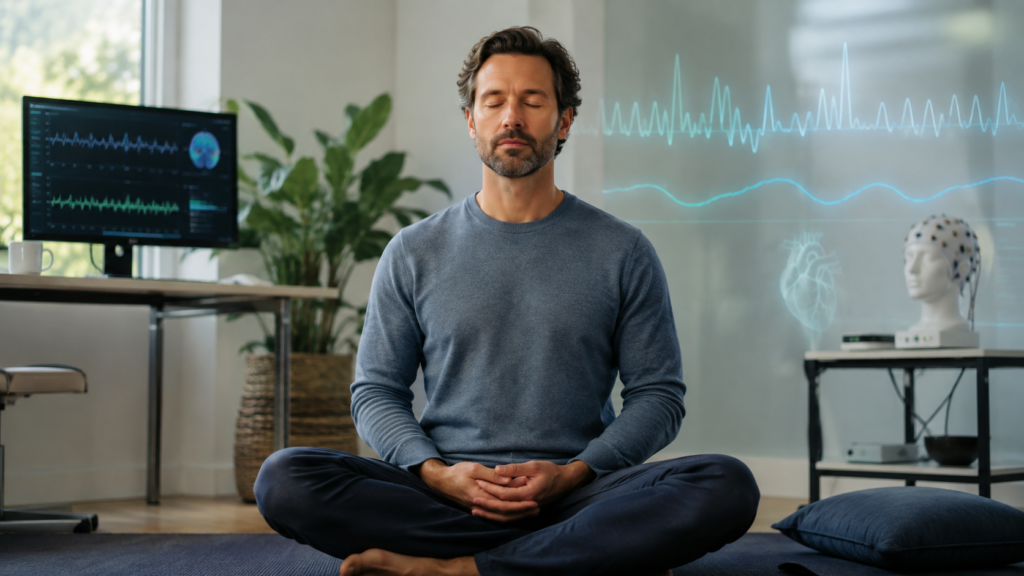
Researchers have studied EEG patterns, autonomic activity, metabolic changes, subjective reports, and other physiological correlates during meditation. Such work can help answer questions such as:
- Does the nervous system enter a reproducible state during practice?
- Are certain brain rhythms or patterns of functional coordination more common during TM?
- Do long-term practitioners differ from non-practitioners on measurable physiological or cognitive variables?
- Are reports of “pure consciousness” associated with recurring physiological signatures?
These are legitimate scientific questions. If repeatable physiological patterns accompany repeatable first-person reports, that would strengthen the case that meditation can be studied as more than a vague subjective activity.
However, such findings do not by themselves establish that pure consciousness is a universal field, that consciousness is ontologically fundamental, or that the experience is identical to the unified field described in physics. Those are broader theoretical interpretations.
Species Universe considers those interpretations worth investigating. The proper response is not to dismiss them because they exceed the immediate measurements, but to label the transition clearly: physiology can support a claim that a distinctive state occurs; philosophy and theory are required to interpret what that state ultimately means.
This approach is consistent with the site’s broader treatment of Meditation as a Technology of Consciousness and Vedic Knowledge Systems.
Where the research is strongest
Several features of the TM literature deserve genuine credit.
- It has been studied for a long time. TM research is not based on a handful of recent wellness studies.
- Randomized trials exist. This is more informative than relying only on testimonials or uncontrolled before-and-after observations.
- Several outcomes have been studied repeatedly. Blood pressure, anxiety, stress, and PTSD have more than one supporting study.
- Some research has used active comparison groups. This helps separate the effects of meditation from simply receiving attention or sitting quietly.
- There are clinically relevant outcomes. The literature does not consist solely of abstract EEG measures; it includes blood pressure, symptom scales, and cardiovascular endpoints.
- Government and professional health organizations now discuss meditation as a legitimate complementary health approach. That does not validate every TM claim, but it does place meditation within mainstream scientific and clinical evaluation.
Where the research is limited
A serious evaluation must also acknowledge recurring weaknesses.
1. Researcher allegiance and institutional concentration
A meaningful portion of the TM literature has been produced by investigators affiliated with Maharishi-related universities or research organizations, or by researchers who have long worked within the TM research community. That does not invalidate the studies. It does, however, increase the importance of replication by teams with no institutional commitment to the intervention.
2. Small studies
Many meditation trials involve relatively modest sample sizes. Small studies are more vulnerable to unstable estimates, chance findings, and exaggerated effect sizes.
3. Blinding is difficult
Participants generally know which intervention they receive. Teachers know what they are teaching. Expectations, enthusiasm, social contact, and perceived novelty can therefore influence self-reported outcomes.
4. Heterogeneous control conditions
A meditation program may look more impressive when compared with a waiting list than when compared with another structured intervention. Meta-analyses that combine different control conditions must therefore be interpreted carefully.
5. Short follow-up
Some reported benefits appear strongest in the early months. We know less about durability over many years, especially outside highly motivated practitioner populations.
6. Selective outcomes and publication bias
Like many behavioral and complementary-health fields, meditation research can be vulnerable to selective publication of positive findings and multiple-outcome testing. Preregistered trials and publication of null findings improve confidence.
7. Health effects do not settle metaphysics
Even a strong clinical effect would not, by itself, prove Maharishi Vedic Science, collective consciousness, or the identity of consciousness with a unified physical field. Those require additional lines of reasoning and evidence.
What remains unresolved
Several questions are still genuinely open.
- Is TM uniquely effective? Some studies and meta-analyses favor TM, but direct, high-quality head-to-head comparisons with other meditation methods remain too limited for sweeping conclusions.
- How much of the effect depends on regularity, instruction quality, expectation, and long-term adherence?
- Which people benefit most? Effects may differ by age, baseline anxiety, cardiovascular risk, trauma history, and motivation.
- How durable are benefits? More multi-year independent studies are needed.
- Are reported states of pure consciousness associated with a distinctive and reproducible neurophysiological pattern? There is suggestive work, but the question is far from closed.
- Do those states tell us something fundamental about consciousness itself? This remains a scientific and philosophical frontier rather than an established conclusion.
- Can effects extend beyond the individual? Claims such as the Maharishi Effect require a different evidentiary framework and will be addressed separately in The Maharishi Effect and Collective Consciousness.
The Species Universe perspective
The scientific research on TM is significant because it creates a bridge between first-person experience and third-person measurement.
TM practitioners describe an inward settling of mental activity and, in some cases, awareness without ordinary thought content. Science can ask whether those reports correspond to reproducible changes in physiology, cognition, behavior, and health. If they do, then meditation becomes scientifically interesting not only as a relaxation tool but as a structured method for altering the condition of the observer.
That still leaves the deepest question open: what is the ontological status of the awareness being experienced?
Maharishi Mahesh Yogi proposed a much larger answer through Maharishi Vedic Science: that the deepest level of consciousness is not merely a private mental state but reflects a universal field underlying both mind and nature. Species Universe takes that proposal seriously as a framework to investigate. It is not treated here as something already demonstrated by blood-pressure studies, EEG measurements, or subjective reports.
The distinction is crucial. Scientific caution should protect us from overstating what a study proves. It should not prevent us from asking larger questions that the data make intellectually interesting.
This page therefore arrives at a middle position that is stronger than either advocacy or dismissal:
- TM has a genuine scientific research base.
- Several health effects are supported well enough to merit serious attention.
- Some claims remain preliminary or methodologically contested.
- The experiential and consciousness-related implications remain an active field of inquiry.
- The larger Vedic interpretation should be investigated on its own merits rather than being smuggled into clinical findings—or excluded merely because it is philosophically ambitious.
Continue with Transcendental Meditation as a Technology of Consciousness, the Methodological Framework, and the upcoming page on The Maharishi Effect and Collective Consciousness.
Selected research sources
- Effects of Transcendental Meditation on Blood Pressure: A Meta-analysis — meta-analysis of 18 primary studies.
- 2025 AHA/ACC Guideline for the Prevention, Detection, Evaluation and Management of High Blood Pressure in Adults — includes discussion of TM and blood pressure.
- Stress Reduction in the Secondary Prevention of Cardiovascular Disease — randomized trial in Black adults with coronary heart disease.
- Effects of the Transcendental Meditation Technique on Trait Anxiety — meta-analysis of randomized controlled trials.
- Effectiveness of Mantra-Based Meditation on Mental Health — systematic review and meta-analysis.
- Non-trauma-focused Meditation Versus Exposure Therapy in Veterans With PTSD — randomized controlled trial.
- Pilot Randomized Controlled Trial of Transcendental Meditation for PTSD in Veterans.
- National Center for Complementary and Integrative Health: Meditation and Mindfulness—Effectiveness and Safety.
- NCCIH: Hypertension and Complementary Health Approaches.
Health note: TM may be used as a complementary practice, but this page is not medical advice. People with hypertension, cardiovascular disease, PTSD, severe anxiety, or other medical or psychiatric conditions should make treatment decisions with qualified health professionals and should not stop prescribed treatment because of meditation research.