Physics Foundations Cornerstone Article
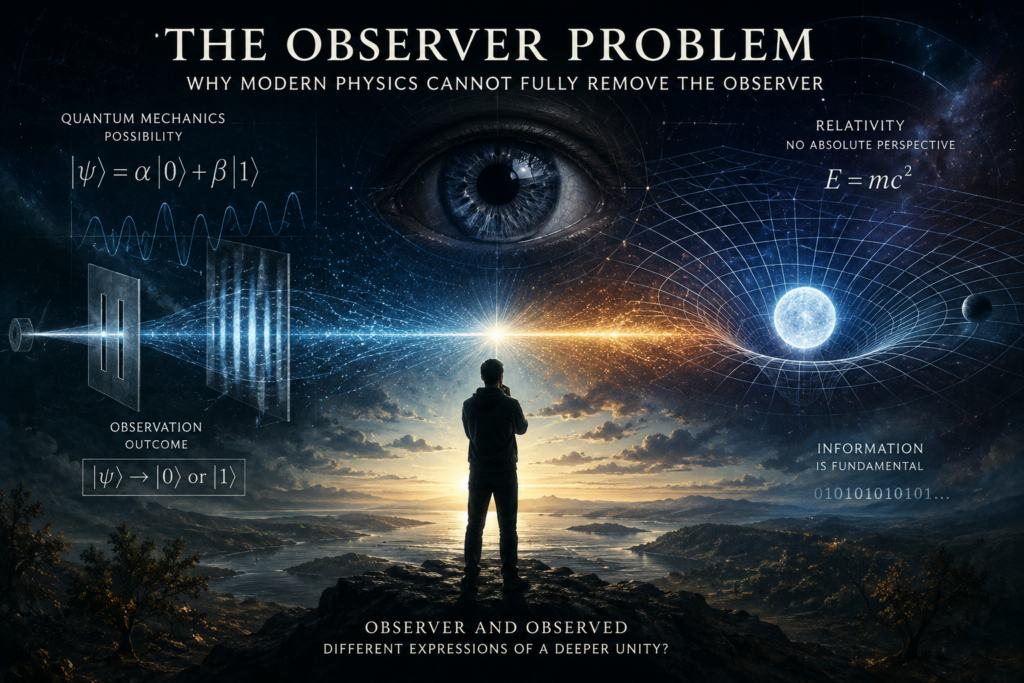
The observer problem sits at the intersection of quantum mechanics, relativity, information theory, and consciousness studies. Although modern science has achieved extraordinary success in describing the physical world, the role of the observer continues to reappear at the foundations of our most successful theories.
This cornerstone article explores why the observer cannot be completely removed from modern physics and how questions of observation, measurement, information, and experience challenge classical assumptions about an entirely observer-independent reality.
As part of the Physics Foundations section of Species Universe, this guide examines one of the deepest unresolved questions in science: whether the distinction between observer and observed is fundamental, or whether it emerges from a deeper and more unified description of reality.
Because these questions span physics, philosophy, and consciousness studies, this article is intentionally comprehensive. Readers are encouraged to use the Table of Contents below to explore individual sections and return to the article as their understanding develops.
Table of Contents
- The Question Physics Keeps Encountering
- The Classical Dream of Observer-Independent Reality
- Relativity and the End of Absolute Perspective
- Quantum Mechanics and the Return of the Observer
- Information, Measurement, and Reality
- Consciousness and the Limits of Physical Description
- Toward a Deeper Unity: What the Observer Problem May Be Telling Us
- Frequently Asked Questions
- The Beginning, Not the End
- Further Exploration
The Question Physics Keeps Encountering
Imagine that you are standing alone beneath a clear night sky.
Above you stretches a universe so vast that light from some of the stars entering your eyes tonight began its journey before human civilization existed.
You look up and ask a simple question:
What is all of this?
For thousands of years, humanity has searched for an answer.
We have looked to religion.
We have looked to philosophy.
We have looked to science.
Of all these approaches, science has been the most successful at explaining the physical world. Through observation, experimentation, and mathematics, it has transformed our understanding of nature.
Science revealed that Earth is not the center of the cosmos.
It uncovered the laws of motion.
It explained electricity, chemistry, genetics, and the evolution of life.
It carried human beings to the Moon and sent robotic explorers to the edge of the Solar System.
The success of science has been so extraordinary that many people assume its fundamental picture of reality is largely complete.
Yet beneath this success lies a problem that refuses to disappear.
A problem so strange that some of the greatest physicists in history have spent decades arguing about it.
A problem that sits at the intersection of quantum mechanics, relativity, information, and consciousness.
A problem known as the Observer Problem.
At first glance, the problem seems almost absurd.
How could an observer matter?
Surely the universe existed long before human beings appeared.
The stars were shining billions of years before anyone looked at them.
Galaxies formed.
Planets emerged.
Life evolved.
Reality does not seem to require our permission to exist.
And yet modern physics has repeatedly stumbled upon situations in which observation appears far more important than anyone expected.
The deeper scientists investigate the foundations of reality, the harder it becomes to draw a clear line between the observer and the observed.
This is not because physics has proven that consciousness creates reality.
It has not.
Nor is it because science has somehow become mystical.
It has not.
The problem is far more subtle.
The observer keeps reappearing.
Again and again.
In places where classical science expected to find only objective reality.
The first hints appeared in Einstein’s theory of relativity.
The problem became impossible to ignore with the development of quantum mechanics.
More recently, questions surrounding information, computation, and consciousness have brought renewed attention to the issue.
After more than a century of debate, physicists still do not agree on what the observer problem ultimately means.
That alone should give us pause.
Modern physics is arguably the most successful intellectual achievement in human history.
Its equations describe nature with astonishing precision.
Its predictions have been confirmed countless times.
Its technologies power the modern world.
Yet when we ask some of the most fundamental questions—What is observation? What is measurement? What is reality before it is observed?—the answers become surprisingly difficult.
The observer problem is not a flaw in science.
It is evidence that we have reached the edge of what our current frameworks can easily explain.
And whenever science reaches such a boundary, something important tends to happen.
The old assumptions begin to crack.
Questions once considered settled become open again.
New possibilities emerge.
This has happened before.
For centuries, people believed space and time were absolute.
Einstein showed otherwise.
For centuries, people believed matter consisted of tiny solid objects.
Quantum mechanics revealed a reality far stranger than anyone imagined.
Today, the observer problem may represent another such boundary.
Not because it has already overturned our understanding of reality.
But because it forces us to ask whether some of our most basic assumptions about observer and observed, mind and matter, subject and object, are as fundamental as we once believed.
The purpose of this article is not to argue for a particular conclusion.
Instead, we will follow the problem wherever it leads.
We will examine how the observer entered modern physics.
Why physicists have struggled to remove it.
Why the problem remains unresolved.
And why some researchers believe it may point toward a deeper relationship between consciousness and physical reality than either science or philosophy has yet fully understood.
The journey begins with a dream.
The dream of a universe that could be completely described without reference to any observer at all.
A dream that shaped modern science.
And a dream that modern physics has never fully been able to realize.
The Classical Dream of Observer-Independent Reality
For most of scientific history, the observer was not considered a problem.
In fact, the success of science depended upon treating nature as something that existed independently of whoever happened to be studying it.
This was one of the great breakthroughs of the Scientific Revolution.
Nature could be investigated objectively.
Measurements could be repeated.
Experiments could be verified.
The universe operated according to laws that were the same for everyone.
This idea seems obvious today.
Yet it represented a profound shift in human thinking.
Instead of asking what authority declared to be true, scientists began asking what nature itself revealed through observation and experiment.
The results were extraordinary.
From Galileo to Newton, from Maxwell to Darwin, science uncovered a universe governed by discoverable principles.
The observer became little more than a witness.
Reality existed.
Science described it.
The separation between observer and observed appeared complete.
For centuries, few saw any reason to question this picture.
Then, at the beginning of the twentieth century, reality began behaving in ways that no one expected.
Relativity and the End of Absolute Perspective
The first major challenge to the classical picture of reality did not come from quantum mechanics.
It came from Albert Einstein.
At the beginning of the twentieth century, physics appeared remarkably complete.
Newton’s laws successfully described the motion of objects on Earth and in the heavens.
James Clerk Maxwell’s equations explained electricity, magnetism, and light.
Many physicists believed only minor details remained to be solved.
Yet hidden within the success of classical physics was an anomaly.
Light.
The more scientists studied light, the stranger it appeared.
According to Maxwell’s equations, light always travels at the same speed through a vacuum—approximately 186,000 miles per second (300,000 kilometers per second).
This raised an obvious question.
Relative to what?
If you throw a baseball from a moving train, its speed depends upon the speed of the train.
Common sense suggests light should behave similarly.
If an observer moves toward a beam of light, they should measure a different speed than someone moving away from it.
Experiments repeatedly showed otherwise.
No matter how scientists measured it, the speed of light remained the same.
Most physicists viewed this as a technical problem.
Einstein took it seriously.
Readers interested in the historical development of these ideas can explore Albert Einstein’s original papers on relativity.
Rather than trying to explain the anomaly away, he asked a radical question:
What if the speed of light really is the same for every observer?
The consequences were astonishing.
Space and time, once thought to be absolute, suddenly became relative.
Observers moving at different speeds could disagree about measurements of distance and duration.
Two events that appeared simultaneous to one observer might not appear simultaneous to another.
Neither observer would be wrong.
Both descriptions could be equally valid.
The universe no longer possessed a privileged point of view.
The universe no longer possessed a single, absolute perspective.
Reality had become relational.
This idea is difficult to appreciate because our everyday experiences occur at speeds far below the speed of light.
Yet countless experiments have confirmed Einstein’s predictions.
Time truly passes at different rates under different conditions.
Clocks aboard satellites run differently than clocks on Earth.
Particles moving near the speed of light experience measurable time dilation.
Relativity is not philosophy.
It is physics.
The important lesson for our discussion is not merely that time is relative.
It is that observation became inseparable from perspective.
The observer could no longer be removed entirely from physical description.
Different observers could legitimately describe the same reality in different ways.
This does not mean reality is subjective.
The laws of physics remain objective.
The structure underlying reality remains objective.
What changed was our understanding of measurement.
Observation always occurs from somewhere.
Every measurement is made within a particular frame of reference.
The dream of describing reality from nowhere at all had suffered its first major blow.
Yet relativity did not destroy the classical worldview.
Not entirely.
Although observers mattered, there was still a reality being observed.
The observer influenced description, not existence.
Most physicists remained comfortable with this conclusion.
Then quantum mechanics arrived.
And the problem became far more difficult.
A Thought Experiment with Light
Einstein often explored difficult problems through simple thought experiments.
Imagine standing beside a railroad track during a thunderstorm.
A lightning bolt strikes the track ahead of you.
At precisely the same moment, another lightning bolt strikes behind you.
You observe the flashes and conclude that both strikes occurred simultaneously.
Now imagine another observer traveling rapidly along the track inside a train.
Because the train is moving toward one flash and away from the other, that observer receives the light from one strike before the other.
From their perspective, the two events did not occur simultaneously.
Who is correct?
According to classical thinking, one observer must be mistaken.
According to relativity, both observers are correct.
The disagreement arises because simultaneity itself is not absolute.
This realization fundamentally changed our understanding of reality.
Space and time were no longer fixed containers in which events occur.
They became part of the physical process itself.
The observer had not become central to reality.
But the observer had become impossible to ignore.
This subtle shift often goes unnoticed.
When people think of the observer problem, they typically think of quantum mechanics.
Yet relativity had already introduced an important lesson.
Observation is never entirely detached from context.
The observer and the observed are linked through relationships that cannot simply be removed from physical description.
Quantum mechanics would take this lesson much further.
There, the observer would no longer merely influence perspective.
Observation itself would become entangled with the question of what reality actually is.
The Universe Through the Eyes of Light
Light occupies a unique position in modern physics.
Everything we know about the distant universe reaches us through light.
Every galaxy.
Every star.
Every nebula.
Every image from the James Webb Space Telescope.
All arrive as information carried by light.
Yet light also marks a boundary in our understanding.
As objects move closer and closer to the speed of light, space and time behave in increasingly unfamiliar ways.
Distances contract.
Time slows.
Ordinary intuitions begin to fail.
Physicists must be careful here.
Relativity does not allow us to define a valid reference frame moving exactly alongside a photon.
Nevertheless, the mathematics reveals something profound.
The closer we approach the limit represented by light, the more our ordinary distinctions begin to dissolve.
This observation would later become deeply suggestive for many thinkers.
Not because it proves any particular philosophy.
But because it hints that the reality underlying our everyday experience may be far different from the world that common sense imagines.
The universe was becoming stranger.
And the strangest discoveries were still ahead.
While Einstein was transforming our understanding of space and time, another revolution was unfolding.
A revolution that would challenge not only how reality is measured—but what reality itself may be.
That revolution became known as quantum mechanics.
Quantum Mechanics and the Return of the Observer
If relativity challenged our assumptions about space and time, quantum mechanics challenged our assumptions about reality itself.
By the early twentieth century, physicists believed they had a reasonably clear picture of the universe.
Matter consisted of particles.
Particles occupied definite locations.
Causes produced effects.
Reality existed independently of observation.
The observer’s role was simply to discover what was already there.
Then nature refused to cooperate.
Experiments began revealing behavior that made little sense from a classical perspective.
The deeper scientists looked into the microscopic world, the stranger it became.
Electrons sometimes behaved like particles.
At other times they behaved like waves.
Light exhibited the same dual nature.
Objects that should have possessed definite properties appeared instead to exist as probabilities.
The old picture of tiny billiard balls moving through space was beginning to collapse.
No experiment illustrates this mystery more clearly than the famous double-slit experiment.
For a visual explanation of the experiment and its implications, see the double-slit experiment overview from the University of Colorado Boulder.
The Experiment That Changed Everything
Imagine a barrier containing two narrow openings.
Behind the barrier sits a screen capable of recording where particles arrive.
Now imagine firing tiny particles, such as electrons, one at a time toward the barrier.
Common sense suggests a simple outcome.
Each electron should pass through one slit or the other.
Over time, we should see two bands forming on the screen.
That is exactly what happens if we throw marbles through the slits.
But electrons do something entirely different.
Instead of producing two bands, they create an interference pattern.
This is the pattern produced by waves.
It appears as though each electron somehow passes through both slits simultaneously and interferes with itself.
The result is strange enough.
What happens next is even stranger.
If scientists place detectors near the slits to determine which path the electron actually takes, the interference pattern disappears.
The electron suddenly behaves like a particle.
The act of measurement changes the outcome.
The question that immediately arises is obvious:
What exactly happened?
How can determining which path was taken alter the result?
For more than a century, physicists have debated the answer.
The mathematics works perfectly.
The interpretation remains controversial.
From Certainties to Possibilities
| Classical Physics | Quantum Mechanics |
|---|---|
| Objects possess definite properties | Properties exist as probabilities before measurement |
| Observation reveals reality | Observation appears connected to outcomes |
| Reality is deterministic | Reality is fundamentally probabilistic |
| Measurement is passive | Measurement plays an active role |
Classical physics describes objects.
Quantum mechanics describes possibilities.
Before measurement, a quantum system is represented by what physicists call a wave function.
The wave function does not describe a definite reality in the ordinary sense.
Instead, it describes a range of possible outcomes and their probabilities.
An electron is not represented as a tiny object occupying a specific location.
It is represented by a distribution of possibilities.
Only when a measurement occurs does a specific outcome appear.
This transition lies at the heart of the quantum measurement problem.
Prior to measurement, the mathematics describes possibilities.
After measurement, we observe a definite reality.
The question is simple to ask and extraordinarily difficult to answer:
What causes the transition?
For over a hundred years, no consensus has emerged.
And it is here that the observer returns.
The Observer Reappears
Notice something remarkable.
The observer problem did not emerge because physicists were trying to study consciousness.
It emerged because they were trying to study electrons.
The observer entered the story unexpectedly.
The observer problem did not emerge because physicists were studying consciousness.
It emerged because they were studying electrons.
The mathematics seemed to require a distinction between:
- The quantum system being observed.
- The process of observation itself.
This immediately raised uncomfortable questions.
What counts as an observation?
What counts as a measurement?
When does possibility become actuality?
Does the observer create the outcome?
Does the measuring device create the outcome?
Does interaction itself create the outcome?
Or are we asking the wrong question entirely?
Different interpretations of quantum mechanics provide different answers.
Yet all of them must confront the same underlying mystery.
Why does reality appear to exist in one form before observation and another form afterward?
This question has never completely gone away.
Einstein’s Objection
Einstein’s Challenge
If reality depends upon observation, what exists before observation occurs?
This question remains central to the observer problem today.
Few people were more troubled by these implications than Albert Einstein.
Einstein helped create quantum theory.
Yet he spent much of his later life arguing that the theory could not be the final story.
He famously objected to the idea that physical reality depended upon observation.
His most famous criticism is often summarized by a simple question:
“Do you really believe the Moon is not there when nobody is looking at it?”
Einstein’s concern was not irrational.
It reflected a deep intuition shared by most people.
Reality should exist independently of observation.
The universe should not depend upon observers.
Yet quantum experiments repeatedly confirmed the predictions of the theory.
Nature seemed unwilling to behave according to classical expectations.
Einstein’s challenge remains important because it highlights the central tension at the heart of the observer problem.
On one side stands common sense.
Reality exists independently of observation.
On the other side stands quantum theory.
A framework that appears to place observation in an unexpectedly central role.
Reconciling these perspectives remains one of the greatest unfinished tasks in science.
A Century of Debate
One might assume that a hundred years of research would have resolved these questions.
Surprisingly, it has not.
Physicists have developed numerous interpretations of quantum mechanics.
Some attempt to remove the observer entirely.
Others redefine reality itself.
Still others suggest that observation, information, and physical existence may be more deeply connected than classical science assumed.
Each interpretation solves certain problems.
Each introduces new ones.
The remarkable fact is not that physicists disagree.
The remarkable fact is that they continue to disagree after a century of extraordinary experimental success.
The equations work.
The technology works.
Quantum mechanics remains the most successful scientific theory ever developed.
Yet what it means remains open to interpretation.
That fact alone should command our attention.
It suggests that the observer problem is not a minor technical issue buried within physics.
It may instead be pointing toward something fundamental about the relationship between observation and reality itself.
A New Kind of Question
Before quantum mechanics, the observer was largely an outsider.
Reality existed.
The observer looked at it.
The separation appeared clear.
Quantum mechanics blurred that distinction.
Not necessarily by proving that consciousness creates reality.
Not by proving that mind is fundamental.
But by revealing that the process of observation may be woven more deeply into the structure of reality than anyone expected.
The observer could no longer be treated as completely external to the system being observed.
A new question began to emerge.
Perhaps the real mystery is not why the observer appears in physics.
Perhaps the real mystery is why we ever assumed observer and observed could be completely separated in the first place.
This question lies at the heart of the observer problem.
And it is here that our journey begins to move beyond physics alone.
For the deeper we investigate observation, measurement, and reality, the more we encounter another concept that refuses to disappear.
Information.
Information, Measurement, and Reality
The observer problem did not end with quantum mechanics.
In many ways, it only became more interesting.
As physicists struggled to understand measurement, another concept began moving toward the center of scientific thought.
Information.
At first glance, information appears straightforward.
This sentence contains information.
A book contains information.
A computer contains information.
Yet when physicists began examining reality at its deepest levels, they discovered that information is far more fundamental than it first appears.
In fact, some researchers now believe that information may occupy a position in physics comparable to space, time, matter, and energy.
How did we arrive at such a surprising conclusion?
The answer begins with a simple question.
What exactly happens during a measurement?
Measurement as Information
When a scientist performs an experiment, what are they really doing?
They are obtaining information.
A detector registers a signal.
A sensor records a value.
A telescope captures light.
An instrument produces a result.
In every case, measurement involves transforming possibilities into information.
This observation may seem obvious.
Yet it carries profound implications.
If quantum mechanics describes possibilities before measurement and definite outcomes afterward, then measurement appears to represent more than passive observation.
It represents the creation, transfer, or registration of information.
The moment we begin thinking about measurement this way, the observer problem takes on a new dimension.
The question is no longer merely:
“What is being observed?”
The question becomes:
“How does information become definite?”
And perhaps even:
“What does it mean for information to exist at all?”
The Rise of Information in Physics
Throughout much of scientific history, information was viewed as secondary.
Matter was fundamental.
Energy was fundamental.
Information was simply something we used to describe them.
During the twentieth century, that assumption began to change.
Advances in communication theory, thermodynamics, computation, and quantum mechanics revealed that information possesses an unexpected physical significance.
One of the most influential figures in this development was the American physicist John Archibald Wheeler.
Wheeler proposed a provocative idea often summarized by the phrase:
“It from Bit.”
The phrase suggests that every physical “it”—every particle, field, and physical event—ultimately derives its significance from information.
Whether Wheeler’s idea is literally correct remains a matter of debate.
Yet it captures an important shift in scientific thinking.
The universe increasingly appears less like a collection of isolated objects and more like a network of informational relationships.
This shift is subtle.
But its implications are profound.
A Universe of Relationships
Classical thinking encourages us to imagine reality as consisting of things.
Tables.
Chairs.
Planets.
Stars.
Atoms.
Particles.
Quantum theory tells a different story.
The properties of physical systems often become meaningful only through interaction.
Entangled particles cannot always be described independently of one another.
Quantum states evolve as possibilities until measurement occurs.
Observation becomes inseparable from the acquisition of information.
Reality begins to look less like a collection of separate objects and more like a web of relationships.
This idea should sound familiar.
Relativity already taught us something similar.
There is no absolute perspective.
Measurements depend upon relationships between observers and events.
Quantum mechanics extends the lesson.
Physical properties themselves appear inseparable from interactions that reveal them.
In both cases, relationships become increasingly important.
And relationships are, at their core, informational.
The Information Problem
Key Question
How do possibilities become information, and how does information become experienced reality?
This raises a fascinating possibility.
Perhaps the observer problem is ultimately an information problem.
Consider what happens during a measurement.
Prior to observation, quantum theory describes possibilities.
After observation, a definite outcome exists.
Somehow information has become specified.
A possibility has become an actuality.
Exactly how this occurs remains one of the deepest questions in physics.
Theories differ.
Interpretations differ.
The mystery remains.
Yet all approaches must confront the same fundamental issue.
Information appears to play an essential role in the transition between possibility and reality.
This does not mean that information creates reality.
Nor does it mean that consciousness creates reality.
Those would be conclusions.
We are not there yet.
Instead, we are identifying constraints.
Modern physics increasingly treats information as fundamental.
Observation involves information.
Measurement involves information.
Reality appears inseparable from informational relationships.
These are observations, not interpretations.
The implications remain open.
The Participatory Universe
Wheeler pushed these ideas further than most physicists.
Wheeler’s ideas are summarized in discussions of John Archibald Wheeler’s participatory universe.
He proposed what he called a “participatory universe.”
The phrase has often been misunderstood.
Wheeler was not suggesting that human beings consciously invent reality.
Rather, he was pointing toward a deeper question.
What if observation is not something occurring within a fully formed universe?
What if observation is part of the process through which reality becomes definite?
This idea remains controversial.
Yet it highlights an important shift.
The observer is no longer viewed merely as a passive witness.
Observation itself becomes part of the story.
The universe is no longer simply a collection of objects being viewed from the outside.
Instead, observer and observed become linked through acts of measurement, interaction, and information exchange.
The observer problem becomes increasingly difficult to ignore.
A Boundary We Do Not Yet Understand
At this point, we should pause and acknowledge something important.
Physics does not currently possess a complete theory explaining the relationship between information, observation, and reality.
There are many promising ideas.
There are many successful mathematical frameworks.
Yet fundamental questions remain.
What exactly is information?
Can information exist independently of observation?
What distinguishes a possibility from an observed actuality?
Why does reality appear definite when experienced but probabilistic when described mathematically?
These questions remain open.
The observer problem persists because they remain open.
And as we follow these questions deeper, we eventually encounter another mystery.
Not a mystery of particles.
Not a mystery of space and time.
But a mystery that each of us experiences directly.
Consciousness.
For while physics has become increasingly interested in information, human experience introduces a further question.
Information may be processed by a computer.
Information may be stored in a book.
Information may be encoded in a physical system.
But what is it that experiences information?
The deeper we pursue the observer problem, the more difficult it becomes to avoid that question.
And it is there that physics encounters one of its greatest remaining frontiers.
Consciousness and the Limits of Physical Description
Throughout the development of modern science, consciousness occupied an unusual position.
It was never ignored.
Yet it was rarely treated as fundamental.
Physics focused on matter, energy, space, and time.
Chemistry focused on atoms and molecules.
Biology focused on living systems.
Neuroscience focused on brains and nervous systems.
Consciousness was generally assumed to be something that would eventually be explained by these physical processes.
For many scientific questions, this strategy proved remarkably successful.
The motion of planets could be explained without reference to consciousness.
The behavior of atoms could be explained without reference to consciousness.
The evolution of stars could be explained without reference to consciousness.
Again and again, science advanced by describing objective relationships between observable phenomena.
Yet consciousness remained different.
Not because it resisted scientific investigation.
But because it occupied a unique position in our understanding of reality.
Everything we know about the universe is known through experience.
Every experiment.
Every observation.
Every measurement.
Every equation.
All ultimately enter awareness.
This does not mean consciousness creates the universe.
It means consciousness occupies a unique epistemological position.
It is both the means through which reality is known and one of the phenomena that reality must explain.
This dual role creates a challenge unlike any other in science.
The Hard Problem of Consciousness
In the 1990s, philosopher David Chalmers gave a name to this challenge.
The Stanford Encyclopedia of Philosophy’s discussion of consciousness provides an excellent overview of the ongoing debate.
He called it the Hard Problem of Consciousness.
The hard problem is not explaining behavior.
It is not explaining intelligence.
It is not explaining information processing.
Those are difficult scientific questions, but they are not the hard problem.
The hard problem asks something deeper:
Why is there subjective experience at all?
Why does information processing feel like something from the inside?
Why is there an experience of seeing red?
Of hearing music?
Of feeling joy, curiosity, fear, or wonder?
A computer can process information.
A calculator can process information.
An artificial intelligence system can process information.
But processing information and experiencing information are not obviously the same thing.
The distinction may seem subtle.
Yet it lies at the heart of the problem.
Physics describes structures.
Relationships.
Interactions.
Mathematics.
What it does not obviously describe is experience itself.
And experience is the one thing each observer knows directly.
The View from the Inside
Imagine a neuroscientist studying the human brain.
They may map every neuron.
Measure every electrical signal.
Track every chemical interaction.
Suppose they achieve complete knowledge of the brain’s physical processes.
A question still remains.
Would they have explained why those processes are accompanied by conscious experience?
Or would they simply have described the physical correlates of experience?
This question remains controversial.
Many researchers believe consciousness will eventually be explained entirely through physical processes.
Others believe something important is missing from that picture.
The debate continues because no universally accepted solution has emerged.
Just as the observer problem remains unresolved within physics, consciousness remains one of the deepest unresolved questions in the study of mind.
Information Is Not Experience
| Information | Experience |
|---|---|
| Can be measured | Is directly lived |
| Can be transmitted | Cannot be transferred directly |
| Can be stored | Must be experienced |
| Can exist in computers | Known only through awareness |
This distinction becomes increasingly important as information theory and artificial intelligence advance.
Modern computers process vast amounts of information.
They recognize patterns.
Generate language.
Solve complex problems.
Perform tasks that once appeared to require intelligence.
Yet these achievements raise an important question.
Does information processing alone produce conscious experience?
Or is something more required?
No scientific consensus exists.
Some theories suggest consciousness emerges naturally from sufficiently complex information processing.
Others propose that consciousness reflects deeper organizational principles.
Still others suggest that our current concepts are simply inadequate.
What matters for our discussion is not which theory proves correct.
What matters is that consciousness continues to resist easy reduction.
The problem remains.
The Observer Returns Once More
Notice what has happened.
The observer first appeared in relativity through perspective.
The observer returned in quantum mechanics through measurement.
The observer appeared again through information and observation.
Now the observer reappears through consciousness.
At every stage, the observer becomes increasingly difficult to remove.
Perspective. Measurement. Information. Consciousness.
At every level, the observer returns.
This does not prove that consciousness is fundamental.
It does not prove that reality is mental.
It does not prove that physics is incomplete.
What it does suggest is that consciousness cannot simply be ignored.
Any complete account of reality must eventually explain:
- physical reality
- information
- observation
- conscious experience
together.
The challenge is immense.
Yet the challenge itself may be revealing.
For centuries, science progressed by separating observer from observed.
Subject from object.
Mind from matter.
That separation generated extraordinary advances.
But the deeper physics investigates reality, the more difficult it becomes to maintain those divisions absolutely.
Relativity weakens absolute perspective.
Quantum mechanics weakens observer-independent measurement.
Information theory emphasizes relationships.
Consciousness introduces subjective experience.
Each development points toward the same boundary.
A boundary where the distinction between observer and observed becomes increasingly difficult to define.
Beyond the Divide
Perhaps this convergence is merely coincidence.
Perhaps future discoveries will restore a fully observer-independent picture of reality.
That possibility remains open.
Yet another possibility also deserves consideration.
Perhaps the recurring appearance of the observer is not a problem to be eliminated.
Perhaps it is a clue.
A clue that the categories through which we normally understand reality are not ultimate.
A clue that observer and observed may be related more deeply than classical thinking assumed.
A clue that consciousness and physical reality may not be entirely separate domains requiring a bridge between them.
For if observer and observed emerge from the same underlying reality, then the persistence of the observer problem begins to look less like a failure of physics and more like a signpost.
A signpost pointing toward a deeper unity that our current descriptions have not yet fully captured.
Whether that possibility proves correct remains unknown.
But it brings us to the central question explored throughout Species Universe:
What if the distinction between consciousness and matter is not fundamental?
What if it emerges from a deeper level of reality in which observer and observed have never truly been separate?
To explore that possibility, we must return to the observer problem one final time and ask what lessons can be drawn from the remarkable convergence of relativity, quantum mechanics, information, and consciousness.
Toward a Deeper Unity: What the Observer Problem May Be Telling Us
Throughout this article we have followed a question that modern physics has never fully resolved.
Why does the observer keep returning?
Again and again, physics appears to approach a purely objective description of reality.
Again and again, the observer reappears.
Sometimes through reference frames.
Sometimes through measurement.
Sometimes through information.
Sometimes through consciousness itself.
Each appearance raises a similar question.
Is the observer merely an inconvenient complication?
Or is the observer pointing toward something fundamental about reality?
The answer remains unknown.
Yet the pattern itself deserves attention.
Following the Clues
Science advances by identifying patterns.
Newton recognized a pattern linking falling apples and planetary motion.
Maxwell recognized a pattern linking electricity and magnetism.
Einstein recognized a pattern connecting space and time.
The observer problem presents another pattern.
Relativity teaches that observation always occurs from a particular perspective.
Quantum mechanics teaches that measurement cannot be completely separated from what is measured.
Information theory reveals that reality increasingly appears relational rather than purely object-based.
Consciousness reminds us that every description of reality ultimately enters experience.
These developments emerged independently.
Yet they appear to converge upon a similar boundary.
The boundary separating observer from observed.
This does not prove that observer and observed are the same thing.
But it does raise a legitimate question.
Why does nature repeatedly challenge attempts to separate them completely?
The Limits of Dualism
Much of modern thinking inherited a deep division between mind and matter.
On one side stands the physical universe.
On the other stands the conscious observer.
The challenge then becomes explaining how these two fundamentally different things interact.
This framework has generated centuries of philosophical debate.
How does consciousness emerge from matter?
How does mind influence body?
How does subjective experience arise from objective processes?
These questions remain unresolved.
Perhaps because they begin with an assumption that deserves examination.
The assumption that observer and observed are fundamentally separate realities.
The observer problem invites us to reconsider that possibility.
Not because separation is useless.
It is extraordinarily useful.
Science depends upon making distinctions.
The distinction between observer and observed remains one of the most powerful tools ever developed.
The question is whether that distinction is ultimately fundamental.
Or whether it is an approximation that works within certain domains.
History offers many examples of such approximations.
The Earth appears flat locally.
Yet globally it is curved.
Matter appears solid.
Yet atoms consist mostly of empty space.
Space and time appear separate.
Yet relativity unifies them into spacetime.
Useful distinctions sometimes conceal deeper unities.
Could observer and observed represent another example?
A Different Possibility
Suppose we approach the observer problem from a different direction.
Instead of asking:
“How does consciousness emerge from matter?”
Or:
“How does consciousness create matter?”
We might ask:
“What if both emerge from something deeper?”
This possibility occupies an unusual middle ground.
It rejects neither science nor experience.
It rejects neither matter nor consciousness.
Instead, it treats both as aspects of a more fundamental reality.
Under such a view, the observer problem begins to look different.
The difficulty no longer lies in explaining how two separate domains interact.
The difficulty lies in recognizing that they may never have been fully separate to begin with.
Observer and observed become complementary expressions of a deeper unity.
Subjective and objective become different perspectives upon the same underlying reality.
The distinction remains useful.
But it is no longer absolute.
Lessons from Physics
| Earlier View | Deeper View |
|---|---|
| Electricity and magnetism | Electromagnetism |
| Mass and energy | E = mc² |
| Space and time | Spacetime |
| Observer and observed? | Open question |
Physics itself offers precedents for this kind of shift.
Electricity and magnetism once appeared unrelated.
They became electromagnetism.
Mass and energy once appeared distinct.
Einstein revealed them to be different expressions of the same underlying reality.
Space and time once appeared separate.
Relativity unified them.
In each case, apparent opposites were revealed to be aspects of a deeper whole.
The observer problem raises the possibility that a similar transformation may lie ahead.
Not necessarily a unification of physics and consciousness in the simplistic sense often portrayed in popular culture.
But perhaps a deeper framework capable of accounting for both.
Such a framework does not yet exist.
At least not in a form accepted by mainstream science.
Yet the questions remain.
And the questions themselves may be among the most important clues we possess.
Thought Experiment
If observer and observed emerge from the same underlying reality, then the observer problem may not be asking how two separate things interact.
It may be asking whether they were ever truly separate in the first place.
The Species Universe Perspective
Species Universe begins with neither materialism nor idealism.
It begins with the observer problem.
It begins with the unresolved tensions that appear when quantum mechanics, relativity, information, and consciousness are taken seriously together.
The central proposal is not that consciousness creates reality.
Nor is it that reality creates consciousness.
The proposal is more modest.
And perhaps more radical.
The proposal is that the distinction between observer and observed may not be fundamental.
The observer problem persists because observer and observed arise from the same underlying reality.
The deeper we investigate either side of the divide, the more the divide itself begins to blur.
This possibility remains speculative.
It is not established science.
Yet it emerges naturally from a simple observation.
Modern physics repeatedly encounters limits whenever it attempts to treat observer and observed as completely independent.
That observation does not settle the question.
But it suggests a direction worth exploring.
A Species-Level Question
This perspective carries implications beyond physics.
The observer problem is not merely a human problem.
Any sufficiently advanced intelligence would eventually confront it.
Any civilization studying the universe deeply enough would encounter quantum mechanics.
Would encounter relativity.
Would encounter information.
Would encounter consciousness.
The same questions would emerge.
What is observation?
What is reality?
What is the relationship between observer and observed?
The observer problem therefore becomes more than a scientific puzzle.
It becomes a species-level question.
A question concerning how intelligence comes to understand its place within reality.
Perhaps this is why the problem feels so persistent.
It is not simply asking us to revise a theory.
It is asking us to reconsider one of our most basic assumptions.
The assumption that the observer stands apart from the universe being observed.
Frequently Asked Questions
What is the observer problem?
The observer problem refers to the unresolved question of why observation appears to play such an important role in modern physics. While classical science treated the observer as separate from reality, quantum mechanics and relativity suggest that observation may be more deeply connected to physical description than previously assumed.
Does quantum mechanics prove consciousness creates reality?
No. Quantum mechanics shows that measurement plays an important role in physical systems, but it does not prove that human consciousness creates reality. Different interpretations of quantum mechanics offer different explanations, and no single interpretation has achieved universal scientific agreement.
How is the observer problem related to relativity?
Relativity demonstrated that measurements of space and time depend upon the observer’s frame of reference. While relativity does not require consciousness, it revealed that observation and perspective cannot always be separated from physical description.
What is the quantum measurement problem?
The quantum measurement problem concerns how quantum possibilities become definite observed outcomes. Before measurement, quantum systems are described by probabilities. After measurement, a specific result appears. Explaining this transition remains one of physics’ deepest unresolved questions.
Why is consciousness discussed in the observer problem?
Consciousness enters the discussion because every observation ultimately occurs within experience. Physics has become extraordinarily successful at describing physical systems, but explaining subjective experience remains one of science’s most difficult open questions.
What is the Species Universe perspective on the observer problem?
Species Universe explores the possibility that observer and observed are not fundamentally separate realities, but complementary expressions of a deeper underlying unity. This is presented as an interpretation and direction for inquiry, not as an established scientific conclusion.
The Beginning, Not the End
The observer problem remains unresolved.
No final answer exists.
No consensus has emerged.
The questions remain open.
Yet open questions are often where the greatest discoveries begin.
The purpose of this article has not been to solve the observer problem.
It has been to understand why it exists.
To understand why it refuses to disappear.
And to consider what it might be telling us.
Whether future science ultimately confirms or rejects the possibility of a deeper unity remains unknown.
But one conclusion seems difficult to avoid.
The observer is not an accidental detail that physics can simply ignore.
The observer sits at the crossroads of some of the deepest questions ever asked.
And until those questions are answered, the observer problem will remain one of the most important mysteries in our search to understand reality.
Perhaps the greatest lesson is also the simplest.
The deeper we investigate the universe, the more we discover that understanding reality and understanding ourselves may be inseparable parts of the same journey.
Whether that journey ultimately reveals a deeper unity between consciousness and physical reality remains unknown. Yet modern physics increasingly suggests that the question itself can no longer be ignored.
Further Exploration
The observer problem is only one part of a much larger puzzle. Continue your journey through the Physics Foundations section by exploring the topics below.
- The Quantum Measurement Problem: Why Possibility Becomes Reality
- Information and Reality
- Observer Dependence in Physics
- Quantum Entanglement and Nonlocality
- Wheeler’s Participatory Universe