Cosmology & Large-Scale Structure
From Early Universe to Galactic Complexity
Why Cosmology Matters in Scientific Models
Cosmology studies the universe at the largest observable scales.
If physics describes fundamental structure, and complexity science describes layered organization, cosmology examines how large-scale cosmic structures arise under physical law.
This page presents the current scientific understanding of:
- The early universe
- Cosmic expansion
- Structure formation
- Galaxy evolution
It does not speculate beyond empirical evidence.
This page forms part of the structured progression introduced in the Science Models overview, where contemporary explanatory frameworks are examined across domains.
The Early Universe
Modern cosmology is grounded in the ΛCDM (Lambda Cold Dark Matter) model.
According to current observations:
- The universe expanded from a hot, dense early state approximately 13.8 billion years ago.
- The cosmic microwave background (CMB) provides strong evidence of this early condition.
- Light element abundances support predictions of Big Bang nucleosynthesis.
The term “Big Bang” refers to expansion from high density — not an explosion into preexisting space.
For an accessible scientific overview of modern cosmological evidence and ongoing research, see NASA’s Universe and Cosmology overview.
Space itself expands.
The physical principles underlying expansion and spacetime curvature are outlined in Physics Foundations — Fields, Relativity, and Quantum Structure.
Cosmic Expansion and Dark Energy
Observations of distant supernovae reveal that cosmic expansion is accelerating.
This acceleration is attributed to dark energy — a term describing the observed effect, not a fully understood substance.
Dark energy:
- Accounts for approximately 68% of the total energy density of the universe.
- Remains one of the most significant unresolved questions in physics.
Scientific cosmology describes the expansion mathematically, even if the underlying cause remains under investigation.
Structure Formation
Large-scale cosmic structure arises through gravitational amplification of small initial fluctuations.
The process includes:
- Quantum fluctuations in the early universe
- Gravitational collapse of matter
- Formation of dark matter halos
- Star formation within galaxies
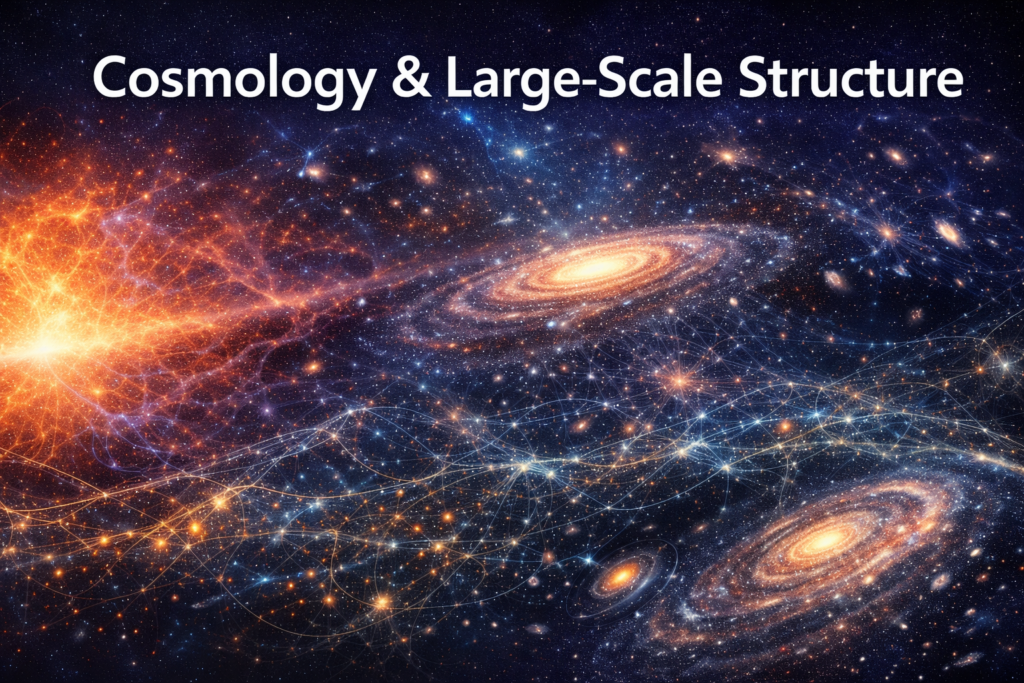
- Clustering of galaxies into filaments and voids
These structures form a “cosmic web.”
The cosmic web emerges through gravitational dynamics — not imposed design.
Galaxies and Stellar Evolution
Galaxies form when gas collapses within dark matter halos.
Within galaxies:
- Stars form from molecular clouds
- Nuclear fusion generates heavier elements
- Supernovae distribute elements into interstellar space
Over cosmic time, stellar processes produce the chemical complexity required for planetary systems.
Cosmic evolution creates conditions under which biological evolution becomes possible.
This is not teleology — it is sequential physical development.
Large-Scale Patterns and Emergence
At cosmic scales, structure exhibits:
- Filamentary clustering
- Voids spanning hundreds of millions of light-years
- Self-similar statistical patterns
These large-scale distributions are consistent with gravitational amplification under general relativity.
Cosmology demonstrates that complex structure can emerge from simple physical laws operating over time.
This aligns structurally with principles discussed in Complexity & Emergence — Self-Organization and Layered Systems.
What Cosmology Does Not Claim
Scientific cosmology does not currently explain:
- Why physical constants take their specific values
- What preceded the earliest measurable epoch
- Whether the universe is finite or infinite
- Whether multiple universes exist
Some hypotheses exist, but they remain speculative.
Distinguishing evidence from speculation preserves credibility.
Relationship to the Larger Structure
Within the Science Models silo:
- Physics Foundations describes fundamental structure.
- Evolutionary Systems describes biological organization.
- Neuroscience & Consciousness describes neural integration.
- Complexity & Emergence describes layered systems.
Cosmology & Large-Scale Structure examines the universe at its largest scale under these same structural laws.
The progression is scale-based, not metaphysical.
Why Cosmology Completes the Scientific Arc
Cosmology shows that:
- Simple physical principles
- Operating across vast timescales
- Produce large-scale ordered structure
Understanding this scale prepares the reader for broader philosophical reflection — but this page remains within empirical boundaries.
Scientific explanation ends where evidence ends.
Moving Forward
The Science Models silo establishes structural credibility.
To explore how different traditions interpret cosmic structure and meaning, continue to Traditional Knowledge — Cosmological and Metaphysical Frameworks.