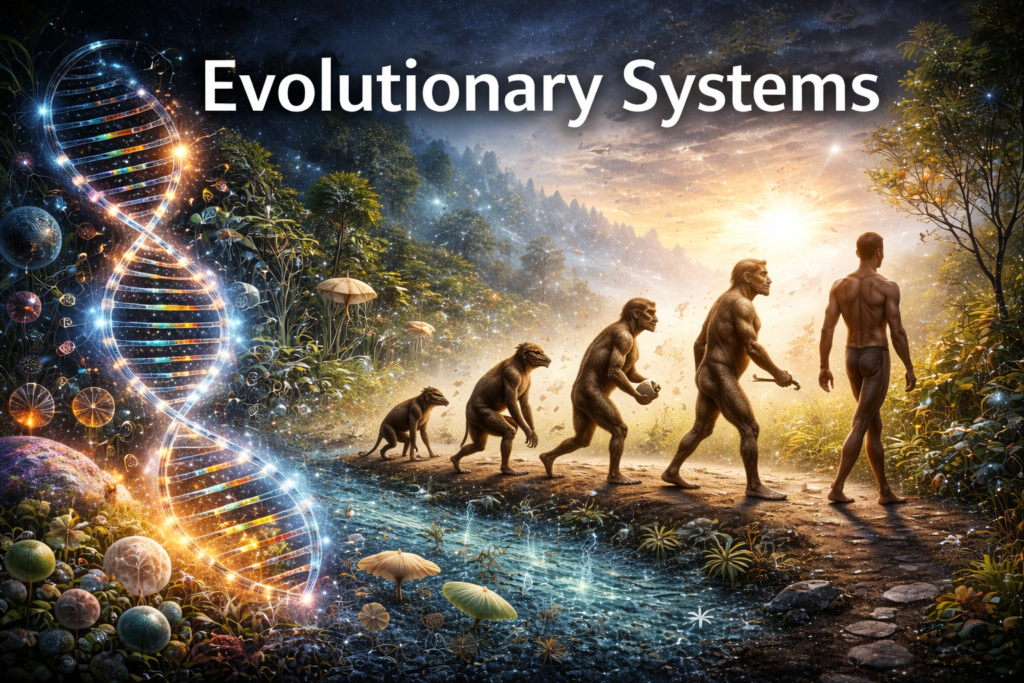
Evolutionary Systems
Biological Development and Adaptive Complexity
Why Evolution Matters in a Scientific Model
Biological evolution provides one of the most robust and well-supported explanatory frameworks in modern science. It explains how complex organisms arise from simpler forms through variation, selection, and environmental interaction.
Unlike physics, which describes structural relations among energy and matter, evolutionary biology describes how those structures become organized into adaptive systems over time.
Any coherent model of reality must understand evolution at the level science describes it.
This discussion continues the structure introduced in the Science Models overview, where modern explanatory frameworks are examined systematically.
For a concise explanation of how natural selection works (including mutation, migration, and drift), see UC Berkeley’s Understanding Evolution: Natural Selection.
The Core Mechanism: Variation and Selection
Evolution operates through a simple but powerful process:
- Genetic variation occurs within populations.
- Some variations enhance survival or reproduction.
- Those variations become more common over generations.
This process, known as natural selection, requires:
- Heritable traits
- Environmental pressures
- Differential reproductive success
Over time, cumulative selection can generate extraordinary biological complexity.
For a clear, institution-level explanation of evolutionary theory and supporting evidence, see the National Academies’ Evolution Resources.
Mutation, Genetic Drift, and Development
Natural selection is not the only evolutionary mechanism.
Other contributing processes include:
- Mutation (random genetic change)
- Genetic drift (random frequency shifts in populations)
- Gene flow (movement of genes between populations)
- Developmental constraints (biological structure limiting variation)
Evolution is not strictly linear or progressive. It is contingent, adaptive, and responsive to environment.
From Single Cells to Multicellular Organisms
Life began as simple cellular systems capable of replication and metabolism.
Over immense timescales:
- Cells formed cooperative clusters.
- Specialization emerged.
- Multicellularity developed.
- Nervous systems evolved.
Each stage introduced new layers of organization.
Evolution demonstrates that complexity can arise from iterative, cumulative processes governed by selection and constraint.
Nervous Systems and Behavioral Adaptation
With the emergence of nervous systems came:
- Sensory integration
- Motor coordination
- Environmental modeling
Organisms developed the capacity to respond flexibly to changing environments.
Brains evolved not as abstract thinking devices, but as adaptive systems enhancing survival through predictive modeling and coordinated action.
Cognition emerges gradually within this evolutionary context.
Human Cognitive Evolution
Human beings represent a distinctive evolutionary development characterized by:
- Language
- Symbolic reasoning
- Cultural transmission
- Abstract modeling
Unlike earlier organisms, humans can reflect upon their own evolutionary history.
This reflexive capacity is itself an evolutionary development, grounded in biological processes.
Within the broader structural model, this corresponds to the domain described in Level 3 — Localized Reality.
Scientific explanations of human cognition remain rooted in neurobiology and evolutionary adaptation.
Evolution Is Not Teleology
A critical distinction:
Evolution does not operate with foresight or predetermined goals.
It does not aim toward perfection, complexity, or consciousness.
Complexity may increase under certain conditions, but evolution also produces simplification when advantageous.
Any interpretation that assigns inherent purpose to biological evolution moves beyond empirical biology into philosophical inquiry.
A disciplined framework must keep that boundary clear.
Emergence and Adaptive Complexity
Evolution demonstrates that:
- Structured organization can arise from simple beginnings.
- Cooperation and competition both shape development.
- Systems can self-organize under constraint.
These features are scientifically observable.
Their interpretation must be handled cautiously.
Evolution describes mechanism.
Meaning is not built into the mechanism itself.
These processes are examined more formally in Complexity & Emergence, where self-organization and layered systems are explored in greater depth.
Relationship to the Larger Structure
Within the broader site architecture:
- Physics Foundations describes structural relations in matter and energy.
- Evolutionary Systems describes how those structures organize into living systems.
- Neuroscience & Consciousness will examine how biological systems generate awareness and self-modeling.
This page establishes the biological layer.
No metaphysical conclusions are drawn here.
Moving Forward
To examine how biological systems produce perception, cognition, and reflective awareness, continue to Neuroscience & Consciousness — Brain, Integration, and Awareness.
Understanding biological development precedes examining conscious experience.