
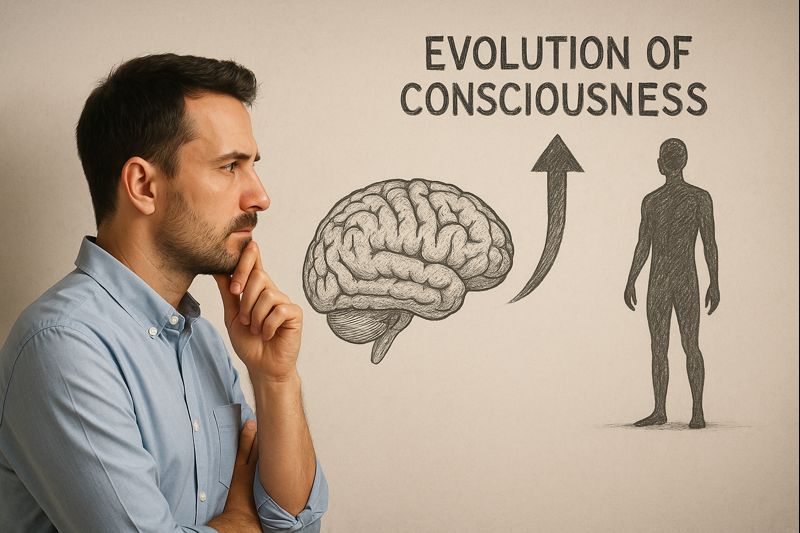


Evolution of Consciousness: From Survival to Self-Awareness
Introduction: Evolution Did Not Stop at the Body
Evolution is usually described as a blind process: genetic variation filtered by survival. Over immense spans of time, matter organizes into increasingly complex forms—molecules, cells, organisms, ecosystems.
But at some point in this process, something extraordinary happens.
The universe begins to experience itself.
Not merely to react, not merely to survive, but to know.
Modern evolutionary theory explains how bodies change. It explains adaptation, reproduction, and competition. What it does not explain—at least not adequately—is how conscious awareness arises, deepens, and eventually turns back on itself.
If consciousness is fundamental, as explored in Consciousness as Fundamental: Why Awareness Cannot Be Reduced to Matter, then evolution cannot be only biological. It must also be experiential.
Species Universe continues here because the next question becomes unavoidable:
What is evolving—life, or awareness itself?
Biological Evolution Explains Form, Not Experience
Darwinian evolution is powerful within its domain. It explains:
- How traits propagate
- Why organisms adapt to environments
- How complexity increases through selection
But it describes evolution strictly from the outside.
It explains what survives, not what experiences.
No description of natural selection explains:
- Why pain feels like pain
- Why perception has meaning
- Why an organism has a point of view
- Why awareness becomes reflective
As with the mind–body problem, something essential is left out: first-person experience.
Consciousness Introduces a New Axis of Evolution
Once awareness appears, evolution gains an interior dimension.
At first, awareness is minimal:
- Sensation
- Reaction
- Simple preference
Later, it becomes richer:
- Emotion
- Memory
- Anticipation
- Learning
Eventually, in humans, awareness becomes self-referential:
- The organism knows that it knows
- Experience can be examined
- Meaning can be questioned
This is not a small step. It is a qualitative shift.
Evolution is no longer just about surviving the environment—it is about understanding one’s place within it.
Self-Awareness Changes the Rules
Self-awareness introduces feedback into evolution itself.
An organism capable of reflecting on experience can:
- Modify behavior intentionally
- Override instinct
- Reshape environments consciously
- Transmit knowledge culturally rather than genetically
This marks a transition from biological evolution to conscious evolution.
At this stage:
- Culture evolves faster than genes
- Ideas shape survival
- Beliefs influence biology (stress, health, longevity)
- Technology externalizes cognition
Evolution begins to operate through awareness, not merely upon matter.
The Observer Enters the Evolutionary Loop
As explored in Observer and Observed: Why Perception Is Not Separate from Reality, observation is not passive. It participates.
When a species becomes aware of itself as a species, evolution becomes reflexive.
Humanity now:
- Studies its own origins
- Modifies its own biology
- Alters planetary systems
- Influences future evolutionary pathways intentionally
This creates a profound responsibility.
A species capable of self-reflection is no longer guided solely by natural selection. It must contend with ethical, psychological, and existential consequences of its own awareness.
Evolution as the Universe Knowing Itself
From a wider perspective, evolution appears less like a random accident and more like a directional unfolding.
Matter organizes into life.
Life organizes into awareness.
Awareness organizes into self-knowledge.
This does not imply a predetermined goal in a simplistic sense. It implies increasing interiority—greater depth of experience and understanding.
The universe does not merely expand outward.
It deepens inward.
From this view, consciousness is not an evolutionary anomaly. It is the point at which the universe becomes intelligible to itself.
Human Potential and the Next Phase of Evolution
If evolution now operates through awareness, the next phase is not guaranteed.
Self-awareness can:
- Liberate
- Integrate
- Expand understanding
But it can also:
- Fragment
- Dominate
- Destroy ecosystems
- Collapse under its own technologies
Evolution of consciousness is not automatic. It requires integration, not just intelligence.
This is where ancient traditions, psychology, neuroscience, and systems thinking converge: growth without inner coherence leads to instability.
The future of evolution depends less on what we can do—and more on how consciously we do it.
Conscious Evolution Is Not Escaping Biology
Importantly, evolving consciousness does not mean rejecting biology or nature.
It means:
- Understanding instincts rather than being ruled by them
- Integrating emotion with reason
- Aligning technology with ecological intelligence
- Letting awareness guide power
Conscious evolution is not about transcendence away from the world. It is about participation with it, intelligently and responsibly.
Species-Level Awakening
When a species recognizes that its inner state affects its outer survival, evolution reaches a critical threshold.
At that point:
- Consciousness becomes the primary adaptive variable
- Cooperation can outweigh competition
- Meaning becomes a stabilizing force
- Evolution becomes self-directed
This is not mysticism. It is a sober assessment of where humanity stands.
We are the first known species capable of understanding evolution itself—and of choosing how it proceeds.
Conclusion: Evolution Is No Longer Blind
Evolution did not stop with the emergence of Homo sapiens.
It crossed a boundary.
For the first time, evolution produced beings capable of asking what evolution is—and what it should become.
If consciousness is fundamental, evolution is not merely the survival of forms. It is the progressive clarification of awareness.
The future of evolution will not be decided by genes alone.
It will be decided by the depth, coherence, and responsibility of consciousness itself.













Leave a Reply