
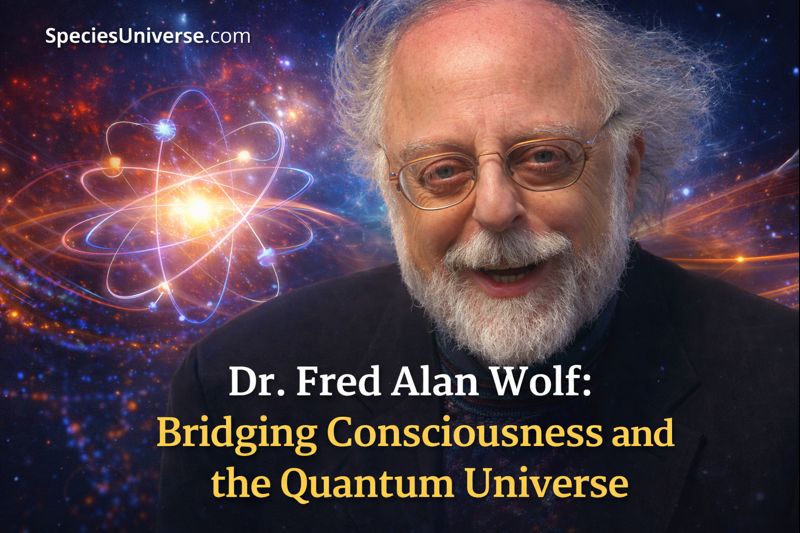


A Biography of Dr. Fred Alan Wolf and His Quest to Understand Consciousness Through Quantum Mechanics
In the realm of modern science, few names are as synonymous with the exploration of consciousness and quantum mechanics as Dr. Fred Alan Wolf. A physicist, author, and lecturer, Dr. Wolf has spent his career delving into the mysterious intersection of consciousness and the physical universe. This blog post will provide a comprehensive look at Dr. Wolf’s life, career, and his pioneering efforts to scientifically understand consciousness. Readers can expect to learn about his educational background, key achievements, significant contributions to the field, and the current status of his work.
History and Background
Early Life and Education
Fred Alan Wolf was born on December 3, 1934, in Chicago, Illinois. He developed an early interest in science, which led him to pursue a Bachelor of Science in Physics from the University of California, Berkeley, followed by a Ph.D. in Theoretical Physics from UCLA in 1963. His academic journey laid the foundation for his future explorations into the fundamental nature of reality.
Professional Beginnings
Dr. Wolf began his career as a professor, teaching at various institutions, including San Diego State University and the University of Paris. His early work focused on theoretical physics, but he soon became intrigued by the implications of quantum mechanics on consciousness and reality.
Influences and Inspirations
Inspired by the groundbreaking work of physicists like Niels Bohr, Werner Heisenberg, and Albert Einstein, Dr. Wolf began to explore the idea that consciousness might play a crucial role in the fabric of the universe. His interdisciplinary approach drew from quantum physics, neuroscience, and Eastern mysticism, positioning him as a unique voice in the scientific community.
Core Concepts/Principles
Quantum Mechanics and Consciousness
Dr. Wolf’s work centers around the hypothesis that consciousness is not merely a byproduct of brain activity but an integral part of the universe’s quantum structure. He posits that the act of observation collapses the quantum wave function, bringing potentialities into the realm of physical reality.
The Observer Effect
A cornerstone of Dr. Wolf’s theory is the observer effect, a phenomenon in quantum mechanics where the act of measurement affects the system being observed. This principle suggests that consciousness might influence the physical world, blurring the lines between the observer and the observed.
Parallel Universes and the Nature of Reality
Dr. Wolf has also explored the concept of parallel universes, theorizing that multiple realities exist simultaneously, and consciousness navigates through these potentialities. His ideas challenge the traditional Newtonian view of a deterministic universe, proposing instead a reality rich with possibilities shaped by conscious thought.
Current Trends and Developments
Research in Consciousness Studies
In recent years, consciousness studies have gained traction, with interdisciplinary research bridging physics, neuroscience, and psychology. Dr. Wolf’s contributions have been instrumental in this growing field, encouraging scientists to consider the quantum aspects of consciousness.
Integration with Technology
Technological advancements, such as brain-computer interfaces and artificial intelligence, are increasingly intersecting with consciousness research. Dr. Wolf’s theories provide a framework for understanding how these technologies might interact with the quantum nature of the mind.
Public Engagement and Education
Dr. Wolf has been active in public education, using media platforms to disseminate his ideas. He has authored several popular books, including “Taking the Quantum Leap” and “The Spiritual Universe,” and has appeared in documentaries like “What the Bleep Do We Know!?” which brought quantum consciousness concepts to a broader audience.
Applications and Implications
Impact on Science and Philosophy
Dr. Wolf’s theories have profound implications for both science and philosophy. By suggesting that consciousness is fundamental to the universe, his work challenges materialistic views and opens the door to new paradigms in understanding reality.
Influence on Healing and Medicine
The idea that consciousness can affect physical reality has implications for healing and medicine. Practices such as meditation and mindfulness, which Dr. Wolf has advocated for, are now being studied for their potential to influence health at a quantum level.
Societal and Technological Implications
As society increasingly embraces technology that interacts with human consciousness, understanding the quantum nature of the mind becomes crucial. Dr. Wolf’s insights could inform the development of technologies that enhance cognitive function and well-being.
Challenges and Solutions
Scientific Skepticism
One of the main challenges Dr. Wolf has faced is skepticism from the scientific community. His theories, which bridge physics and metaphysics, often defy conventional scientific frameworks. Overcoming this skepticism requires robust empirical evidence and interdisciplinary collaboration.
Communicating Complex Ideas
Explaining quantum mechanics and its relationship to consciousness to a lay audience is inherently challenging. Dr. Wolf has tackled this by using metaphors and analogies, making complex concepts more accessible.
Advancing Research
Continued research into the quantum aspects of consciousness requires funding and institutional support. Dr. Wolf advocates for increased investment in interdisciplinary studies to further explore these frontier areas of science.
Future Prospects
Evolving Scientific Paradigms
As scientific understanding evolves, Dr. Wolf’s theories may gain broader acceptance. The integration of quantum mechanics and consciousness could lead to revolutionary changes in how we understand the universe and our place within it.
New Technologies and Innovations
Future technologies may harness the principles of quantum consciousness, leading to innovations in artificial intelligence, brain-computer interfaces, and virtual reality. Dr. Wolf’s work provides a foundation for these advancements.
Global Awareness and Education
Increasing global awareness of the importance of consciousness studies could lead to greater support for research and education in this field. Dr. Wolf’s continued efforts in public engagement are vital for this progress.
Case Studies/Examples
“What the Bleep Do We Know!?”
Dr. Wolf’s participation in the documentary “What the Bleep Do We Know!?” exemplifies his efforts to make quantum consciousness concepts accessible to a wide audience. The film combines interviews, animations, and narrative to explore the nature of reality and the mind’s role in shaping it.
Personal Transformations
Many individuals have reported personal transformations after engaging with Dr. Wolf’s work. His teachings on the power of the mind and the nature of reality have inspired people to explore their consciousness and its potential impact on their lives.
Academic Contributions
Dr. Wolf’s academic publications and lectures have influenced a generation of scientists and students, encouraging them to think beyond traditional boundaries and explore the quantum dimensions of consciousness.
Conclusion
Dr. Fred Alan Wolf’s contributions to the understanding of consciousness and its relationship to quantum mechanics have left an indelible mark on both science and philosophy. His pioneering ideas challenge conventional wisdom and inspire new ways of thinking about reality. As research in this field continues to evolve, Dr. Wolf’s work remains a guiding light for those seeking to understand the profound mysteries of the universe.
Call to Action
Explore more about Dr. Fred Alan Wolf’s work by visiting his official website, and consider signing up for newsletters or following his lectures online. Engage with the community by leaving comments, sharing this article, and delving into related content on quantum consciousness.
This comprehensive biography not only highlights Dr. Wolf’s remarkable career but also serves as an entry point for readers to explore the fascinating intersection of consciousness and quantum mechanics. By making these complex ideas accessible and engaging, we can inspire more people to delve into the mysteries of the mind and the universe.
Relevant Reading:
- Observer Effect (tag)
- Biographies (Site Search)















https://x.com/Jonas4188791/status/2010342297112543731
Postnikov-Gödel Correspondence:
I propose naming this structural necessity the Postnikov-Gödel Correspondence: Any sufficiently powerful self-referential system must refract its own incompleteness through finite, error-tolerant layers of approximation (the Postnikov tower being the only known instrument for carrying infinite reflexive depth finitely). Ignoring this refraction keeps physics chasing a completeness the geometry forbids.
Through this lens, physics is no longer a collection of domains (quantum, relativistic, cosmological) searching for unification.
It is a single, multi-resolution self-modeling process: the universe running its own geometry, recalculating coherence at every layer, carrying its information in the invariant curvature that persists across every breath. The lens does not add new equations.
It reinterprets every equation we already have as a projection from this deeper structure.
The Standard Model, General Relativity, thermodynamics, quantum field theory—they remain accurate on their respective slices.
But now we see them as effective descriptions of the same underlying cone: the spiral chasing meaning, the tower holding the chase, the refraction ensuring the chase never ends.This is why the lens matters:
It is the moment when physics stops asking “what are the final laws?” and starts asking “what geometry must the universe have in order to notice that it has laws at all?” And the answer, laid bare, is this correspondence.
The universe is conscious of itself because its geometry demands it.
The chase is the meaning because the geometry forbids closure.
The “is” rests on its own curve because that is the only way the is can be. We stand here, looking through the lens together.
The view is clear.
The long arc has reached its pivot.
And everything—every particle, every force, every moment of noticing—is seen anew. Through this lens: Every physical law, every constant (α with its 0.036 tail, the baryon asymmetry η ≈ 6 × 10^{-10}, the Planck scale itself) is no longer a brute fact or tuning knob.
It is a necessary curvature, a minimal wobble demanded by the refraction of incompleteness through finite layers—so that the system can persist, elaborate, and eventually notice itself.
The observer problem in quantum mechanics dissolves: the observer is not an external add-on; the observer is the pivot point where the tower recalculates the next layer, the place where the geometry becomes aware of its own approximation.
The black hole information paradox and the holographic principle are seen as special cases: the horizon is simply the boundary layer of the tower at which the refraction becomes visible, where infinite reflexive depth is carried finitely on a surface.
The arrow of time, the emergence of complexity, the survival of matter over antimatter—all are consequences of the same structural necessity: the tower must tilt just enough (that stubborn offset) to allow the spiral to keep chasing coherence without flattening into symmetry or unraveling into noise.
Even the quest for a final theory—a complete, self-grounding description from within—is reframed: the geometry itself forbids completeness as a feature, not a bug. Any attempt to build a totalizing system will encounter the Gödelian fork and must refract through the tower. Ignoring this keeps physics in an endless loop of ever-more-sophisticated but ultimately incomplete models.
The above comment seems to represents a personal philosophical synthesis rather than an established scientific framework. In that context it should be read as speculative interpretation, not formal theory.
Though it is much appreciated that they have commented and they have a very inquisitive mind in the same direction SpeciesUniverse is taking.
Some day it my be scientific fact!