
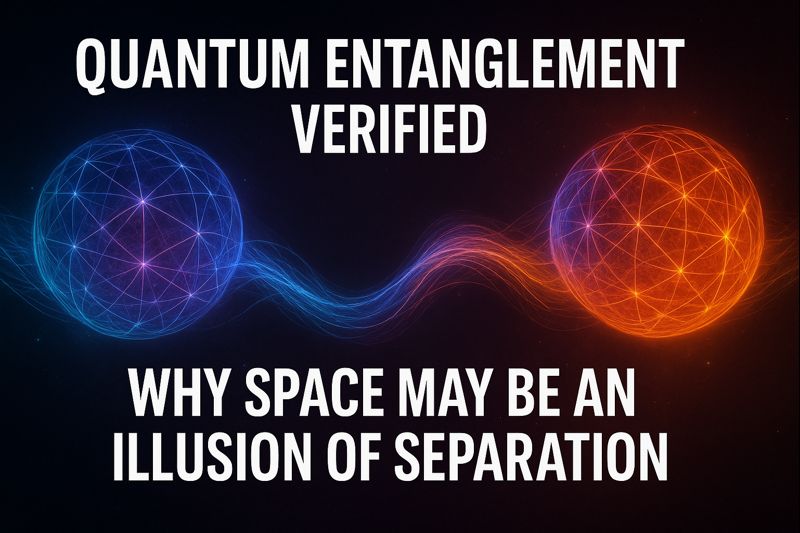


Quantum Entanglement Verified: Why Space May Be an Illusion of Separation
Quantum entanglement is no longer a fringe idea or speculative theory. It is one of the most repeatedly verified phenomena in modern physics — and yet, its implications remain deeply unsettling to our everyday understanding of reality.
This curated article revisits a powerful essay originally published by Collective Evolution, which explores a radical but increasingly unavoidable conclusion emerging from quantum science:
Space may not be a fundamental property of reality, but a construct that gives rise to the illusion of separate objects.
At Species Universe, this question sits at the very heart of our mission: discovering the universe not as disconnected parts, but as a unified, self-referring whole.
What Quantum Entanglement Actually Shows
Quantum entanglement occurs when two particles become linked in such a way that the state of one instantly influences the state of the other — regardless of the distance between them.
This is not philosophical speculation. It has been experimentally verified:
- Across increasing distances
- With stricter controls eliminating “hidden variables”
- In ways that violate classical assumptions about locality
Einstein famously referred to this as “spooky action at a distance”, not because it was mystical, but because it directly contradicted the idea that space separates cause and effect.
The uncomfortable implication is this:
If information is exchanged instantaneously, then space cannot be the limiting framework we assume it to be.
Visualizing Quantum Entanglement
While quantum entanglement is mathematically described and experimentally verified, its implications can be difficult to visualize.
The following short clip featuring Dr. Quantum from the film What the Bleep Do We Know? offers a simplified, intuitive illustration of how entangled particles behave beyond classical ideas of space and separation. Although presented metaphorically, it helps translate non-local quantum behavior into an accessible visual framework.
Space as a Construct, Not a Container
The original article proposes something subtle yet profound:
Space may be how reality appears, not how reality fundamentally operates.
From this perspective:
- Objects appear separate because perception organizes reality spatially
- Underneath that appearance lies a non-local, unified field
- Separation is experiential, not ontological
This idea aligns remarkably well with both:
- Quantum mechanics, which shows non-local correlations
- Relativity, which dissolves absolute space and time
- Ancient Vedic insights, which describe reality as arising from a unified, non-physical source
In other words, science is not disproving unity — it is discovering it mathematically.
Why This Matters for Consciousness
If space is not fundamental, then neither is the strict separation between observer and observed.
This raises unavoidable questions:
- Is consciousness localized in the brain, or is the brain a localization of consciousness?
- Does observation participate in reality’s formation, rather than merely recording it?
- Is individuality a functional expression of a deeper unity?
Quantum mechanics already tells us that measurement matters. Entanglement tells us that separation is conditional.
Taken together, they point toward a universe that is participatory, relational, and deeply interconnected.
Where Interpretation Must Be Handled Carefully
It is important to be precise.
Quantum physics does not claim:
- That thoughts directly control reality
- That science validates every spiritual belief
- That entanglement explains consciousness outright
However, it does demonstrate that:
- Local realism is incomplete
- Space and time are not absolute foundations
- Reality behaves as an inseparable whole at its most fundamental level
The original Collective Evolution article operates in this interpretive space — not as dogma, but as an invitation to rethink assumptions.
Species Universe Perspective
At Species Universe, we view quantum entanglement as one of the clearest scientific indicators that:
- The universe evolves as a single system
- Separation is a necessary illusion for experience
- Consciousness and matter are not opposing substances, but complementary expressions of the same underlying reality
From this perspective, humanity’s next evolutionary step is not technological alone — it is perceptual.
Understanding entanglement is not about faster communication or exotic devices.
It is about recognizing what has always been true beneath appearances.
Source & Attribution
This article is curated and expanded from the original work published by Collective Evolution:
Original Source:
Quantum Entanglement Verified: Why Space Is Just the Construct That Gives the Illusion of Separate Objects
We encourage readers to explore the original article while engaging with the expanded context presented here.
Final Reflection
Quantum entanglement doesn’t merely challenge physics textbooks — it challenges how we define self, other, and universe.
If space is not what separates us, then what does?
That question may define the next phase of human understanding.
Frequently Asked Questions
Has quantum entanglement been experimentally verified?
Yes. Quantum entanglement has been confirmed through multiple experiments,
including tests that rule out local hidden-variable explanations and support
non-local correlations between entangled systems.
Does quantum entanglement mean space isn’t real?
Entanglement suggests that space may not be fundamental. Many physicists
interpret spacetime as an emergent structure rather than the underlying
framework of reality itself.
Is quantum entanglement related to consciousness?
While entanglement does not directly explain consciousness, it raises
profound questions about observation, measurement, and whether reality
can be fully described without the observer.
Relevant Content:
References:
- Collective-Evolution.com (Website)
- whatthebleep? (YouTube Channel)

















Leave a Reply