
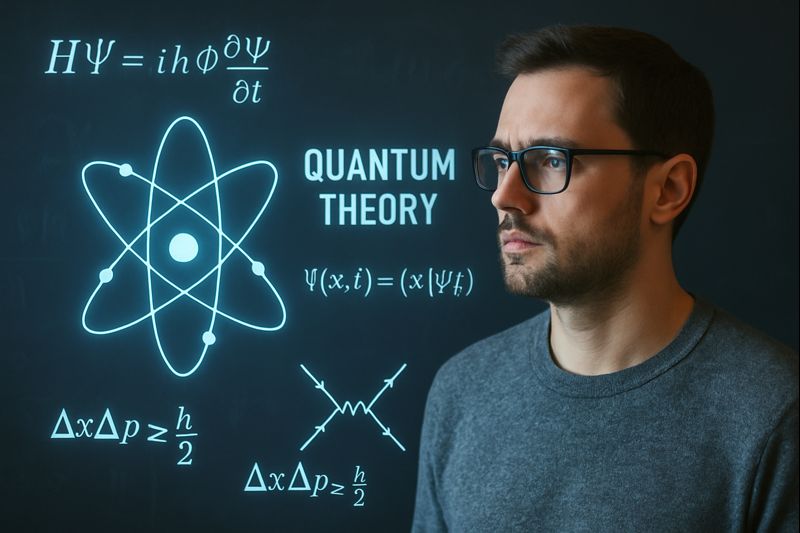


5 Questions About Quantum Theory
Why the Strangest Theory in Science Still Shapes Our Understanding of Reality
Quantum theory is often described as the most successful—and most unsettling—theory ever developed in science. It predicts experimental outcomes with extraordinary precision, yet resists any simple explanation of what reality actually is.
In this Oxford University Press blog article, “5 Questions About Quantum Theory,” the author steps back from equations and interpretations to ask a more fundamental question: what does quantum theory really tell us about the universe, and why does it continue to trouble physicists more than a century after its birth?
For readers of Species Universe, this piece serves as an important grounding document. It highlights the unresolved tensions at the heart of modern physics—tensions that point beyond particles and fields toward something far more fundamental.
Why This Article Matters
Quantum mechanics works. That is not in dispute. From semiconductors to lasers to MRI machines, modern technology rests on its predictions. And yet, as this article makes clear, scientists still do not agree on what quantum theory means.
The five questions explored here cut directly to the core of the quantum conundrum:
- Is quantum theory complete, or merely an approximation of something deeper?
- Does it describe objective reality, or only our observations of it?
- Why does measurement play such a mysterious role?
- Is randomness fundamental, or does it hide a deeper order?
- Can quantum theory ever be reconciled with relativity?
These are not technical questions. They are ontological ones—questions about the nature of existence itself.
Key Insight: Quantum Theory Breaks the Classical Worldview
One of the most important takeaways from this article is that quantum theory did not simply add new facts to physics—it overturned the very assumptions on which classical physics was built.
Classical physics assumes:
- Objects exist independently of observation
- Properties are definite whether measured or not
- Space and time provide a stable background for events
Quantum theory challenges all three.
As the article explains, quantum systems do not possess definite properties until they are measured. Instead, they exist as probability distributions—not in space and time as we experience them, but in an abstract mathematical space that only collapses into physical reality through interaction.
For Species Universe, this aligns directly with the deeper implication: physical reality appears to emerge from something non-physical.
Measurement, Observation, and the Uncomfortable Role of the Observer
One of the article’s most striking points is how unavoidable the concept of measurement becomes in quantum theory. Unlike classical physics, where observation is passive, quantum mechanics treats observation as participatory.
This raises an uncomfortable but unavoidable question:
What exactly is doing the observing?
The article does not claim that human consciousness “creates reality,” but it does acknowledge that quantum theory cannot fully describe the world without referencing acts of observation. This unresolved role of the observer has led to decades of debate, from the Copenhagen interpretation to many-worlds and beyond.
From the Species Universe perspective, this is not a weakness—it is a clue.
When physics reaches a point where it must account for observation itself, it is brushing up against the boundary between objective description and conscious experience.
Randomness or Hidden Order?
Another central theme in the article is quantum randomness. Are quantum events fundamentally random, or does this randomness mask a deeper, hidden structure?
Einstein famously rejected the idea that “God plays dice,” yet experiments have consistently favored quantum indeterminacy over hidden-variable explanations—at least within classical assumptions.
The article presents this tension without resolving it, but that unresolved status is precisely the point. Quantum theory works astonishingly well without telling us why it works.
For Species Universe, this echoes a broader insight found in both modern physics and ancient traditions: the universe may be lawful without being mechanistic. Order does not necessarily arise from tiny billiard balls colliding in space, but from deeper organizing principles that are not directly observable.
A Theory Without a Final Interpretation
Perhaps the most important realization for readers is this: quantum theory has no single accepted interpretation.
More than a century after its development, physicists still disagree about:
- Whether the wavefunction is real or informational
- Whether collapse is physical or apparent
- Whether multiple realities exist simultaneously
- Whether time itself is fundamental or emergent
This article does not attempt to resolve these debates. Instead, it shows that the lack of consensus is not due to ignorance or failure, but because quantum theory may be pointing beyond the limits of our current conceptual language.
Why Species Universe Curated This
This article is not about exotic speculation or fringe ideas. It is a sober reflection from a mainstream academic source acknowledging something profound:
Our most successful physical theory cannot yet tell us what reality is.
For Species Universe, that admission is foundational. It supports the central theme that:
- Matter may not be primary
- Space and time may be emergent
- Observation may not be secondary
- And reality may be far more relational than material
Quantum theory does not invalidate science—it completes it by revealing its own limits.
Closing Reflection
The five questions explored in this article remain open not because physics has failed, but because it has succeeded so deeply that it has exposed the edge of what purely material explanations can provide.
Quantum theory works with astonishing accuracy, yet refuses to settle into a comfortable picture of reality. In that refusal lies its greatest gift.
It invites us—not to abandon reason—but to expand it.
Original Source:
Oxford University Press Blog — “5 Questions About Quantum Theory”
Why Read It:
To understand why the deepest problems in physics are not technical details, but questions about reality, knowledge, and the role of the observer itself.
Frequently Asked Questions
(Click on questions to get answers.)
Why is quantum theory still considered mysterious?
Quantum theory produces extraordinarily accurate predictions, yet it lacks a single agreed-upon interpretation of what reality actually is. Concepts such as wavefunction collapse, measurement, and observer participation challenge classical assumptions about objective existence.
Does quantum theory suggest reality depends on observation?
Quantum mechanics shows that physical properties are not fully defined until measured. While this does not prove consciousness creates reality, it does indicate that observation plays an unavoidable role in how reality manifests.
Is quantum randomness fundamental or hiding deeper order?
Experiments suggest quantum events are genuinely probabilistic, though some physicists believe this randomness may emerge from deeper, non-classical structures. The question remains open and central to quantum foundations.
Why can’t physicists agree on a single interpretation of quantum mechanics?
Quantum theory works mathematically but resists intuitive explanation. Competing interpretations—such as Copenhagen, many-worlds, and relational models—each explain the data while implying radically different realities.
What does quantum theory imply about the nature of reality?
Quantum theory suggests that reality may be relational, probabilistic, and emergent rather than composed of independently existing objects. This challenges materialist assumptions and opens deeper questions about consciousness and existence.

















Leave a Reply