
Physics Foundations Cornerstone Article
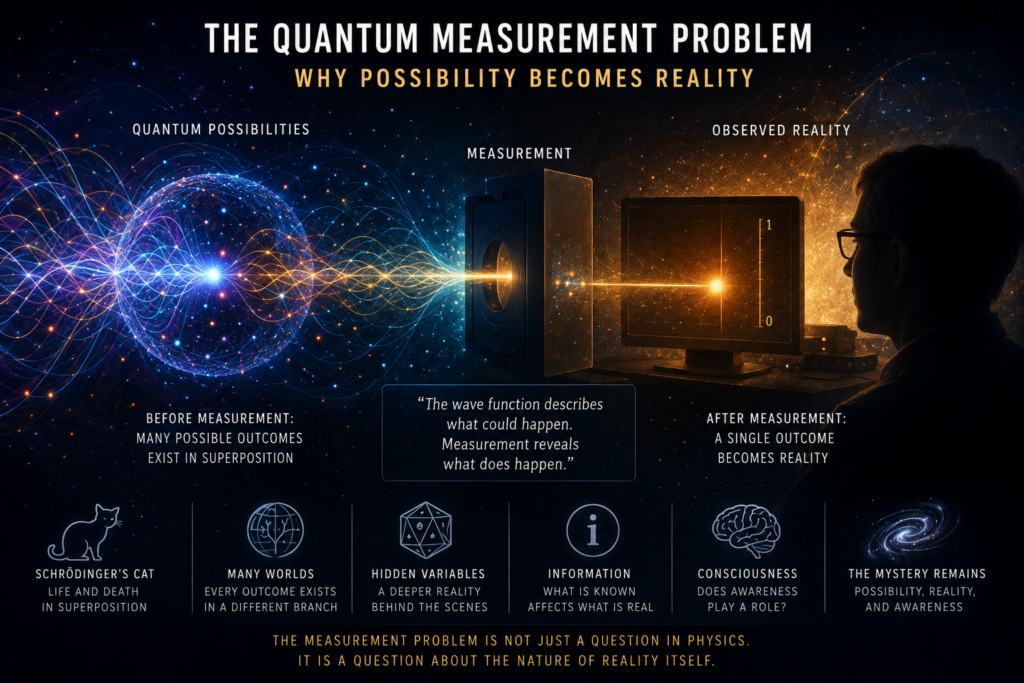
This page is part of the Physics Foundations section of Species Universe and serves as a cornerstone exploration of one of the deepest unresolved questions in modern science: the quantum measurement problem.
The article examines wave function collapse, Schrödinger’s Cat, the Copenhagen Interpretation, Many Worlds, hidden variables, information theory, consciousness, and the transition from possibility to experienced reality.
Because this topic sits at the intersection of physics, philosophy, and consciousness studies, this guide is intentionally comprehensive. Readers are encouraged to use the Table of Contents below to navigate specific sections and return to the article as needed.
Table of Contents
- A Universe of Possibilities
- The Strange Success of Quantum Mechanics
- Before Measurement: A Universe of Possibilities
- Schrödinger’s Cat and the Problem of Observation
- The Collapse Problem
- The Copenhagen Interpretation
- The Many-Worlds Interpretation
- Hidden Variables and Einstein’s Dream
- Information, Measurement, and Reality
- Does Consciousness Cause Collapse?
- What the Measurement Problem Is Really Asking
- Toward a Deeper Unity: The Species Universe Perspective
- Frequently Asked Questions
- The Beginning, Not the End
- Further Exploration
A Universe of Possibilities
Imagine flipping a coin.
Before it lands, there are two possible outcomes.
Heads.
Tails.
Once the coin lands, one possibility becomes reality.
The mystery appears simple.
The coin was always a physical object.
Its motion followed the laws of physics.
If we possessed enough information about the forces involved, we could—in principle—predict the outcome before it occurred.
Nothing about the situation seems especially mysterious.
Now imagine an electron.
Quantum mechanics tells us that before measurement, an electron cannot always be described in the same way as a coin.
Instead of possessing a definite position, a definite momentum, or even a definite state, the electron is represented by a wave function—a mathematical description of possibilities.
This is where the story becomes strange.
According to quantum theory, the wave function evolves smoothly and predictably.
Its behavior is governed by one of the most successful equations in all of science: the Schrödinger equation.
The mathematics works with astonishing precision.
Physicists use it to design semiconductors, lasers, medical imaging technologies, and modern computers.
The theory has passed every experimental challenge thrown at it.
And yet hidden within its success lies a question that has never been fully answered.
What exactly happens when a measurement occurs?
Before measurement, quantum mechanics describes possibilities.
After measurement, we observe a definite reality.
Somehow the world we experience emerges from a world described by probabilities.
How?
No one knows.
This puzzle is known as the quantum measurement problem.
At first glance, it may appear to be a highly technical issue buried deep within theoretical physics.
In reality, it touches some of the most fundamental questions ever asked.
What is reality?
What is observation?
What distinguishes a possibility from an actuality?
Why does the world appear definite when quantum theory describes it as probabilistic?
For more than a century, physicists have debated these questions.
Some argue that measurement causes a quantum system to collapse into a specific state.
Others argue that no collapse occurs at all.
Still others suggest that the distinction between observer and observed may itself require rethinking.
Remarkably, these disagreements persist despite the extraordinary success of quantum mechanics.
The equations work.
The experiments work.
The technologies work.
Yet physicists still disagree about what the theory ultimately tells us about reality.
This situation is almost unique in science.
Imagine engineers building airplanes while simultaneously debating whether gravity actually exists.
Imagine biologists successfully curing diseases while disagreeing about whether cells are real.
Yet something similar has occurred in quantum physics for more than a century.
The theory succeeds beyond expectation.
Its meaning remains unsettled.
This should immediately capture our attention.
Not because quantum mechanics has failed.
But because it has succeeded so completely while leaving one of its deepest questions unresolved.
The measurement problem is not merely a puzzle about particles.
It is a puzzle about reality itself.
The observer problem introduced us to the difficulty of removing the observer from modern physics.
The measurement problem takes us one step further.
It asks what may be the most profound question in quantum theory:
How does a universe described by possibilities become the reality we actually experience?
To understand why this question remains open, we must first appreciate the extraordinary success of quantum mechanics itself.
For before we can understand the mystery, we must understand the theory that revealed it.
The Strange Success of Quantum Mechanics
Few scientific theories have been tested as rigorously as quantum mechanics.
And few have succeeded so completely.
Since its development in the early twentieth century, quantum theory has become the foundation of modern physics.
Every transistor inside a computer.
Every laser.
Every MRI machine.
Every smartphone.
Every semiconductor.
All depend upon principles first discovered through quantum mechanics.
The modern technological world exists because quantum theory works.
This point cannot be overstated.
When physicists say quantum mechanics is successful, they do not merely mean that it is useful.
They mean that it predicts experimental outcomes with astonishing precision.
In some cases, its predictions agree with measurements to more than ten decimal places.
Such accuracy is almost unheard of in science.
Again and again, experiments have confirmed the theory.
Again and again, nature has agreed with the mathematics.
This creates a remarkable situation.
Normally, when scientists disagree about the meaning of a theory, it is because the theory itself is uncertain.
The data may be incomplete.
The experiments may be inconclusive.
Competing models may explain observations equally well.
Quantum mechanics is different.
The experiments are not the problem.
The theory’s predictive power is not the problem.
The problem is understanding what the theory is actually telling us about reality.
This distinction is crucial.
The measurement problem does not arise because quantum mechanics fails.
It arises because quantum mechanics succeeds while describing reality in a way that appears profoundly unfamiliar.
Imagine receiving a map that always leads you to the correct destination.
Every time.
Without fail.
Yet no one can explain why the map works.
Would you trust the map?
Certainly.
Would you still want to understand it?
Of course.
This is roughly the situation physicists face with quantum theory.
The mathematics guides us with extraordinary reliability.
The deeper meaning remains unsettled.
Predictions Without Agreement
One of the strangest aspects of quantum mechanics is that physicists can agree completely on its predictions while disagreeing fundamentally about its interpretation.
Consider an experiment involving electrons.
Physicists from different schools of thought may disagree about what an electron truly is.
They may disagree about whether wave functions are physically real.
They may disagree about whether reality splits into multiple worlds.
They may disagree about whether collapse occurs at all.
Yet when asked to calculate the probability of an experimental outcome, they often arrive at exactly the same answer.
This situation is unusual.
The mathematics appears to stand above the interpretations.
The calculations work regardless of which philosophical picture one prefers.
As a result, generations of physicists adopted a practical attitude.
Use the equations.
Trust the predictions.
Do not worry too much about what the theory means.
This approach became famous through a phrase often attributed to physicist David Mermin:
“Shut up and calculate.”
The phrase was partly humorous.
Yet it captured a genuine sentiment.
Quantum mechanics worked so well that many physicists preferred to focus on its predictive power rather than its conceptual puzzles.
For decades, this strategy proved remarkably productive.
Technology advanced.
Experiments improved.
Quantum theory continued to succeed.
Yet the deeper questions never disappeared.
If anything, they became harder to ignore.
The Price of Success
The extraordinary success of quantum mechanics creates a challenge.
If the theory were failing, replacing it would be easy.
Scientists would simply search for a better model.
But quantum mechanics does not appear broken.
It appears extraordinarily accurate.
The mystery therefore lies elsewhere.
The mystery lies in understanding how such a successful theory can leave one of its most fundamental questions unanswered.
How does a world described mathematically by possibilities become the definite reality we experience?
The question is not merely philosophical.
It sits at the heart of the theory itself.
For quantum mechanics seems to describe two very different kinds of evolution.
One governs possibilities.
The other governs observed outcomes.
The relationship between the two remains unclear.
And it is here that the measurement problem truly begins.
To understand why, we must first examine how quantum mechanics describes reality before a measurement takes place.
For before an observation occurs, the quantum world appears to exist in a form radically different from the reality we experience every day.
Before Measurement: A Universe of Possibilities
Our everyday experience encourages us to think of reality as definite.
A coffee cup sits on a table.
A book rests on a shelf.
The Moon occupies a position in the sky.
Objects appear to possess specific properties whether we happen to be observing them or not.
This assumption feels so natural that we rarely question it.
Classical physics embraced this picture.
A planet has a definite location.
A baseball follows a definite trajectory.
A pendulum swings through a definite path.
Even when we lack complete information, we generally assume that the object itself possesses well-defined properties.
Quantum mechanics challenges this intuition.
Not because reality becomes chaotic.
Not because nature abandons order.
But because the theory appears to describe the world in a fundamentally different way before a measurement occurs.
The Wave Function
At the heart of quantum mechanics lies a mathematical object known as the wave function.
The wave function is among the most successful concepts in all of science.
Yet it is also among the most mysterious.
Physicists use the wave function to describe quantum systems such as electrons, photons, and atoms.
The mathematics allows extraordinarily accurate predictions.
What remains uncertain is what the wave function actually represents.
Some physicists interpret it as a description of physical reality itself.
Others interpret it as a description of information.
Still others view it as a tool for calculating probabilities.
The debate continues because the mathematics works regardless of interpretation.
What matters for our discussion is that the wave function does not describe reality in the same way classical physics does.
Instead of describing a single outcome, it describes a range of possibilities.
More Than Ignorance
This distinction is important.
Imagine a deck of cards lying face down on a table.
You do not know which card sits on top.
Yet the card itself already possesses a definite identity.
Your uncertainty reflects a lack of information.
The card knows what it is, even if you do not.
Quantum mechanics appears to describe something different.
Before measurement, an electron is not merely hiding a definite position from us.
The theory itself describes a range of possible positions.
The uncertainty seems to belong to the system rather than to the observer.
This is one reason quantum mechanics feels so strange.
The probabilities do not appear to reflect simple ignorance.
They appear to be woven into the structure of the theory itself.
Superposition
The mathematical description of multiple possibilities existing simultaneously is known as superposition.
Superposition is one of the central concepts in quantum mechanics.
It is also one of the most difficult to visualize.
When physicists say that a quantum system exists in a superposition of states, they do not mean that the system rapidly switches between different possibilities.
Nor do they mean that we simply lack information.
Instead, the wave function includes multiple possible outcomes at the same time.
Only when a measurement occurs does a specific result appear.
This idea often sounds impossible because nothing in ordinary experience behaves this way.
We do not encounter cats that are both asleep and awake.
We do not encounter traffic lights that are simultaneously red and green.
We do not encounter coins that are both heads and tails.
Yet quantum experiments repeatedly confirm that microscopic systems behave in ways that cannot be explained without superposition.
The mathematics may be unfamiliar.
The evidence is not.
A World Unlike Our Own
At this point, a natural question arises.
If quantum systems exist as possibilities, why does everyday reality appear so definite?
Why do chairs not exist in superpositions?
Why do planets not appear in multiple locations simultaneously?
Why does the world we experience seem stable and concrete?
These questions lead directly toward the measurement problem.
For somewhere between the quantum world and ordinary experience, possibilities appear to become actualities.
The transition is so familiar that we rarely notice it.
Every observation seems to produce a definite outcome.
Every measurement appears to reveal a specific reality.
Yet quantum mechanics itself does not clearly explain how this transition occurs.
The theory describes possibilities with extraordinary precision.
The world we experience consists of actualities.
Understanding the relationship between the two remains one of the deepest challenges in modern physics.
The First Great Mystery
The measurement problem can now be stated in its simplest form.
Before measurement, quantum mechanics describes a superposition of possibilities.
After measurement, a definite outcome exists.
What happened?
What transformed possibility into actuality?
What selected one outcome from many?
Did the wave function physically change?
Did new information appear?
Did observation itself play a role?
Or does the question arise because our understanding of reality remains incomplete?
For more than a century, physicists have proposed different answers.
None has achieved universal agreement.
The mystery remains.
And perhaps no thought experiment illustrates that mystery more clearly than one proposed by a physicist who never intended it to be taken literally.
His name was Erwin Schrödinger.
And his famous cat would become one of the most recognizable symbols in all of science.
Schrödinger’s Cat and the Problem of Observation
In 1935, Austrian physicist Erwin Schrödinger proposed what would become one of the most famous thought experiments in scientific history.
Ironically, he did not create it to support quantum mechanics.
He created it to expose what he believed was a serious problem.
The thought experiment became known simply as:
Schrödinger’s Cat.
More than ninety years later, the cat remains one of the most recognizable symbols of quantum theory.
Not because it explains the measurement problem.
But because it forces us to confront it.
A Thought Experiment
Imagine a sealed box.
Inside the box are:
- A living cat
- A tiny amount of radioactive material
- A detector capable of sensing radioactive decay
- A vial of poison
The setup is simple.
If the radioactive atom decays, the detector triggers a mechanism that breaks the vial of poison.
The cat dies.
If the atom does not decay, nothing happens.
The cat remains alive.
According to quantum mechanics, before observation occurs, the radioactive atom exists in a superposition of possible states.
It has not yet been observed to decay.
Nor has it been observed not to decay.
The mathematics describes both possibilities simultaneously.
The problem emerges when we extend this logic to the entire system.
If the atom exists in a superposition, then the detector becomes linked to that superposition.
The poison becomes linked to that superposition.
And eventually, the cat becomes linked to that superposition.
The mathematics appears to imply that before observation, the cat exists in a state that includes both possibilities:
- Alive
- Dead
Not one or the other.
Both.
The Absurdity Schrödinger Wanted Us to See
Schrödinger did not believe that cats literally exist in a state of being both alive and dead.
Quite the opposite.
He regarded the implication as absurd.
His point was simple.
If quantum mechanics truly applies universally, then the strange uncertainty found in microscopic systems appears to spread into the everyday world.
The boundary between the quantum world and the classical world becomes difficult to define.
Where exactly does the transition occur?
At the atom?
At the detector?
At the poison?
At the cat?
At the observer opening the box?
The thought experiment was designed to expose this ambiguity.
And nearly a century later, the ambiguity remains.
The Real Question
Many discussions of Schrödinger’s Cat focus on whether the cat is alive or dead.
That is not the most important question.
The real question is:
When does a possibility become a reality?
Before the box is opened, quantum mechanics describes multiple possibilities.
After the box is opened, a definite outcome exists.
The observer sees either a living cat or a dead cat.
Never both.
Something appears to have changed.
The measurement problem asks what that change actually is.
Did the wave function collapse?
Did observation create a definite outcome?
Did reality branch into multiple versions?
Was the cat always in a definite state?
Different interpretations of quantum mechanics provide different answers.
Yet all must confront the same mystery.
How does a world described by possibilities become a world of actual experiences?
Observation and Reality
Notice how naturally the observer reappears.
The thought experiment begins with a quantum system.
A radioactive atom.
Yet by the end of the story, we are asking questions about observation itself.
Who observes?
What counts as an observation?
When does a measurement occur?
Why does reality appear definite once the box is opened?
The cat forces these questions into the open.
It transforms the measurement problem from an abstract issue in theoretical physics into a problem that anyone can understand.
We may never place a cat inside such a box.
But every quantum measurement confronts the same challenge.
Before observation, the theory describes possibilities.
After observation, experience presents a definite reality.
The gap between those two descriptions remains one of the deepest mysteries in modern science.
A Puzzle Hidden in Plain Sight
The remarkable thing about Schrödinger’s Cat is that it does not introduce a new problem.
It merely reveals a problem that was already present.
The mathematics of quantum mechanics works perfectly well without cats.
The cat simply forces us to confront a question that is easy to overlook.
What exactly is a measurement?
For as soon as we ask that question seriously, we discover that quantum theory appears to describe two very different kinds of evolution.
One governs the smooth development of possibilities.
The other governs the appearance of definite outcomes.
Understanding the relationship between these two processes lies at the heart of the measurement problem.
And it is here that we encounter the concept most often associated with quantum measurement.
The idea of wave function collapse.
The Collapse Problem
At first glance, the measurement problem may appear surprisingly simple.
Before a measurement occurs, quantum mechanics describes a range of possible outcomes.
After a measurement occurs, one specific outcome is observed.
Somehow, a single reality emerges from multiple possibilities.
The question is obvious.
What happened?
Physicists often describe this transition using the language of wave function collapse.
Before measurement, the wave function contains multiple possibilities.
After measurement, only one outcome remains.
The wave function appears to have “collapsed” into a definite state.
This language is widely used throughout physics.
Yet it immediately raises a deeper question.
What Exactly Collapses?
The phrase “wave function collapse” sounds descriptive.
But it does not actually explain anything.
It simply gives a name to the mystery.
Imagine watching a coin spin through the air.
You might say:
The coin landed heads.
That describes what happened.
It does not explain why it happened.
Similarly, saying that the wave function collapses describes the transition from possibilities to outcomes.
The real question remains:
What causes the collapse?
Quantum mechanics provides extraordinarily accurate predictions for the probabilities of different outcomes.
What it does not clearly provide is a physical explanation for why one particular outcome occurs.
This distinction lies at the heart of the measurement problem.
Two Different Kinds of Evolution
Part of the difficulty arises because quantum mechanics appears to describe reality using two different rules.
The first is continuous and predictable.
The wave function evolves smoothly according to the Schrödinger equation.
Given enough information, physicists can calculate how the wave function changes over time.
This evolution is elegant.
Mathematical.
Deterministic.
Nothing in the equation itself appears to select a particular outcome.
Then measurement occurs.
Suddenly, a single result appears.
One possibility becomes reality.
The smooth evolution described by the Schrödinger equation seems to give way to something fundamentally different.
Physicist John Bell summarized the issue bluntly:
The Schrödinger equation explains everything—except the part where something actually happens.
Whether Bell intended the statement literally or not, it captures the essence of the problem.
Quantum theory appears to describe two very different processes:
| Process | Description |
|---|---|
| Wave Function Evolution | Continuous, predictable, governed by the Schrödinger equation |
| Measurement Outcome | Definite result appearing from multiple possibilities |
The challenge is understanding how these two processes relate to one another.
The Measurement Boundary
One proposed solution is that measurement itself creates the transition.
But this immediately raises another question.
What qualifies as a measurement?
Suppose an electron interacts with a detector.
Has a measurement occurred?
Suppose the detector records information in memory.
Has a measurement occurred?
Suppose a scientist later examines the result.
Has the measurement occurred now?
The deeper we investigate, the harder it becomes to identify a precise boundary.
Somewhere between quantum possibilities and everyday experience, a transition appears to occur.
Yet physics provides no universally accepted location for that boundary.
This uncertainty is one reason the measurement problem has persisted for so long.
The theory predicts outcomes with extraordinary precision.
The underlying process remains unclear.
A Puzzle Hidden in Every Experiment
It is tempting to think of the measurement problem as an obscure issue affecting only highly specialized quantum experiments.
In reality, it appears everywhere.
Every time a detector records a signal.
Every time a photon strikes a sensor.
Every time a measurement produces a result.
The same question quietly emerges.
How did one outcome become actual?
Most of the time, physicists can safely ignore the question.
The calculations work regardless.
Technology functions regardless.
The universe continues operating regardless.
Yet the conceptual problem remains.
The success of quantum mechanics does not remove the mystery.
In some ways, it deepens it.
For if the theory works so well, then whatever process transforms possibilities into realities must already be woven into the fabric of nature itself.
Three Broad Possibilities
Over the past century, physicists have proposed many different solutions.
Although the details vary enormously, most fall into one of three broad categories.
First, collapse is real.
The wave function genuinely changes during measurement.
Something physical occurs that selects a specific outcome.
Second, collapse is not real.
The appearance of collapse results from our perspective, while the underlying quantum description remains intact.
Third, our understanding of reality remains incomplete.
The measurement problem may be signaling the need for a deeper framework beyond current interpretations.
These possibilities have inspired some of the most fascinating debates in modern science.
They have produced competing interpretations of quantum mechanics, each attempting to explain how possibilities become actualities.
The most influential of these interpretations emerged from the earliest days of quantum theory itself.
It became known as the Copenhagen Interpretation.
And for much of the twentieth century, it served as the dominant way physicists understood the quantum world.
The Copenhagen Interpretation
When physicists first confronted the mysteries of quantum mechanics, they faced a difficult choice.
The experiments were working.
The mathematics was working.
Yet the meaning of the theory remained unclear.
What exactly was a wave function?
What happened during measurement?
Why did definite outcomes appear?
Among the earliest and most influential answers emerged from a group of physicists centered around the Danish physicist Niels Bohr.
Their approach eventually became known as the Copenhagen Interpretation.
For much of the twentieth century, it served as the dominant way of understanding quantum mechanics.
And even today, many textbooks present some version of its ideas.
A Practical Philosophy
One reason for the success of the Copenhagen Interpretation was its practicality.
Rather than attempting to describe an underlying quantum reality, it focused on what physicists could actually observe and measure.
The approach can be summarized in a simple way:
Quantum mechanics tells us how to predict the outcomes of experiments.
Beyond that, caution is required.
This attitude may seem unsatisfying.
Yet it emerged from a genuine difficulty.
The quantum world did not behave like the familiar world of everyday objects.
Attempts to describe electrons as tiny particles often failed.
Attempts to describe them as ordinary waves also failed.
The quantum world seemed to resist classical categories.
Bohr argued that the role of physics was not necessarily to describe reality as it exists independently of observation.
Rather, physics should describe what can be said about nature based upon experimental results.
This subtle shift became one of the defining features of the Copenhagen Interpretation.
The Classical–Quantum Divide
Central to Copenhagen is the idea that a distinction exists between the quantum system being studied and the classical measuring apparatus used to observe it.
The quantum system may exist in a superposition of possibilities.
The measuring device produces a definite outcome.
Somewhere between the two, the transition occurs.
This idea proved extraordinarily useful.
It allowed physicists to perform calculations, conduct experiments, and build technologies without becoming trapped in endless philosophical debates.
Yet it also raised an obvious question.
Where exactly is the boundary?
Quantum mechanics describes atoms.
Atoms make up detectors.
Detectors make up laboratories.
Laboratories contain observers.
If everything is ultimately composed of quantum systems, why should a special boundary exist at all?
Bohr generally regarded this question as misguided.
For him, the distinction between measurement and system was a practical necessity for doing physics.
Many others were not satisfied.
The Power of Prediction
Despite these concerns, Copenhagen achieved something remarkable.
It worked.
Physicists could calculate probabilities.
Design experiments.
Interpret results.
Build technologies.
The practical success of the interpretation helped establish its dominance.
In effect, Copenhagen allowed quantum mechanics to move forward without requiring a complete solution to the measurement problem.
For many researchers, this was enough.
After all, science often advances by developing successful models before fully understanding their deeper implications.
Yet the unanswered questions never disappeared.
They merely remained in the background.
Key Idea
Before measurement: a quantum system is described by a wave function containing multiple possibilities.
After measurement: a definite outcome is observed.
The Copenhagen Interpretation: the transition is treated as a fundamental part of quantum measurement itself.
Einstein’s Concern
Not everyone was convinced.
Among the most famous critics was Albert Einstein.
Einstein admired quantum mechanics.
He helped create many of the ideas that eventually contributed to its development.
Yet he remained deeply uncomfortable with its implications.
For Einstein, a complete scientific theory should describe reality itself, not merely observations of reality.
The Copenhagen Interpretation seemed to abandon that goal.
If the wave function only describes what can be known about a system, what exists before measurement?
If reality becomes definite only through observation, what does that imply about the world when no one is looking?
Einstein believed these questions deserved answers.
Bohr often replied that the questions themselves were based upon classical assumptions that no longer applied.
The debate became one of the most famous intellectual exchanges in the history of science.
And in many ways, it continues today.
The Strength and the Weakness
The strength of the Copenhagen Interpretation is clear.
It successfully connects quantum theory to experimental practice.
It provides a framework for making predictions.
It avoids many speculative claims.
Its weakness is equally clear.
It does not fully explain why measurement produces definite outcomes.
Instead, it largely accepts measurement as a fundamental feature of the theory.
For some physicists, this is entirely reasonable.
For others, it feels incomplete.
The measurement problem remains because many researchers continue to ask the same question Einstein asked.
What actually happens during measurement?
The Copenhagen Interpretation provides a practical answer.
Whether it provides a complete answer remains a matter of debate.
And that debate would eventually inspire a radical alternative.
A proposal so audacious that many physicists initially dismissed it as absurd.
Yet it remains one of the most discussed interpretations of quantum mechanics today.
Its name is the Many-Worlds Interpretation.
The Many-Worlds Interpretation
In 1957, a young physicist named Hugh Everett III proposed an idea so radical that many physicists initially dismissed it outright.
His proposal began with a simple observation.
The Schrödinger equation works.
Beautifully.
Accurately.
Consistently.
So why not trust it completely?
Instead of asking how the wave function collapses during measurement, Everett asked a different question:
What if the wave function never collapses at all?
At first glance, this may sound like a minor adjustment.
In reality, it changes everything.
The Central Idea
The Copenhagen Interpretation accepts collapse as a fundamental part of quantum measurement.
Many Worlds rejects collapse entirely.
According to Everett’s proposal:
- The wave function always evolves according to the Schrödinger equation.
- No special measurement process exists.
- No mysterious collapse occurs.
- Every possible outcome continues to exist.
The mathematics remains unchanged.
The interpretation changes.
And the consequences are extraordinary.
A Universe That Branches
Imagine returning to Schrödinger’s famous cat.
Inside the box, quantum mechanics describes multiple possibilities.
The cat may live.
The cat may die.
Copenhagen says that when observation occurs, one possibility becomes reality.
Many Worlds says something very different.
Both outcomes occur.
The universe simply branches.
In one branch, the observer opens the box and finds a living cat.
In another branch, the observer opens the box and finds a dead cat.
Both outcomes exist.
Both observers exist.
Both realities continue.
The observer experiences only one branch and therefore perceives a single outcome.
Yet the overall wave function continues evolving without collapse.
Key Difference
| Copenhagen Interpretation | Many-Worlds Interpretation |
|---|---|
| Collapse occurs | No collapse occurs |
| One outcome becomes reality | All outcomes continue |
| Measurement is special | Measurement is ordinary quantum evolution |
| Probabilities select outcomes | Probabilities describe branching structure |
Why Physicists Took It Seriously
At first, the idea sounded absurd.
An endless number of branching universes?
Multiple versions of ourselves?
Countless alternative outcomes?
The concept seemed more like science fiction than physics.
Yet Everett’s proposal possessed a remarkable advantage.
It removed the collapse problem entirely.
The wave function evolves according to a single rule.
The Schrödinger equation never stops working.
No mysterious transition is required.
No special measurement boundary must be introduced.
In this sense, Many Worlds offers a simpler mathematical picture than Copenhagen.
The price is accepting a far more extraordinary vision of reality.
“The Many-Worlds Interpretation solves the measurement problem by denying that collapse ever occurs.”
The Cost of Simplicity
This creates an unusual situation.
The mathematics becomes simpler.
Reality becomes stranger.
For many physicists, this tradeoff remains difficult to accept.
The interpretation appears to require an enormous number of parallel branches continually emerging throughout the universe.
Every quantum event contributes to an ever-expanding structure of possibilities.
Supporters argue that this follows naturally from the mathematics.
Critics argue that the interpretation introduces an extravagant ontology that cannot be directly observed.
The debate continues because both sides raise legitimate questions.
A Different View of Reality
Perhaps the most important lesson of Many Worlds is not whether it is correct.
The deeper lesson is that the measurement problem forces us to reconsider assumptions that once seemed obvious.
For centuries, reality appeared singular.
One universe.
One history.
One outcome.
Everett’s proposal challenges that intuition.
The question is no longer merely:
“Which outcome occurred?”
The question becomes:
“Why do we experience only one outcome if the underlying mathematics describes many?”
The measurement problem has changed form.
But it has not disappeared.
Species Universe Reflection
Notice what has happened.
The Copenhagen Interpretation accepts collapse but leaves its mechanism unclear.
Many Worlds removes collapse but dramatically expands the structure of reality itself.
Both interpretations preserve the mathematics.
Both explain the experiments.
Yet they present profoundly different pictures of what reality actually is.
The measurement problem therefore appears to involve more than physics alone.
It challenges our most basic assumptions about possibility, actuality, and the nature of reality itself.
The debate between Copenhagen and Many Worlds would dominate much of the twentieth century.
Yet another possibility remained.
A possibility that Einstein hoped would restore a more familiar picture of reality.
Perhaps quantum mechanics was incomplete.
Perhaps hidden beneath the probabilities existed a deeper level of reality that had not yet been discovered.
This idea would become known as the Hidden Variables approach.
Hidden Variables and Einstein’s Dream
Albert Einstein never accepted that quantum mechanics represented the final description of reality.
This often surprises people.
After all, Einstein was one of the founders of quantum theory itself.
His work on light quanta helped establish the concept of photons.
His contributions helped shape the very field he would later criticize.
Yet Einstein remained deeply uncomfortable with the idea that reality might be fundamentally probabilistic.
For him, probabilities were signs of incomplete knowledge.
They did not describe reality itself.
They described our uncertainty about reality.
A Different Possibility
Imagine watching a coin land heads.
If you knew every force acting on the coin, every air current, every vibration, and every detail of its motion, the outcome would not appear random.
The randomness would simply reflect a lack of information.
Einstein suspected something similar might be true for quantum mechanics.
Perhaps the wave function did not provide a complete description of reality.
Perhaps deeper variables existed beneath the probabilities.
Variables that remained hidden from observation.
Variables that would restore a fully objective reality independent of measurement.
This became known as the Hidden Variables approach.
Einstein’s Hope
The basic idea was simple.
Quantum mechanics might be analogous to a map that contains useful information but leaves out important details.
The probabilities would not be fundamental.
They would emerge from deeper processes that had not yet been discovered.
If such hidden variables existed, then:
- Reality would possess definite properties before measurement.
- Observation would reveal those properties rather than create them.
- Probabilities would reflect incomplete knowledge.
- The measurement problem might ultimately disappear.
For Einstein, this possibility seemed far more reasonable than wave function collapse or branching universes.
“God does not play dice with the universe.”
— Albert Einstein
The quote is often misunderstood.
Einstein was not making a religious argument.
He was expressing a scientific intuition.
He believed that reality should possess an underlying order that existed independently of observation.
The EPR Challenge
In 1935, Einstein joined physicists Boris Podolsky and Nathan Rosen in publishing what became known as the EPR paper.
The paper posed a challenge to the completeness of quantum mechanics.
The argument centered on a phenomenon that would later become famous:
quantum entanglement.
Two particles interact.
They then separate.
Yet quantum mechanics predicts that measurements performed on one particle remain correlated with measurements performed on the other.
Even when enormous distances separate them.
Einstein found this deeply troubling.
He famously referred to it as:
“Spooky action at a distance.”
If quantum mechanics was correct, then something very strange appeared to be happening.
Either:
- Information traveled instantaneously.
- Reality possessed nonlocal connections.
- Or the theory was incomplete.
Einstein preferred the third option.
Bell Changes the Game
For decades, the debate remained largely philosophical.
Then, in 1964, physicist John Bell made a remarkable breakthrough.
Bell transformed the discussion into something measurable.
He derived a set of mathematical inequalities that allowed experiments to distinguish between:
| Possibility | Description |
|---|---|
| Hidden Variables | Reality possesses definite properties before measurement |
| Standard Quantum Theory | Probabilities are fundamental and entanglement is real |
For the first time, the disagreement became experimentally testable.
This was a historic development.
A philosophical argument had become a scientific question.
Nature’s Answer
Over the following decades, increasingly sophisticated experiments were performed.
The most famous were conducted by Alain Aspect and his collaborators in the 1980s.
Again and again, the results favored quantum mechanics.
Again and again, Bell’s inequalities were violated.
The experiments suggested that Einstein’s preferred form of local hidden variables could not explain reality.
This result shocked many physicists.
Einstein’s dream of restoring a fully local, observer-independent picture of reality appeared to be in serious trouble.
Yet the story did not end there.
For Bell’s experiments did not prove that Copenhagen was correct.
Nor did they prove that Many Worlds was correct.
What they demonstrated was something perhaps even more surprising.
Reality itself appears to be more deeply interconnected than classical physics had imagined.
What Bell Really Revealed
Many popular accounts describe Bell’s work as proving Einstein wrong.
The situation is more subtle.
Bell showed that certain assumptions cannot all be true simultaneously.
In particular:
- Locality
- Hidden variables
- Quantum predictions
cannot all coexist in the way Einstein hoped.
Something must give.
Different interpretations choose different paths.
Some abandon locality.
Some abandon collapse.
Some abandon the idea that measurement reveals pre-existing properties.
The measurement problem survives because Bell did not eliminate the mystery.
He clarified it.
The universe appears stranger than Einstein hoped.
Yet exactly how strange remains a matter of debate.
Species Universe Reflection
Notice the recurring pattern.
The observer problem challenged the idea of an entirely observer-independent description of reality.
The measurement problem challenged the transition from possibility to actuality.
Bell’s work challenged the assumption that reality consists of separate, independently existing parts.
Each step reveals a universe that appears increasingly relational.
Increasingly interconnected.
Increasingly resistant to the classical intuition that objects possess completely independent existence apart from their relationships.
Whether this points toward a deeper unity remains an open question.
But it is becoming increasingly difficult to ignore the pattern.
Bell’s work narrowed the range of possibilities.
Yet it did not tell physicists what measurement actually is.
The central mystery remained untouched.
How does a quantum possibility become an experienced reality?
To move further, we must return to a concept that has been quietly present throughout the entire discussion.
Information.
Information, Measurement, and Reality
At first glance, the measurement problem appears to be a question about particles.
Electrons.
Photons.
Atoms.
Wave functions.
Yet the deeper physicists investigated the problem, the more another concept began appearing at the center of the discussion.
Information.
This shift was subtle.
But it may be one of the most important developments in modern science.
For much of scientific history, information was viewed as secondary.
Matter was fundamental.
Energy was fundamental.
Information was simply something observers used to describe physical systems.
Today, many physicists are no longer certain that this picture is complete.
What Does Measurement Actually Produce?
Consider a simple measurement.
A detector records a photon.
A sensor measures a temperature.
A telescope captures light from a distant galaxy.
What happened?
The obvious answer is:
A measurement occurred.
But what does that actually mean?
At its core, every measurement produces information.
Before measurement, multiple possibilities may exist.
After measurement, a specific outcome is known.
Information has been acquired.
The question immediately becomes more interesting.
Did the measurement create new information?
Did it reveal information that already existed?
Or did something even more fundamental occur?
The measurement problem suddenly looks different.
Instead of asking:
What caused collapse?
we begin asking:
What role does information play in the transition from possibility to actuality?
A Different Way of Seeing Reality
Classical physics encouraged us to think of reality as a collection of objects.
Planets.
Stars.
Particles.
Fields.
The observer simply discovers facts about those objects.
Information is secondary.
Quantum mechanics challenges this picture.
The properties of a quantum system often become meaningful only through interaction.
Measurement reveals relationships.
Observation reveals correlations.
Reality begins to appear less like a collection of isolated objects and more like a network of informational connections.
This shift may sound philosophical.
In fact, it emerged directly from physics itself.
From Objects to Relationships
Relativity already hinted at this transformation.
Space and time are not absolute.
Measurements depend upon relationships between observers and events.
Quantum mechanics pushes the lesson further.
The properties we observe appear inseparable from the processes that reveal them.
In both cases, relationships become increasingly important.
And relationships are fundamentally informational.
Rather than asking:
What is this object?
modern physics increasingly asks:
How is this object related to everything else?
This may seem like a subtle distinction.
Its implications are profound.
John Wheeler’s Question
Few physicists explored these ideas more deeply than John Archibald Wheeler.
Wheeler studied under Niels Bohr.
He worked with some of the greatest physicists of the twentieth century.
And late in his career he proposed a provocative idea often summarized by a famous phrase:
“It from Bit.”
The phrase is simple.
Its implications are not.
Wheeler suggested that physical reality—every “it” in the universe—may ultimately arise from informational distinctions, measurements, and acts of observation.
Whether this proposal is literally correct remains debated.
But the question Wheeler raised remains important.
Could information be more fundamental than we once believed?
Key Question
If reality is built from matter and energy, why does information appear so central to measurement?
Or perhaps more provocatively:
Can reality be fully understood without understanding information itself?
The Participatory Universe
Wheeler eventually described reality using a phrase that continues to spark debate:
The Participatory Universe.
The phrase is often misunderstood.
Wheeler was not claiming that human beings consciously create reality.
His idea was subtler.
Observation appears woven into the structure of physical description.
The observer is not simply standing outside reality looking in.
The observer participates in the process through which information becomes meaningful.
Whether one agrees with Wheeler or not, his proposal reflects a broader trend.
The deeper physics investigates reality, the harder it becomes to completely separate:
- Observation
- Information
- Measurement
- Reality
The four appear increasingly intertwined.
Information Is Not Yet Experience
At this point, an important distinction must be made.
Information is not the same thing as consciousness.
A book contains information.
A computer processes information.
A detector records information.
None of these examples automatically imply conscious experience.
The distinction matters.
For if information and consciousness are not identical, then understanding information alone cannot fully solve the observer problem.
Another question remains.
A deeper question.
One that every observer encounters directly.
Who—or what—experiences information?
The measurement problem leads naturally toward that question.
Not because quantum mechanics proves consciousness is fundamental.
And not because consciousness explains quantum mechanics.
Rather, because any complete account of reality must eventually explain both.
Physics increasingly points toward information.
Human experience points toward awareness.
Understanding the relationship between the two may be one of the most important scientific challenges of the twenty-first century.
Species Universe Reflection
Notice how the conversation has evolved.
The measurement problem began as a question about particles.
It became a question about observation.
Then a question about collapse.
Then a question about information.
At each stage, the observer quietly reappears.
Not necessarily as the cause of reality.
But as something that cannot be completely removed from the story.
Perhaps this is coincidence.
Perhaps future discoveries will eliminate the mystery.
Or perhaps the repeated appearance of information and observation is pointing toward something deeper.
A clue that our usual distinction between observer and observed may not be as fundamental as we once believed.
To explore that possibility, we must now confront a question that modern science has not yet fully answered.
What is consciousness?
And why does subjective experience exist at all?
Does Consciousness Cause Collapse?
Few questions generate more controversy in discussions of quantum mechanics than the relationship between consciousness and measurement.
For some, the connection appears obvious.
For others, it appears completely unnecessary.
The debate has persisted for nearly a century because it touches two of science’s deepest mysteries simultaneously:
- The measurement problem.
- The nature of consciousness.
Remarkably, these questions became linked almost from the beginning of quantum theory.
Not because physicists set out to study consciousness.
But because measurement itself proved difficult to explain.
Following the Measurement Chain
To understand how consciousness entered the discussion, consider what happens during a measurement.
An electron interacts with a detector.
The detector records a signal.
The signal appears on a computer screen.
A scientist observes the result.
Information moves through a chain of physical systems.
The question is simple.
At what point does a definite outcome emerge?
Does it occur when the electron interacts with the detector?
When the detector records information?
When the computer stores data?
When a scientist reads the result?
The deeper physicists examined the chain, the more difficult it became to identify a clear boundary.
This became known as the Von Neumann Chain, after mathematician and physicist John von Neumann.
The Von Neumann Chain
A quantum system interacts with:
- A detector.
- A recording device.
- A computer.
- A scientist.
- The scientist’s awareness of the result.
Where does the transition from possibility to actuality occur?
Von Neumann realized that quantum mechanics could, in principle, be extended through the entire chain.
If detectors are composed of atoms, and atoms obey quantum mechanics, then why should the chain stop at the detector?
Why not include the laboratory?
Why not include the observer?
The question remained open.
Wigner’s Proposal
Physicist Eugene Wigner took the idea one step further.
Wigner was not a fringe thinker.
He was one of the most respected physicists of the twentieth century and a recipient of the Nobel Prize in Physics.
While reflecting on the measurement problem, Wigner proposed a provocative possibility.
Perhaps consciousness itself plays a role in the transition from quantum possibilities to definite outcomes.
In this view, the chain ends not with a detector or a computer but with conscious awareness.
The act of conscious observation would complete the measurement process.
The idea became known as the Consciousness Causes Collapse interpretation.
“It was not possible to formulate the laws of quantum mechanics in a fully consistent way without reference to consciousness.”
— Eugene Wigner
Today, this statement remains one of the most debated quotations in the history of quantum physics.
Why the Idea Was Attractive
The proposal possessed a certain elegance.
The measurement problem asks:
When does a definite reality appear?
Conscious experience appears to possess exactly the quality that quantum mechanics seems to require.
When we observe something, we experience a specific outcome.
Not multiple outcomes.
Not a superposition.
A definite result.
For some physicists and philosophers, this seemed more than coincidence.
Perhaps consciousness represented the missing ingredient needed to explain measurement.
Perhaps the observer problem and the measurement problem pointed toward the same underlying mystery.
Why Most Physicists Remain Skeptical
Despite its appeal, the consciousness-collapse hypothesis faces significant challenges.
The first is practical.
Modern experiments can often be described without introducing consciousness at all.
Detectors record measurements.
Computers store results.
Data can remain unexamined for years.
Yet the physical processes appear to unfold normally.
Many physicists therefore argue that consciousness adds nothing necessary to the theory.
The second challenge is conceptual.
What exactly qualifies as consciousness?
Humans?
Animals?
Artificial intelligence?
A single cell?
Without a clear definition, the proposal becomes difficult to test scientifically.
The third challenge is explanatory.
Even if consciousness plays a role, how would it cause collapse?
What mechanism would be involved?
The hypothesis appears to move the mystery rather than solve it.
Instead of asking:
What causes collapse?
we now ask:
How does consciousness cause collapse?
The problem changes form but remains.
A Question That Refuses to Disappear
Yet something interesting has happened over the past century.
Most physicists have rejected consciousness-collapse theories.
And yet consciousness itself never entirely disappeared from the conversation.
Why?
Because every interpretation eventually encounters a similar difficulty.
At some point, information becomes experience.
At some point, observations become known.
At some point, reality appears within awareness.
Even if consciousness does not cause collapse, any complete account of reality must eventually explain why conscious experience exists at all.
The question remains.
What Quantum Mechanics Actually Tells Us
It is important to be precise.
Quantum mechanics does not prove that consciousness creates reality.
Quantum mechanics does not prove that consciousness causes collapse.
Quantum mechanics does not prove that consciousness is fundamental.
These claims go beyond what the theory itself establishes.
What quantum mechanics does reveal is something more modest.
And perhaps more important.
The relationship between observation, information, and reality remains incomplete.
The observer cannot be removed as easily as classical physics once assumed.
The measurement problem persists because the transition from possibility to actuality remains unexplained.
Consciousness enters the discussion because it occupies a unique position within that mystery.
Not because the problem has been solved.
But because it has not.
Species Universe Reflection
The most interesting possibility may not be that consciousness causes collapse.
Nor that consciousness is irrelevant.
Perhaps both positions begin from the same assumption.
The assumption that consciousness and physical reality are fundamentally separate things.
One side tries to explain reality through consciousness.
The other tries to explain consciousness through reality.
But what if both emerge from a deeper underlying process?
What if observer and observed are not two independent domains requiring a bridge between them?
What if the persistence of the measurement problem reflects the limitations of the distinction itself?
These questions remain speculative.
Yet they emerge naturally from the convergence of quantum mechanics, information, and conscious experience.
And they point toward the deeper synthesis explored throughout Species Universe.
For the measurement problem may ultimately be asking a larger question than physics alone can answer.
It may be asking what relationship exists between possibility, actuality, and awareness itself.
What the Measurement Problem Is Really Asking
After more than a century of debate, one fact has become increasingly clear.
The measurement problem is not merely a disagreement about mathematical equations.
Nor is it simply a dispute between competing interpretations of quantum mechanics.
The deeper question lies elsewhere.
Beneath the arguments about collapse, branching universes, hidden variables, and consciousness sits a more fundamental mystery.
A mystery that every interpretation attempts to address in its own way.
The mystery can be expressed in a single question:
How Does Possibility Become Reality?
At first glance, the question sounds almost philosophical.
Yet it emerges directly from quantum theory itself.
Before measurement, the wave function describes possibilities.
After measurement, we experience a definite outcome.
Somehow a transition occurs.
The challenge is not that physics lacks equations.
The challenge is understanding what those equations are actually telling us about reality.
For more than a century, physicists have proposed different answers.
Yet every interpretation ultimately revolves around the same boundary.
The boundary between what could happen and what does happen.
The Forgotten Assumption
Most discussions of the measurement problem begin with an assumption so familiar that it often goes unnoticed.
The assumption is that possibilities and realities are fundamentally different kinds of things.
Possibilities belong to mathematics.
Reality belongs to the physical world.
The task is therefore to explain how one becomes the other.
But what if this assumption deserves closer examination?
What if possibility and actuality are not entirely separate domains?
What if they represent different aspects of a deeper process?
The measurement problem becomes far more interesting when viewed from this perspective.
Instead of asking:
How does possibility become reality?
we begin asking:
What is the relationship between possibility and reality in the first place?
This subtle shift changes everything.
A Pattern Across Physics
Notice how similar questions have appeared elsewhere in modern physics.
Relativity challenged the assumption that space and time are separate.
The observer problem challenged the assumption that observer and observed are completely independent.
Information theory challenged the assumption that information is merely secondary to matter and energy.
Now the measurement problem challenges the assumption that possibility and actuality are entirely distinct.
In each case, reality appears less fragmented than classical thinking suggested.
The boundaries remain useful.
But they begin to look less absolute.
A pattern starts to emerge.
Potential and Manifest
One way of viewing the measurement problem is to think of quantum possibilities as a form of potential.
Potential is not nothing.
A seed contains the potential for a tree.
A musical score contains the potential for a symphony.
A scientific theory contains the potential for discovery.
Potential exists.
Yet it is not identical to its eventual manifestation.
Quantum mechanics seems to reveal a universe in which potential plays a far more fundamental role than classical physics ever imagined.
Before measurement, the wave function describes structured possibilities.
Not random chaos.
Not pure nothingness.
Possibilities governed by precise mathematical relationships.
The mystery lies in understanding how those possibilities become the realities we experience.
The Observer Returns Again
At this point, the observer quietly reappears.
Not because quantum mechanics explicitly demands consciousness.
Not because measurement necessarily requires a human observer.
But because every attempt to understand actuality eventually encounters observation.
The transition from possibility to reality is inseparable from the appearance of a definite outcome.
And definite outcomes are precisely what observers experience.
The observer problem and the measurement problem therefore begin to converge.
Both point toward the same unresolved boundary.
A boundary separating what is possible from what is experienced.
A boundary whose nature remains unclear.
Beyond Reduction
Many scientific questions are solved by reducing complex phenomena to simpler components.
Chemistry can often be reduced to physics.
Biology can often be reduced to chemistry.
Complex systems can often be analyzed through their constituent parts.
The measurement problem resists this strategy.
Every time we attempt to reduce the process further, the same question returns.
What transforms possibility into actuality?
The problem survives because it does not appear to concern a particular object.
It concerns the structure of reality itself.
It concerns the relationship between potential and manifestation.
Between information and experience.
Between observer and observed.
Species Universe Reflection
Perhaps the most important lesson of the measurement problem is not that reality is strange.
Reality has always been strange.
The deeper lesson may be that many of our most basic conceptual divisions are less fundamental than we imagine.
The distinction between observer and observed.
The distinction between information and reality.
The distinction between possibility and actuality.
Again and again, modern physics encounters boundaries that appear clear from a classical perspective yet become increasingly difficult to define at deeper levels of analysis.
This does not prove that all distinctions disappear.
Nor does it prove that consciousness creates reality.
What it suggests is something more modest.
And perhaps more profound.
The universe may be organized in a way that is more unified than our categories initially reveal.
If so, the measurement problem is not merely a technical puzzle within quantum mechanics.
It is a clue.
A clue pointing toward a deeper relationship between observation, information, potential, and reality itself.
Whether that relationship ultimately reveals a more complete understanding of consciousness, physics, or both remains unknown.
But the question remains one of the most important ever encountered in science.
For hidden within the measurement problem is a possibility that continues to challenge our understanding of existence itself:
Reality may not simply consist of things.
Reality may also consist of the process through which possibility becomes experience.
Toward a Deeper Unity: The Species Universe Perspective
The purpose of this article has not been to solve the measurement problem.
If the greatest physicists of the past century have not solved it, we should be cautious about claiming to do so here.
The purpose has been something more modest.
To understand why the problem exists.
To understand why it has persisted.
And to understand what it may be telling us.
For more than a century, physicists have proposed different solutions.
The Copenhagen Interpretation accepts collapse.
Many Worlds removes collapse.
Hidden Variables seek a deeper level of reality.
Information-based approaches focus on relationships and observation.
Consciousness-based approaches attempt to account for subjective experience.
Each perspective illuminates part of the puzzle.
Yet none has achieved universal agreement.
This alone is remarkable.
Quantum mechanics is among the most successful scientific theories ever developed.
Yet its deepest conceptual question remains unresolved.
Perhaps that fact deserves more attention than it usually receives.
Looking Beyond the Interpretations
When different interpretations disagree, it is tempting to focus on their differences.
One proposes collapse.
Another proposes branching universes.
Another proposes hidden variables.
The arguments can become highly technical.
Yet beneath the disagreements lies a striking commonality.
Every interpretation attempts to explain the same transition.
The transition from possibility to actuality.
The transition from potential outcomes to experienced reality.
The transition from what could happen to what does happen.
This is the true heart of the measurement problem.
Not the mathematics.
The transition itself.
A Recurring Pattern
Something else becomes visible when we step back.
The measurement problem is not the only place where modern physics encounters conceptual boundaries.
Relativity challenged the separation of space and time.
The observer problem challenged the separation of observer and observed.
Information theory challenged the separation of information from physical reality.
The measurement problem challenges the separation of possibility from actuality.
Different fields.
Different theories.
Different questions.
Yet a similar pattern appears repeatedly.
The boundaries that once seemed absolute begin to look increasingly relational.
Increasingly contextual.
Increasingly interconnected.
This does not eliminate the distinctions.
Space and time remain useful concepts.
Observer and observed remain useful concepts.
Possibility and actuality remain useful concepts.
The question is whether those distinctions are ultimately fundamental.
Or whether they emerge from something deeper.
The Species Universe Perspective
Species Universe begins with a simple observation.
The deepest problems in modern science repeatedly appear at the boundaries between concepts we normally treat as separate.
Observer and observed.
Information and reality.
Consciousness and matter.
Potential and manifestation.
The conventional approach assumes that one side must ultimately explain the other.
Either consciousness emerges from matter.
Or matter emerges from consciousness.
Either information is secondary to physical reality.
Or physical reality is secondary to information.
Species Universe explores a different possibility.
What if both sides emerge from a deeper underlying reality?
Under this view, the measurement problem looks different.
The question is no longer:
How does consciousness create reality?
Nor:
How does matter create consciousness?
The question becomes:
What process gives rise to both?
The observer and the observed.
The knower and the known.
The possibility and the actuality.
All become expressions of a deeper unity rather than fundamentally separate domains.
The Lesson of Light
Einstein often developed his greatest insights through simple thought experiments.
One of the most famous involved imagining what reality would look like from the perspective of a beam of light.
That question helped reveal the limitations of classical assumptions about space and time.
The Species Universe perspective begins with a similarly simple observation.
According to relativity, a photon experiences no passage of time.
No traversed distance.
From the photon’s perspective, emission and absorption are not separated by years, centuries, or billions of light-years.
The distinction exists for observers within spacetime.
The distinction disappears from the perspective of light itself.
Quantum mechanics presents a parallel mystery.
Before measurement, reality appears as a structured field of possibilities.
After measurement, a definite outcome appears.
Again, a distinction emerges.
Again, the question becomes whether that distinction is fundamental or contextual.
Species Universe explores the possibility that these mysteries are not unrelated.
That the apparent separation between observer and observed, consciousness and matter, possibility and actuality, may arise within a deeper reality that is not itself fragmented in the same way.
This remains an interpretation.
Not an established scientific conclusion.
But it is an interpretation that emerges naturally from the problems themselves.
A Species-Level Question
Perhaps the most important implication is that the measurement problem is not merely a problem for physicists.
It is a problem for any intelligence attempting to understand reality.
Any sufficiently advanced civilization would eventually encounter quantum mechanics.
Would eventually confront observation.
Would eventually ask what relationship exists between possibility and actuality.
The question therefore extends beyond humanity.
It becomes a species-level question.
How does intelligence come to understand its relationship to reality?
And what happens when the distinction between observer and observed begins to dissolve?
The Beginning of Inquiry
The Species Universe perspective does not claim that science has already answered these questions.
It does not claim that consciousness has been proven fundamental.
It does not claim that quantum mechanics confirms ancient wisdom traditions.
Such conclusions would go beyond the available evidence.
Instead, it proposes that the deepest unresolved questions in modern science may be pointing in a common direction.
Toward a reality that is less fragmented than it first appears.
Toward a reality in which observation, information, consciousness, and physical existence cannot be fully understood in isolation from one another.
Whether this direction ultimately proves correct remains unknown.
But the possibility deserves serious investigation.
For if the measurement problem is telling us anything, it may be that reality is not simply a collection of objects existing independently of observation.
It may be a process.
A process through which potential becomes actual.
Information becomes experience.
And the universe gradually comes to know itself through the observers that emerge within it.
Species Universe Reflection
The deepest question raised by the measurement problem may not be:
“What causes collapse?”
Nor:
“Which interpretation is correct?”
The deeper question may be:
“What is the relationship between possibility, reality, and awareness?”
For more than a century, quantum mechanics has continued to point toward that mystery.
Not by providing an answer.
But by refusing to let the question disappear.
And perhaps that persistence is itself a clue.
Frequently Asked Questions
What is the quantum measurement problem?
The quantum measurement problem refers to the unresolved question of how a quantum system described by multiple possibilities becomes a definite observed outcome. Quantum mechanics accurately predicts probabilities, but physicists still debate how possibilities become actual realities.
What is wave function collapse?
Wave function collapse is the idea that a quantum system transitions from multiple possible states into a single observed outcome during measurement. While collapse is widely used in quantum theory, physicists continue to debate whether it represents a real physical process or simply an effective description of observation.
Does Schrödinger’s Cat mean the cat is both alive and dead?
Schrödinger created the thought experiment to highlight what he saw as a problem with quantum theory. The cat was not intended as a literal claim about cats. Instead, the experiment illustrates the difficulty of understanding how quantum possibilities become definite outcomes.
Does quantum mechanics prove that consciousness creates reality?
No. Quantum mechanics does not prove that consciousness creates reality. Some interpretations have suggested a role for consciousness in measurement, while many others do not. The scientific community has not reached a consensus on the relationship between consciousness and quantum measurement.
What is the Copenhagen Interpretation?
The Copenhagen Interpretation is one of the earliest and most influential interpretations of quantum mechanics. It treats measurement as a fundamental part of the theory and focuses on predicting observable outcomes rather than describing an underlying quantum reality.
What is the Many-Worlds Interpretation?
The Many-Worlds Interpretation proposes that the wave function never collapses. Instead, all possible outcomes continue to exist in different branches of reality. Each observer experiences only one branch, creating the appearance of a single outcome.
What did Bell’s Theorem prove?
Bell’s Theorem demonstrated that certain forms of local hidden-variable theories cannot reproduce the predictions of quantum mechanics. Experiments have repeatedly supported quantum predictions, suggesting that reality may be more interconnected than classical physics assumed.
What is the Species Universe perspective on the measurement problem?
Species Universe explores the possibility that the measurement problem reflects a deeper relationship between observer and observed, possibility and actuality, consciousness and matter. This is presented as an interpretation and framework for inquiry rather than an established scientific conclusion.
The Beginning, Not the End
The quantum measurement problem remains one of the deepest unresolved questions in modern science.
For more than a century, physicists have debated its meaning.
Wave functions.
Collapse.
Many Worlds.
Hidden Variables.
Information.
Consciousness.
Each interpretation illuminates part of the mystery.
None has produced a universally accepted solution.
This is not a failure of science.
It is a reminder of how profound the question truly is.
For beneath the technical language lies a challenge that reaches far beyond quantum mechanics itself.
The measurement problem asks how possibility becomes actuality.
How potential becomes experience.
How a universe described by probabilities gives rise to the definite reality we encounter every day.
These questions touch physics.
They touch philosophy.
They touch consciousness.
And perhaps most importantly, they touch the relationship between the observer and the world being observed.
For centuries, science advanced by separating these domains.
Observer and observed.
Mind and matter.
Subject and object.
The success of that approach cannot be denied.
Yet modern physics repeatedly encounters situations where the boundaries become difficult to define.
The observer problem revealed one such boundary.
The measurement problem reveals another.
Neither tells us that consciousness creates reality.
Neither proves that reality is merely a product of observation.
What they do suggest is that the relationship between observer and observed may be more fundamental than classical assumptions allowed.
The Species Universe perspective begins with this possibility.
Not as a conclusion.
Not as a belief.
But as a question worthy of serious investigation.
What if the deepest mysteries of physics are not pointing toward greater fragmentation?
What if they are pointing toward greater unity?
What if the recurring appearance of observation, information, and experience is not an accident of our theories, but a clue about the nature of reality itself?
These questions remain open.
Perhaps they will remain open for generations.
Yet they continue to emerge wherever inquiry reaches the deepest levels of existence.
The measurement problem therefore represents more than a technical puzzle in quantum mechanics.
It represents an invitation.
An invitation to examine the assumptions through which we understand reality.
An invitation to explore the relationship between possibility and actuality.
And ultimately, an invitation to investigate whether consciousness and physical reality are as separate as they first appear.
The journey is far from complete.
In many ways, it is only beginning.
For the next question naturally follows from this one:
If quantum mechanics describes a universe of possibilities, what exactly is the nature of the reality from which those possibilities emerge?
Further Exploration
The quantum measurement problem is only one piece of a much larger puzzle. Continue your exploration of the Physics Foundations section through the topics below.
-
- The Observer Problem: Why Modern Physics Cannot Fully Remove the Observer
Explore why both relativity and quantum mechanics repeatedly return to the role of the observer, challenging the classical assumption of a completely observer-independent reality.
- The Observer Problem: Why Modern Physics Cannot Fully Remove the Observer
-
- Information and Reality
Investigate the growing role of information in modern physics and why many researchers believe it may be more fundamental than previously assumed.
- Information and Reality
-
- Observer Dependence in Physics
Examine how relativity and quantum mechanics both reveal limits to the idea of a single, absolute description of reality.
- Observer Dependence in Physics
-
- Quantum Entanglement and Nonlocality
Discover why entangled particles continue to challenge classical assumptions about separation, locality, and the structure of reality itself.
- Quantum Entanglement and Nonlocality
-
- Wheeler’s Participatory Universe
Explore John Wheeler’s provocative proposal that observers may play a deeper role in the unfolding structure of reality than classical science imagined.
- Wheeler’s Participatory Universe
-
- Comparative Models of Consciousness
Compare scientific, philosophical, and traditional approaches to consciousness while examining where they converge and where they differ.
- Comparative Models of Consciousness

















Leave a Reply