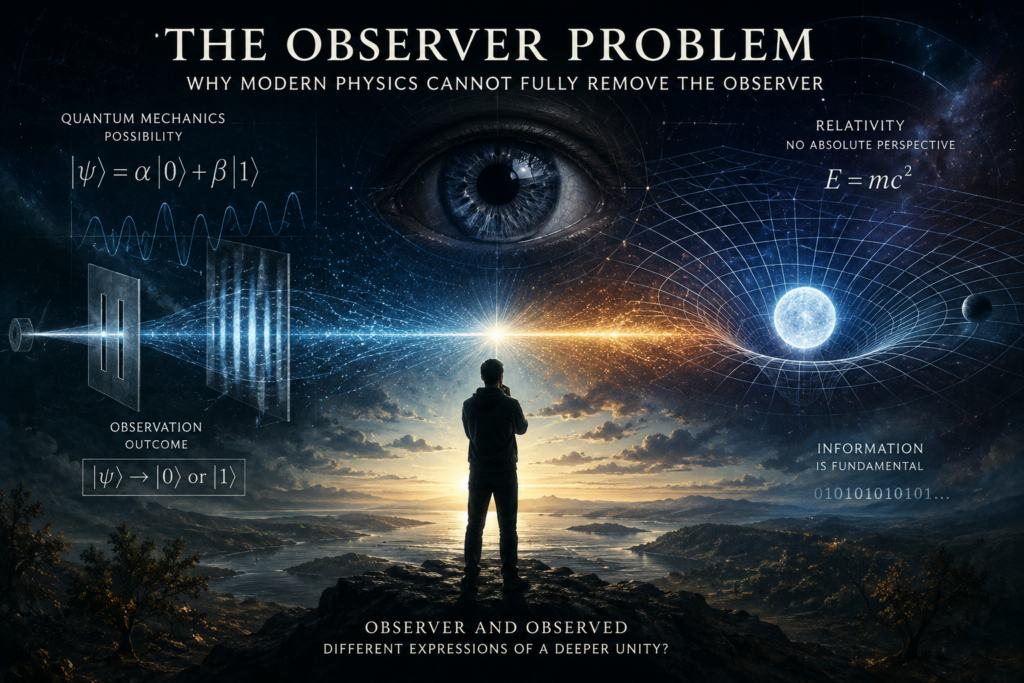
The Classical Dream of Observer-Independent Reality
For centuries, the success of science appeared to validate a simple and powerful assumption:
Reality exists independently of those who observe it.
This assumption became one of the foundations of modern scientific thinking.
Whether anyone was present to witness an event seemed irrelevant. Planets orbited the Sun. Apples fell from trees. Rivers flowed toward the sea. Nature followed laws that existed independently of human perception.
This perspective proved extraordinarily successful.
The Scientific Revolution separated itself from religious authority by insisting that nature could be investigated directly through observation, experimentation, and mathematical description. By focusing on measurable phenomena rather than belief, science transformed civilization.
The resulting advances were staggering.
Steam engines powered industry. Electricity transformed communication. Modern medicine extended life expectancy. Computers emerged from mathematical principles once considered purely abstract.
With each success, confidence grew that the universe was fundamentally objective. The observer was treated as an external witness, not an essential participant.
In this classical view, nature resembles a vast machine.
The machine operates according to fixed laws.
Observers simply discover those laws.
The universe does not care whether anyone is watching.
This worldview reached its greatest expression in the work of Sir Isaac Newton. Newtonian physics described a universe governed by precise mathematical relationships operating within an absolute framework of space and time.
Space existed independently.
Time flowed uniformly.
Matter moved through this stage according to deterministic laws.
If one possessed complete information about every particle in the universe, one could theoretically predict the entire future.
The observer occupied no special position.
The observer was simply another object within the machine.
For over two centuries this view dominated scientific thought.
Then cracks began to appear.
The first major crack emerged through the work of Albert Einstein.
The second emerged through Quantum Mechanics.
Together they would force science to reconsider assumptions that had seemed unquestionable.
Relativity and the End of Absolute Perspective
Einstein’s revolution did not begin by challenging reality itself.
Instead, it began with a question.
What if the speed of light is truly the same for all observers?
At first glance this seems like a technical detail.
Yet its implications were profound.
Classical physics assumed that observers moving relative to one another could still agree on fundamental measurements of space and time.
Einstein discovered otherwise.
Different observers moving at different velocities could disagree about lengths, durations, and the order of events.
Both observers could be correct.
There was no privileged viewpoint from which reality could be described absolutely.
This realization led to Special Relativity.
Time became relative.
Space became relative.
Only the deeper structure connecting them remained invariant.
The consequences were extraordinary.
Clocks run at different rates depending on velocity.
Distances contract.
Mass and energy become interchangeable.
Events that appear simultaneous to one observer may not appear simultaneous to another.
The universe no longer possesses an absolute stage upon which events unfold.
Observation itself becomes inseparable from reference frame.
This is often misunderstood.
Relativity does not imply that reality is subjective.
The laws of physics remain objective.
What changes is our understanding of observation.
Measurements depend upon the relationship between observer and observed.
Observation cannot be completely detached from context.
This was the first major blow to the classical dream of a perfectly observer-independent universe.
Yet relativity still preserved one important principle.
There remained a physical reality that observers measured.
The observer mattered because of perspective.
Quantum mechanics would introduce a much deeper challenge.
Quantum Mechanics and the Return of the Observer
The development of quantum theory represents one of the greatest achievements in scientific history.
It is also one of the strangest.
Quantum theory predicts experimental results with extraordinary accuracy.
No scientific theory has been tested more rigorously.
Yet no scientific theory has generated more debate about what reality actually is.
The trouble begins with a simple observation.
At microscopic scales, nature does not behave like ordinary objects.
Electrons sometimes behave like particles.
At other times they behave like waves.
Light exhibits the same dual nature.
The famous double-slit experiment revealed this mystery dramatically.
When unobserved, particles produce interference patterns characteristic of waves.
When measured, they appear as localized particles.
The mathematics describing this situation does not describe definite objects moving through space.
Instead, it describes probabilities.
Quantum systems exist as distributions of possibilities.
Only when measurement occurs does a specific outcome appear.
The mathematics works perfectly.
The interpretation remains controversial.
Why?
Because the theory appears to require two different kinds of reality.
Before measurement there exists a spread of possibilities.
After measurement there exists a definite outcome.
The transition between these states remains one of physics’ deepest mysteries.
This is known as the measurement problem.
And this is where the observer returns.
Not necessarily human consciousness.
Not necessarily awareness.
But observation.
Measurement.
Interaction.
The production of definite outcomes.
For over a century physicists have debated precisely what causes this transition.
No consensus exists.
Different interpretations provide different answers.
Yet all of them must somehow confront the same puzzle:
Why does reality appear as possibilities in one context and definite outcomes in another?
The observer problem emerges directly from this question.
What Exactly Is an Observer?
One reason the observer problem remains confusing is that the word “observer” means different things to different people.
In everyday language an observer is simply a conscious person watching something.
In physics the situation is more complicated.
An observer may be:
- A measuring device
- A detector
- An interacting particle
- A laboratory apparatus
- A conscious scientist
Different interpretations of quantum mechanics assign different roles to observation.
Some attempt to eliminate observers entirely.
Others treat observation as fundamental.
Still others redefine reality itself.
This diversity of approaches reveals something important.
Physics does not yet possess a universally accepted definition of observation.
The observer remains strangely elusive.
The deeper physicists investigate, the harder it becomes to draw a clean line between observer and observed.
A measuring device is made of matter.
The scientist is made of matter.
The observed system is made of matter.
Where exactly does one end and the other begin?
The classical distinction becomes increasingly difficult to maintain.
This is not merely a philosophical problem.
It is a scientific one.
The success of quantum theory forces us to confront questions that classical physics could safely ignore.
Questions about information.
Questions about measurement.
Questions about reality itself.
And ultimately questions about the relationship between consciousness and the physical world.
Why the Problem Refuses to Disappear
Many physicists hoped that technological progress would eventually remove these conceptual difficulties.
It has not.
Quantum computers.
Quantum cryptography.
Quantum teleportation.
Quantum field theory.
Each success strengthens the theory.
Yet none eliminate the foundational questions.
In some respects the mysteries have only become sharper.
Modern experiments continue to confirm nonlocal correlations.
Entanglement links particles across enormous distances.
Information appears to occupy a deeper role than previously imagined.
Reality increasingly resembles a network of relationships rather than a collection of isolated objects.
The observer problem persists because it touches something fundamental.
It asks whether observer and observed can truly be treated as separate categories.
Classical science assumed they could.
Modern physics increasingly struggles to maintain that assumption.
This does not prove consciousness creates reality.
Nor does it prove matter creates consciousness.
It simply reveals that the boundary between observer and observed may not be as clear as once believed.
And if that boundary becomes difficult to define, deeper questions inevitably arise.
What is the relationship between mind and matter?
Between information and reality?
Between experience and existence?
These questions point beyond the observer problem itself.
They point toward a larger inquiry.
One that may ultimately require a new understanding of unity, observation, and existence.
Light, Information, and the Limits of Separation
If the observer problem is genuinely fundamental, then we should expect to find clues to it not only in quantum mechanics but throughout physics itself.
Surprisingly, one of the most important clues may have been sitting in plain sight for more than a century.
That clue is light.
Light occupies a unique position in modern physics.
Everything we know about the external universe ultimately arrives through light or its electromagnetic relatives. Every astronomical observation, every visual experience, every measurement of distant stars and galaxies depends upon information carried by light.
Yet light is far more than a messenger.
It also sits at the very foundation of relativity.
Einstein’s revolutionary insight began with a simple but profound observation:
The speed of light appears to be the same for all observers.
This fact forced a complete rethinking of space and time.
Lengths became relative.
Durations became relative.
Even simultaneity became relative.
Yet the speed of light remained invariant.
This was not merely a curious feature of nature.
It became one of the organizing principles of modern physics.
The closer an object moves to the speed of light, the stranger reality appears.
Time slows.
Distances contract.
Mass increases.
At the speed of light itself, our ordinary intuitions begin to fail entirely.
Physicists must be careful here.
Strictly speaking, photons do not possess a valid rest frame within relativity. One cannot simply “ride along” with a light beam and describe what a photon experiences.
Yet Einstein himself frequently used imaginative thought experiments involving light to explore the implications of his theories.
These thought experiments reveal something important.
The concepts of space and time that dominate our everyday experience are not fundamental features of reality. They emerge from a deeper structure.
The closer we move toward the limit represented by light, the more our familiar distinctions begin to dissolve.
This observation becomes especially interesting when compared with quantum mechanics.
Quantum systems also challenge ordinary distinctions.
Particles become waves.
Possibilities become actualities.
Location becomes uncertain.
Separate systems become entangled.
In both relativity and quantum mechanics, reality appears less like a collection of isolated objects and more like a network of relationships.
The observer problem emerges precisely at this boundary.
We find ourselves asking:
Are observer and observed truly separate things?
Or are they different aspects of a deeper process?
The question becomes increasingly difficult to avoid.
Major Attempts to Solve the Observer Problem
Physicists have not ignored these questions.
Over the last century numerous interpretations of quantum mechanics have attempted to resolve the observer problem.
Each offers valuable insights.
Each faces significant challenges.
The Copenhagen Interpretation
Historically, the most influential interpretation has been the Copenhagen Interpretation.
Associated primarily with Niels Bohr and Werner Heisenberg, this view treats the quantum wave function as a description of possible outcomes.
Before measurement, multiple possibilities exist.
After measurement, a definite result appears.
The Copenhagen Interpretation succeeds operationally.
It predicts experiments correctly.
However, it leaves an uncomfortable question unanswered:
What exactly counts as a measurement?
The observer remains present but somewhat mysterious.
Many Worlds
The Many Worlds Interpretation attempts to eliminate collapse entirely.
According to this view, all possible outcomes occur.
Reality continuously branches into multiple versions of itself.
The observer does not collapse possibilities.
Instead, the observer becomes correlated with one branch among many.
Many physicists find this interpretation elegant because it preserves the mathematical structure of quantum theory.
Others find it extravagant because it appears to generate an immense number of parallel realities.
Decoherence
Decoherence explains how interactions with the environment cause quantum possibilities to appear classical.
It has become one of the most important developments in modern quantum theory.
Yet decoherence does not completely solve the observer problem.
It explains why quantum superpositions become difficult to observe.
It does not fully explain why one specific outcome appears.
Relational Quantum Mechanics
More recently, some physicists have proposed that physical properties exist only relative to observers.
According to this view, reality is fundamentally relational.
Objects do not possess absolute properties independent of interaction.
This interpretation is particularly interesting because it echoes a lesson already learned from relativity:
Observation and relationship cannot be completely removed from physical description.
Consciousness-Based Interpretations
A smaller but persistent group of thinkers have suggested that consciousness itself may play a role in measurement.
These ideas remain controversial.
Most physicists do not regard consciousness as part of established quantum theory.
Nevertheless, such proposals continue to appear because the observer problem itself remains unresolved.
The important point is not which interpretation is correct.
The important point is that no interpretation has achieved universal acceptance.
A century after quantum theory emerged, physicists still disagree about what the theory ultimately means.
This alone should command our attention.
The Species Universe Perspective
Species Universe begins with a simple observation.
The observer problem appears whenever we attempt to maintain a strict separation between observer and observed.
Classical thinking inherited this separation from centuries of successful scientific practice.
The universe was treated as an object.
The observer was treated as something standing apart from it.
This distinction proved useful.
It remains useful.
Yet usefulness and ultimate truth are not necessarily the same thing.
Relativity weakened the notion of absolute perspective.
Quantum mechanics weakened the notion of observer-independent measurement.
Information theory increasingly emphasizes relationships rather than isolated objects.
Consciousness remains difficult to reduce entirely to physical description.
Taken individually, none of these observations prove a deeper unity.
Taken together, they suggest that reality may not be organized according to the categories we inherited from classical thought.
Species Universe proposes that the observer problem persists because the observer and observed arise from the same underlying reality.
This is not a claim that consciousness creates matter.
Nor is it a claim that matter creates consciousness.
Rather, it is the possibility that both emerge from a deeper foundation that appears differently depending upon how it is observed.
Under this view, consciousness and physical reality are not separate substances struggling to interact.
They are complementary expressions of a more fundamental unity.
The observer problem becomes difficult because we are attempting to divide what may not ultimately be divisible.
Toward a Deeper Unity
Throughout history, science has repeatedly discovered that apparent opposites emerge from deeper unities.
Electricity and magnetism became electromagnetism.
Space and time became spacetime.
Mass and energy became interchangeable.
In each case, distinctions that once seemed absolute were revealed to be contextual.
The observer problem raises the possibility that another such unification may await discovery.
The challenge is enormous.
We do not yet possess a complete theory capable of integrating consciousness, observation, information, quantum mechanics, and spacetime into a single framework.
Yet the absence of a complete theory does not remove the questions.
If observer and observed are fundamentally inseparable, then our understanding of reality remains incomplete.
If they are fundamentally separate, then physics must eventually explain how that separation is maintained.
Either way, the problem remains.
The observer problem is not merely a technical issue buried within quantum theory.
It is a question about the nature of existence itself.
It asks whether the divisions through which we ordinarily understand reality are ultimately fundamental—or whether they emerge from a deeper unity that modern physics is only beginning to glimpse.
What Is at Stake for Human Understanding?
At first glance, the observer problem may appear to be a technical issue buried deep within theoretical physics.
It is anything but.
The observer problem sits at the intersection of some of humanity’s oldest and most important questions.
What is reality?
What is consciousness?
What is our relationship to the universe?
For centuries, science has advanced by dividing reality into manageable parts. This approach has been enormously successful. Yet every method has limits.
The observer problem emerges precisely where those limits begin to appear.
Modern physics has shown us that reality is stranger than our everyday intuitions suggest.
Space and time are not absolute.
Matter is not as solid as it appears.
Information occupies a deeper role than previously imagined.
Observation cannot always be cleanly separated from what is observed.
None of these discoveries prove a particular philosophical position.
But they do challenge assumptions that many people take for granted.
Perhaps the most important lesson is one of humility.
A century after the birth of quantum mechanics, some of the most brilliant minds in science still disagree about what the theory ultimately means.
This disagreement should not be viewed as a failure.
It should be viewed as an invitation.
It reminds us that our understanding of reality remains unfinished.
The observer problem points toward questions that extend beyond physics.
Questions concerning consciousness.
Questions concerning information.
Questions concerning the relationship between subjective experience and objective description.
Questions concerning whether the divisions we impose upon reality are truly fundamental.
Or merely useful approximations.
The answers to these questions may influence not only our understanding of science, but our understanding of ourselves.
Conclusion: Why Modern Physics Cannot Fully Remove the Observer
The dream of classical science was elegant.
A universe existing independently of observers.
A reality describable from nowhere in particular.
A complete account of nature requiring no reference to observation itself.
That dream produced extraordinary achievements.
Yet modern physics has complicated the picture.
Relativity removed absolute perspective.
Quantum mechanics challenged observer-independent measurement.
Information theory revealed deeper layers beneath material description.
Consciousness remains one of the most profound unresolved questions in science.
Again and again, the observer reappears.
Not necessarily as a human being.
Not necessarily as consciousness.
But as an unavoidable feature of physical description.
For more than a century, physicists have attempted to explain why.
Many valuable insights have emerged.
No universally accepted solution has appeared.
The observer problem remains.
Species Universe does not claim to possess the final answer.
It begins with a simpler observation.
Perhaps the persistence of the observer problem is itself a clue.
Perhaps observer and observed cannot be completely separated because they do not originate as separate things.
Perhaps the distinction emerges only after a deeper unity has already been divided into conceptual categories.
This possibility remains speculative.
Yet it offers a direction for inquiry.
Not away from science.
Not away from evidence.
But deeper into the implications of what science has already discovered.
If the observer problem teaches us anything, it is that reality may be more interconnected than classical thinking imagined.
The boundaries between observer and observed, mind and matter, subject and object may not be as fundamental as they appear.
Whether future discoveries confirm or reject this possibility remains to be seen.
But the question itself may be among the most important questions humanity can ask.
For if the observer cannot ultimately be removed from reality, then understanding the observer becomes inseparable from understanding the universe itself.
And that journey may only be beginning.
Further Exploration
This article serves as an introduction to one of the central questions explored throughout Species Universe.
Readers interested in continuing this inquiry may wish to explore:
- The Quantum Measurement Problem
- Observer Dependence in Physics
- Wheeler’s Participatory Universe
- Information and Reality
- The Measurement Boundary
- Level 1: The Unmanifest
- Level 2: The Measurement Boundary
- Comparative Models of Consciousness
Each examines a different aspect of the relationship between observation, reality, consciousness, and the deeper structures that may underlie them.