Vedic Knowledge Systems
(Traditional Knowledge → Comparative Structure)
Introduction: The Vedic Tradition as a System of Inquiry
Among the world’s ancient knowledge traditions, the Vedic philosophical systems of India stand out for their sustained and systematic exploration of consciousness. Developed over millennia through texts such as the Vedas and the Upanishads, this tradition attempts to address some of the same fundamental questions that continue to challenge modern science:
- What is the relationship between the observer and the observed?
- Does reality exist independently of awareness, or does awareness play a fundamental role in its manifestation?
- Is the universe fundamentally composed of matter, or does consciousness participate in the structure of reality itself?
This page examines the Vedic tradition within the broader Traditional Knowledge section of Species Universe.
While the language and methods of the Vedic tradition differ from those of modern science, the questions it raises remain strikingly relevant. This page examines the Vedic systems not as replacements for scientific explanation, but as structured philosophical frameworks that attempted to investigate consciousness through disciplined introspection and reasoning.
The goal is not to claim that ancient thinkers anticipated modern physics, but to evaluate whether some of their conceptual structures resonate with problems currently encountered in physics, neuroscience, and philosophy of mind.
The comparison presented here follows the rules defined in the Methodological Framework for evaluating traditional knowledge systems.
The Upanishadic Investigation of Consciousness
The Upanishads, composed roughly between 800 BCE and 300 BCE, represent the philosophical culmination of early Vedic thought. These texts shift attention away from ritual and toward a deeper inquiry into the nature of awareness and reality.
Central to this investigation are two concepts:
Atman – the inner self or witnessing awareness
Brahman – the ultimate ground of existence
The Upanishadic insight is often summarized in the expression:
“Tat Tvam Asi” — That Thou Art.
This phrase suggests that the deepest layer of individual awareness (Atman) is not separate from the fundamental ground of reality (Brahman). Rather than describing a dualistic universe composed of independent substances, the Upanishadic framework proposes that the apparent multiplicity of the world emerges from a deeper unity.
From a modern perspective, this can be interpreted as an early attempt to address a question still unresolved today:
Is consciousness merely a product of physical processes, or is it an intrinsic aspect of reality?
The Upanishads do not offer mathematical models or empirical experiments. Instead, they propose that this question can only be explored through direct examination of awareness itself.
These questions echo the modern scientific challenge of the measurement boundary between observer and observed.
Layers of Reality in Vedic Thought
Vedic philosophy often describes reality as structured in multiple layers or levels of manifestation.
These layers are not necessarily separate worlds, but different modes through which reality becomes experienced and expressed.
Commonly described levels include:
- Pure Consciousness – the foundational ground of awareness
- Subtle Levels of Mind and Intelligence
- Mental and Sensory Experience
- Physical Manifestation
This hierarchical model attempts to explain how the diversity of observable phenomena may emerge from a unified underlying source.
While these concepts were developed in philosophical rather than scientific terms, they raise questions that echo modern investigations into emergence:
How does complexity arise from simpler underlying structures?
How do physical systems give rise to subjective experience?
The Vedic model proposes that consciousness is not produced by matter alone but participates in the unfolding of reality.
Maharishi Mahesh Yogi and the Modern Interpretation
In the twentieth century, Maharishi Mahesh Yogi sought to reinterpret the Vedic tradition using the language of modern science. His work emphasized the idea that pure consciousness could be understood as the foundational field from which all physical phenomena emerge.
Maharishi frequently drew comparisons between:
- the Unified Field in physics, and
- pure consciousness described in Vedic texts.
These comparisons are not universally accepted and remain philosophically debated. However, they represent an attempt to articulate ancient insights using contemporary scientific concepts.
The significance of Maharishi’s approach lies in its methodological proposal: that disciplined exploration of consciousness through meditation might complement scientific inquiry into the nature of reality.
Meditation as a Mode of Investigation
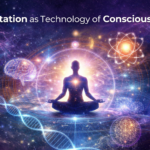
Within the Vedic tradition, meditation is not simply a relaxation technique or spiritual practice. It is regarded as a disciplined method for examining the structure of awareness itself.
The practice known as Transcendental Meditation (TM) is one modern expression of this approach. TM aims to allow the mind to settle into a state described as pure awareness, in which mental activity becomes minimal while consciousness remains fully awake.
Practitioners often report experiences characterized by:
- heightened clarity
- reduced mental noise
- a sense of unified awareness
These reports have motivated scientific research examining potential physiological correlates of meditation, including changes in brain activity, coherence patterns, and stress physiology.
While such studies remain ongoing and interpretations are debated, they raise an important methodological question:
Can systematic first-person exploration of consciousness complement third-person scientific observation?
This question lies at the heart of current interdisciplinary research into consciousness.
The scientific investigation of contemplative practice will be explored further in meditation and consciousness research (coming soon).
Jyoti and the Structure of Time
Some Vedic traditions, particularly those associated with Jyotisha (Vedic astronomy and cosmology), propose that the universe possesses an intrinsic order in which patterns unfold across time.
In this view, an individual life can be compared to the growth of a seed into a tree. The entire potential structure exists implicitly from the beginning, but its expression unfolds gradually as time progresses.
Modern physics has also explored models of time that challenge everyday intuition. In relativity, for example, spacetime can be represented as a four-dimensional structure in which past, present, and future coexist within a single geometric framework.
While the conceptual language differs, both perspectives raise similar questions:
Is time fundamentally sequential, or does it possess a deeper underlying structure?
Comparisons of this kind must be approached carefully. The goal is not to equate ancient cosmology with modern relativity, but to examine whether both traditions were grappling with comparable conceptual challenges.
Points of Interest for Modern Inquiry
Several themes within Vedic philosophy continue to attract attention from contemporary scholars and scientists:
Observer Centrality
The Vedic tradition places awareness at the center of its investigation. This focus resonates with modern discussions surrounding the observer’s role in quantum measurement and consciousness studies.
Unity and Multiplicity
The idea that diversity emerges from an underlying unity parallels modern scientific efforts to unify fundamental forces and fields.
Consciousness as Fundamental or Emergent
Whether consciousness arises from matter or represents a deeper feature of reality remains one of the central open questions in science and philosophy.
These ideas resonate with ongoing questions explored in modern physics foundations.
Limitations and Cautions
Despite these points of interest, important differences remain between Vedic philosophy and modern science.
Scientific theories are evaluated through:
- mathematical formalism
- predictive capability
- empirical testing
Vedic systems rely primarily on:
- philosophical reasoning
- introspective observation
- experiential validation
These differences mean that traditional knowledge cannot substitute for scientific methodology.
However, examining these traditions may still provide conceptual insights into how humanity has historically approached questions about consciousness and reality.
Conclusion: A Tradition of Consciousness Exploration
The Vedic knowledge systems represent one of the earliest sustained attempts to investigate consciousness as a fundamental aspect of reality.
Although developed in a very different historical and intellectual context, these traditions raise questions that remain central to modern scientific inquiry:
- What is the nature of consciousness?
- How does awareness relate to the physical world?
- Is reality fundamentally unified or fundamentally divided?
Exploring these questions through both scientific and contemplative perspectives may help illuminate aspects of reality that neither approach can fully resolve alone.
The next pages in this section examine other traditions and perspectives that also attempted to grapple with these questions, allowing a broader comparison between ancient inquiry and modern scientific thought.