How does a universe that begins in extreme simplicity give rise to stars, galaxies, life, and reflective awareness?
Within the Science & Models framework of Species Universe, cosmology is not treated as a finished story. It is approached as an evolving scientific model constrained by observation, mathematics, and unresolved foundational tensions—particularly those involving quantum mechanics, relativity, and the role of observation itself .
This page explores:
- The standard cosmological model
- The emergence of large-scale structure
- The role of quantum fluctuations
- The arrow of time and entropy
- The unresolved tensions between spacetime, information, and observation
We proceed from established science outward—carefully distinguishing what is measured, what is inferred, and what remains open.
1. The Standard Cosmological Framework
Modern cosmology is built upon:
- General Relativity
- Observational astronomy
- Particle physics
- Precision measurements of cosmic background radiation
The dominant model is often called ΛCDM (Lambda Cold Dark Matter).
It includes:
- Cosmic expansion
- Dark energy (Λ)
- Cold dark matter
- Ordinary baryonic matter
- Radiation
The theoretical foundation begins with the Big Bang—not as an explosion in space, but as an expansion of spacetime itself.
Observational Pillars
Three primary observational confirmations support this model:
- Cosmic Expansion
First measured through redshift observations by Edwin Hubble, showing galaxies receding from one another. - Cosmic Microwave Background (CMB)
Radiation discovered by Arno Penzias and Robert Wilson, later mapped in detail by the Planck spacecraft. - Large-Scale Structure
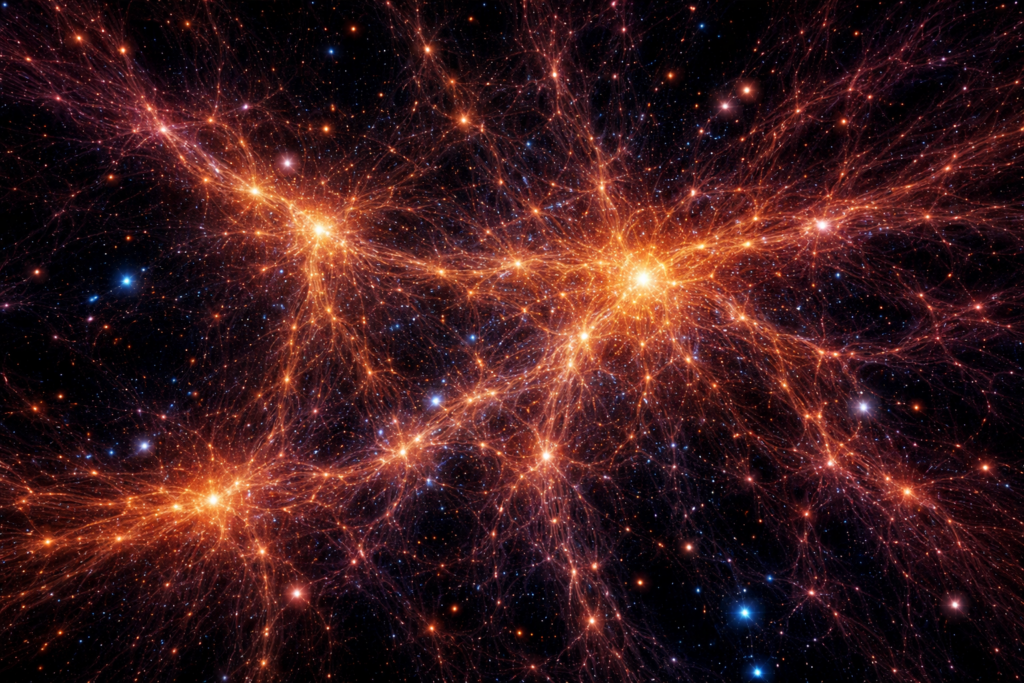
Galaxy surveys reveal a vast cosmic web of filaments, voids, and clusters.
These are experimentally grounded facts. The interpretation of their deeper meaning remains open.
2. From Quantum Fluctuations to Galaxies
One of cosmology’s most striking claims is this:
The structure of the entire universe originated from quantum fluctuations.
During a proposed early phase called Cosmic Inflation, spacetime expanded exponentially.
Tiny quantum fluctuations—normally microscopic—were stretched to cosmic scales.
Those fluctuations became:
- Density variations
- Gravitational seeds
- The scaffolding for galaxies
This is not mystical language. It is mathematically modeled through quantum field theory in curved spacetime.
Yet here a deep question arises:
If structure originates in quantum fluctuations, and quantum mechanics is inherently observer-dependent in its formalism, then what does that imply about the earliest moments of the universe?
This is not a claim that “consciousness created the universe.”
It is a recognition that quantum theory embeds measurement and interaction at its foundation.
The cosmological model assumes:
- A quantum state
- Dynamical evolution
- Decoherence
- Classicalization
But the transition from quantum indeterminacy to classical spacetime remains conceptually incomplete.
3. The Cosmic Web and Emergent Order
As the universe cooled:
- Hydrogen formed
- Gravity amplified density differences
- Stars ignited
- Galaxies assembled
Over billions of years, matter self-organized into what we now call the cosmic web—a network of:
- Filaments
- Clusters
- Voids
Simulations show remarkable agreement with observed structure.
But deeper questions remain:
- Why do the laws allow structure formation at all?
- Why does the universe begin in a low-entropy state?
- Why is the cosmological constant small but non-zero?
These are not minor details. They are foundational puzzles.
4. Entropy, Time, and the Arrow of Structure
Cosmology intersects with thermodynamics in a critical way.
The early universe appears to have had:
- Extremely low gravitational entropy
- High uniformity
Yet over time, structure increases.
This appears paradoxical until one distinguishes between:
- Thermodynamic entropy
- Gravitational entropy
Clumping under gravity actually increases total entropy.
Thus, stars and galaxies are not violations of entropy—they are its expression under gravitational law.
But the deeper mystery persists:
Why was the early universe so low in gravitational entropy?
This is sometimes called the “Past Hypothesis.”
It is a boundary condition, not yet derived from deeper theory.
5. Dark Matter and Dark Energy
Approximately 95% of the universe is not directly observed.
- ~27% dark matter
- ~68% dark energy
Dark matter explains galaxy rotation curves and structure formation.
Dark energy explains accelerating expansion.
But their nature remains unknown.
Here cosmology meets particle physics—and uncertainty deepens.
Is dark energy:
- A cosmological constant?
- Vacuum energy?
- A dynamical field?
Quantum field theory predicts vacuum energy vastly larger than observed.
This mismatch is one of the largest known discrepancies between theory and measurement.
6. Spacetime: Fundamental or Emergent?
One of the most active areas of research today asks:
Is spacetime fundamental?
Or does it emerge from deeper informational or quantum structure?
Approaches include:
- Holographic principles
- Quantum gravity models
- Entanglement-based spacetime emergence
Some proposals suggest that spacetime geometry itself may arise from quantum entanglement networks.
If true, then:
- Structure emerges from information
- Geometry emerges from relational states
- The universe may be fundamentally relational
This aligns with relativity’s elimination of absolute frames.
But it remains an open research program—not established fact.
7. Observer-Dependence in Cosmology
Relativity eliminates privileged reference frames.
Quantum mechanics embeds measurement at its core.
Cosmology describes a universe that evolves from quantum indeterminacy into classical structure.
The tension lies here:
The model describes a universe long before biological observers existed.
Yet the mathematical structure of quantum theory presumes interaction, decoherence, or measurement-like processes.
Possible resolutions explored in physics include:
- Decoherence without consciousness
- Many-worlds interpretations
- Objective collapse models
- Relational quantum mechanics
Species Universe does not assume which is correct.
But it does treat the observer–observed boundary as a structural question, not a trivial one .
8. Cosmology as an Evolutionary Process
From a species-level perspective:
Cosmology is not merely about distant galaxies.
It is about:
- The evolution of structure
- The emergence of complexity
- The rise of reflective systems
The same laws that shaped:
- Quantum fluctuations
- Galactic clusters
- Stellar nucleosynthesis
…also shaped:
- Biochemistry
- Nervous systems
- Self-reflective intelligence
Whether consciousness is:
- Emergent from matter
- Fundamental within matter
- Or relationally co-defined
…remains open.
But cosmology provides the structural backdrop against which that question must be asked.
9. What Is Established vs. What Is Open
Established
- Cosmic expansion
- CMB radiation
- Large-scale structure
- Nucleosynthesis
- Relativity’s large-scale validity
Open Problems
- Nature of dark matter
- Nature of dark energy
- Quantum-to-classical transition
- Low entropy initial conditions
- Quantum gravity
- Spacetime emergence
Philosophical Frontier
- Is information primary?
- Is geometry emergent?
- Is observer-dependence fundamental?
- Does the distinction between mind and matter survive deeper unification?
10. Why Cosmology Matters to the Framework
Cosmology is not separate from the consciousness question.
It defines:
- The origin of structure
- The conditions for complexity
- The mathematical fabric of reality
If:
- Structure arises from quantum fluctuations
- Spacetime may be emergent
- Geometry may derive from information
…then the traditional division between “objective cosmos” and “subjective awareness” cannot remain unexamined.
This is not a conclusion.
It is a pressure point.
Cosmology forces us to confront:
- Origins
- Boundaries
- Emergence
- Observation
- Information
- Unity
And it does so using mathematics and measurement—not metaphysics.
Where This Connects Next
This page connects directly to:
- Complexity & Emergence — Self-Organization and Layered Systems (Coming Soon)
- Quantum Foundations & Measurement (Coming Soon)
- Information, Entropy & Reality (Coming Soon)
- Neuroscience & Consciousness
- Spacetime & Gravity (Taming Gravity) (Coming Soon)
Each layer of structure—from cosmic web to neural network—raises the same structural question:
Is separation fundamental?
Or is it an effective description within a deeper unity?
Cosmology does not answer that question.
But it makes it unavoidable.