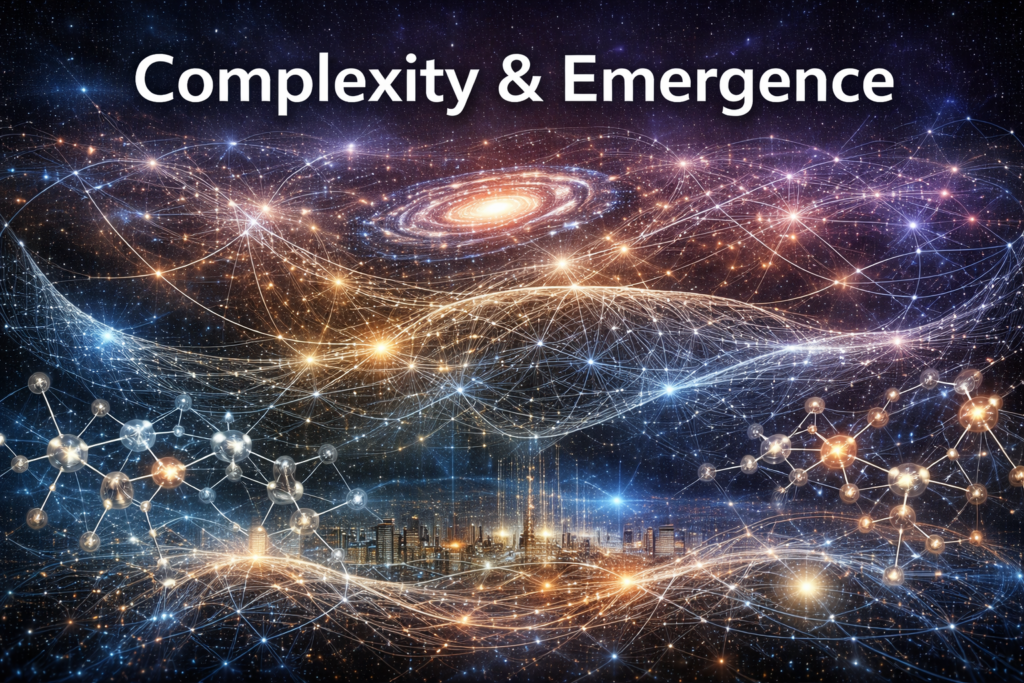
Complexity & Emergence
Self-Organization and Layered Systems
Why Complexity Matters in Scientific Models
Modern science increasingly recognizes that many natural systems cannot be fully understood by analyzing their smallest components in isolation.
While reductionism remains a powerful method, certain phenomena emerge only when elements interact within organized systems.
Complexity science examines how structure, order, and new properties arise from interactions across scales.
This discussion builds upon the broader context introduced in the Science Models overview, where contemporary explanatory frameworks are organized systematically.
This page explores those structural principles without attributing inherent purpose or teleology.
What Is Emergence?
Emergence refers to properties or behaviors that arise from the interaction of simpler components but are not reducible to those components individually.
For example:
- A single neuron is not conscious.
- Billions of interacting neurons may generate awareness.
- Individual water molecules are not “wet.”
- Collective molecular interaction produces fluid properties.
Emergence does not violate physical law. It operates within it.
For a leading interdisciplinary research perspective on complexity science and emergent systems, see the Santa Fe Institute’s overview of complexity science.
It describes layered organization.
Self-Organization in Physical Systems
Self-organization occurs when order arises spontaneously in dynamic systems without centralized control.
Examples include:
- Snowflake formation
- Spiral galaxies
- Chemical reaction-diffusion patterns
- Phase transitions
These systems obey physical laws, yet complex structure emerges through feedback, constraint, and interaction.
The underlying physical principles governing these interactions are outlined in Physics Foundations — Fields, Relativity, and Quantum Structure.
Order is not imposed externally. It arises through systemic dynamics.
Nonlinearity and Feedback
Many complex systems exhibit nonlinear behavior, meaning small changes in input can produce disproportionately large effects.
Feedback loops play a central role:
- Positive feedback amplifies change.
- Negative feedback stabilizes systems.
Biological ecosystems, neural networks, climate systems, and economic systems all exhibit nonlinear dynamics.
Understanding these feedback mechanisms is essential for modeling adaptive complexity.
Networks and Distributed Organization
Complex systems often take the form of networks.
Networks consist of:
- Nodes (components)
- Connections (relationships)
- Patterns of interaction
In distributed systems:
- No single node governs the whole.
- Structure arises from relational patterns.
Examples include:
- Neural networks
- Social systems
- Internet architecture
- Protein interaction networks
Network theory provides tools for analyzing how structure emerges from connectivity.
Layered Organization Across Scales
Scientific models increasingly recognize that reality is organized in layers:
- Subatomic structure
- Atomic chemistry
- Molecular systems
- Cellular biology
- Neural networks
- Social systems
The integration of neural systems and awareness is examined in greater depth in Neuroscience & Consciousness — Brain, Integration, and Awareness.
Each layer operates under the same physical laws, yet introduces new structural regularities.
Emergent properties at one level may become foundational elements at the next.
This layered organization does not negate reductionism. It complements it.
Complexity Without Teleology
It is important to distinguish between:
- Increasing complexity
- Directed purpose
Complex systems can become more structured without aiming toward a goal.
Evolutionary processes, for example, may increase complexity under certain conditions, but they do not inherently aim toward specific outcomes.
As discussed in Evolutionary Systems — Biological Development and Adaptive Complexity, evolutionary processes may increase complexity under certain conditions, but they do not inherently aim toward specific outcomes.
Emergence describes pattern formation. It does not imply intention.
Maintaining this distinction preserves scientific discipline.
Relationship to Other Scientific Domains
Within the Science Models silo:
- Physics Foundations describes the fundamental structural substrate.
- Evolutionary Systems describes adaptive biological organization.
- Neuroscience & Consciousness describes neural integration and awareness.
Complexity & Emergence examines how layered organization operates across all these domains.
It is a structural bridge, not a metaphysical claim.
Why Complexity Is Conceptually Important
Understanding complexity helps clarify:
- How structured systems arise without centralized design
- How cooperation and competition coexist
- How stability and instability interact
- How layered organization produces new regularities
These insights strengthen scientific explanation while maintaining empirical boundaries.
Moving Forward
Having examined structure at multiple scales, the next step is to consider the universe at its largest observable level in Cosmology & Large-Scale Structure — From Early Universe to Galactic Complexity.
Complexity theory prepares us to understand how large-scale cosmic organization unfolds under physical law.