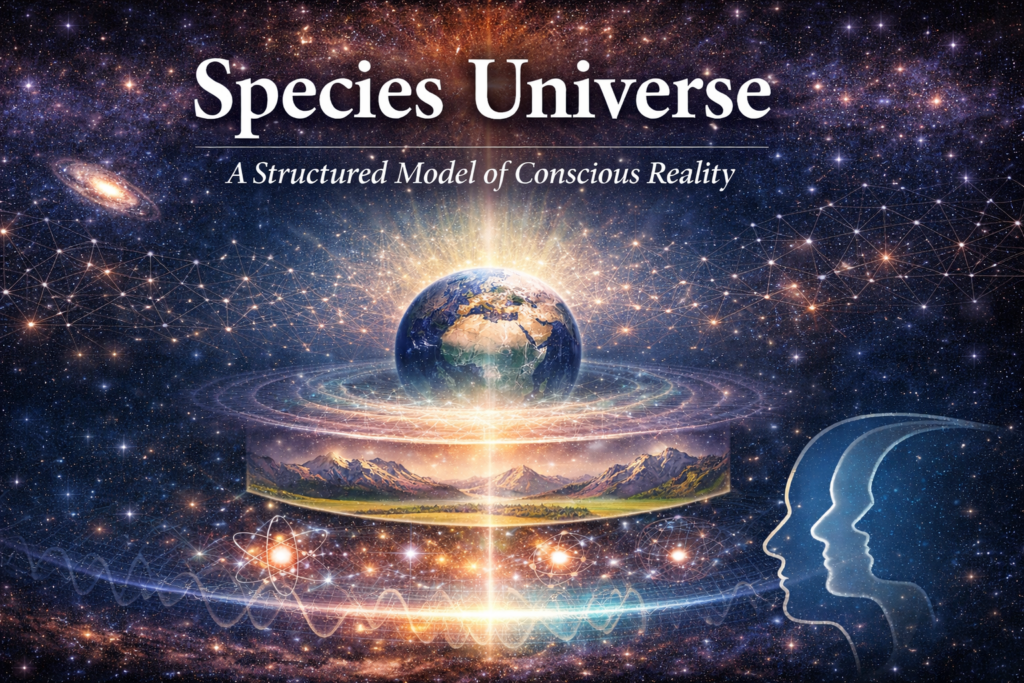
Species Universe – Discovering the Universe as a Living Expression of Consciousness
Introduction
Species Universe proposes a model of reality in which consciousness and physical structure are not treated as fundamentally separate domains, but as deeply intertwined aspects of a single underlying process.
Modern physics has revealed a universe that is relational, dynamic, and structured by fields rather than solid objects. Evolutionary biology has demonstrated that life is not an anomaly, but a natural unfolding of complex organization over time. Neuroscience continues to investigate how subjective awareness arises within biological systems.
Yet despite these advances, a central question remains unresolved:
Is consciousness an emergent byproduct of matter, or does it reflect something more foundational within reality itself?
Species Universe does not begin by asserting an answer. It begins by examining structure.
From Mechanism to Relational Structure
Classical science described the universe as a mechanical system composed of independent parts interacting through deterministic laws. That model was powerful, but incomplete.
Relativity reframed space and time as relational rather than absolute. Quantum theory revealed that physical systems cannot always be described independently of observation and measurement context. Field theory replaced solid particles with dynamic excitations of underlying fields.
These developments do not prove that consciousness is fundamental. But they complicate the assumption that matter is self-sufficient and fully independent of relational structure.
They invite reconsideration.
The Role of Observation
In quantum mechanics, measurement plays a nontrivial role. The formalism does not easily allow for a fully detached observer. Instead, systems are described probabilistically until interaction occurs.
There are many interpretations of what this means.
Species Universe explores one possibility:
That the boundary between observer and observed may not be absolute, and that what we call “measurement” may reflect a deeper relational process embedded in reality itself.
This is not a rejection of physics. It is an inquiry into how its structure may be interpreted.
Evolution as Increasing Interiorization
Biological evolution demonstrates increasing complexity over time. Matter organizes into molecules, molecules into cells, cells into organisms, organisms into self-reflective systems.
Conscious awareness, as far as we can observe, emerges within this evolutionary trajectory.
One interpretation is that consciousness is a late-stage accident.
Another possibility is that evolution reveals progressive expressions of relational potential already inherent in the fabric of reality.
Species Universe examines this second possibility as a working hypothesis.
Nothingness and Potential
Modern physics describes vacuum states not as empty voids, but as structured fields of potential.
Philosophical traditions have long described a ground of being characterized not by objecthood, but by undifferentiated potential.
These descriptions are not identical. They arise from different methods and epistemologies.
However, their structural similarity raises an interpretive question:
Could what physics describes mathematically as non-local potential correspond conceptually to what philosophy has described symbolically as “nothingness”?
Species Universe does not assert identity. It explores structural resonance.
A Living Expression
When we examine the universe across scales, we observe:
- Dynamic self-organization
- Increasing complexity
- Recursive relational structures
- Self-reflective awareness emerging within the system
One interpretive model views this as purely mechanical unfolding.
Another sees the universe as behaving analogously to a living system — not biologically alive in the ordinary sense, but structurally self-organizing and internally expressive.
Species Universe adopts the second model as a lens of inquiry.
It asks whether the cosmos may be understood as a species-scale process through which awareness becomes increasingly localized, differentiated, and reflective.
The Four-Level Framework
To explore this possibility without collapsing into speculation, Species Universe is structured through a layered framework:
- Level 1 — The Unmanifest: Undifferentiated potential.
- Level 2 — The Measurement Boundary: Relational interaction and structure formation.
- Level 3 — Localized Reality: Spacetime embodiment and biological evolution.
- Level 4 — Reflective Consciousness: Self-awareness, meaning, and ethical orientation.
This framework does not claim finality. It offers a scaffold for structured exploration.
An Invitation to Inquiry
Species Universe is not a doctrine. It is a model.
It does not require acceptance. It invites examination.
If consciousness and structure are not ultimately separate, then the universe may not be a collection of inert objects but an unfolding relational process in which we participate.
If that is even partially true, it carries implications not only for physics and philosophy, but for civilization and ethics.
The task, however, is not to declare such a conclusion prematurely.
The task is to build a model rigorous enough to withstand scrutiny.
That work begins with structure.