


Science Refutes God? — A Species Universe Curation
Curated Analysis
The Intelligence Squared debate titled “Science Refutes God” is framed as a contest between science and theism, but beneath its rhetorical surface it reveals something far more consequential for a Species Universe perspective. The debate exposes a shared assumption on both sides: that reality is fundamentally material, and that consciousness—if addressed at all—must either be reduced to brain activity or pushed outside science altogether. This assumption, rather than God per se, is the real point of tension.
Science does not merely study matter—it reveals the intimate role of the observer in shaping reality.
Arguing for the motion, Lawrence Krauss and Michael Shermer contend that modern science has steadily displaced the need for a divine explanation. Krauss emphasizes cosmology and the plausibility of a universe arising from “nothing,” while Shermer frames religious belief as a psychological and sociological construct shaped by evolution and social order. Their core claim is not merely that God lacks evidence, but that natural laws are sufficient—and that appealing to anything beyond them is irrational.
Yet what becomes clear through careful listening is that the “nothing” invoked by modern cosmology is not classical nothingness. Krauss himself repeatedly qualifies his claims with could, might, and plausible, acknowledging that science operates within probabilistic models rather than final metaphysical certainty. From a Species Universe standpoint, this is precisely where materialism quietly dissolves. Quantum mechanics does not reveal a solid, self-sufficient material world—it reveals a relational reality, one that depends on observation, measurement, and informational constraints. What is often presented as a refutation of God is, more accurately, a refutation of naïve realism.
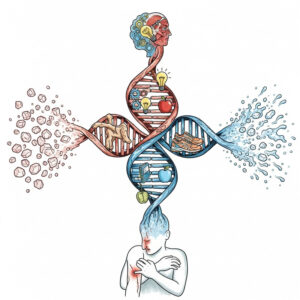
Quantum mechanics replaces certainty with probability—and matter with relationship.
On the opposing side, Ian Hutchinson and Dinesh D’Souza argue that science is simply not equipped to address questions of meaning, purpose, morality, or ultimate origin. Hutchinson draws a sharp line between scientific knowledge and other forms of knowing, warning against scientism—the belief that science is the only valid path to truth. D’Souza emphasizes that science can explain how the universe behaves, but not why it exists or what comes after death.
From the Species Universe lens, both camps miss a crucial synthesis. The debate assumes that if God is not an external agent acting within spacetime, then meaning must be illusory. But quantum theory already undermines the notion of an observer-independent universe. The act of measurement, the role of probability, and the inseparability of observer and observed all point toward a reality in which mind and matter are not separate substances, but complementary aspects of a single process.
Where science ends its explanations, unity—not emptiness—remains.
When Shermer explains spiritual experiences as brain-generated phenomena, he treats consciousness as a byproduct. Yet neuroscience itself has not explained why subjective experience exists at all. Likewise, when Krauss argues that the universe does not require purpose, he assumes that purpose must be imposed from outside. A Species Universe approach reframes this entirely: purpose may be intrinsic, arising from the universe’s capacity to become self-aware through evolving forms of life.
Seen this way, the debate does not demonstrate that science refutes God. Instead, it shows that science refutes outdated metaphysical models—both theological and materialistic. Quantum mechanics, far from closing the door on meaning, opens a deeper question: what kind of universe gives rise to observers capable of asking these questions in the first place?
This curation draws directly from the video transcript provided .
Key Takeaways:
- Science refutes an external, mechanistic God—but not the primacy of consciousness.
What modern physics dismantles is the idea of a detached creator acting within a clockwork universe, not the possibility that consciousness is fundamental. - Quantum mechanics quietly dissolves strict materialism.
The probabilistic, observer-dependent nature of reality challenges the assumption that matter exists independently of mind. - The real divide is not science vs. religion, but reductionism vs. unity.
Both sides of the debate overlook the emerging picture of reality as a unified process in which mind and matter are inseparable.
““The laws of physics tell us what’s likely and what’s unlikely—they don’t tell us why the universe exists at all.”
From a Species Universe perspective, this statement marks the threshold where science stops describing mechanisms and begins pointing—implicitly—toward a deeper unity of existence, one in which consciousness is not an accident of matter, but its most revealing expression.













Leave a Reply