How Species Universe Thinks
A Framework for Exploring Reality, Consciousness, and the Universe
Introduction: Why a Framework Is Necessary
Species Universe explores some of the deepest questions humanity has ever asked:
- What is the universe made of?
- What is consciousness?
- Why does reality appear the way it does?
- Is evolution limited to biology—or does it apply to understanding itself?
These questions sit at the intersection of modern science, philosophy, and ancient knowledge traditions. Because these domains use different methods and assumptions, confusion often arises—not from lack of intelligence, but from lack of clarity about how conclusions are reached.
This page exists to make our approach explicit.
Species Universe does not ask readers to accept beliefs.
It invites readers to follow reasoning, understand distinctions, and explore convergences where they genuinely occur.
Our Core Principle
Understanding evolves. Models must remain aligned with reality as it is—not as we assume it to be.
Science progresses by refining models.
Philosophy examines the assumptions behind those models.
Traditional knowledge systems explore reality through direct experience and introspection.
Species Universe treats all three as complementary modes of inquiry, not competing belief systems.
The Three-Layer Framework
All content on Species Universe operates within one or more of the following clearly defined layers.
Understanding which layer you are in matters.
Layer 1: Established Science
This layer contains ideas that are empirically supported, mathematically formalized, and broadly accepted within the scientific community.
Examples include:
Relativity
- Measurements of space and time depend on the observer’s frame of reference
- Spacetime is not an absolute backdrop but a dynamic structure
- There is no privileged “outside” perspective of the universe
Quantum Mechanics
- Physical systems exist in superposition prior to measurement
- Non-local correlations (entanglement) are experimentally verified
- The mathematical formalism predicts outcomes with extraordinary precision
Evolution
- Complex forms emerge through selection acting on variation
- Adaptation is context-dependent
- Systems that fail to align with reality do not persist
At this level:
- No metaphysical claims are made
- No spiritual conclusions are drawn
- The focus is on what is measured and modeled
Species Universe treats established science with respect and precision.
Layer 2: Open Scientific Questions
This layer addresses where science itself acknowledges uncertainty.
These are not fringe ideas—they are active areas of research and debate.
Examples include:
- What constitutes a “measurement” in quantum mechanics?
- Why does classical reality emerge from quantum systems?
- Is spacetime fundamental or emergent?
- What is the ontological status of the quantum wavefunction?
- Is consciousness an emergent property of matter—or something more basic?
At this level:
- Competing interpretations exist
- No single explanation has been decisively confirmed
- Scientific humility is essential
Species Universe emphasizes these questions because they reveal the limits of current models, not their failure.
Layer 3: Philosophical & Traditional Insight
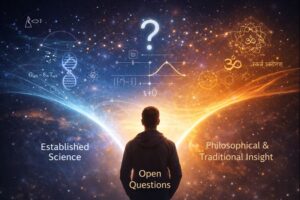
The three-layer framework used by Species Universe to distinguish established science, open questions, and philosophical interpretation.
This layer explores interpretive frameworks, not experimental claims.
Here we engage:
- Philosophy of mind
- Ontology and epistemology
- Traditional knowledge systems, especially Vedic thought
Examples include:
- Consciousness as self-referral awareness
- The distinction between appearance and underlying reality (e.g., Maya)
- The idea that subject and object may not be fundamentally separate
- “Nothingness” not as absence, but as potential
Important clarification:
These perspectives are presented as lenses for understanding—not as scientific proof.
They are valuable because they:
- Address questions science brackets rather than resolves
- Offer internally coherent models refined over millennia
- Often converge structurally with insights from modern physics
Species Universe does not claim ancient traditions replace science.
It explores why different epistemologies may point toward similar patterns.
Why We Juxtapose These Domains
We do not juxtapose science and tradition to:
- Undermine scientific rigor
- Promote belief over evidence
- Declare final answers
We juxtapose them to ask a deeper question:
Why do radically different methods of inquiry converge on similar ideas about reality, observer-dependence, and unity?
This convergence does not prove metaphysical claims—but it does suggest that:
- Materialist assumptions may be incomplete
- Observer-centric models deserve serious consideration
- Understanding may evolve beyond current paradigms
Evolution Beyond Biology
A central idea of Species Universe is that evolution applies not only to organisms, but to models of understanding.
- Classical physics evolved into relativity and quantum mechanics
- Absolute space and time gave way to relational frameworks
- Objectivity itself became contextual
From this perspective:
- Consciousness studies are not a regression into mysticism
- They are a continuation of scientific evolution into previously excluded domains
How to Read Species Universe
To help orient readers, we offer this simple guide:
You are never required to believe anything here.
You are invited to follow the reasoning.
All conclusions are provisional and open to revision.
If a claim is scientific, it will be labeled as such.
If a question is unresolved, that uncertainty will be stated.
If an interpretation is offered, it will be presented transparently.
What Species Universe Is—and Is Not
Species Universe is:
- An exploratory platform
- A synthesis of science, philosophy, and tradition
- A space for rigorous, open-ended inquiry
Species Universe is not:
- A belief system
- A replacement for science
- A claim of final truth
Closing Perspective
Humanity is not merely observing the universe.
We are part of the process by which the universe becomes aware of itself.
Whether this ultimately points to consciousness as fundamental remains an open question—but it is a question worth approaching with clarity, humility, and intellectual courage.
Species Universe exists to support that exploration.