
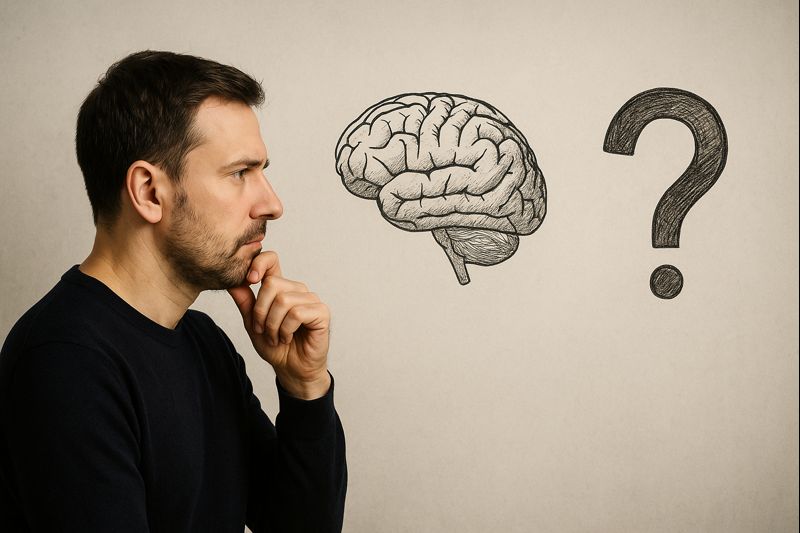


Consciousness as Fundamental: Why Awareness Cannot Be Reduced to Matter
Introduction: The Assumption Beneath All Assumptions
Modern science begins with a quiet premise so familiar that it is rarely questioned: matter is primary, and consciousness somehow emerges from it.
Brains are physical. Neurons fire. Chemistry unfolds. And somewhere along this chain, subjective experience appears—thoughts, feelings, perception, meaning.
But after decades of research across neuroscience, physics, and philosophy, this assumption has led not to clarity, but to paradox.
As explored in The Mind–Body Problem: Why Modern Science Still Can’t Explain Conscious Experience, no physical explanation has yet accounted for why experience exists at all. And as shown in Observer and Observed: Why Perception Is Not Separate from Reality, observation itself cannot be removed from the structure of reality.
These are not minor anomalies. They point toward a deeper possibility:
Consciousness may not be produced by matter.
Matter may arise within consciousness.
What “Consciousness as Fundamental” Actually Means
To say that consciousness is fundamental does not mean:
- That physics is wrong
- That the brain is irrelevant
- That subjective belief replaces objective inquiry
It means something far more precise.
A fundamental property is one that:
- Cannot be derived from something more basic
- Is required for all explanations to function
- Does not disappear when systems are reduced
Consciousness meets all three criteria.
Every observation, measurement, theory, and experiment presupposes awareness. Even the claim that “only matter exists” is something known—and knowing is itself an act of consciousness.
This creates an asymmetry that cannot be ignored:
- Matter is known through consciousness
- Consciousness is never known through matter alone
The Failure of Emergence as an Explanation
Emergence is often invoked as the solution: consciousness “emerges” when matter reaches sufficient complexity.
But emergence explains patterns, not presence.
Complexity can account for:
- Organization
- Behavior
- Information processing
It does not explain:
- Why experience exists at all
- Why there is a point of view
- Why anything feels like something rather than nothing
No increase in complexity transforms objective description into subjective awareness. The gap is conceptual, not technical.
This is why even leading philosophers of mind acknowledge that consciousness resists reduction. David Chalmers, for example, distinguishes between the “easy problems” of cognition and the hard problem—why physical processes are accompanied by experience at all (see Stanford Encyclopedia of Philosophy, “Consciousness”).
Physics Quietly Supports the Shift
While neuroscience struggles to derive consciousness from matter, physics has been undergoing its own conceptual transformation.
At fundamental levels, the universe is no longer described as solid objects moving through space, but as:
- Fields
- Probabilities
- Relationships
- Information structures
In quantum theory, properties do not exist in a definite state independent of observation. Measurement is not passive—it plays a constitutive role.
This does not mean that human minds create reality, but it strongly suggests that reality is participatory rather than purely objective.
Physicists such as Erwin Schrödinger and David Bohm openly questioned whether consciousness could be treated as secondary, with Schrödinger famously arguing that consciousness cannot be accounted for in physical terms alone.
Consciousness Is Not Found—It Is What Finds
A crucial but often overlooked fact is this:
Consciousness is never observed as an object.
It is always that which observes.
You can observe brain activity.
You can observe behavior.
You can observe neural correlates.
But you cannot observe awareness itself from the outside—because it is not in the world the way objects are. It is the condition under which a world appears at all.
This is why attempts to “locate” consciousness in the brain always fail. Not because the brain is irrelevant, but because awareness is not spatial in the same way physical objects are.
The Vedic Parallel: Awareness as the Ground of Reality
Long before modern science encountered these problems, Vedic traditions articulated a remarkably similar conclusion.
They did not claim that consciousness is inside the universe.
They claimed that the universe appears within consciousness.
In this view:
- Awareness is self-existent
- Matter is a manifestation within it
- Individual experience is localized expression, not separate substance
This perspective was not speculative theology. It arose from systematic inquiry into experience itself—what happens when awareness observes its own nature without assumptions.
What science is now discovering indirectly, these traditions described directly: the observer is not a byproduct of the observed.
Consciousness as the Missing Link in Evolution
If consciousness is fundamental, evolution must be reconsidered.
Evolution is typically framed as:
- Random variation
- Natural selection
- Survival optimization
But this framework describes forms, not experience.
An evolutionary process that produces self-awareness is not merely biological—it is reflective. The universe begins to know itself.
From this perspective, explored further in Species Universe’s work on evolution and species development, consciousness is not an accidental side effect. It is a directional feature of cosmic development.
Matter organizes toward life.
Life organizes toward awareness.
Awareness organizes toward self-knowledge.
Why This Matters for Science and Society
Treating consciousness as secondary has consequences:
- Meaning becomes accidental
- Ethics become arbitrary
- Human potential is artificially constrained
- Technology develops without interior wisdom
By contrast, recognizing consciousness as fundamental:
- Grounds meaning without mysticism
- Aligns science with lived experience
- Restores coherence between observer and world
- Reframes intelligence, creativity, and responsibility
This is not anti-science. It is post-materialist science—science that includes the one thing it previously left out.
A More Coherent Starting Point
Instead of asking:
“How does matter produce consciousness?”
A more coherent question is:
“How does consciousness present itself as matter?”
This shift does not end inquiry. It clarifies it.
When awareness is treated as primary, the mind–body problem softens, the observer–observed divide dissolves, and reality becomes intelligible in a deeper sense.
Conclusion: Awareness Is Not an Output—It Is the Ground
Consciousness does not appear at the end of evolution like a decorative flourish.
It is present at the beginning as the condition of all appearance.
Matter, energy, space, and time are patterns within awareness—not the other way around.
Recognizing this is not belief.
It is a correction of perspective.
Consciousness is not what we have.
It is what we are.
And until science fully integrates that fact, the most important part of reality will remain unexplained.
Internal Linking (Recommended)
- Link early reference to The Mind–Body Problem
- Link mid-article reference to Observer and Observed
- Forward-link later to Evolution of Consciousness (future anchor)
External Authority References (Suggested)
- Stanford Encyclopedia of Philosophy – Consciousness
- Stanford Encyclopedia of Philosophy – The Mind–Body Problem
- David Chalmers – Facing Up to the Problem of Consciousness
- Erwin Schrödinger – Mind and Matter














Leave a Reply