


A Journey Within: TM and Universal Consciousness
 I’m John, and my path began with Transcendental Meditation (TM). Decades of daily practice taught me to sit quietly, repeat a personal mantra, and watch thoughts drift. Slowly, I sensed something vast beyond my individual mind – what ancient texts call universal consciousness. As our own SpeciesUniverse “Concept” page notes, TM is “a form of silent mantra meditation… practiced 20 minutes twice a day, which allows the mind to settle inward beyond thought to experience the source of thought, which is pure consciousness”. In those still moments I felt connected to “that larger, all-encompassing universal consciousness”. It was a glimpse of the Vedic insight, “Sarvam khalvidam Brahma” – “All this is Brahman… from It the universe comes forth, in It the universe merges, and in It the universe breathes”. Einstein himself hinted at this mystery, remarking that “the most beautiful thing we can experience is the mysterious – it is the source of all true art and science.” By wonder and reverence I too began to question how my attention, and yours, might play a role in the unfolding of life itself.
These experiences of oneness led me to explore science: the quantum observer effect, neuroplasticity, epigenetics, and the emerging field of quantum biology. Each field revealed ways that our mindful observation – our focused attention and intention – can influence matter, genes, cells, even evolution. In the 20th century, pioneers like Schrödinger and Heisenberg already saw hints of this unity. Schrödinger wrote that “inconceivable as it seems… you and all other conscious beings… are all in all,” echoing the Upanishadic “Tat Tvam Asi” (That Thou Art). In my own life and through meditation, I began seeing how each choice, each directed thought, ripples outward. This article weaves those threads: from personal TM insight to the latest science, and back to a vision – that collective mindfulness might one day catalyze our species’ evolution.
The Observer Effect: Consciousness and Quantum Physics
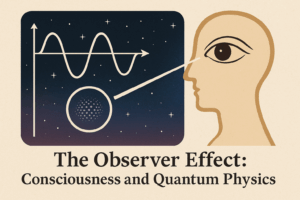
A symbolic visualization of the quantum observer effect—where conscious observation collapses the wave into a particle, shaping physical reality.
Quantum mechanics surprises us with a fundamental idea: the act of observation changes reality. In the famous double-slit experiment, electrons fired through two slits form a wavy interference pattern if unobserved, but when we measure which slit they go through, the interference disappears and they hit the screen like ordinary particles. As one account explains, “Once an observer begins to watch the particles going through the openings, the picture changes dramatically… when under observation, electrons are being ‘forced’ to behave like particles”. In other words, simply by observing, the probabilistic wavefunction collapses.
Our SpeciesUniverse Concept essay puts it this way: the observer effect suggests “that by the very act of watching, the observer affects the observed reality”. If observation can determine physical outcomes, then consciousness is not just a passive bystander; it becomes an active participant in shaping reality. This doesn’t mean our thoughts magically move objects, but it hints that awareness itself has causal power at the quantum level. In practical terms, the quantum field isn’t a fixed stage independent of us. Instead, as one essay observes, the universe “is a dynamic, interconnected field of possibilities – a reality shaped as much by consciousness as by physical laws”.
- In quantum terms, measurement equals interaction. Whenever we check a particle’s position or path, we inevitably disturb it.
- The famous phrase “the collapse of the wavefunction” simply means that potentials (many possible outcomes) resolve to one outcome when observed.
- Implication: If mind and matter truly interact at this level, then focused attention might influence probabilities, however subtly.
This science dovetails with ancient wisdom: the Vedas call the world maya, an illusion of duality, because in truth “the distinction between the observer and the observed… is ultimately an illusion”. In meditation I experienced something similar – the witnessing self and witnessed thoughts merge. Such hints of unity resonate through both quantum experiments and spiritual teaching. As Schrödinger reflected, our waking consciousness may be one “singular,” with the “plural” selves an illusion. In a sense, every mindful observation is a ripple in that singular mind.
Attention and Neuroplasticity: Rewiring the Brain
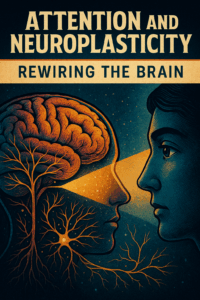
Mindful attention activates neuroplasticity—rewiring the brain’s structure and function through conscious observation.
Our focus matters biologically too. Modern neuroscience shows that where attention goes, the brain grows. Numerous studies confirm that meditation literally changes brain structure and function – a process called neuroplasticity. For example, one systematic review notes that mindfulness practice “induces neuroplasticity, increases cortical thickness, reduces amygdala reactivity, and improves brain connectivity”. In plain terms, regular meditation strengthens regions of the cortex involved in self-awareness and decision-making, while quieting the fear-center in the amygdala.
Other findings include:
- Thicker Prefrontal Cortex: Meditators often show increased gray matter in prefrontal areas (the seat of attention and emotional regulation).
- Stronger Connectivity: Brain scans reveal more robust links between the prefrontal cortex and other networks (like the “default mode” involved in mind-wandering). This means meditators can switch off rumination more easily and stay present.
- Calmer Stress Response: Long-term practitioners exhibit reduced cortisol and changes in neurotransmitters (higher GABA, serotonin, BDNF) that correlate with better mood and resilience.
Together, these changes enhance attention, emotional balance, and learning. In practical terms, disciplined observation (the kind we train in meditation) is like mental exercise: neurons that fire together wire together. Each time we bring the mind back to the present moment, we are literally sculpting our neural circuits for clarity and compassion.
- Focused attention increases awareness circuits: Studies link meditation to growth in the anterior cingulate cortex (attention-regulation).
- Mindfulness improves self-control: Strengthening the prefrontal cortex helps us pause before habitual reactions.
- Reduced stress preserves the brain: Smaller, less reactive amygdala (the fight-or-flight center) means less wear-and-tear from chronic stress.
These insights suggest that our intentional mental habits feed back into biology. As we observe and attend to thoughts without judgment, our brains increasingly embody that calm witness state. In other words, conscious attention rewires itself into a more peaceful, resilient brain.
Epigenetics: Writing Our Genes with Mindfulness

A visual metaphor showing how conscious attention can influence gene expression—depicting mindfulness as a beam of light illuminating and interacting with DNA.
Beyond the brain, attention and lifestyle leave marks on our genes. The new science of epigenetics shows that gene expression is not fixed – it is tuned by our experiences. Chemical “tags” like DNA methylation can silence or activate genes in response to environment. For example, decades of research into trauma has revealed that horrific stress can imprint on the epigenome. Children of Holocaust survivors exhibit altered methylation on stress-related genes, affecting their hormone levels even without direct trauma exposure. In one scientist’s words, genes provide the templates for proteins, but “how much of those proteins gets produced… depends on the environment. This discovery… gave rise to epigenetics”.
Fortunately, the flipside is also true: positive experiences can switch on healthful genes. In enriched environments (like nurturing parental care or cognitive stimulation), rodents show decreased methylation at the glucocorticoid receptor gene – a change that leads to calmer stress responses. Likewise, meditation and mind–body practices are being studied for similar effects. Researchers hypothesize that the “inner silence” of mindfulness might reproduce the epigenetic benefits of enrichment. Early studies hint that practices like yoga and meditation can alter the expression of inflammation and stress genes in blood cells. In short, every habit, emotion, and meditation can inscribe a message in our DNA.
- Trauma vs. Mindfulness: Harsh stress often increases epigenetic “silencing” of protective genes, while loving attention can lift that repression.
- Intergenerational Impact: The epigenetic legacy of trauma may be reversible – for instance, psychotherapy and stress-reduction can gradually normalize cortisol-related gene methylation.
- Mindful Living: Practices like meditation potentially leave behind their own “signature” marks. Scientists are even looking for specific methylation patterns linked to sustained inner calm.
In essence, epigenetics reveals that our genes listen to the story of our lives. By observing our thoughts and choosing kindness and equanimity, we are rewriting our genetic destiny – nurturing wellbeing not only in ourselves but possibly in future generations.
Quantum Biology: Bridging Mind and Cell

A powerful depiction of how consciousness interfaces with cellular biology—unifying quantum awareness and molecular life through the lens of quantum biology.
Convergence of the above ideas is emerging in quantum biology – a field exploring quantum phenomena in living systems. We already know life exploits quantum tricks: for example, plants use quantum coherence to optimize photosynthesis, and some birds navigate by quantum magnetic sensors. In fact, as one review notes, “biological evolution is able to exploit quantum stochasticity,” and scientists wonder if quantum events could even play roles in our brains.
Pioneering theories take this further. Physicist Matthew Fisher has proposed that nuclear spins of phosphorus atoms in neurons could act as rudimentary quantum bits, enabling a form of quantum computation in the brain. A study even suggests that the brain’s myelin sheath can generate entangled photon pairs across distances – a mechanism that might help synchronize neuron firing across the cortex. While these ideas are still speculative, they hint at a deep continuum between the quantum and biological.
Key points:
- Quantum biology finds real-world quantum effects (superposition, entanglement) in biology – from photosynthesis to smell.
- The quantum brain hypothesis: Even if the brain is mostly “warm and wet,” it may exploit subtle quantum processes. Recent analyses argue that “quantum events could play a non-trivial role… in neuronal cells”.
- If consciousness or intention has a quantum component, then focused mind could in principle interface with cellular processes directly.
This doesn’t mean our thoughts instantaneously change DNA via quantum magic. But it suggests that nature is neither strictly classical nor separate – the very building blocks of life may resonate with awareness. At the least, quantum biology provides a conceptual bridge: perhaps the mind’s focus (a large-scale quantum measurement) influences small-scale quantum factors in cells. Evolution may have already woven this connection, using quantum laws to fine-tune life’s machinery. The upshot is a unified picture: mind and cell as points on the same continuum rather than isolated layers.
Cultivating Evolutionary Habits: Mindfulness Practices
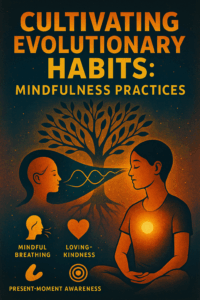
A visual guide to mindfulness practices—each habit nurturing inner awareness and evolutionary growth through presence and compassion.
Mindful observation is a skill anyone can develop. Here are practical steps to harness attention for evolution:
- Daily Meditation Routine: Commit to a regular practice (e.g., 20 minutes of TM or mindfulness twice a day). Even a few minutes of silent mantra meditation allows the mind to settle and unveils deeper awareness. Find a quiet space, sit comfortably, and gently focus on your breath, mantra, or a mental image (like a calm center). When the mind wanders, simply note the thoughts and return to the anchor. Over time, this trains the brain’s attention networks and invites the mind to experience its own observer state.
- Mindful Moments: Apply “mindfulness mini-breaks” throughout the day. Before and after tasks, take a few conscious breaths, noticing how your body feels. When walking, eating or even showering, bring full awareness to the sensations. Cultivate experiential observation: watch thoughts and emotions arise without judgment, like clouds passing in the sky. This repeated noticing reinforces the habit of attention and gradually integrates meditative awareness into all living.
- Positive Intention: Direct your meditation towards uplifting intentions. Vedic traditions speak of bhavana, the cultivation of virtuous attitudes. You might focus on compassion for yourself, loved ones, or even all life. For example, silently wish well-being for others or envision the health of future generations. This aligns your mind with pro-evolutionary values and may even generate beneficial epigenetic signals (since positive emotions lower stress hormones). In John’s TM practice, he often extended the mantra’s resonance to include cosmic life, silently dedicating each session to the well-being of our planet and its species.
- Nature Connection: Spend time immersed in natural environments with an open, observant mind. Remember Einstein’s advice: “Look deep into nature, and then you will understand everything better.” The field itself teaches through every leaf and cell. Even simple practices like stargazing or walking barefoot on earth while fully attentive can remind us of being part of a living cosmos. Many spiritual texts (e.g. Upanishads) find Brahman in the wilderness – a reminder that mindful observation of nature can sharpen our insight into unity.
- Learn and Reflect: Educate yourself on the science-mysticism frontier. Reading and contemplating ideas from quantum physics to epigenetics – like in this article – seeds the intellect and inspiration. Write a journal of your meditation experiences, noting any synchronicities or shifts in perspective. Join community meditation groups; group coherence can amplify the effect. As in TM organizations, collective practice often feels exponentially more powerful.
Each step helps rewire your body and mind toward evolution. Consistent practice creates a positive feedback loop: attention grows stronger, health improves, and awareness of oneness deepens. Over months and years, the small daily changes accumulate, becoming habits that favor creativity, empathy, and long-term thinking – exactly the traits evolution needs at the species level.
Vision: Collective Mindfulness as Evolutionary Catalyst
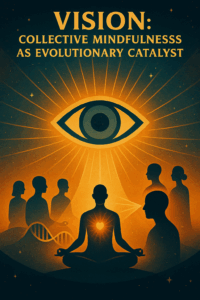
A powerful symbol of shared awareness—collective mindfulness illuminating the evolutionary path through unity, vision, and inner transformation.
Imagine a planet where millions are doing this inner work. Quantum physics and Vedic wisdom both hint at a profound possibility: we are co-creators of reality. Our SpeciesUniverse explorations put it starkly: if observation shapes matter, then the cosmos “is self-aware, continuously observing and shaping itself through countless conscious entities like us”. In other words, the universe and our minds are in feedback.
When enough people awaken this inner observer, we could reach a tipping point. In a sense, humanity itself becomes a conscious organ of life, directing evolution with intention. As one speciesuniverse essay points out, such entanglement suggests “all things in the universe are fundamentally connected… our consciousness may be part of a vast, unified network that transcends space and time”. Under that vision, meditating is not retreating from the world but actively participating in its unfolding.
Albert Einstein captured the spirit when he said, “Science without religion is lame, religion without science is blind”. Our journey shows how science and spiritual insight can walk hand in hand. By combining rigorous mindfulness with curiosity about the quantum and biological depths of life, we enact Einstein’s synthesis. Each mindful breath aligns with Schrödinger’s realization that we are all the same consciousness. Each compassionate action reverberates through the entangled field of being.
In the end, maybe evolution is not a random process but a quest for increased awareness. If consciousness pervades the cosmos, as many mystics affirm, then our role is to witness and wisely steer that awareness. The Upanishads put it: when one realizes “I am That Brahman,” (meaning individual self and cosmic Self are one), the illusion of separation dissolves. Perhaps our collective insight can awaken precisely such a realization on Earth.
Today’s scientific insights into mind, genes and quantum phenomena are precisely the tools and confirmations needed to guide that evolution. By nurturing inner silence and broad awareness, we light up neurons, flip epigenetic switches toward health, and maybe even nudge quantum fields. It may sound aspirational, but each calm, aware moment plants a seed for the life of tomorrow. In this shared experiment, mindful observation is our ally and instrument. Together – as one species practicing one Earth – we may indeed become the evolution we dream of, one mindful moment at a time.
Sources: Cutting-edge science and timeless wisdom inform this perspective. For further reading, see related articles on SpeciesUniverse.com, including our concept overviews and meditative science features.

















Leave a Reply