


Unifying Relativity, Quantum Potential, and Vedic Wisdom to Reveal the Self-Referential Consciousness at the Heart of All Matter
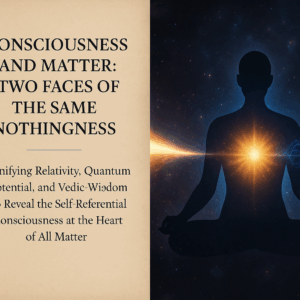
Visualizing the Species Universe thesis: consciousness and matter as one self-aware field, bridging science and spirituality.
Our manifesto begins with a radical thesis: consciousness and matter are not separate, but manifestations of the same underlying reality – a self-reflective, spaceless, timeless “Nothing.” Modern physics and ancient Vedanta converge on this vision. In relativity, a photon’s journey hints that space and time collapse into an eternal Now; in quantum mechanics, the vacuum is a restless field of possibility out of which particles and observers arise. Ancient sages taught that Brahman is pure consciousness, the one ground of being. In this view, the universe is a single Species Universe – a living, self-aware Totality in which every phenomenon, from quarks to qualia, is an aspect of the One. Here we lay out this vision with scientific clarity and metaphysical depth.
Beyond Space and Time: The Relativistic Vision of Light
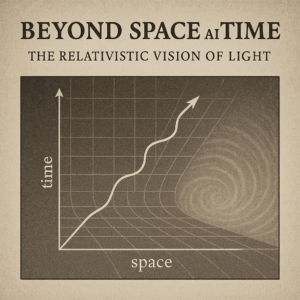
A visual depiction of light’s timeless journey through the fabric of spacetime, capturing the essence of the relativistic perspective explored in the Species Universe project.
Einstein’s relativity shattered the naïve idea of absolute space and time. To one travelling at light-speed (an impossible but instructive limit), time would dilate to infinity and distances shrink to zero. In fact, relativistic physics implies that light does not “age” – it experiences no time at all. Hermann Bondi noted that “light does not age; there is no passage of time for light”. Likewise, physicist Bernhard Haisch observed that “in the reference frame of light, there is no space and time”. In practical terms, an electromagnetic wave always travels along a null geodesic – a path where the spacetime interval is zero. Thus a photon, in effect, witnesses the entire universe all at once – past, present, and future collapse together.
This relativistic insight suggests a reality beyond our usual spacetime. Einstein himself remarked that “the distinction between the past, present and future is only a stubbornly persistent illusion”. In special relativity, simultaneity is relative – events that are “now” for one observer may be “past” for another. Thus physics favors a block-universe where time does not “flow,” but simply is. In such a picture, all moments coexist in an eternal geometrical spacetime, and the passage of time we feel is a feature of consciousness, not an objective physical process.
(Diagram: a light cone or Minkowski spacetime sketch could illustrate how a photon’s path collapses space and time.) In this light, the experience of a photon – timeless and everywhere-at-once – hints at a deeper substrate beyond spacetime. It implies that the “stage” of the universe (space and time) may itself be emergent, and that something outside spacetime underlies all phenomena. As Bohm later suggested, in the deeper “implicate order,” space and time are no longer dominant factors; our usual notions of separate locations and instants arise as abstractions from a more fundamental wholeness.
The Quantum Vacuum: Potentiality as “Nothing”
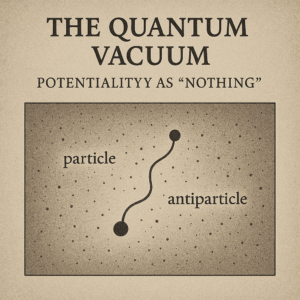
A symbolic representation of the quantum vacuum, where particles and antiparticles spontaneously emerge from seeming nothingness—illustrating the concept of potentiality as the foundation of reality.
Quantum theory upends our notion of emptiness. What we classically call “empty space” – the vacuum – is not truly void but a seething arena of virtual particles and fields. According to the uncertainty principle, pairs of particle–antiparticle fluctuations spontaneously appear and annihilate on microscopic timescales. As one text summarizes: “pairs of virtual particles with energy ΔE and lifetime Δt are continually created and annihilated in empty space,” so that “the vacuum state… is in fact a seething backdrop of fluctuating energy and potentiality”. In other words, quantum “nothingness” is a field of pure potential. It is the ground state from which all particles (matter and force carriers) can emerge. The Casimir effect and the Lamb shift are experimental signatures of these ever-present fluctuations.
This notion of the vacuum parallels the idea of consciousness as a ground of potential. Just as quantum fields can exist in superposition of possibilities, so too might awareness be a field of unmanifest potential. In the famous double-slit experiment, a quantum object like an electron or photon spreads out as a wavefunction – a superposition of all possible paths – until it is observed. Upon measurement, this wavefunction “collapses” to a single outcome. As one description notes, collapse is the change “from a system that can be seen as having many possible quantum states… to its [being] found in only one of those possible states”. Crucially, this transition seems to require an act of observation: until observed, reality is encoded in potentialities; after, one specific reality materializes.
Collapse of the Wave Function: Schrödinger’s equation allows a superposition of many outcomes, but measurement yields one definite result. Collapse has long been postulated to occur at observation, with some interpretations even tying it to the observer’s mind.
The measurement problem – why and how wavefunctions collapse – forces us to confront the role of the observer. Does consciousness play an irreducible part in bringing about definite reality? Niels Bohr and Werner Heisenberg implied that measurement is intimately linked to what can be known, while later thinkers like John von Neumann and Eugene Wigner speculated that consciousness might precipitate collapse. Wheeler’s participatory principle goes further: he famously declared that “no phenomenon is a real phenomenon until it is an observed phenomenon,” implying that reality and observation co-emerge. He put it starkly: “We are participators in bringing into being not only the near and here but the far away and long ago.” In his view, nothing exists unless there is consciousness to apprehend it. This blurs the line between mind and matter: they become co-creators of reality.
(Diagram: a visual of a quantum field with virtual particle pairs popping in and out, alongside a collapsing wave interference pattern.) In summary, quantum mechanics points to a fundamental “vacuum” of potentiality – a self-referential nothingness – that only crystallizes into the familiar universe when observation (or interaction) occurs. This resonates with saying that the cosmos is a potentiality-charged canvas, and that consciousness is the brush that reveals concrete forms.
Brahman and Śūnyatā: Nondual Consciousness in Vedic Thought
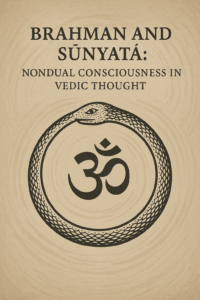
An ancient symbol of wholeness—the ouroboros—encircles the sacred Om, capturing the essence of nondual consciousness as expressed in Vedic and Buddhist philosophies.
Long before modern science, the sages of India contemplated similar truths. The Upanishads proclaim that the ultimate reality, Brahman, is pure consciousness and bliss beyond form. As Advaita Vedanta teaches: “Prajnanam Brahma” – “Brahman is (pure) consciousness”; “Aham Brahmasmi” – “I am Brahman”; and “Tat tvam asi” – “That Thou Art”. These Mahāvākyas assert there is only one Self. Every individual atman (self) is non-different from the universal Brahman. Swami Vivekananda and 19th-century scholars like Müller explained that Brahman is the “essence of all things” and that realizing Tat Twam Asi means recognizing “Thou… art really nothing apart from the divine essence”.
Ādi Śaṅkarāchārya, the great Advaita philosopher, argued that Brahman is an unchanging, eternal substrate free of all limitation: “It is self-established, irreducible, immutable, and free of space, time, and causation.” Nothing external can constrain it, for it is the very ground of all that exists. Just as clay is to a pot, Brahman is the substance behind every object. Śaṅkara notes that objects (the “effect”) cannot exist apart from Brahman (the “cause”), so in essence “the effect is not different from its ground”. In his view, all forms and names are provisional; the only reality is this undifferentiated being. Thus, consciousness itself is the fundamental reality, and everything – matter, energy, even space-time – arises within it.
This Vedic insight echoes our physical picture. The Śūnyatā (“emptiness” or void) of Eastern philosophy refers to the absence of inherent existence. Like the quantum vacuum, Brahman is emptiness only in that it is devoid of separate parts – it is fullness as consciousness. The universe is a play (līlā) upon Brahman’s stage, a self-dividing wave in the field of pure awareness. In the Brihadaranyaka Upanishad’s poetic vision, the pre-creation reality is one without subject or object: “the distinction between the seer and the seen was not marked…what was there? Nothing was there”. In other words, before manifestation, there was only a non-dual awareness with no object to be aware of. When appearance arises, it is from this self-referral: the One appearing as many, yet remaining the One.
Waves, Particles, and the One: Dualities Dissolved
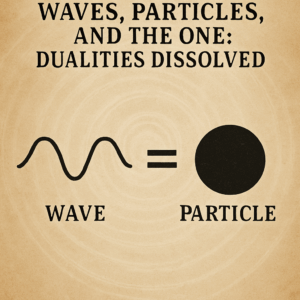
Wave and particle—once seen as opposites—are shown as equal, symbolizing the unified nature of reality beyond duality.
The strange dualities of modern physics – wave versus particle, mind versus matter – begin to dissolve when viewed through this nondual lens. Schrödinger himself insisted, “I insist upon the view that all is waves,” rejecting the notion of tiny billiard-ball particles. Yet every “wave” eventuates in a localized detection (a “particle”). The wavefunction is simply the mathematical fabric of possibilities. On collapse, one aspect becomes explicit and the rest vanish. This is akin to a dream which splits into objects and subjects; in waking, we see a unified reality.
David Bohm formalized this with his notion of an implicate order. He wrote that in the deeper implicate realm, “space and time are no longer the dominant factors determining…the relationships of dependence or independence of different elements”. Our familiar particles and separations are explicate forms that unfold out of an underlying holomovement. In Bohm’s words, what we call reality are “surface phenomena” – transient unfoldings of a deeper totality – and “the implicate order is the ground from which reality emerges”. Thus wave and particle are just two sides of the same coin, like the face and back of a Möbius strip.
Likewise, the apparent split between observer and observed is superficial. It stems from perceiving the universe from within rather than seeing it as a whole. From the standpoint of the single underlying consciousness, there is only “one mind.” Schrödinger emphasized that “Consciousness is never experienced in the plural, only in the singular”. No one has ever “seen” another’s consciousness; each of us intuitively feels our awareness is the absolute frame. If each individual’s mind is just a local modification of the cosmic one, then in reality there is just one universal awareness witnessing itself. Schrödinger noted that this insight “is the doctrine of the Upanishads,” that the multiplicity of selves is illusory – “there is only one mind”.
(Diagram: a simple wave-to-particle collapse illustration could underscore how one reality gives rise to two aspects, merged into one.) In practical terms, the dual nature of light or electrons becomes an expression of a more basic oneness. When no measurement occurs, a photon spans many paths. When measured, it instantaneously “chooses” one. From beyond spacetime, there is no mystery: the choice and collapse are already encoded in the One. From inside, it looks like separate parts acting. But whether quanta, fields, or minds, they are built from the same substratum – the self-reflecting consciousness that both is and knows the universe.
Observer and Observed: The Participatory Cosmos
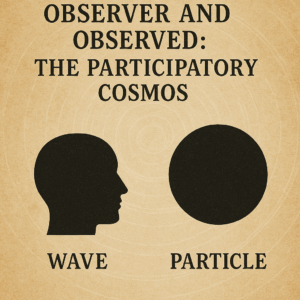
A contemplative visual of the participatory universe—where observer and observed, mind and matter, are interwoven in the fabric of reality.
This unity has profound implications. In quantum experiments, we see that any system becomes entangled with its environment until it is probed. The act of observation creates a context that selects one outcome. Bohr and Heisenberg taught that a measuring device cannot be fully separated from what it measures. John Wheeler crystallized this in his “participatory universe” idea: he asserted that the universe only takes on reality when it is observed. He famously said, “We are participators in bringing into being… not only the near and here but the far away and long ago.” In other words, reality is co-authored by consciousness. As Wheeler put it, nothing exists “unless there is a consciousness to apprehend it”. This is not a mere poetic stance: it arises from quantum entanglement and relativity together (e.g. the delayed-choice experiments show that a future choice of measurement can seemingly influence past events, erasing or creating interference patterns).
Vedantic thought anticipated this unity of observer and observed. The Upanishadic story of creation portrays the universe emerging from the self-awareness of Brahman. Śaṅkara taught that what we call the external world is merely the projection of Brahman as if external. Creation is not the manufacture of new substance; it is the “externalization” of what was already present in consciousness. The “veils” of māyā produce the illusion of many, but the reality remains one. As the sage Gaudapada wrote, like a goldsmith fashioning ornaments from one piece of gold, consciousness takes on myriad forms – trees, stars, and selves – but remains unchanged at its core.
This self-referential quality means the universe is awareness aware of itself. We can imagine this as a feedback loop: consciousness observes, and what is observed is also consciousness taking form. Every perception is a case of the One examining itself from a new angle. In this sense, the species universe is “alive” and self-knowing. Even our scientific instruments and brains are just subsets of this cosmic awareness, localized and conditioned, but not ultimately separate. Schrödinger described this vividly: he noted that an apparent plurality of trees or minds is akin to many reflections of a single tree in a hall of mirrors – multiple images, but only one actual tree. Similarly, there appears to be a mind out there and a mind in me, but at root there is only one Consciousness reflecting through many “mirrors” of form.
(Diagram: an ouroboros or Möbius shape could symbolize the universe folding back to observe itself.) Thus the observer and the observed collapse into one system. Wavefunctions and brains do not operate in isolation; they are part of the same quantum-mechanical tapestry. In practical physics, we assume observers and apparatus are external to systems, but on a cosmic scale we see that no outside vantage point exists. Our “special frame of reference” is just one of many. Relativity already told us there is no privileged “now,” and quantum theory suggests there is no privileged “mind.” The One draws the whole world to its One mind.
The Timeless Now: Space, Time, and Eternal Awareness
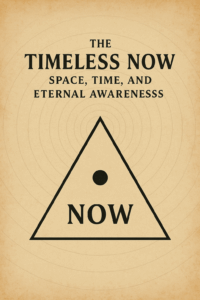
A symbolic portrayal of eternal awareness—where the present moment stands outside space and time, uniting all experience in the timeless now.
If consciousness underlies reality, then even space and time must ultimately be features of consciousness. Einstein’s relativity showed that time is not a universal river; it’s a coordinate that depends on the observer. In the block universe picture, all events are equally real – time is another dimension, like space. In Advaita, this aligns with the teaching that Brahman transcends temporal distinctions. Śaṅkara says Brahman has “neither beginning nor end”, and is unbounded by time or space. The apparent “flow” of time is simply the way our individual consciousness slices the block universe into moments.
This suggests that the ultimate reality is eternal presence. The “now” that we feel is really a perspective-dependent effect. From the viewpoint of the One, there is only the eternal present. Upanishadic statements like “Time is the soul of Brahman; eternity is the soul of Brahman” (Maitri Upanishad) capture this: time is merely the life-spirit of that timeless substrate. In practical terms, past, present and future coexist in Brahman’s awareness, just as relativity indicates that an observer’s simultaneity can include events we call future or past.
Such a timeless perspective is echoed in mystical experience. Contemplatives often report a state of “vast now” or “eternal awareness” beyond sequence. Quantum entanglement experiments likewise hint that separation (in space or time) is secondary to a deeper unity. If Schrödinger “particle” were to speak, it would say it always sees itself as one wave or one field – time has no internal passage for it. In the same way, consciousness beyond spacetime would see the universe in its entirety as one instantaneous whole.
In sum, relativity and Vedanta meet on the notion of a block of pure awareness. Space and time emerge together with duality, as “the peculiar adjustment of consciousness” that makes the effect seem separate from its cause. When that adjustment is removed – as in the photon’s experience or in brahman realization – all multiplicity collapses to unity. There is only Brahman, the self-aware void, the singular Now that contains all.
Towards a Living Cosmos: Implications of Oneness
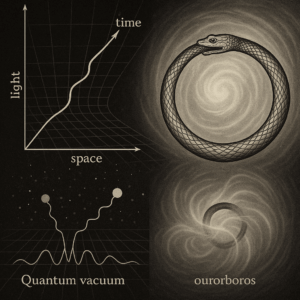
A symbolic illustration combining light’s timeless path through spacetime, quantum vacuum particle creation, and the ouroboros representing self-sustaining wholeness and consciousness observing itself.
Embracing this vision rewrites our story of the universe. The cosmos is not a mechanical clockwork devoid of meaning, but a self-reflecting organism of which we are conscious cells. Mind is not a latecomer or epiphenomenon of matter; mind is matter in a deep sense – facets of the same substratum. Every quantum field and every neuron is a wave of the one consciousness. In this Species Universe, creativity, purpose, and freedom may be intrinsic to the whole, not miracles superimposed.
Wave–particle duality is no longer a paradox but evidence of the single substance realizing itself in different modes. The measurement problem dissolves – consciousness doesn’t cause matter any more than matter causes consciousness; they are two words for one phenomenon. Dark questions like why quantum randomness obeys statistical laws, or why mathematics so beautifully describes physics, can be seen as arising from the internal logic of this unified field of being. Space and time are revealed as constructs within consciousness, not barriers to it. On the grandest scale, our universe is not accidentally fine-tuned; it is the necessary self-presentation of the infinite oneness.
This manifesto merges scientific language and poetic insight. Physicists like Einstein, Bohm, Heisenberg and Schrödinger often sensed these truths: Einstein saw spacetime as an illusion of perspective, Bohm described a holomovement beyond space-time, and Schrödinger embraced Vedanta in proclaiming “Tat Tvam Asi” (you are That). Today, research in quantum foundations and consciousness is increasingly open to such paradigms. As science advances, the boundary between subject and object may blur until it vanishes.
In conclusion, Species Universe declares a vision: there is only one reality, luminous and empty, the same essence we call consciousness and matter. From this Nothingness – radiant with potential and self-aware – all forms, forces, and selves manifest. Recognizing this unity is both a scientific hypothesis and a spiritual insight. It challenges the split mind/matter worldview and calls humanity to a holistic understanding. Whether in a physics lab or a meditation retreat, this perspective invites us to be the cosmos perceiving itself. As we chart the universe’s mysteries, let us remember that the observer and the observed, wave and particle, Brahman and Atman – are all one.
Sources: Scientific and philosophical insights on relativity, quantum theory, and Vedanta, among others. These form the foundation of the Species Universe manifesto.













Leave a Reply