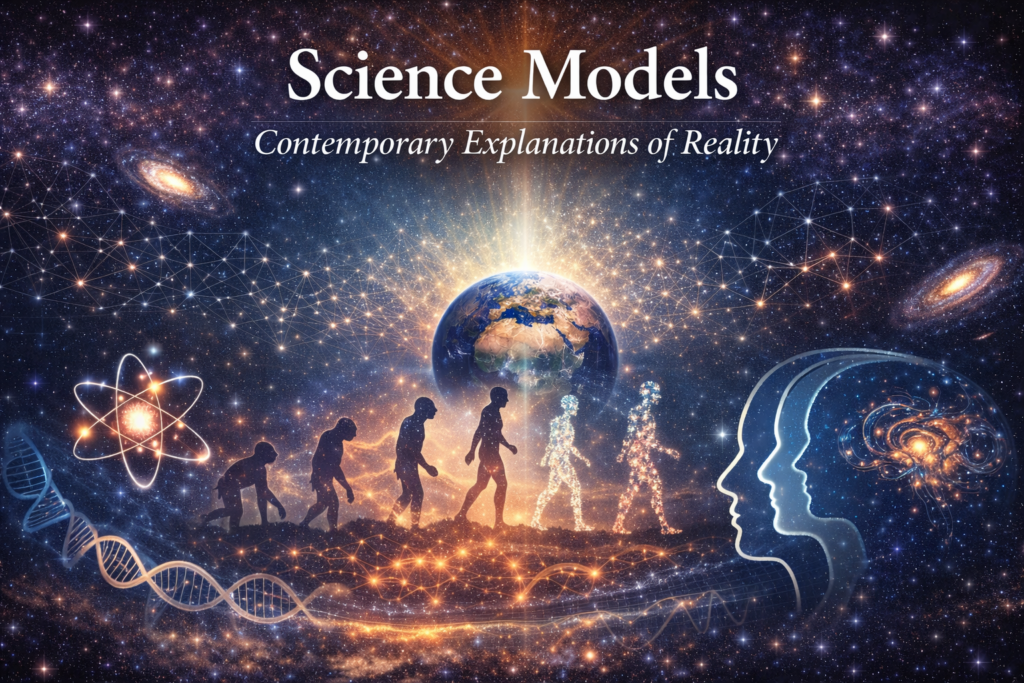
Science Models – Contemporary Explanations of Reality
Why Science Models Matter
Modern science has transformed humanity’s understanding of the universe. Through observation, mathematical formalism, experimentation, and peer review, scientific models have revealed a reality far more dynamic and relational than earlier mechanical descriptions suggested.
From quantum field theory to evolutionary biology, science provides structured explanations of how physical systems behave, organize, and evolve over time.
This section examines those models with intellectual respect and analytical clarity.
What Is a Scientific Model?
A scientific model is not a final description of reality. It is a structured framework that:
- Organizes empirical observations
- Generates testable predictions
- Uses mathematical or conceptual formalisms
- Evolves as new data emerges
Scientific models are powerful precisely because they remain revisable. They are refined through falsification, replication, and theoretical integration.
Species Universe approaches science not as something to replace, but as something to understand deeply.
Physics Foundations
Modern physics provides foundational insights into the structure of reality.
Quantum theory describes systems probabilistically and reveals that particles are better understood as excitations of underlying fields. Relativity reframes space and time as interwoven dimensions shaped by mass and energy.
These developments challenge simplistic materialism, but they do not automatically validate philosophical conclusions. They establish structural features that invite careful interpretation.
For an accessible academic overview of quantum field theory and modern physics foundations, see this university-level introduction to quantum field theory.
This section explores those features without collapsing science into metaphysics.
Evolutionary Systems
Biological evolution demonstrates how complexity emerges over time through variation, selection, and adaptation.
Life is not static. It is dynamic organization sustained through energy exchange and environmental interaction.
From molecular chemistry to multicellular organisms, evolutionary processes show increasing structural sophistication. Human reflective awareness appears within this trajectory, raising questions about how interior experience relates to physical systems.
Science explains the mechanisms of evolution. Interpretation begins when we ask what these mechanisms imply.
Neuroscience and Consciousness
Neuroscience investigates how biological systems generate perception, memory, and self-modeling.
The brain integrates sensory input, predicts outcomes, and constructs coherent experiential narratives. Many scientific approaches treat consciousness as an emergent property of neural complexity.
Whether consciousness is fully reducible to neural processes remains an open question in philosophy of mind. Science continues to map correlation; interpretation concerns ontological status.
For a rigorous overview of the ongoing debates surrounding consciousness and reductionism, see the Stanford Encyclopedia of Philosophy’s entry on the philosophy of mind.
This section examines the empirical foundations before drawing conclusions.
Cosmology and Large-Scale Structure
Cosmology studies the universe at its largest scales — its origin, expansion, and structural development.
Observations of cosmic background radiation, galactic formation, and thermodynamic evolution provide a narrative of increasing complexity from early conditions to present structure.
These models are mathematical and data-driven. They describe large-scale organization without appealing to purpose or teleology.
Observations of cosmic background radiation, galactic formation, and thermodynamic evolution provide a narrative of increasing complexity from early conditions to present structure.
NASA provides an accessible overview of these cosmological observations and large-scale structural developments.
Interpretive questions arise only after structural description is understood.
Complexity and Emergence
Modern science increasingly recognizes that complex systems exhibit properties not reducible to their smallest components.
Self-organization, feedback loops, network dynamics, and information processing contribute to emergent behavior across physical and biological systems.
Emergence does not negate physical law. It reveals layered organization within it.
This insight plays an important role in bridging scientific explanation and philosophical inquiry.
Relationship to the Framework
Science Models describe how reality behaves.
The Framework: organizes those descriptions into layered structural levels.
Traditional Knowledge: explores historical metaphysical systems.
Curated Library: gathers thinkers who have engaged these questions deeply.
Each section maintains its own role.
Science Models remain grounded in empirical method.
Why This Matters
If structural credibility is the foundation, modern science must be treated seriously and accurately.
Without understanding scientific models:
- Interpretation becomes speculation.
- Philosophy becomes detached from data.
- Cosmology becomes narrative rather than analysis.
Science does not answer every philosophical question.
But it establishes the structural boundaries within which responsible interpretation must operate.
Begin Exploring
Explore the sub-sections below to examine specific scientific domains:
- Physics Foundations
- Evolutionary Systems
- Neuroscience and Consciousness
- Cosmology and Structure
- Complexity and Emergence
Understanding begins with structure.
Interpretation follows.