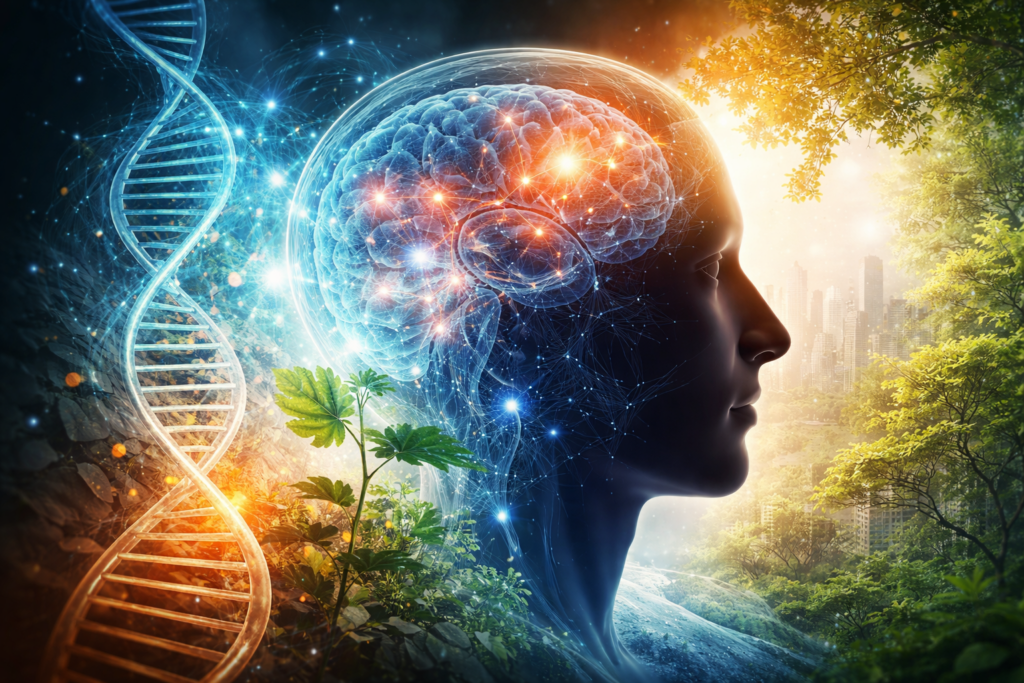


Nature vs. Nurture
From Genetic Blueprint to Emergent Conscious Identity
Introduction: A Debate That Refuses to Die
Few debates in psychology and philosophy have persisted as stubbornly as nature versus nurture. The question appears simple:
Are we primarily shaped by genetic inheritance, or by environment and experience?
For centuries, thinkers divided into camps. Some argued that biology determines destiny. Others insisted that environment writes the entire script. The conflict became ideological.
The philosophical foundations of this discussion are explored in the nature versus nurture debate in philosophy, which traces the question back centuries.
Modern science, however, has quietly dissolved the battlefield.
The deeper insight is not that both matter equally.
It is that the question itself was incomplete.
From a systems perspective — and especially within the broader inquiry of Species Universe — identity is not a static trait produced by one force or another. It is an emergent pattern arising from structured interaction across multiple levels of reality.
The real question becomes:
How does potential become actuality?
Part I: What “Nature” Actually Means
Genes as Constraints, Not Commands
When we refer to “nature,” we mean biological inheritance — DNA, gene regulation systems, developmental pathways, and neurochemical architecture.
Humans possess roughly 20,000 protein-coding genes. These genes:
- Encode proteins
- Regulate cellular development
- Influence neural architecture
- Shape neurotransmitter systems
- Constrain physiological responses
What they do not do is encode behaviors directly.
Understanding the basic principles of genetics helps clarify why genes influence development without rigidly determining behavior.
There is no gene “for” ambition.
No gene “for” morality.
No gene “for” intelligence.
Genes establish structural tendencies — probability distributions within which development unfolds.
Behavioral genetics research, including twin and adoption studies, shows measurable heritability in:
- Cognitive ability
- Temperament
- Emotional reactivity
- Risk-taking behavior
- Susceptibility to depression or addiction
But heritability is statistical. It reflects population-level variance, not personal destiny.
Nature defines ranges of possibility. It does not determine outcomes.
Developmental Biology: Early Constraints
Prenatal development illustrates this clearly.
Genetic instructions guide:
- Neural tube formation
- Cortical layering
- Hormonal regulation
- Synaptic density patterns
Yet even before birth, environment intrudes:
- Maternal stress alters fetal stress calibration
- Nutrition affects neural development
- Toxin exposure modifies gene expression
Biology begins interacting with environment before consciousness arises.
The separation was never clean.
Part II: What “Nurture” Actually Does
“Nurture” encompasses:
- Parenting style
- Socioeconomic status
- Cultural norms
- Peer influence
- Education
- Trauma
- Historical context
But nurture is not merely external influence. It is environmental input interacting with biological systems.
For example:
- Chronic stress reshapes the amygdala and hippocampus.
- Enriched learning environments increase synaptic density.
- Social isolation alters dopamine regulation.
Experience sculpts neural circuitry.
The brain is plastic — especially in early life — but plasticity never operates independently of biological constraints.
Environment does not overwrite nature.
It activates and shapes it.
Part III: Epigenetics — The Collapse of the Wall
Epigenetics fundamentally altered the debate.
Epigenetic mechanisms allow environmental factors to:
- Turn genes on or off
- Modify transcription rates
- Alter stress-response systems
- Influence long-term health outcomes
Importantly:
DNA sequence remains unchanged.
Gene expression shifts.
For example:
- Early trauma can recalibrate stress-response genes.
- Chronic adversity can alter inflammatory gene expression.
- Supportive caregiving can buffer biological vulnerability.
Some epigenetic modifications may persist across generations.
This means experience can influence biological inheritance patterns.
Nature and nurture are not parallel tracks.
They are interwoven feedback loops.
Research into epigenetic regulation of gene expression continues to reveal how life experiences can influence biological systems throughout development.
Part IV: Neuroscience and Adaptive Architecture
Neuroplasticity
Neuroplasticity demonstrates that the brain reorganizes itself through:
- Repetition
- Learning
- Emotional experience
- Deliberate practice
- Injury recovery
London taxi drivers show enlarged hippocampal regions due to spatial navigation training. Musicians show motor cortex reorganization. Meditation alters attentional networks.
Genetic predisposition may influence ease of acquisition.
But sustained environmental engagement reshapes structure.
The brain is not a pre-written script.
It is a self-modifying system.
Temperament vs Character
Research shows infants display early temperament differences:
- High reactivity vs low reactivity
- Novelty-seeking vs caution
- Emotional intensity differences
These likely have biological roots.
Yet long-term personality development depends on:
- Attachment security
- Reinforcement patterns
- Social modeling
- Reflective self-regulation
Temperament is nature’s starting condition.
Character is shaped through interaction.
Part V: The Failure of Determinism
Why Genetic Determinism Fails
- Gene expression is context-sensitive.
- Development is nonlinear.
- Plasticity allows adaptation.
- Epigenetics introduces modulation.
If genes were destiny, identical twins would be psychologically identical.
They are not.
Why Environmental Determinism Fails
- Early temperament differences exist before significant experience.
- Neurobiological variation constrains learning rates.
- Not all individuals respond identically to identical environments.
Environment matters profoundly.
But it operates within biological boundaries.
The mature scientific position rejects both extremes.
Part VI: Emergence — Identity as a Process
Here the discussion deepens.
At what level do we locate “the self”?
Not in DNA alone.
Not in environment alone.
Not in neurons alone.
Identity emerges across layers:
- Molecular biology
- Neural architecture
- Psychological narrative
- Cultural embedding
- Reflective awareness
Each level influences and is influenced by the others.
This pattern reflects what scientists call emergence in complex systems (coming soon), where new properties appear through interaction between simpler components.
This is emergence — structured novelty arising from relational interaction.
The self is not a static object.
It is a dynamic pattern.
Part VII: Evolutionary Framing
Nature vs nurture mirrors a larger evolutionary principle.
Evolution itself operates through:
- Genetic mutation (structure)
- Environmental selection (interaction)
- Adaptive refinement (feedback)
Genes provide variation.
Environment selects expression.
Over time, interaction produces new stable patterns.
Human development follows the same structure:
Potential → Interaction → Stabilization → Adaptation
This recursive architecture scales from biology to culture.
Part VIII: Artificial Intelligence as a Boundary Case
AI provides a useful contrast.
Exploring the relationship between intelligence and consciousness helps clarify why advanced computation does not automatically imply subjective awareness.
Machine learning systems:
- Begin with architectural constraints (analogous to genetics).
- Train on datasets (analogous to environment).
- Adjust weights via feedback loops.
Performance emerges from interaction.
Yet something crucial remains unclear:
Does structured processing produce subjective awareness?
The AI case forces us to ask:
Is intelligence merely environmental adaptation?
Or is conscious experience an additional emergent layer?
Nature vs nurture reappears in a new form:
Architecture vs data.
The debate continues — but now at the frontier of cognitive science.
Part IX: Implications for Human Potential
Understanding gene–environment interaction changes practical thinking.
Education
Abilities are neither fixed nor infinitely malleable. They are conditionally expandable.
Mental Health
Genetic vulnerability does not imply inevitability. Early intervention modifies trajectories.
Social Policy
Environmental inequality amplifies biological risk.
Personal Development
Deliberate practice reshapes neural circuitry.
We are structured plastic systems.
Not predetermined.
Not limitless.
Conditionally adaptive.
Part X: A Species-Level Reflection
From a broader Species Universe perspective, the nature vs nurture debate reflects a deeper epistemic habit: dividing reality into isolated categories.
But modern science increasingly reveals relational structure:
- Genes require environment to function.
- Neurons require experience to organize.
- Intelligence requires interaction.
- Identity requires feedback.
Structure and interaction co-generate each other.
The debate dissolves when we recognize:
Nature and nurture are not opposing forces.
They are interdependent dimensions of a unified developmental process.
Conclusion: Co-Authored Becoming
The mature resolution of the nature vs nurture debate is not compromise.
It is integration.
Genes define structured potential.
Environment activates pathways.
Experience refines architecture.
Reflection introduces direction.
Identity is not inherited.
It is not imposed.
It emerges.
Human beings are neither biological automatons nor blank slates.
We are dynamically co-authored systems — shaped by constraint, sculpted by interaction, and capable of recursive self-modification.
This insight echoes the deeper implications of the observer effect in quantum mechanics (Coming Soon), where interaction between observer and system plays a fundamental role in shaping measurable reality.
The debate began with a division.
It ends with a realization:
Becoming is relational.
What is the nature vs nurture debate?
The nature vs nurture debate examines whether human behavior is primarily shaped by genetic inheritance or environmental experience. Modern science shows that development emerges from continuous interaction between genes, brain systems, and life experiences.
What is epigenetics?
Epigenetics is the study of how environmental influences affect gene expression without changing the DNA sequence itself. Factors such as stress, diet, social relationships, and learning can activate or suppress genes through chemical regulatory mechanisms.
Are humans shaped more by genetics or environment?
Modern research shows that neither genetics nor environment acts alone. Human development results from an ongoing interaction between inherited biological structures and environmental experiences that shape brain development and behavior.
Can life experiences change gene expression?
Yes. Environmental factors such as nutrition, stress, education, and social conditions can influence epigenetic mechanisms that regulate how genes are expressed. These changes can affect health, cognition, and behavior across a person’s lifetime.
Why is the nature vs nurture debate still important?
Understanding the interaction between genetics and environment helps scientists improve education, mental health treatment, and public policy. It also provides insight into human potential and how biological systems adapt to experience.