
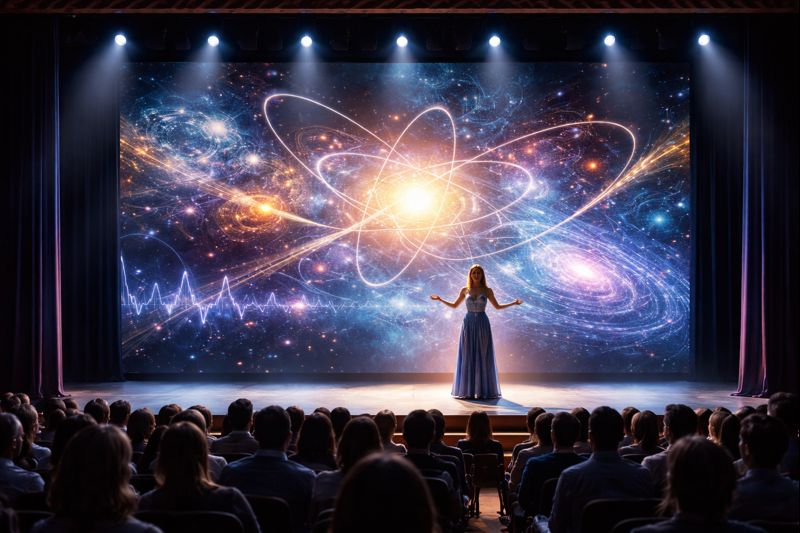


Moving Theater Forward: Storytelling in a Quantum World
Throughout human history, theater and storytelling have served as essential tools for making sense of reality. Long before formal science, performance and myth were how societies explored causality, identity, time, and meaning. Theater has never existed in isolation from humanity’s understanding of the universe; it has always reflected the dominant worldview of its era.
As science has evolved, storytelling has quietly evolved alongside it.
Classical physics—with its deterministic laws, linear time, and clearly separated objects—shaped centuries of narrative structure. Stories unfolded in orderly sequences. Causes preceded effects. Characters possessed stable identities. The world appeared as a fixed stage upon which events played out independently of the observer.
Modern physics has overturned this picture.
Quantum mechanics reveals a universe that is fundamentally relational, probabilistic, and observer-participatory. At the most basic level of nature, outcomes are not fully determined until observation occurs. Events are context-dependent. Systems can exist in superposition. Distant phenomena can be nonlocally correlated. These are not philosophical abstractions; they are experimentally verified features of reality.
This raises a cultural question that is rarely asked, but increasingly unavoidable:
If reality itself is no longer classical, why should our storytelling remain so?
Theater occupies a unique position among the arts. Unlike film or literature, it unfolds live, in shared space, with a present audience whose attention, interpretation, and emotional engagement subtly influence the performance. In this sense, theater already embodies a principle that modern physics has made explicit: the inseparability of observer and observed.
To move theater forward in a quantum age is not simply to introduce scientific themes into scripts. It is to allow the form of performance itself to evolve in ways that reflect a deeper understanding of reality.
This may include narratives that branch rather than resolve linearly, characters whose identities shift with context, time experienced as layered or simultaneous rather than sequential, and meaning that emerges through participation rather than passive reception. Such approaches do not “explain” quantum mechanics; instead, they resonate with its implications at the level of experience.
From a Species Universe perspective, this is not merely an artistic experiment. Culture is how a species rehearses new models of reality before fully inhabiting them. As our scientific understanding changes, our cultural expressions must adapt if we are to remain aligned with how the universe actually functions.
Theater, therefore, becomes more than entertainment. It becomes a training ground for post-material understanding—a space where audiences can safely encounter uncertainty, dissolve rigid assumptions, and engage with a reality that is participatory rather than objective, relational rather than isolated.
Integrating quantum insight into theater is not about turning performances into lectures. It is about allowing storytelling to mirror what science and ancient traditions alike are converging upon: that reality is not something happening “out there,” independent of us, but something that emerges through relationship, attention, and awareness.
Seen in this light, moving theater forward is inseparable from moving human understanding forward.
Frequently Asked Questions
(Click on questions for dropdown answers).
What does quantum mechanics have to do with theater and storytelling?
Quantum mechanics reveals that reality is participatory, contextual, and observer-dependent. Theater, as a live art form involving shared presence between performers and audience, naturally reflects these principles through its structure and experience.
Is this article suggesting that theater should explain quantum physics?
No. The goal is not to teach physics on stage, but to allow storytelling forms to evolve in ways that resonate with a non-classical understanding of reality, where meaning emerges through participation rather than fixed narratives.
Why is theater uniquely suited to exploring consciousness?
Unlike recorded media, theater unfolds in real time with a present audience. This mirrors the observer effect in quantum mechanics, where observation plays an active role in shaping outcomes.
How does this relate to the Species Universe framework?
Species Universe explores how humanity’s understanding evolves alongside scientific discovery. Theater functions as a cultural rehearsal space, helping the species adapt to a worldview where consciousness, observation, and reality are fundamentally interconnected.
Is this perspective scientific or philosophical?
It is both. The article is grounded in established findings from quantum mechanics while exploring their philosophical and cultural implications, clearly distinguishing between experimental science and interpretive synthesis.
For the complete article read here.













Leave a Reply