
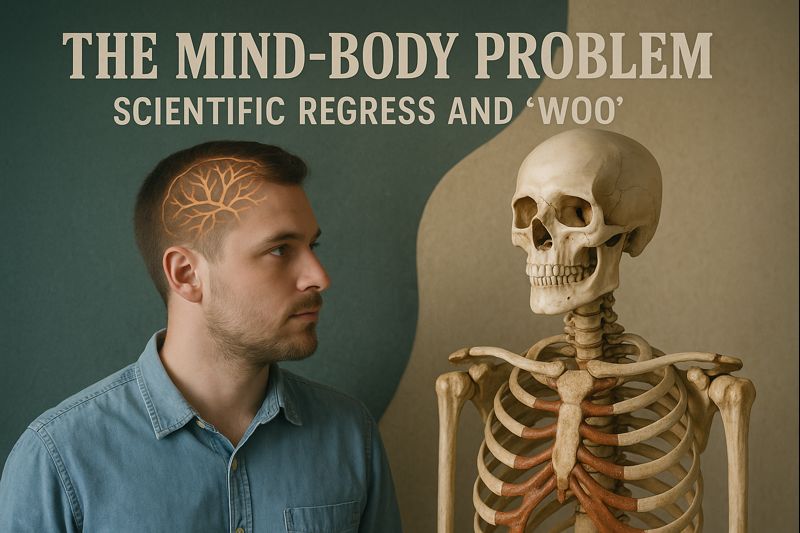


The Mind–Body Problem, Scientific Regress and “Woo”
Curated Commentary
The mind–body problem remains one of the most persistent and unresolved questions in science and philosophy: how subjective experience arises from—or relates to—the physical body. Despite centuries of inquiry and decades of rapid progress in neuroscience, no consensus has emerged on how consciousness fits within a purely physical description of reality.
This Scientific American blog article, “The Mind–Body Problem, Scientific Regress and ‘Woo,’” offers a clear example of how mainstream science currently approaches this dilemma. The author argues forcefully against non-materialist interpretations of consciousness, warning that unexplained phenomena should not become gateways to speculative or unscientific explanations. In doing so, the article reflects a widely held concern within scientific culture: that abandoning physicalist frameworks risks undermining rigor itself.
This perspective is important to understand — and worth engaging with — precisely because it represents the dominant stance within contemporary science.
Why This Article Matters
The value of this article lies not only in what it claims, but in what it reveals.
The author emphasizes that science advances by grounding explanations in physical mechanisms and cautions against invoking consciousness, mind, or awareness as fundamental entities when their causal role remains unclear. From this viewpoint, references to consciousness beyond brain activity are often dismissed as “woo” — a term used to signal ideas perceived as vague, unfalsifiable, or metaphysical.
Yet embedded within this critique is an unspoken tension: the mind–body problem persists despite the success of physical explanation.
Neuroscience can correlate mental states with brain activity in extraordinary detail. Physics can describe matter and energy with astonishing precision. But correlation is not identity, and mechanism does not automatically yield experience. The question of why there is something it is like to be a conscious observer remains unanswered.
Scientific Regress and the Limits of Explanation
The article gestures toward a deeper issue often encountered in foundational science: explanatory regress.
Physical explanations proceed step by step:
- mental states are explained by neural processes
- neural processes by biochemistry
- biochemistry by physics
- physics by fields, equations, and symmetries
At each level, explanation advances — yet the fact of experience itself remains untouched. Eventually, explanation arrives at abstract formalisms that describe behavior, not awareness. At that point, science has not failed, but it has reached the boundary of what third-person description can deliver.
This boundary is not necessarily an invitation to mysticism, nor does it invalidate scientific method. But it does raise a legitimate question:
Is consciousness merely an emergent byproduct of matter, or is it a fundamental aspect of reality that current frameworks are not designed to address?
The article resists this question by reaffirming methodological caution. Species Universe curates it because the question remains open.
Between Reductionism and Speculation
One of the article’s central concerns is the danger of prematurely elevating consciousness to a foundational role without testable models. This caution is well-taken. History is filled with examples where gaps in knowledge were filled with assumptions later overturned by evidence.
At the same time, history also shows that progress often requires questioning whether existing frameworks are sufficient. Concepts once considered speculative — atoms, spacetime curvature, quantum nonlocality — eventually became central to scientific understanding when new tools and perspectives emerged.
The current debate over consciousness may represent a similar moment of tension: not between science and superstition, but between established methodology and phenomena that resist straightforward reduction.
An Invitation to Inquiry
This article is curated here not as a conclusion, but as a reference point.
It articulates the strongest version of the materialist caution against expanding the concept of consciousness beyond brain processes. Reading it carefully helps clarify:
- why many scientists remain skeptical of non-physical accounts of mind
- where scientific explanations are robust
- and where they remain incomplete
For readers exploring consciousness, the value lies in holding both rigor and openness at once — recognizing the power of scientific explanation while remaining attentive to questions it has not yet resolved.
The mind–body problem endures not because science has failed, but because it continues to encounter the profound mystery of experience itself.
Key Takeaways:
- Socrates was the first person who posed mind-body problems.
- After Socrates there followed more than two millennia of pointless philosophical bickering.
- The great Francis Crick and Christof Koch said it was time to rescue the mind -body problem from philosophers and make it a respectable scientific problem.
“After Socrates, there followed more than two millennia of what I unfairly call “pointless philosophical bickering.” Thinkers trying to solve the mind-body problem generally fell into one of three camps: Idealism (mind rules), materialism (matter rules) and dualism (matter and mind are separate but equal).”
Source
Scientific American – Cross-Check Blog
“The Mind–Body Problem, Scientific Regress and ‘Woo’”
Relevant Content:
Reference:













Leave a Reply