


Applied Consciousness: How Awareness Shapes Reality and Action
Introduction — Why Consciousness Must Be Applied
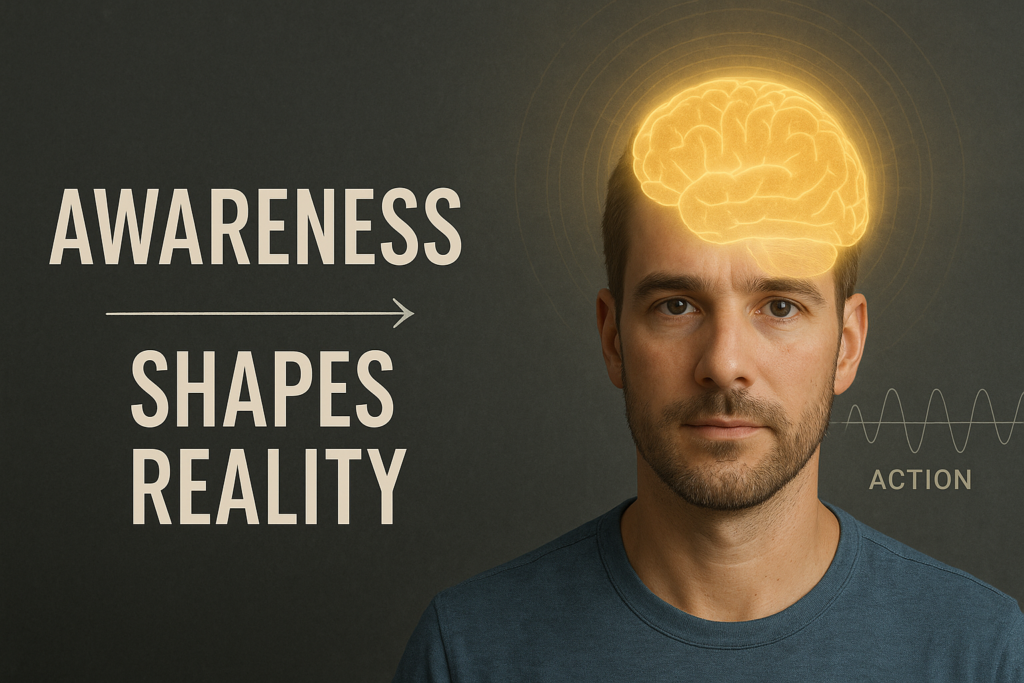
Applied consciousness shows how awareness directly shapes perception, thought, and action.
Consciousness is one of the most discussed and least operationalized concepts in modern thought. In science, philosophy, and spirituality, it is often treated as an abstract mystery—something to be debated, measured, or contemplated from a distance. Yet every moment of human life is already an expression of consciousness in action. We are never not applying consciousness; we are simply doing so with varying degrees of clarity. The real question, then, is not whether consciousness is applied, but whether it is applied consciously or unconsciously.
Modern science has revealed something deeply unsettling to classical assumptions: observation matters. In quantum physics, the act of measurement alters outcomes. In psychology, perception shapes behavior. In neuroscience, attention reorganizes neural pathways. Across disciplines, the same insight keeps resurfacing—awareness is not passive. It participates. Applied Consciousness names this participation and brings it into focus as a practical, evolutionary skill rather than a philosophical abstraction.
Species Universe approaches applied consciousness as the missing link between understanding reality and living within it responsibly. When awareness is left unexamined, it is driven by habit, fear, and inherited assumptions. When awareness becomes conscious of itself, it becomes a stabilizing force capable of reshaping action, learning, health, and collective systems.
Consciousness vs. Attention — A Crucial Distinction
To understand applied consciousness, an important distinction must be made between consciousness and attention. Consciousness can be understood as the underlying field of awareness—the capacity for experience itself. Attention, by contrast, is the direction or focus within that field. Consciousness is constant; attention moves.
Most human activity is governed not by consciousness itself, but by fragmented, reactive attention. Attention jumps from thought to thought, stimulus to stimulus, driven by conditioning rather than choice. Applied consciousness begins when attention is recognized as something that can be directed deliberately rather than hijacked automatically.
This distinction matters because attention shapes experience. What we attend to grows in psychological, emotional, and even physiological significance. Chronic stress, for example, is not merely a response to external conditions but to sustained attention on perceived threat. Creativity, learning, and insight emerge when attention stabilizes and opens rather than contracts.
Applied consciousness is not about controlling experience, but about recognizing where attention is operating from—fear or clarity, habit or understanding.
The Observer Effect Beyond Physics
In quantum mechanics, the observer effect reveals that measurement influences the behavior of physical systems. While the technical details are complex, the philosophical implication is simple: reality does not unfold independently of observation. This insight is often confined to physics, treated as an anomaly relevant only at microscopic scales. But the deeper principle extends far beyond the laboratory.
In human systems, observation shapes outcomes constantly. How a person perceives a challenge influences their response. How a teacher observes a student influences learning. How a society frames a problem determines the solutions it allows. Applied consciousness recognizes that perception is not neutral—it is formative.
When awareness operates unconsciously, perception reinforces existing patterns. When awareness becomes conscious of itself, perception becomes flexible. This flexibility is what allows insight, adaptation, and genuine change.
Applied consciousness does not require belief in any metaphysical claim. It is an empirical observation: the quality of awareness directly influences the quality of action.
Applied Consciousness in Daily Life
In everyday experience, applied consciousness shows up in subtle but powerful ways. Decision-making improves when awareness is present rather than reactive. Emotional regulation becomes possible not through suppression, but through observation. Habits weaken when they are seen clearly instead of fought blindly.
Much of human suffering persists not because solutions are unavailable, but because awareness is fragmented. People often act before seeing. Applied consciousness introduces a pause—a moment of clarity in which perception precedes reaction.
This does not mean withdrawal from life. On the contrary, applied consciousness enables more precise engagement. Actions become aligned rather than compulsive. Energy previously consumed by internal conflict becomes available for creativity, understanding, and meaningful contribution.
Education as Applied Consciousness
Traditional education focuses on information transfer, while largely ignoring the state of awareness in which learning occurs. Yet research consistently shows that attention, emotional regulation, and perception profoundly affect learning outcomes. Applied consciousness reframes education as the cultivation of clarity rather than the accumulation of data.
When awareness is engaged, learning becomes integrative rather than fragmented. Understanding replaces memorization. Insight replaces repetition. Education, in this sense, becomes an evolutionary process—refining how reality is perceived rather than merely expanding what is known.
Species Universe treats education as one of the most important applications of consciousness, because how we learn determines how we think, and how we think determines how we act collectively.
From Individual Awareness to Collective Impact
Applied consciousness scales. Individual clarity influences families, organizations, and societies. Systems reflect the awareness of those who participate in them. When awareness is fragmented, systems become rigid and reactive. When awareness stabilizes, systems adapt.
This is why technological advancement alone cannot solve systemic crises. Without a corresponding evolution in awareness, tools amplify existing dysfunction. Applied consciousness provides the missing stabilizer—ensuring that intelligence is not divorced from responsibility.
Conclusion — Consciousness Is Already Applied
Consciousness is not something that must be activated; it is something that must be recognized. Every action already expresses awareness, whether clearly or blindly. Applied consciousness simply makes this process explicit.
The future of humanity does not depend solely on new technologies or theories, but on whether awareness itself becomes conscious of its role in shaping reality. Applied consciousness is not an ideology or technique—it is the recognition that perception participates in creation.
Once this is seen, the question shifts from what should we do to from where are we seeing. That shift changes everything.













Leave a Reply